
Potassium Fertilizers Market Size by Identifying, Projecting The, Region – Segment-Level Market Assessment, Growth Opportunity Analysis, Competitive Mapping & Forecast to 2032
Overview
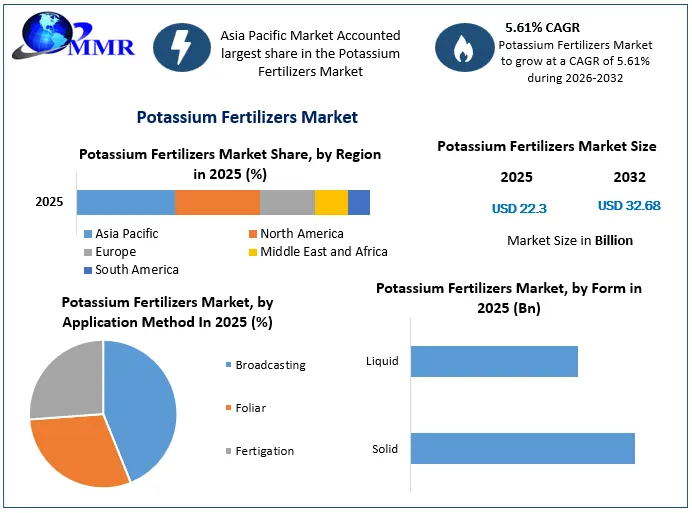
Global Potassium Fertilizers market was valued US$ 22.3 Billion in 2025 and is expected to reach US$ 32.68 Billion by 2032, at CAGR of 5.61 % during forecast period.
To know about the Research Methodology :- Request Free Sample Report
Potassium Fertilizers Market Segment Analysis
By product type, the market is divided into potassium chloride (Muriate of Potash - MOP), sulfate of potash (SOP), potassium nitrate (KNO3), and others. The potassium chloride (MOP) segment dominated the market in 2025, holding the largest revenue and volume share (accounting for over 60–70% of global demand) due to its cost-effectiveness, high potassium density and widespread suitability for large-scale commodity crops such as cereals, grains, and oilseeds. During the forecast period of 2026–2032, while MOP will maintain its overall volumetric dominance, specialty variants like sulfate of potash (SOP) and potassium nitrate are expected to expand at a faster compound annual growth rate (CAGR). This trend is driven by an increasing shift toward high-value horticulture, greenhouse farming, and the need for low-chloride, low-salinity nutrients.
By application method, the market is divided into broadcasting, foliar application, and fertigation. The broadcasting segment dominated the market in 2025 (holding over 50% of the market share) because it is simple, highly scalable, compatible with mechanized spreading equipment, and cost-efficient for extensive open-field crops. Over the 2026–2032 forecast period, the fertigation segment is projected to be the fastest-growing application method. This growth is supported by the global adoption of precision farming, drip irrigation expansion in water-scarce regions, and the rising integration of fully water-soluble potassium fertilizers in modern agricultural practices.
Potassium Fertilizer Market Regional Insights:
The Asia-Pacific region dominated the global potassium fertilizers market in recent years and is projected to maintain its leading position throughout the long-term forecast period. This strong growth is primarily fueled by the region's expanding population base, which creates escalating demand for food grains, nutrient-dense produce, and higher agricultural yields. Countries like China and India face severe arable land constraints, compelling agricultural producers to adopt intensive fertilization regimes and balanced NPK application to maximize output per hectare. Furthermore, regional governments actively support modern farming practices through subsidies and infrastructure development. Potassium fertilizers also play a vital role in helping crops endure severe regional weather conditions, including drought and high-temperature stress.
North America serves as both a primary consumption region and a major production and export hub for global potassium fertilizers. The market is driven by highly mechanized commercial farming across extensive corn, soybean, and wheat belts, alongside widespread adoption of precision agriculture and digital nutrient management systems. Supported by significant mining reserves and key market players, particularly in Canada and the United States, North America benefits from robust processing and logistics infrastructure. This supply-side strength makes the region crucial for maintaining international trade flows and global price stability.
Latin America, anchored by Brazil, represents one of the most dynamic volume growth engines for the potassium fertilizers market. The region’s agricultural footprint is dominated by massive commercial operations dedicated to high-demand export crops such as soybeans, sugarcane, corn, and coffee, all of which require substantial potassium inputs to maintain soil productivity. As Latin America relies overwhelmingly on imports to fulfill its fertilizer requirements, the regional market remains highly vulnerable to global supply chain disruptions, international freight rate fluctuations, and geopolitical tension in major producing nations.
In Europe, the potassium fertilizers market is characterized by mature agricultural practices, stringent environmental compliance, and an emphasis on sustainable soil management. Rather than rapid volume expansion, regional growth across the coming decade is oriented toward efficiency, precision fertigation, and high-value crop nutrition. European growers are increasingly adopting specialty, low-chloride variants such as Sulfate of Potash (SOP) and Potassium Nitrate (KNO3) to minimize soil salinity risks and support high-value horticultural and greenhouse crop production under strict regulatory standards.
Production vs. Consumption of Potassium Fertilizers, 2025 - Region Wise
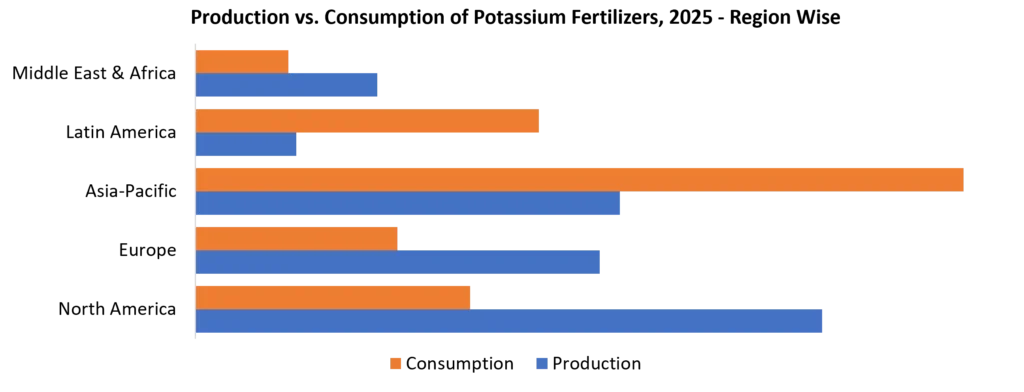
Asia-Pacific leads global potassium fertilizer consumption, driven by intensive agriculture and high crop production, while North America remains a major production and export hub. Latin America has a significant supply-demand gap, reflecting strong agricultural demand and reliance on imports, particularly in Brazil.
Potassium Fertilizers Market Recent Industry Developments:
| Month & Year | Recent Development |
| March 2026 | Tessenderlo Kerley International entered into an Asset Transfer Agreement to acquire a Sulfate of Potash (SOP) production facility in Sweden from Cinis Fertilizer AB, expanding its portfolio of low-chloride, specialty crop-nutrition solutions. |
| January 2026 | BHP finalized a comprehensive capital review for Stage 1 of its flagship Jansen Potash Project in Saskatchewan, Canada, adjusting the investment target to $8.4 billion with completion reaching 75% to deliver 4.15 million tonnes per year by mid-2027. |
| December 2025 | Indian Potash Limited signed a strategic multi-lateral agreement with Uralchem, Rashtriya Chemicals and Fertilizers, and National Fertilizers Limited to establish joint production pipelines and secure raw material availability for balanced soil nutrition programs. |
| November 2025 | K+S Potash Canada initiated a long-term capital expansion program at its Bethune mine site, aiming to double its operational footprint and boost annual production capacity toward 4 million tonnes per year. |
Global Potassium Fertilizers Market Competitive Landscape:
The global potassium fertilizers market is characterized by a concentrated upstream structure dominated by major international producers, alongside a multi-tiered ecosystem of regional manufacturers and localized distributors. Primary global tier-1 giants—such as Nutrien Ltd. and The Mosaic Company in North America, JSC Belaruskali and Uralkali PJSC in Eastern Europe, K+S AG and EuroChem Group AG in Western Europe, and ICL Group Ltd. and SQM in the Middle East and South America—control large-scale extraction from raw potash reserves. These primary players are complemented by multinational processing and distribution networks like Yara International ASA and Sinofert Holdings, as well as specialized regional companies like Qinghai Salt Lake Industry in Asia-Pacific and Compass Minerals in North America. Downstream, localized ag-retailers and liquid fertigation compounders operate close to major farming clusters in Latin America, South Asia, and Southeast Asia to handle custom blending and direct farmgate delivery.
From a strategic and commercial perspective, market participants employ distinct positioning and pricing models based on product positioning and supply chain integration. Primary producers prioritize capital-intensive capacity expansions and mine-life extension projects to achieve economies of scale and drive down per-tonne extraction costs. To shield themselves from commodity margin volatility on standard Muriate of Potash (MOP), major firms are expanding into higher-margin specialty products like Sulfate of Potash (SOP) and Potassium Nitrate (), while forming strategic off-take alliances with key import-dependent markets like Brazil and India. Pricing mechanics reflect this division: bulk commodity MOP relies on benchmark contract pricing negotiated with major buying coalitions in China and India to establish a global floor, alongside regional spot pricing influenced by freight rates and seasonal demand. Conversely, specialty variants follow a value-based pricing approach dictated by crop sensitivity and fertigation requirements, while local blenders utilize cost-plus pricing incorporating inland logistics and agronomic support.
Scope of Global Potassium Fertilizers Market: Inquire before Buying
| Potassium Fertilizers Market | |||
|---|---|---|---|
| Report Coverage | Details | ||
| Base Year: | 2025 | Forecast Period: | 2026-2032 |
| Historical Data: | 2020 to 2025 | Market Size in 2025: | 22.3 USD Billion |
| Forecast Period 2026-2032 CAGR: | 5.61% | Market Size in 2032: | 32.68 USD Billion |
| Segments Covered: | By Product Type | Potassium chloride Sulfate of Potash (SOP) Potassium nitrate Others |
|
| By Application Method | Broadcasting Foliar Fertigation |
||
| By Form | Solid Liquid |
||
| By Crop Type | Cereals & grains Oilseeds & pulses Fruits & vegetables Others |
||
Global Potassium Fertilizers Market, by Region
North America (United States, Canada and Mexico)
Europe (UK, France, Germany, Italy, Spain, Sweden, Austria and Rest of Europe)
Asia Pacific (China, South Korea, Japan, India, Australia, Indonesia, Malaysia, Vietnam, Taiwan, Bangladesh, Pakistan and Rest of APAC)
Middle East and Africa (South Africa, GCC, Egypt, Nigeria and Rest of ME&A)
South America (Brazil, Argentina Rest of South America)
Key Players operating in the Global Potassium Fertilizers Market
North America
-
Nutrien Ltd. (Canada)
-
The Mosaic Company (United States)
-
Intrepid Potash, Inc. (United States)
Europe
-
K+S AG (Germany)
-
EuroChem Group AG (Switzerland / Regional operations across Europe)
-
Yara International ASA (Norway)
-
Borealis AG (Austria)
-
Tessenderlo Group / Tessenderlo Kerley International (Belgium)
Eastern Europe / CIS
-
JSC Belaruskali (Belarus)
-
Uralkali PJSC (Russia)
-
Uralchem JSC / Acron Group (Russia)
Asia-Pacific
-
Sinofert Holdings Limited / Sinochem Agriculture (China)
-
Migao Corporation (Singapore / China)
-
Indian Potash Limited (IPL) (India)
Middle East & Africa
-
ICL Group Ltd. (Israel Chemicals Ltd.) (Israel)
-
Haifa Group / Haifa Chemicals Ltd. (Israel)
-
OCP Group (Morocco)
South America
Others
Frequently Asked Questions:
1. What is the current market size and future growth projection for the global potassium fertilizers market?
The global potassium fertilizers market was valued at US$ 22.3 Billion in 2025 and is expected to reach US$ 32.68 Billion by 2032, growing at a CAGR of 5.61% during the forecast period.
2. Which product type segment dominates the potassium fertilizers market?
Potassium chloride (Muriate of Potash - MOP) dominates the market, accounting for 60–70% of global consumption. This is due to its high potassium concentration (~60% K2O), cost-effectiveness, and widespread use on broadacre crops like grains and oilseeds.
3. What application method is expanding at the fastest rate?
While broadcasting currently holds the largest volume share, fertigation is projected to be the fastest-growing application method due to the increasing adoption of precision farming, drip irrigation systems, and water-soluble specialty fertilizers.
4. Which region holds the largest share of the global market?
The Asia-Pacific region holds the largest market share and is expected to remain the key growth driver, supported by extensive agricultural activities, large population bases, and intensive farming practices in China and India.
5. What is the main risk facing the global potassium fertilizer supply chain?
The market faces significant geopolitical vulnerability and supply concentration, as global potash reserves and production are heavily localized in a few nations—primarily Canada, Russia, Belarus, and China.