
Port Equipment Market - Industry Structure Evaluation, Demand Drivers Analysis, Regional Growth Analysis and Identification, Competitive Positioning / Landscape Review & Global Market Size Forecast to 2032
Overview
The Port Equipment Market size was valued at USD 8.66 Billion in 2024 and the total Port Equipment revenue is expected to grow at a CAGR of 4.93% from 2025 to 2032, reaching nearly USD 12.73 Billion.
Port Equipment Market Overview:
Port equipment is used to handle various types of material at the port, including cargo and machinery. Port equipment is a material handling solution for port infrastructure and application, which is used for loading and unloading commodities and passengers. The port equipment consists of reach tractors, goosenecks, stackers, forklift trucks, trailers, and ship-to-shore cranes. This equipment is very important for every operation and functioning of the port. The port equipment's effectiveness determines the amount of material, which port handles, and which ports receive the most cargo. Equipment with the most up-to-date technology is expected at the busiest ports to allow for optimal load management. As ports are the linking point between land and sea trade, port equipment is important in the broader trade and distribution network of products and services.
 To know about the Research Methodology :- Request Free Sample Report
Port Equipment Market Dynamics:
Growing seaborne trade across the globe, as port equipment is utilized to transfer cargo between ships and land-based modes of transportation, is driving the port equipment market growth. In addition, the growing quantity of container exports in emerging nations, such as India, and China are boosting the demand for port equipment.
In recent years, the global shipping industry has experienced significant growth, with growing liner shipping at the forefront. This growth has been fueled by increased international trade volumes. As a result, the logistical requirements to manage this large volume are expanding, which in turn increased the usage of port material handling equipment. The use of forklift trucks, automated transit vehicles, ship loaders, reach stackers, cranes, and container lift trucks have increased with the development of ports across the globe, which in turn is expected to uplift the port equipment market growth during the forecast period.
Growing awareness of carbon footprint and inclination toward environmentally friendly transportation is expected to increase the port equipment product demand during the forecast period. When compared to marine transportation, land and air transportation have a higher carbon impact. According to the International Chamber of Shipping (ICS), shipping emits 3-8 grams per tonne-kilometer, whereas trucks emit 80 grams per tonne-kilometer. As a result, the government's stringent regulations across the globe are limiting the carbon emission from port equipment leading to the adoption of alternate fuel for equipment. The ports are implementing alternative fuel equipment to reduce the logistical carbon impact, which in turn supports the market's growth. For instance, Europe has allocated more than US$ 4.5 million for the H2Port initiative, to adopt hydrogen fuel cell equipment at the ports.
Different free-trade agreements, such as the Trans-Pacific Strategic Economic Partnership (TPSEP), NAFTA, AFTA, and other initiatives, have helped countries across the globe to boost their economies by increasing the import and export of goods and commodities through seaports. As a result, the market for port equipment is expected to grow significantly during the forecast period.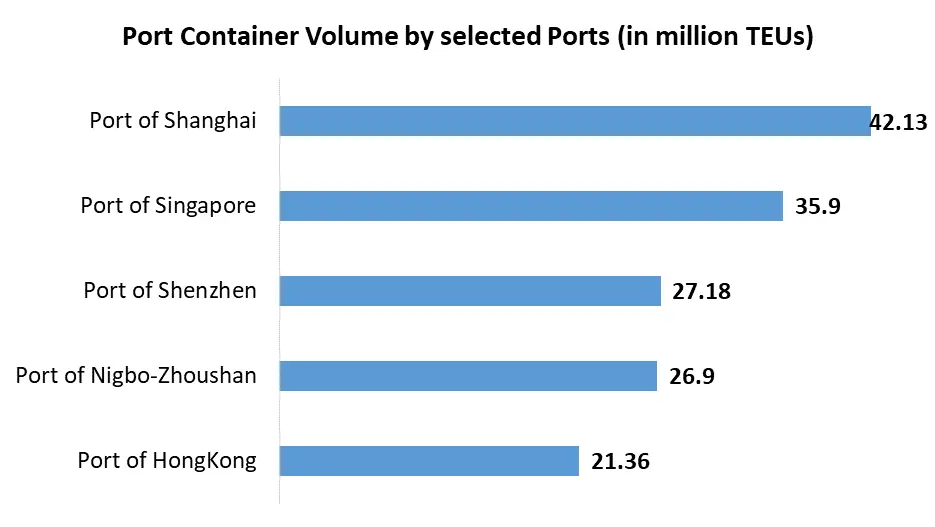
Port Equipment Market Segment Analysis:
Based on the Equipment Type, the Port Equipment Market is segmented into Mooring Systems, Tug Boats, Cranes, Ship loaders, Container Lift Trucks, and Others. The Cranes segment held the largest market share, accounting for 34.1% in 2024. The segment growth is attributed to the growing adoption of cranes in port, to reduce cost per move. Cranes enable port operators to handle a greater variety of vessels. To reduce noise and carbon emissions, port owners are replacing older cranes with advanced models. In addition, the current ongoing port expansion projects to accommodate a bigger number of boats are expected to fuel the port equipment market growth for this segment.
The Ship loaders segment is expected to witness significant growth at a CAGR of 4.81% during the forecast period. The growing number of loading and unloading operations, leading to increasing use of ship loaders in port equipment types. It provides flexibility in handling large cargo at a faster rate of transfer. In addition, mobile ship loaders are being installed in several ports across the globe to improve operational efficiency, which in turn is expected to fuel the port equipment market growth for this segment.
Based on the Application, the Port Equipment Market is segmented into Ship Handling, Bulk Handling, Container Handling, and Others. The Container Handling segment held the largest market share, accounting for 41% in 2024. The necessity for diverse port operations such as heavy lifting, stacking, loading, and unloading, among others, is driving the port equipment market growth for this segment. Manufacturers are also incorporating various auction procedures to improve the overall system's performance, which is expected to uplift the port equipment market growth for this segment during the forecast period.
Port Equipment Market Regional Insights:
Asia Pacific region held the largest market share accounted for 53.7% in 2024. The region’s growth is attributed to the rise in maritime commerce transport activity in the region. With the presence of some of the world's most populous emerging countries, such as China and India, the region has seen significant government investment in the port industry. In India, almost 95% of trade by volume is carried out by sea, hence there is a need for more established and massive ports along with sufficient equipment in the region. For instance, the Indian government has launched Project Unnati in 2022, which aims to upgrade and increase the efficiency of 12 ports around the country. Yangshan Port, from China, opened an automated container terminal port in 2018 with a US$ 2.15 billion investment. As a result, the port equipment market is expected to grow significantly during the forecast period.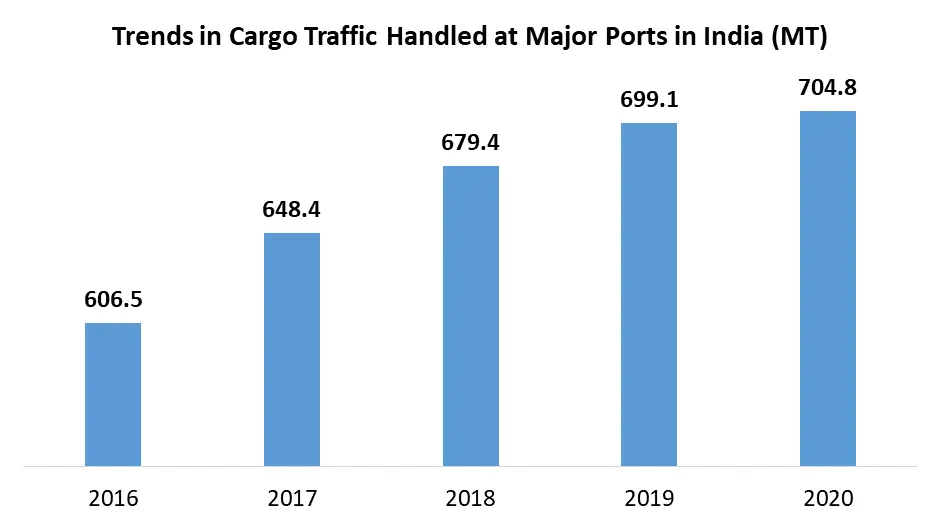
North America region is expected to witness significant growth at a CAGR of 5.12% during the forecast period. The region’s growth is attributed to the increasing cargo commerce in countries such as the United States and Canada. According to the US Department of Commerce and Bureau of Labor Statistics, the material handling and logistics is one of America's largest and fastest-growing businesses. The annual consumption of material handling and logistics equipment and systems in the United States exceeds $156 billion, which in turn driving the port equipment market growth in the region.
The objective of the report is to present a comprehensive analysis of the global Port Equipment Market to the stakeholders in the industry. The past and current status of the industry with the forecasted market size and trends are presented in the report with the analysis of complicated data in simple language. The report covers all the aspects of the industry with a dedicated study of key players that include market leaders, followers, and new entrants.
PORTER, PESTEL analysis with the potential impact of micro-economic factors of the market have been presented in the report. External as well as internal factors that are supposed to affect the business positively or negatively have been analyzed, which will give a clear futuristic view of the industry to the decision-makers.
The reports also help in understanding the Port Equipment Market dynamic, structure by analyzing the market segments and projecting the Port Equipment Market size. Clear representation of competitive analysis of key players by End-Users, price, financial position, product portfolio, growth strategies, and regional presence in the Port Equipment Market make the report investor’s guide.
Port Equipment Market Scope: Inquire before buying
| Port Equipment Market | |||
|---|---|---|---|
| Report Coverage | Details | ||
| Base Year: | 2024 | Forecast Period: | 2025-2032 |
| Historical Data: | 2019 to 2024 | Market Size in 2024: | USD 8.66 Bn. |
| Forecast Period 2025 to 2032 CAGR: | 4.93% | Market Size in 2032: | USD 12.73 Bn. |
| Segments Covered: | by Type | Electric Hybrid Diesel |
|
| by Equipment Type | Mooring Systems Tug Boats Cranes Ship loaders Container Lift Trucks Others |
||
| by Application | Ship Handling Bulk Handling Container Handling Others |
||
Port Equipment Market, by Region
North America (United States, Canada and Mexico)
Europe (UK, France, Germany, Italy, Spain, Sweden, Austria, Turkey, Russia and Rest of Europe)
Asia Pacific (China, India, Japan, South Korea, Australia, ASEAN and Rest of APAC)
Middle East and Africa (South Africa, GCC, Egypt, Nigeria and Rest of ME&A)
South America (Brazil, Argentina, Columbia and Rest of South America)
Port Equipment Market, Key Players are
1. ABB
2. American Crane & Equipment
3. Anhui Heli
4. Baltkran
5. Cavotec
6. CVS Ferrari
7. Famur Famak
8. Hyster
9. Kalmar
10. Konecranes
11. Liebherr
12. Lonking Holdings Limited
13. Mcnally Bharat Engineering
14. Prosertek
15. Sany
16. Til Limited
17. Timars Svets & Smide Ab
18. TTS
Frequently Asked Questions:
1] What segments are covered in the Port Equipment Market report?
Ans. The segments covered in the Port Equipment Market report are based on Type, by Equipment type, and Application.
2] Which region is expected to hold the highest share in the Port Equipment Market?
Ans. The Asia Pacific region is expected to hold the highest share in the Port Equipment Market.
3] What is the market size of the Port Equipment Market by 2032?
Ans. The market size of the Market by 2032 is USD 12.73 Bn.
4] What is the forecast period for the Market?
Ans. The forecast period for the Market is 2025-2032.
5] What was the Global Port Equipment Market size in 2024?
Ans: The Global Port Equipment Market size was USD 8.66 Billion in 2024.