
Polymethyl Methacrylate Market – Global Market Size, Strategic Growth Drivers, Risk Assessment Framework, Regulatory Landscape Review, Competitive Intensity Mapping & Long-Term Industry Outlook to 2034
Overview
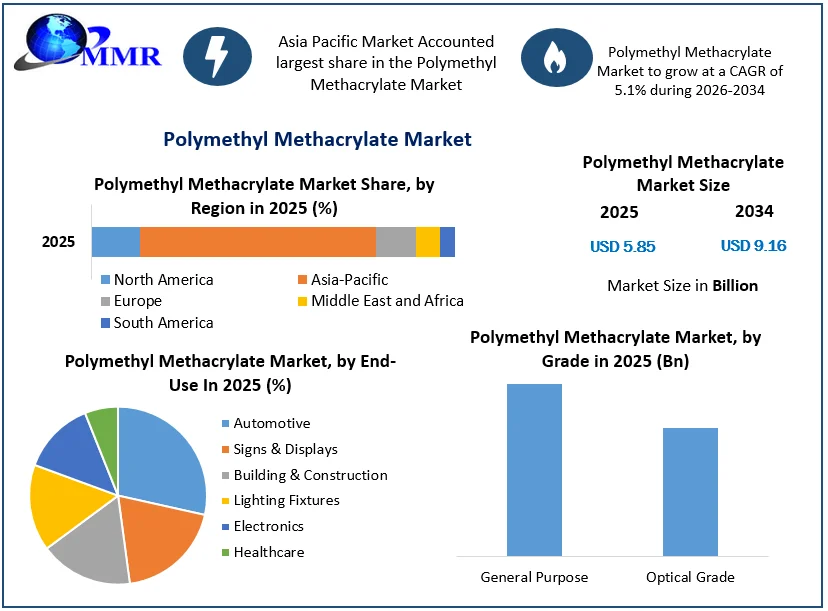
The Polymethyl Methacrylate Market size was valued at USD 5.85 Billion in 2025 and the total Polymethyl Methacrylate revenue is expected to grow at a CAGR of 5.10% from 2026 to 2034, reaching nearly USD 9.16 Billion by 2034.
Polymethyl Methacrylate Market Overview
Polymethyl methacrylate (PMMA) is more popularly known as acrylic. It is a transparent and rigid thermoplastic. It is produced from the monomer methyl methacrylate. Polymethyl methacrylate is far more durable, easier to make, and less expensive to produce than similar materials.
It also performs better than glass in terms of optometry, UV protection, and scratch resistance. It is therefore widely used in many industries as an alternative to glasses. It is used in production many different items, such as aquariums, LCD panels, optic glasses, cell phone displays, glass windows, vehicle glass, and lighting covers. The price of polymethyl methacrylate is increasing in the market as a result of the faster growth of its finished sectors. Because of its outstanding properties for eye-care, such as its great transparency and ultraviolet light protection, Polymethyl methacrylate (PMMA) does have an advantage in the market. It also passes stringent environmental safety regulations to be accepted commercially because it is made of reusable polymers.
Polymethyl Methacrylate Market Size, Growth and Share Analysis
To know about the Research Methodology :- Request Free Sample Report
Polymethyl Methacrylate Market Dynamics
Polymethyl Methacrylate is exceptional optical qualities and lightweight design, and it is employed in automobile applications such as taillights, headlight lenses, and interior trims. Polymethyl methacrylate is in greater demand as a result of the car industry's ongoing search for lightweight materials to increase fuel economy and lower emissions. Polymethyl methacrylate’s transparency, resilience to weather, and durability make it a popular choice for windows, skylights, and signage in the building sector. The global construction industry is experiencing growth, especially in emerging regions, which is driving up demand for Polymethyl methacrylate in architectural and building applications.
The electronics industry's need for Polymethyl methacrylate is driven by the rising use of electronic devices and the rising need for high-quality display panels. Polymethyl methacrylate manufacturing technologies, including casting, injection moulding, and extrusion, have continuously improved, resulting in higher-quality, more affordable, and more customisable products. A wide range of industries and applications now find Polymethyl methacrylate more appealing as a result of these improvements. The need for sustainable and environmentally friendly materials is rising as people become more conscious of environmental challenges and regulations. Because Polymethyl methacrylate is recyclable and has less of an impact on the environment than some other plastics, it is gaining popularity among both consumers and businesses.
Growth Restrains For Polymethyl Methacrylate Market
Polymethyl methacrylate is made from raw ingredients obtained from petroleum, changes in the price of crude oil have an impact on its pricing. The price volatility of raw materials has the potential to affect market dynamics and Polymethyl methacrylate manufacturers' profitability. Alternative materials like glass, polycarbonate, and other thermoplastics compete with Polymethyl methacrylate. These alternatives provide comparable qualities at cheaper prices, depending on the needs of the particular application, which challenge the prevalent use of Polymethyl methacrylate. Even though Polymethyl methacrylate is recyclable, the process of making it releases greenhouse gases, and disposing of it have negative environmental effects.
Geopolitical tensions, transportation issues, or shortages of raw materials, all because disruptions in the supply chain that impact Polymethyl methacrylate product availability and cost. The market, subject to supply chain risks if production facilities or the sourcing of raw materials are dependent on particular locations. Even with improvements in manufacturing technologies, processing PMMA still faces several difficulties. These include the intricacy of the moulding process, the possibility of warping or shrinking, and the inability to achieve complex shapes. Research & development expenditures as well as ongoing innovation are necessary to get over these technological obstacles.
Challenges in Polymethyl Methacrylate Market
The construction and automobile industries, which are big Polymethyl methacrylate customers are impacted by consumer spending and investment during economic downturns or slowdowns in important regions. Global economic uncertainty have an impact on Polymethyl methacrylate product demand as well as market dynamics. There are several steps in the Polymethyl methacrylate supply chain, including sourcing raw materials, manufacturing, distribution, and sales. It is difficult to manage the complexity of the supply chain, arrange logistics, and guarantee that items are delivered to clients on time, particularly for multinational firms with different locations. Differentiation becomes essential for producers to stand out and gain market share as the Polymethyl methacrylate industry gets more competitive. In a competitive market, creating distinctive features for products, establishing powerful brands, and convincingly presenting value propositions to consumers are constant difficulties.
Opportunities in Polymethyl Methacrylate Market
PMMA producers have a lot of room to grow thanks to emerging nations' rapid urbanisation, growing disposable incomes, and improving infrastructure. The building, automotive, and electronics industries find growing customers in the emerging economies of Asia, South America, and Africa. Polymethyl methacrylate, which is renowned for its lightweight qualities, has prospects because of the trend towards light-weighting in the automotive and transportation industries to enhance fuel efficiency and reduce emissions. As manufacturers prioritise weight reduction measures, Polymethyl methacrylate's application in vehicle glass, interior trimmings, and lightweight components has been growing. Polymethyl methacrylate is appropriate for a range of medical applications, including orthopaedic implants, medical equipment, and prostheses because of its biocompatibility, clarity, and moulding ability. Opportunities for growth in the healthcare industry is presented by ongoing innovation in medical-grade Polymethyl methacrylate materials and technologies.
Polymethyl Methacrylate Market Segment Analysis
Based on The Grade, the worldwide market is further divided into general-purpose and optical-grade Polymethyl methacrylate. In 2025, the general purpose-grade category held a dominant position in the industry over the course of the forecasted period (2026-2034), the segment is expected to continue growing at a steady pace and hold its leading position in the market.
It is linked to the rising need in a number of industries, including the automotive, real estate, signboards & displays, and healthcare sectors, for general-purpose-grade Polymethyl methacrylate. Conversely, the optical-grade segment is anticipated to develop at the quickest rate during the forecasted period. This market's growth is linked to the rising need for medical supplies and electronics.
Based on End-Use, the global industry has been further divided into automotive, building & construction, signs & displays, lighting fixtures, electronics, maritime, healthcare, agricultural, and consumer products. With the highest proportion the Signs and Displays end-use segment led the global market. The construction sector came in second. The market is predicted to continue growing at a consistent CAGR and hold its top spot for the duration of the forecasted period (2026-2034). However, over the projected period (2026-2034), the automotive end-use segment is anticipated to increase at the quickest rate. This is explained by both the rising demand for automobiles and the increasing use of polymethyl methacrylate in the automotive industry. Polymethyl methacrylate is presently used to make a variety of vehicle parts because of its low weight and affordability.
Polymethyl Methacrylate Market Regional Insights
In 2025, Asia Pacific polymethyl methacrylate market contributed for more than 30% of the global revenue. The regions dense population is contributing to the rise of the electronics, automotive, and real estate sectors, especially in nations like South Korea, Japan, China, and India. China’s urbanised population is growing and anticipated to reach 65%. The ongoing increase in China’s urbanisation uplifting the growth of both residential as well as commercial spaces, which is indirectly fuelling the growth of the Asia Pacific PMMA market.The second-largest market for Polymethyl methacrylate is Europe. The region is home to four of the top ten manufacturing nations in the world, Germany, Italy, France, and the United Kingdom, which drives up demand. Because of their dense markets, the building, automotive, and machinery manufacturing sectors employ the majority of Polymethyl methacrylate. Advanced technology, growing businesses, and construction sector fuelling the growth of Polymethyl methacrylate sector in the region.
Polymethyl Methacrylate Market Recent Development
| Date | Company | Development | Impact |
|---|---|---|---|
| 09 April 2025 | Röhm GmbH | Röhm announced global price increases across its flagship PLEXIGLAS® and ACRYLITE® PMMA molding compound portfolios effective 14 April 2025 due to rising international trade tariffs. | The adjustment helps offset elevated raw material import tariffs while highlighting operational cost pressures across global acrylic resin supply chains. |
| 27 May 2025 | Asahi Kasei Corporation | Asahi Kasei decided to completely exit its PMMA acrylic resin and MMA monomer businesses, scheduling a full production shutdown at its Kawasaki plant by September 2026. | The strategic exit reflects heightened market competition and margin erosion driven by rapid petrochemical capacity expansion in China. |
| 16 June 2025 | Mitsubishi Chemical Group Corporation | Mitsubishi Chemical approved the relocation of its Nantong PMMA manufacturing plant to construct a new 60,000-ton capacity facility in Jiangsu Province starting in early 2026. | The project solidifies the company's manufacturing footprint in China, which accounts for nearly 40% of global PMMA market demand. |
| 11 September 2025 | Mitsubishi Chemical Group Corporation | Mitsubishi Chemical and Honda Access jointly commercialized a recycled PMMA resin for door visors installed on the N-ONE e: mini-electric vehicle. | This deployment marks the automotive industry's first commercial use of recycled acrylic resin for vehicle door visors. |
| 07 February 2026 | Lummus Technology | Lummus Technology and Sumitomo Chemical launched the commercial licensing of their advanced Polymethyl Methacrylate Chemical Recycling (PMMA-CR) technology. | The process enables scalable, closed-loop depolymerization into high-purity MMA monomer while cutting greenhouse gas emissions by ~50%. |
Polymethyl Methacrylate Market Competitive Landscapes
• In December 2023, Specialty material solutions provider Trinseo is aiming to advance the potential of sustainable plastics with its polymethyl methacrylate (PMMA) depolymerisation plant in Rho, Italy, apparently enabling efficient recycling of PMMA-based materials.
• Plazit-Polygal (Israel), a producer of engineering thermoset sheets, was bought by Plaskolite LLC in 2021. The activities and properties of Plazit-Polygal throughout South America, North America, and Europe are anticipated to be acquired by Plaskolite.
• Aristech Surfaces LLC was acquired by Trinseo S.A. in 2021. The manufacturer of PMMA continuously casting and surface layer panels in North America was Aristech Technologies.
Polymethyl Methacrylate Market Scope: Inquiry Before Buying
| Polymethyl Methacrylate Market | |||
|---|---|---|---|
| Report Coverage | Details | ||
| Base Year: | 2025 | Forecast Period: | 2026-2034 |
| Historical Data: | 2020 to 2025 | Market Size in 2025: | US $ 5.85 Bn. |
| Forecast Period 2026 to 2034 CAGR: | 5.1% | Market Size in 2034: | US $ 9.16 Bn. |
| Segments Covered: | by Grade | General Purpose Optical Grade |
|
| by Form | Extruded Sheets Beads Pellets Cast Acrylic Sheets Others |
||
| by End-Use | Automotive Signs & Displays Building & Construction Lighting Fixtures Electronics Healthcare Others |
||
Polymethyl Methacrylate Market by Region
North America (United States, Canada, and Mexico)
Europe (UK, France, Germany, Italy, Spain, Sweden, and the Rest of Europe)
Asia Pacific (China, South Korea, Japan, India, Indonesia, Malaysia, Australia, Vietnam, Taiwan, Bangladesh, Pakistan, and the Rest of APAC)
Middle East and Africa (South Africa, GCC, Egypt, Nigeria, and the Rest of ME&A)
South America (Brazil, Argentina Rest of South America)
Polymethyl Methacrylate Market Key Players
The Polymethyl Methacrylate (PMMA) encompasses the global production, distribution, and commercial trade of PMMA—a transparent thermoplastic commonly known as acrylic or acrylic glass.
| Company Name | Headquarters | Core Competencies |
| Arkema S.A. | Colombes, France | PMMA resins, acrylic materials, specialty chemicals |
| Trinseo PLC | Wayne, Pennsylvania, USA | PMMA resins, engineering plastics |
| Röhm GmbH | Darmstadt, Germany | PLEXIGLAS® PMMA, acrylic resins, MMA |
| Mitsubishi Chemical Group Corporation | Tokyo, Japan | PMMA resins, acrylic sheets, specialty materials |
| Evonik Industries AG | Essen, Germany | High-performance polymers, PMMA technologies |
| Sumitomo Chemical Co., Ltd. | Tokyo, Japan | PMMA resins, engineering plastics, specialty chemicals |
| Asahi Kasei Corporation | Tokyo, Japan | Engineering plastics, PMMA materials |
| Chi Mei Corporation | Tainan, Taiwan | PMMA resins, engineering plastics |
| Kuraray Co., Ltd. | Tokyo, Japan | Acrylic resins, specialty polymers |
| LOTTE Chemical Corporation | Seoul, South Korea | PMMA resins, petrochemicals |
| Kolon Industries, Inc. | Seoul, South Korea | Engineering plastics and PMMA materials |
| LG Chem Ltd. | Seoul, South Korea | Engineering plastics, PMMA materials |
| Wanhua Chemical Group Co., Ltd. | Yantai, China | PMMA resins, advanced chemical materials |
| Plaskolite LLC | Columbus, Ohio, USA | Acrylic sheets, PMMA sheet manufacturing |
| Unigel S.A. | São Paulo, Brazil | MMA monomer and PMMA production |
| 3A Composites GmbH | Singen, Germany | Acrylic sheets and composite materials |
| Toray Industries, Inc. | Tokyo, Japan | Advanced materials and engineering plastics |
| Suzhou Double Elephant Optical Materials Co., Ltd. | Suzhou, China | Optical-grade PMMA sheets |
| Plazit-Polygal Group | Kibbutz Gazit, Israel | Acrylic and thermoplastic sheet manufacturing |
| Covestro AG | Leverkusen, Germany | Engineering plastics, specialty polymer materials |
Frequently Asked Questions:
1. What is the market size of the Polymethyl Methacrylate market in 2025?
Ans. The market size of Polymethyl Methacrylate market in 2025 was USD 5.85 Billion.
2. What is the major challenge for the Polymethyl Methacrylate market growth?
Ans. Stringent environmental regulations is the major challenge for the Polymethyl Methacrylate Market.
3. Which region is expected to lead the global Polymethyl Methacrylate market during the forecast period?
Ans. Asia Pacific is expected to lead the global Wedding Polymethyl Methacrylate during the forecast period.
4. What is the projected market size & and growth rate of the Polymethyl Methacrylate Market?
Ans. The Polymethyl Methacrylate Market size was valued at USD 5.85 billion in 2025 and the total Polymethyl Methacrylate revenue is expected to grow at a CAGR of 5.10 % from 2026 to 2034, reaching nearly USD 9.16 Billion by 2034.
5. What segments are covered in the Polymethyl Methacrylate Market report?
Ans. The segments covered in the Polymethyl Methacrylate market report are Grade, Form, End-Use, and Region.