
Perfume Ingredients Market by Ingredients Type, by Product Type, by Fragrance Type, by Application, by End User and Regional Insights 2034
Overview
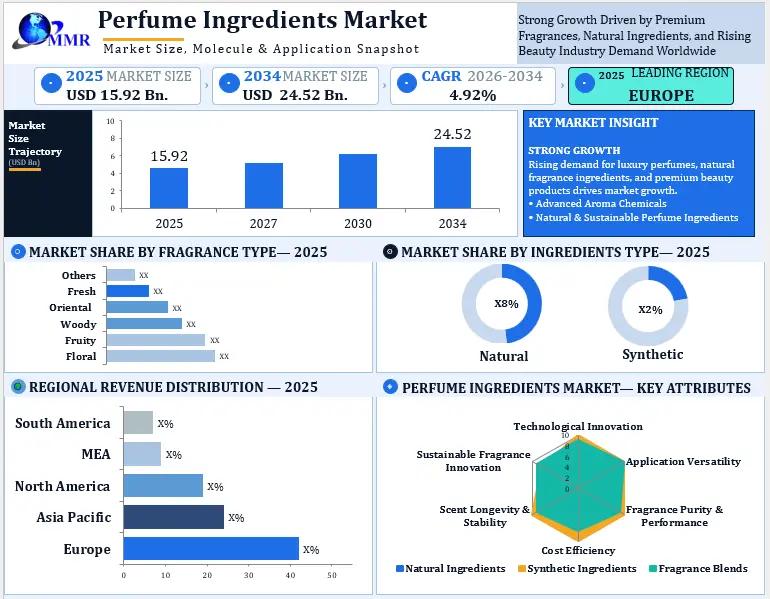
The Global Perfume Ingredients Market was valued at USD 15.92 Billion in 2025 and is projected to reach USD 24.52 Billion by 2034, growing at a CAGR of 4.92% during the forecast period 2026–2034.
| Parameter | Value |
| Market Size (2025) | USD 15.92 Billion |
| Market Size (2034) | USD 24.52 Billion |
| CAGR | 4.92% |
| Historical Period | 2020 to 2025 |
| Forecast Period | 2026 to 2034 |
Global Perfume Ingredients Market Overview
The Perfume Ingredients Market focuses on natural and synthetic aromatic compounds used in the production of perfumes, fragrances, cosmetics, personal care products, and household fragrances. These ingredients include essential oils, aroma chemicals, fragrance compounds, natural extracts, and synthetic scent molecules that provide distinctive aromas, improve fragrance stability, and enhance product appeal. The Global Perfume Ingredients Market plays an important role in the fragrance and personal care industry as consumers increasingly prefer premium perfumes, long-lasting fragrances, and personalized scent experiences. Manufacturers use perfume ingredients to develop unique fragrance profiles, improve scent longevity, maintain formulation consistency, and differentiate products across luxury and mass-market categories. Growing demand for premium fragrances, natural perfume ingredients, and innovative aroma chemicals supports market expansion worldwide.
The Perfume Ingredients Market Trends highlight rising demand for sustainable fragrance ingredients, biotechnology-derived aroma compounds, clean-label formulations, and advanced fragrance encapsulation technologies. Major buyers include perfume manufacturers, cosmetics companies, personal care brands, household product manufacturers, and fragrance formulation companies. Emerging opportunities exist in natural essential oils, sustainable synthetic aroma chemicals, niche perfumes, and high-performance fragrance delivery systems. Europe represents a leading regional market, supported by established fragrance manufacturing industries in France, Germany, Switzerland, and Italy, while Asia-Pacific creates opportunities through expanding beauty and personal care consumption. Key industry participants include Givaudan, dsm-firmenich, International Flavors & Fragrances (IFF), Symrise, and MANE. For example, Givaudan develops natural and synthetic fragrance ingredients, combining ingredient innovation with advanced perfumery technologies to serve global beauty and fragrance manufacturers.
Maximize Market Research (MMR) Perfume Ingredients Market Analysis examines key growth drivers, ingredient categories, application-based demand, regional market dynamics, competitive strategies, and emerging investment opportunities. The research highlights how premium fragrance consumption, sustainable ingredient sourcing, biotechnology innovation, and expanding cosmetics manufacturing influence the global perfume ingredients industry. It also evaluates challenges related to raw material price fluctuations, ingredient safety regulations, supply chain transparency, and natural ingredient availability. Increasing investment in bio-based aroma chemicals, specialty fragrance ingredients, and sustainable perfume formulations creates strategic opportunities for chemical manufacturers, fragrance houses, and beauty brands. The Global Perfume Ingredients Market Growth Outlook through 2034 reflects the industry's focus on fragrance innovation, product differentiation, sustainable manufacturing, and evolving consumer preferences.
Perfume Ingredients Market Size, Growth & Share Analysis
To know about the Research Methodology :- Request Free Sample Report
Global Perfume Ingredients Market Key Highlights
• Strong Market Growth: The Global Perfume Ingredients Market is projected to reach USD 24.52 Billion by 2034, growing at a CAGR of 4.92% during 2026–2034, from USD 15.92 Billion in 2025.
• Premium Fragrance Demand Accelerates: Rising demand for luxury perfumes, long-lasting fragrances, natural essential oils, and specialty aroma chemicals supports global market expansion.
• Europe Leads the Perfume Ingredients Market: France, Switzerland, Germany, and Italy strengthen regional leadership through luxury perfumery, advanced fragrance manufacturing, and premium aromatic ingredient innovation.
• Biotechnology and AI Transform Fragrance Innovation: Increasing adoption of precision fermentation, AI-powered fragrance formulation, and bio-based aroma chemicals creates opportunities for sustainable and personalized perfume ingredients.
• Leading Companies Drive Competitive Innovation: Givaudan, dsm-firmenich, IFF, Symrise, and MANE compete through sustainable ingredient sourcing, advanced fragrance technologies, specialty aroma molecules, and strategic expansion.
Global Perfume Ingredients Market Dynamics:
Drivers: Rising Demand for Premium Fragrances, Personal Care Products, and Natural Aroma Ingredients
The Perfume Ingredients Market Growth is driven by increasing consumer demand for luxury perfumes, premium personal care products, and long-lasting fragrance formulations. Expanding beauty and cosmetics industries support the consumption of natural essential oils, synthetic aroma chemicals, and specialty fragrance compounds. Perfume manufacturers use essential oils such as rose, jasmine, lavender, and sandalwood to develop distinctive fragrance profiles, while synthetic ingredients improve scent consistency and stability. Premium perfumes commonly contain 15%–20% fragrance concentrate, creating demand for high-quality aromatic ingredients. Growing interest in personalized fragrances, daily grooming products, and premium beauty experiences strengthens the Global Perfume Ingredients Market.
Restraints: Volatile Natural Raw Material Prices and Stringent Fragrance Safety Regulations
The Perfume Ingredients Market faces restraints from fluctuating essential oil prices, limited availability of natural botanical extracts, and stringent ingredient safety requirements. Natural fragrance production depends on agricultural yields, climatic conditions, seasonal harvesting, and extraction efficiency. For example, rose essential oil production can require around 3,000–5,000 kg of rose petals to obtain 1 kg of oil, depending on the flower variety and extraction process. Such resource-intensive production increases procurement costs for premium natural aroma ingredients. Compliance with IFRA fragrance safety standards, chemical registration requirements, and allergen labeling regulations adds formulation and testing expenses, affecting the commercial expansion of natural and synthetic perfume ingredients.
Opportunities: Expanding Bio-Based Aroma Chemicals and Sustainable Fragrance Ingredient Innovation
The Perfume Ingredients Market Opportunities expand through growing demand for biotechnology-derived fragrance molecules, renewable aroma chemicals, and sustainable perfume formulations. Manufacturers invest in microbial fermentation, enzymatic synthesis, and green extraction technologies to develop alternatives to resource-intensive natural ingredients. Advanced fragrance delivery systems, including microencapsulation technologies with particle sizes commonly ranging from 1–100 micrometers, support controlled fragrance release in suitable personal care and household product applications. Increasing consumer preference for niche perfumes, vegan fragrances, and responsibly sourced essential oils creates opportunities for specialty ingredient suppliers. Innovation in bio-based perfume ingredients, sustainable aroma chemicals, and high-performance fragrance compounds supports product differentiation and market expansion.
Challenges: Complex Fragrance Formulation, Ingredient Consistency, and Global Supply Chain Management
The Perfume Ingredients Market Challenges include maintaining fragrance consistency, managing complex ingredient combinations, ensuring chemical compatibility, and controlling production costs. Premium fragrance formulations can contain 50–200 or more individual aromatic ingredients, requiring precise blending, stability testing, and quality control to maintain a consistent scent profile. Natural essential oils exhibit variations in chemical composition due to geographical origin, harvesting conditions, and extraction methods, creating formulation challenges for fragrance manufacturers. Global supply chains also face difficulties related to botanical ingredient traceability, transportation costs, and raw material availability. Competition among perfume ingredient manufacturers, specialty aroma chemical suppliers, and global fragrance houses increases pressure to deliver innovative, reliable, and cost-effective fragrance solutions.
Global Perfume Ingredients Market Trends
| Key Market Trends | Perfume Ingredients Market Trends and Industry Insights |
| Precision Fermentation and Bio-Based Aroma Molecules | Fragrance manufacturers adopt precision fermentation and enzyme-based synthesis to develop sustainable perfume ingredients, improve molecular consistency, and reduce dependence on agricultural raw materials. |
| AI-Powered Fragrance Design and Molecular Discovery | Artificial intelligence and predictive molecular modeling accelerate the discovery of novel aroma chemicals, optimize fragrance combinations, and support personalized perfume development. |
| Alcohol-Free and Water-Based Perfume Innovation | Growing interest in water-based fragrances and alcohol-free perfume formulations encourages innovation in advanced solubilizers, fragrance carriers, and high-performance scent delivery systems. |
| Biodegradable Fragrance Encapsulation Technology | Biodegradable microencapsulation and controlled-release fragrance technologies improve scent longevity and support the development of long-lasting perfume ingredients for personal care and fabric care applications. |
| Next-Generation Captive Fragrance Molecules | Leading fragrance companies invest in exclusive synthetic aroma molecules and advanced molecular engineering to create distinctive scent profiles, improve fragrance stability, and develop alternatives to restricted ingredients. |
Global Perfume Ingredients Market Segment Analysis
Global Perfume Ingredients Market, by Application
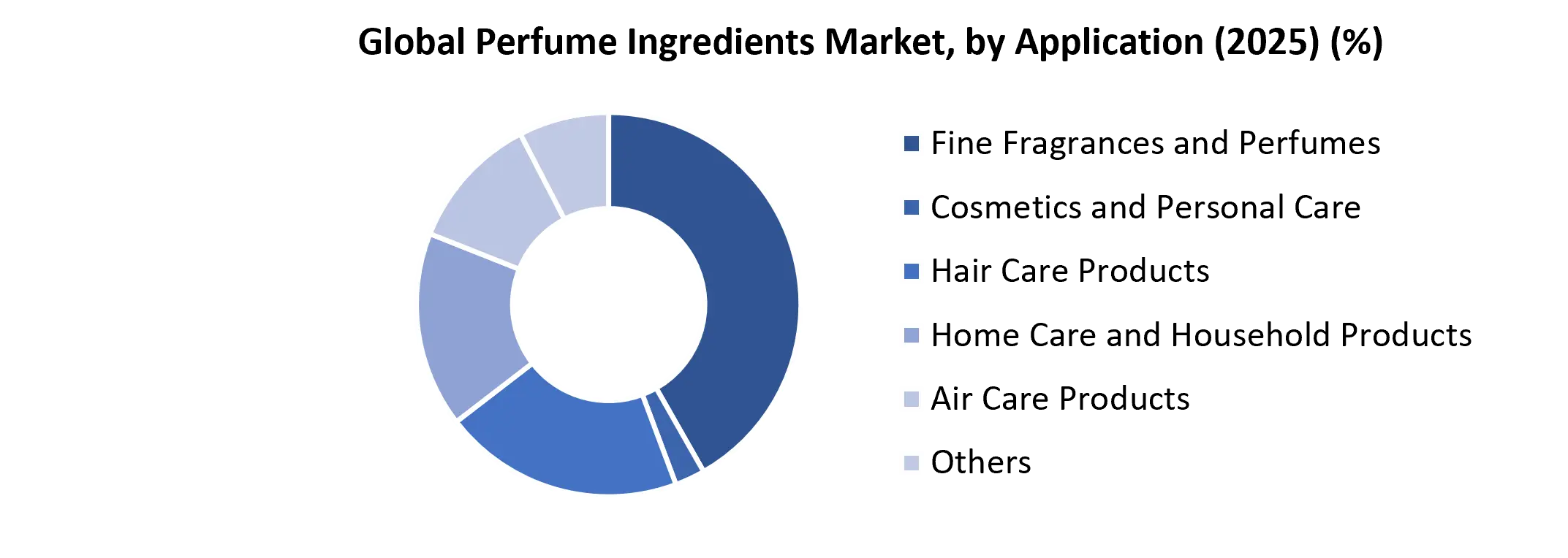
The Perfume Ingredients Market by Application is segmented into Fine Fragrances and Perfumes, Cosmetics and Personal Care, Hair Care Products, Home Care and Household Products, Air Care Products, and Others. The Fine Fragrances and Perfumes segment generates demand for premium essential oils, synthetic aroma chemicals, and long-lasting fragrance compounds. Cosmetics and Personal Care applications use fragrance ingredients in skincare, deodorants, and beauty products, while Hair Care Products incorporate aromatic compounds in shampoos, conditioners, and styling products. Home Care and Household Products utilize fragrance blends in detergents and cleaning solutions, whereas Air Care Products support demand for room fresheners, diffusers, and scented sprays. Increasing demand for sustainable perfume ingredients, premium fragrances, and innovative scent formulations supports Perfume Ingredients Market growth across these applications.
 Global Perfume Ingredients Market, by End User
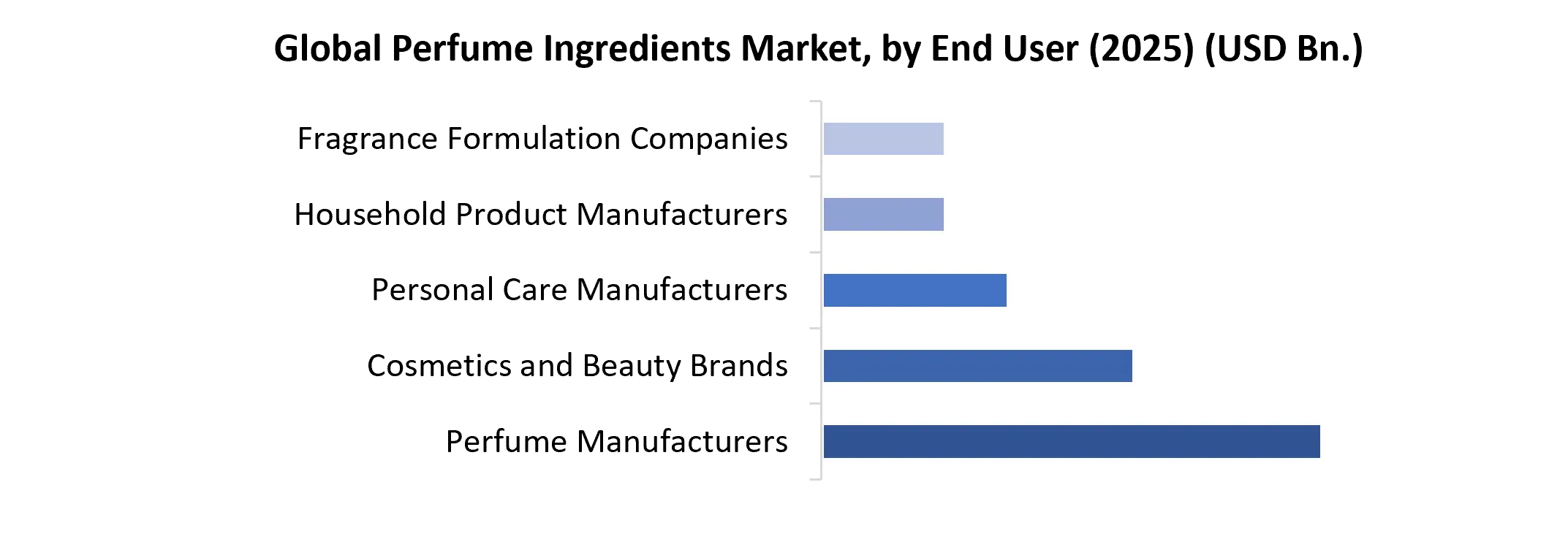
The Global Perfume Ingredients Market by End User is segmented into Perfume Manufacturers, Cosmetics and Beauty Brands, Personal Care Manufacturers, Household Product Manufacturers, and Fragrance Formulation Companies. Perfume Manufacturers drive demand for premium essential oils, synthetic aroma chemicals, and long-lasting fragrance compounds used in luxury and mass-market perfumes. Cosmetics and Beauty Brands incorporate natural fragrance ingredients into skincare, makeup, and beauty products, while Personal Care Manufacturers use aromatic compounds in deodorants, soaps, and body care formulations. Household Product Manufacturers utilize fragrance blends in detergents, fabric softeners, and cleaning products. Fragrance Formulation Companies focus on customized scent development, sustainable aroma chemicals, and innovative fragrance technologies, supporting Perfume Ingredients Market growth across global consumer industries.
 Global Perfume Ingredients Market Regional Insights
Europe holds a leading position in the Global Perfume Ingredients Market, supported by established luxury perfume manufacturing, advanced fragrance technologies, and specialty aroma chemical production. France, Switzerland, Germany, and Italy represent major fragrance industry hubs, with strong demand for natural perfume ingredients, synthetic aroma chemicals, essential oils, and sustainable fragrance compounds. Leading companies, including Givaudan, dsm-firmenich, and Symrise, strengthen regional innovation in premium perfumery, bio-based fragrance ingredients, and high-performance scent formulations.
Asia-Pacific presents significant Perfume Ingredients Market growth opportunities, driven by expanding cosmetics manufacturing, increasing beauty product consumption, and growing demand for premium fragrances. China, India, Japan, and South Korea support demand for fragrance ingredients, aromatic chemicals, botanical extracts, and essential oils. India's natural aromatic raw material industry and China's chemical manufacturing capabilities strengthen regional supply chains, while increasing demand for affordable luxury perfumes and personal care fragrances supports market expansion.
North America's Perfume Ingredients Market benefits from strong demand for luxury perfumes, niche fragrances, and innovative personal care products. The United States and Canada support the adoption of bio-based aroma chemicals, clean-label fragrance ingredients, synthetic fragrance molecules, and personalized perfume formulations. Increasing investment in AI-assisted fragrance development, biotechnology-derived ingredients, and premium beauty products creates opportunities for fragrance manufacturers and specialty chemical suppliers.
The Middle East & Africa Perfume Ingredients Market is characterized by strong demand for luxury oriental fragrances, concentrated perfume oils, and traditional aromatic compounds. Saudi Arabia, the United Arab Emirates, and Oman represent important markets for oud fragrance ingredients, amber accords, musk compounds, rose extracts, and long-lasting perfume formulations. Growing demand for premium attars, niche Arabian perfumes, and customized fragrance blends supports opportunities for natural essential oil suppliers and specialty aroma chemical manufacturers.
South America's Perfume Ingredients Market benefits from established personal care manufacturing, demand for affordable fragrances, and interest in natural botanical ingredients. Brazil represents an important regional market for essential oils, natural fragrance extracts, aroma chemicals, and perfume ingredients used in cosmetics and deodorants. Argentina, Colombia, and Chile contribute to fragrance consumption and beauty product distribution. The availability of botanical resources and demand for sustainable fragrance formulations support opportunities in natural perfume ingredients and specialty fragrance chemicals.
Global Perfume Ingredients Market Recent Developments
| Published Date | Recent Developments |
| October 2026 | Symrise announces a major production capacity expansion in India for Globalide, its sustainable macrocyclic musk fragrance ingredient, strengthening global supply capabilities and supporting demand for high-performance perfume ingredients and specialty aroma chemicals. |
| September 2026 | International Flavors & Fragrances (IFF) launches AQUASCENT, an advanced vegan, water-based fragrance carrier technology using biodegradable materials, expanding innovation in sustainable perfume ingredients, fine fragrance formulations, and alcohol-free fragrance solutions. |
| September 2026 | Symrise completes the acquisition of Floral Concept, a French natural fragrance ingredient manufacturer, strengthening its premium natural perfume ingredients portfolio and expanding botanical extraction and fragrance production capabilities in Grasse, France. |
| September 2026 | dsm-firmenich announces a strategic partnership with Boltz PBC to integrate artificial intelligence into fragrance ingredient discovery, accelerating innovation in AI-driven aroma chemical development, scent molecules, and advanced perfume formulations. |
| September 2026 | Givaudan opens a new Fragrance & Beauty development hub in Casablanca, Morocco, expanding local perfumery laboratories, fragrance application capabilities, and commercial operations to support demand for premium fragrance ingredients and customized perfume formulations across North and West Africa. |
Global Perfume Ingredients Market Competitive Landscape
The Perfume Ingredients Market Competitive Landscape features major companies such as Givaudan, dsm-firmenich, International Flavors & Fragrances (IFF), Symrise, MANE, Robertet, and Takasago International Corporation. Givaudan competes through advanced fragrance technologies and an extensive aroma chemical portfolio, while dsm-firmenich focuses on biotechnology-derived ingredients and sustainable fragrance solutions. IFF emphasizes innovative scent formulations, while Symrise strengthens its position through specialty aroma chemicals and natural fragrance ingredients. MANE and Robertet compete through premium botanical extracts, essential oils, and customized perfume formulations. Increasing demand for luxury perfume ingredients and high-performance fragrance compounds encourages manufacturers to differentiate their products through quality, innovation, and global distribution capabilities.
The Perfume Ingredients Market Competitive Strategies focus on product innovation, strategic acquisitions, manufacturing expansion, and sustainable ingredient sourcing. In 2026, Givaudan strengthens its fragrance capabilities through strategic partnerships and expansion initiatives, while dsm-firmenich advances AI-powered fragrance ingredient discovery and specialty aroma molecules. Symrise focuses on production capacity and high-performance fragrance ingredients. Increasing investment in bio-based aroma chemicals, premium natural extracts, and long-lasting perfume formulations intensifies competition and creates growth opportunities across the Global Perfume Ingredients Market. Leading fragrance manufacturers also prioritize regulatory compliance, ingredient traceability, and personalized fragrance development to strengthen customer relationships and expand their presence in emerging markets.
Perfume Ingredients Market Scope: Inquire before buying
| Perfume Ingredients Market | |||
|---|---|---|---|
| Report Coverage | Details | ||
| Base Year: | 2025 | Forecast Period: | 2026-2034 |
| Historical Data: | 2020 to 2025 | Market Size in 2025: | 15.92 USD Billion |
| Forecast Period 2026-2034 CAGR: | 4.92% | Market Size in 2034: | 24.52USD Billion |
| Segments Covered: | by Ingredients Type | Natural Ingredients Synthetic Ingredients |
|
| by Product Type | Essential Oils Aroma Chemicals Botanical Extracts Fragrance Blends Other Specialty Ingredients |
||
| by Fragrance Type | Floral Fruity Woody Oriental Fresh Others |
||
| by Application | Fine Fragrances and Perfumes Cosmetics and Personal Care Hair Care Products Home Care and Household Products Air Care Products Others |
||
| by End User | Perfume Manufacturers Cosmetics and Beauty Brands Personal Care Manufacturers Household Product Manufacturers Fragrance Formulation Companies |
||
Global Perfume Ingredients Market, by Region:
North America (United States, Canada, and Mexico)
Europe (UK, France, Germany, Italy, Spain, Sweden, Austria, and the Rest of Europe)
Asia Pacific (China, South Korea, Japan, India, Australia, ASEAN, Indonesia, Philippines, Malaysia, Vietnam, Thailand, ASEAN, Rest of Asia Pacific)
Middle East & Africa (South Africa, GCC, Nigeria, Rest of ME&A)
South America (Brazil, Argentina, Rest of South America)
Global Perfume Ingredients Market, Major Players:
1. Givaudan SA
2. dsm-firmenich
3. International Flavors & Fragrances Inc. (IFF)
4. Symrise AG
5. MANE SA
6. Robertet Group
7. Takasago International Corporation
8. Sensient Technologies Corporation
9. BASF SE
10. Kao Corporation
11. T. Hasegawa Co., Ltd.
12. Bell Flavors & Fragrances Inc.
13. Huabao International Holdings Limited
14. CPL Aromas Limited
15. Iberchem S.A.
16. Eurofragance S.L.U.
17. Keva
18. Oriental Aromatics Limited
19. Privi Speciality Chemicals Limited
20. Eternis Fine Chemicals Limited
21. Anthea Group
22. Atul Limited
23. Treatt plc
24. Vigon International LLC
25. Axxence Aromatic GmbH
26. LANXESS AG
27. Eastman Chemical Company
28. Anhui Hyea Aromas Co., Ltd.
29. Zhejiang NHU Co., Ltd.
30. YingYang (China) Aroma Chemical Group
31. PFW Aroma Chemicals B.V.
32. Berjé Inc.
33. Lebermuth, Inc.
34. Alpha Aromatics
35. Flavorchem Corporation
36. Aromatech Group
37. Nactis Flavours
38. Lluch Essence S.L.
39. Elixens
40. Albert Vieille SAS
41. Ernesto Ventós S.A.
42. Ultra International B.V.
43. AOS Products Pvt. Ltd.
44. Kancor Ingredients Limited
45. Phoenix Aromas & Essential Oils LLC
46. M&U International LLC
47. A. Fakhry & Co.
48. Biolandes SAS
49. Van Aroma
50. Synthite Industries Pvt. Ltd.
FAQ
1.What is the Global Perfume Ingredients Market size and forecasts by 2034?
The Global Perfume Ingredients Market is valued at USD 15.92 Billion in 2025 and is projected to reach USD 24.52 Billion by 2034, at a CAGR of 4.92% during 2026–2034.
2.What are the major factors driving Perfume Ingredients Market growth?
Rising demand for luxury perfumes, natural fragrance ingredients, synthetic aroma chemicals, premium cosmetics, and long-lasting fragrances drives global Perfume Ingredients Market growth.
3.Which region leads the Global Perfume Ingredients Market?
Europe holds a leading position in the Perfume Ingredients Market, supported by luxury perfume manufacturing, specialty aroma chemical production, and established fragrance industries in France, Switzerland, Germany, and Italy.
4.What are the major types of perfume ingredients used in fragrance manufacturing?
The Perfume Ingredients Market includes natural and synthetic ingredients, such as essential oils, aroma chemicals, botanical extracts, fragrance blends, and specialty aromatic compounds.
5.Who are the leading companies in the Global Perfume Ingredients Market?
Major Perfume Ingredients Market key players include Givaudan, dsm-firmenich, International Flavors & Fragrances (IFF), Symrise, MANE, Robertet, and Takasago International Corporation.
6.What are the emerging trends and growth opportunities in the Perfume Ingredients Market?
Major Perfume Ingredients Market trends include bio-based aroma chemicals, AI-powered fragrance development, sustainable essential oils, water-based perfumes, and biodegradable fragrance encapsulation technologies
.
7.What does the MMR Global Perfume Ingredients Market Report cover?
The MMR Perfume Ingredients Market Report covers market size, CAGR, natural and synthetic ingredients, product types, applications, end users, regional analysis, competitive landscape, market trends, and investment opportunities through 2034.