
Peptic Ulcer Market Size by Drug Type, Ulcer Type, Distribution Channel, Region – Revenue Pool Analysis, Margin Structure Assessment, Capital Flow Trends, Competitive Benchmarking & Forecast to 2032
Overview
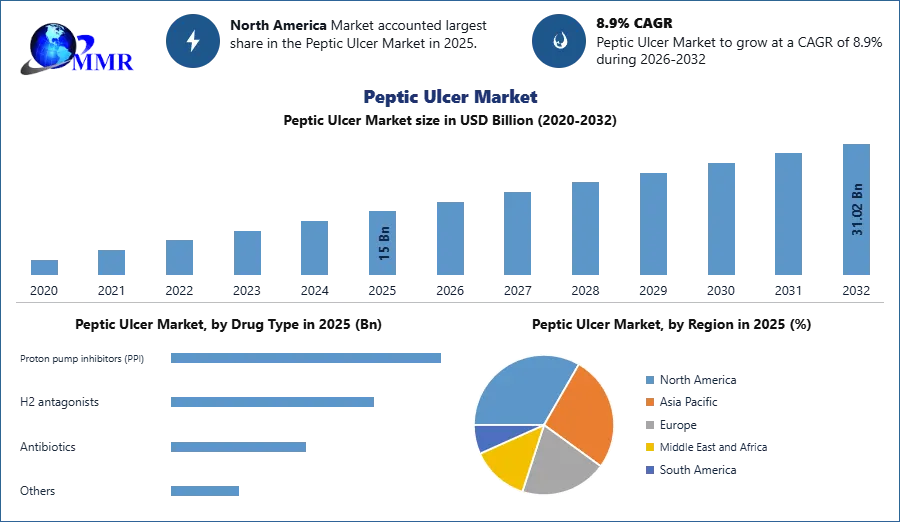
Peptic Ulcer Market was valued at USD 15.0 Bn in 2025, and it is expected to reach USD 31.2 Bn by 2032, exhibiting a CAGR of 8.9 % during the forecast period 2026-2032.
Peptic Ulcer Market Overview:
Peptic ulcers are open sores that form on the stomach's inner lining and the upper region of the small intestine. Gastric ulcers and duodenal ulcers are two different forms of peptic ulcers. Peptic ulcer disease (PUD) occurs when the stomach's thick layer of mucus that protects it from digestive fluids thins.
Peptic Ulcer Market Snapshot
 To know about the Research Methodology :- Request Free Sample Report
The report explores the Peptic Ulcer Market's segments (Drug Type, Ulcer Type, Distribution Channel). Data has been provided by market participants, and regions (North America, Asia Pacific, Europe, Middle East & Africa, and South America). The MMR market report provides a thorough analysis of the rapid advances that are currently taking place across all industry sectors. Facts and figures, illustrations, and presentations are used to provide key data analysis for the historical period from 2020 to 2032. The report investigates the Peptic Ulcer Market’s drivers, limitations, prospects, and barriers. This MMR report includes investor recommendations based on a thorough examination of the Peptic Ulcer Market's contemporary competitive scenario.
Peptic Ulcer Market Dynamics:
Peptic ulcers are sores that form on the lining of the stomach, oesophagus, and intestines. Vomiting, scorching stomach discomfort, bloating, and food intolerance are all symptoms of peptic ulcers. Gastric ulcers, duodenal ulcers, and esophageal ulcers are the three forms of ulcers that can occur. Stomach infections caused by H. pylori, drinking, stomach tumors, the use of anti-inflammatory medicines such as aspirin, and smoking are some of the causes of peptic ulcers. If left untreated, peptic ulcers can lead to serious consequences such as internal bleeding and stomach lining perforation.
During the projected period, the worldwide peptic ulcer market is expected to increase at a quick rate. Peptic ulcers can be caused by lifestyle factors such as aerated drinks, drunkenness, fatty food consumption, and stress. This is a significant driving force in the Peptic Ulcer Market. In the elderly, peptic ulcers can cause significant morbidity. As a result, the market is expected to be driven by a growth in this demographic during the forecast period. Other factors expected to boost the worldwide peptic ulcer market from 2018 to 2026 include an increase in patient pool and increased consumption of medications like aspirin, ibuprofen, and other anti-inflammatory drugs.
The increased global prevalence of stomach ulcers is expected to boost the market's growth. When stomach acid eats away at your stomach's protective lining, a Peptic ulcer forms. The stomach acid generates open sores that might bleed and cause pain. Stomach ulcers are one of the many ways that gastric ulcer disease expresses itself. Peptic ulcers are treated using drugs that decrease peptic ulcer discharge, such like PPIs and H2 receptor antagonists, as well as acid neutralization agents, such as antacids and antibiotics for H. pylori infection. These drugs are typically administered in combination for effective therapy.
Another important element impacting the rate of growth of the peptic ulcers market is the increase in healthcare spending, which serves to improve the market's infrastructure. Various government agencies are also trying to improve healthcare infrastructure by improving financing, which will have an impact on market dynamics.
Furthermore, the market for Peptic ulcers will grow as more public and private groups take steps to raise awareness. Furthermore, people's sedentary lifestyles, such as heavy alcohol use and smoking addiction, will fuel the growth of the Peptic ulcers market. The primary drivers expected to boost the market's growth rate during the forecast period are an increase in disposable income and an increase in the geriatric population.
Prolonged use of peptic ulcer medicines such proton pump inhibitors and antibiotics can raise the risk of hip bone fracture by reducing the ability to absorb calcium and iron. Other negative effects include an increased risk of opportunistic infections caused by S. aureus. C. pneumoniae and pneumonia Due to a reduction in normal gut flora, deficiency occurs. The worldwide peptic ulcer medicines market is projected to be hampered by such a scenario.
Furthermore, the market's growth is likely to be hampered by the widespread availability of generic medications and low patient adherence to medication in several countries.
To increase their market share, key players in the market might focus on tailored therapy and care of PUD patients. For example, researchers from the Institute of Medical Microbiology in Switzerland concluded in a study published in the Journal of Clinical Medicine (MDPI) in July 2022 that next-generation sequencing technology may assist rapid supervision of virulence determinants in H. pylori, which could be useful in the personalized treatment and management of patients with PUD.
High doses of nonsteroidal anti-inflammatory drugs (NSAIDs) have also been linked to an increased risk of recurrent PUD. As a result, market participants may concentrate their research and development efforts on H. pylori eradication therapy, which has the potential to minimize the incidence of recurrent PUD in NSAID users.
An increase in the amount of research and development activities is fueling the market's expansion. This will benefit the growth of the Peptic ulcers market. Companies are adopting long-term approaches to gain a competitive advantage in the peptic ulcer industry, such as new product launches, collaborative agreements, and product updates.
The announcement by the big pharmaceutical corporation is expected to strengthen its market position in the coming years.
Furthermore, increased investment in advanced technology development and an increase in the number of emerging markets would create further favourable conditions for the expansion of stomach ulcers during the projection period.
The treatment's exorbitant cost will stifle the market's expansion. The peptic ulcers market will be challenged by a shortage of skilled experts and a lack of healthcare infrastructure in developing economies. Moreover, over the projection period of 2026-2032, strong regulatory rules and a lack of public awareness will constrain and impede the market's growth pace.
Peptic Ulcer Market Segment Analysis:
Based on Drug Type, Proton Pump Inhibitor is dominating the market with highest CAGR during the forecast period. This is owing to these medications' strong efficacy in treating ulcers by reducing inflammation, acid secretion, and discomfort produced by ulceration. Furthermore, the therapeutic benefits of proton pump inhibitors, as well as their painful impact when used in conjunction with antibiotics, are projected to fuel market expansion.
Peptic Ulcer Market, by Drug Type in 2025 (%)
Based on the Ulcer Type, Gastric Ulcer segment is dominating the market with highest CAGR of during the forecast period. Due to the high prevalence of the condition, the stomach ulcers sector is likely to account for a large proportion of the global market over the forecast period.
Based on the Distribution Channel:
Hospital Pharmacies segment is dominating the market with highest CAGR during the forecast period. Because of the growing number of hospitals and the wide range of services available at a single location, the hospital pharmacies sector is expected to dominate the global market from 2026 to 2032.
Peptic Ulcer Market Regional Insights:
The North America region dominated the market with highest share in 2022. The North America region is expected to witness significant growth at a CAGR of xx% through the forecast period.
The Peptic Ulcer Market is divided into five regions: North America, Latin America, Europe, Asia Pacific, and the Middle East and Africa. During the forecast period, North America is expected to dominate the worldwide peptic ulcers market, accounting for the greatest share. The rise of the market in North America is attributable to an increase in awareness of peptic ulcer therapy, the use of anti-inflammatory medications, and the prevalence of stomach cancer in the region. Furthermore, unhealthy lifestyles, high health-care spending, and sophisticated health-care infrastructure are driving the market's expansion in the region.
The regional group of North America now dominates the global market for peptic ulcer medications. The mature healthcare market in the region is primarily driving the regional segment's growth. Research & development activities, in addition to increased spending on the creation of novel and innovative treatments, are driving the expansion of the North American area.
Because of the growing senior population, Europe is expected to take a considerable portion of the worldwide market. During the projected period, the Asia Pacific market is expected to grow at a quicker rate. Due to the vast population, increased health awareness, and high frequency of lifestyle-related disorders, stomach infections caused by H. Pylori, and cancer, it is the most profitable market.
The objective of the report is to present a comprehensive analysis of the Peptic Ulcer Market to the stakeholders in the industry. The past and current status of the industry with the forecasted market size and trends are presented in the report with the analysis of complicated data in simple language. The report covers all the aspects of the industry with a dedicated study of key players that include market leaders, followers, and new entrants.
PORTER, PESTEL analysis with the potential impact of micro-economic factors of the market have been presented in the report. External as well as internal factors that are supposed to affect the business positively or negatively have been analyzed, which will give a clear futuristic view of the industry to the decision-makers.
The reports also help in understanding the Peptic Ulcer Market dynamic, structure by analyzing the market segments and projecting the Peptic Ulcer Market size. Clear representation of competitive analysis of key players by Vehicle type, price, financial position, product portfolio, growth strategies, and regional presence in the Peptic Ulcer Market make the report investor’s guide.
Peptic Ulcer Market Scope: Inquire before buying
| Peptic Ulcer Market | |||
|---|---|---|---|
| Report Coverage | Details | ||
| Base Year: | 2025 | Forecast Period: | 2026-2032 |
| Historical Data: | 2020 to 2025 | Market Size in 2025: | 15 USD Billion |
| Forecast Period 2026-2032 CAGR: | 8.9% | Market Size in 2032: | 31.02 USD Billion |
| Segments Covered: | by Drug Type | Proton pump inhibitors (PPI) H2 antagonists Antibiotics Others |
|
| by Ulcer Type | Gastric Ulcer Duodenal Ulcer |
||
| by Distribution Channel | Hospital Pharmacies Retail Pharmacies Online Pharmacies |
||
| By Application | Electronics & Semiconductors Healthcare & Pharmaceuticals Energy & Power (Batteries, Solar Cells, Fuel Cells) Automotive Aerospace & Defense Chemicals & Catalysts Construction Environmental Applications Packaging Textiles |
||
Peptic Ulcer Market, by Region
North America (United States, Canada and Mexico)
Europe (UK, France, Germany, Italy, Spain, Sweden, Austria, Turkey, Russia and Rest of Europe)
Asia Pacific (China, India, Japan, South Korea, Australia, ASEAN and Rest of APAC)
Middle East and Africa (South Africa, GCC, Egypt, Nigeria and Rest of ME&A)
South America (Brazil, Argentina, Columbia and Rest of South America)
Peptic Ulcer Market, Key Players are
1. Abbott Laboratories
2. AstraZeneca PLC
3. Cadila Healthcare Ltd. (Zydus Cadila)
4. Daewoong Pharmaceutical Co., Ltd.
5. Eisai Co., Ltd.
6. Pharmaking Co., Ltd.
7. Taiho Pharmaceutical Co., Ltd.
8. Takeda Pharmaceutical Co., Ltd.
9. Yuhan Corporation
10. GlaxoSmithKline plc
11. Novartis AG
12. Daiichi Sankyo Company Limited
13. Actelion Ltd
14. Boehringer Ingelheim
15. Sanofi S.A.
16. Ranbaxy Laboratories Limited, Inc.
17. Takeda Pharmaceuticals Company Limited
18. Pfizer Inc.