
Passive Optical LAN (POL) Market - Industry Structure Evaluation, Demand Drivers Analysis, Regional Growth Analysis and Identification, Competitive Positioning / Landscape Review & Global Market Size Forecast to 2032
Overview
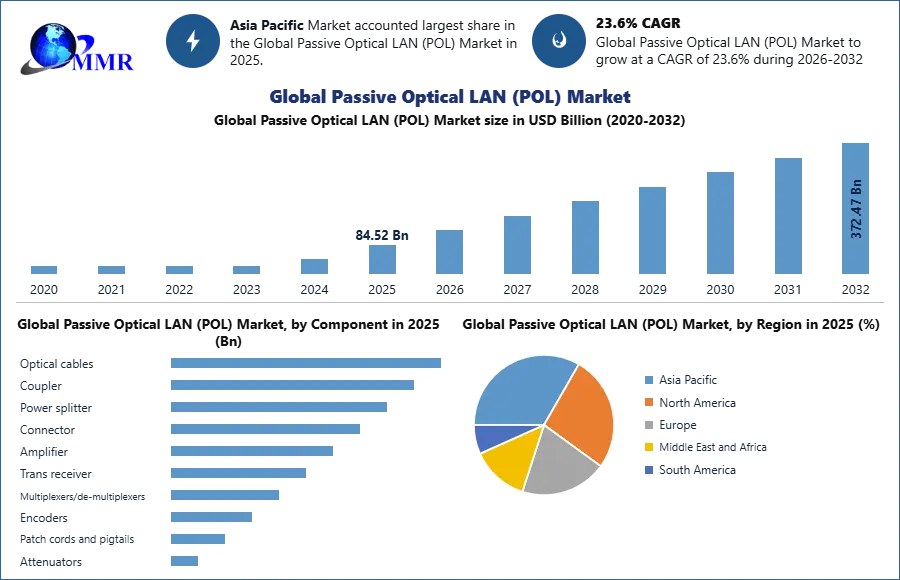
The Passive Optical LAN Market size was valued at USD 84.52 Billion in 2025 and the total Passive Optical LAN revenue is expected to grow at a CAGR of 23.6% from 2026to 2032, reaching nearly USD 372.47Billion.
Passive Optical LAN (POL) Market Overview:
Passive optical LAN (POL) is a layer-2 transport medium that uses passive optical network (PON) technology to deliver converged video, data, and voice services at gigabit rates to the user's location through a single strand of fibre. The data is disseminated and sent to the desktop in the traditional paradigm through layers of cables, switches, and routers, incurring additional costs. POL is a less expensive and more energy-efficient alternative. With single-mode fibre, it employs a distinct style of architecture. An optical line terminal (OLT), optical network terminals (ONTs), and an optical splitter are also included in a POL for audio transmission.
 To know about the Research Methodology :- Request Free Sample Report
Passive Optical LAN (POL) Market Dynamics:
During the projected period, the worldwide passive optical LAN (POL) market is expected to develop due to energy efficient network solutions owing to the use of passive optical components:.
Traditional copper-based Ethernet local network solutions are more environmentally friendly than POL systems. Optical splitters are used instead of workgroup switches in POL solutions. It also complies with HVAC regulations by removing workgroup switches, which saves tens of thousands of KW of electricity. Furthermore, PON employs small passive optical splitters at the building's enclosures, which are typically found on each storey. As a result, PON generates no heat, uses no electricity, and can even be installed in electrical closets. These systems save space in the ceiling and are environmentally benign due to their potential to lower fire loads.
Over the forecast period, the global passive optical LAN (POL) market is expected to rise due to rising bandwidth requirements:
In the current market, there is a huge desire for more bandwidth. According to an 81 percent response rate in a survey of IT professionals, the need for increased bandwidth is currently enormous and is likely to grow even more in the near future. As the number of subscribers grows, so are the number of devices linked to networks and the number of data-dense services that can be delivered over those networks. According to Coherent Market Insights' analysis, the African region is predicted to have the highest bandwidth demand, with a CAGR of over 50%. Furthermore, the Asian market's bandwidth consumption is predicted to grow at a CAGR of above 20%.
In the worldwide passive optical LAN (POL) market, research and development (R&D) efforts can give considerable economic prospects:
To improve their market presence, major market players engage in research and development efforts. For example, 3M Company introduced 3M Easy Cleaver, a new fibre cleaving tool that makes fibre installation faster and more cost-effective, in June 2014. Coarse Wavelength Division Multiplexers and Planar Light Circuits were two optical components introduced by 3M in 2012. (PLC).
Market Restraints:
During the forecast period, technical and operational challenges such as dispersion, attenuation, and signal losses are likely to limit the growth of the global passive optical LAN (POL) market:
The market's dispersion is a key stumbling block. This is the procedure for spreading the signal across a period of time. Chromatic dispersion and modal dispersion are two types of dispersion that might damage an optical data transmission. The spread of signal in time caused by chromatic dispersion is caused by the varying speeds of light rays. The spread of signal in time caused by the distinct propagation modes in the fibre is known as modal dispersion. Despite the fact that attenuation in optical fibres is substantially smaller than in other media, it occurs in both single-mode and multi-mode transmission.
Over the projected period, the growing preference for wireless networks is expected to stifle the growth of the global passive optical LAN (POL) market.
The biggest problem that the passive optical LAN business is now facing is the growing desire for wireless internet. Mobile technology is continuously evolving, and the use of smartphones and tablets has risen dramatically in recent years. Mobile customers benefit from 4G LTE networks since they give high-speed Internet connectivity. Service providers are adamant about bringing enhanced LTE to market as soon as possible. As a result, these issues are likely to slow the growth of the global passive optical LAN (POL) market in the near future.
Optical LAN may minimize polymers connected with the cabling infrastructure by thousands of pounds by using less quantity, smaller dimension, and shorter lengths of fibre optic cabling and converged network services. 2 The circumference of the plastic jacketing that wraps around the silicon dioxide glass core is.357", whereas the circumference of the plastic jacketing that covers CAT6a is.926". SMF has 61 percent less plastic jacketing as a result of this. Because CAT6a cabling only provides service to one Gigabit port, Passive Optical LAN SMF cable may provide service to 128 Gigabit endpoints, the savings are multiplied.
Passive Optical LAN (POL) Market Segment Analysis:
The wavelength division multiplexers/de-multiplexers segment, which accounted for 36% of the market, was followed by optical amplifiers in 2024. Because of their rising use in ultra-high capacity networks, the latter has a significant proportion of the passive optical LAN (POL) market. Following bandwidths and fibre optic technologies, fixed and variable optical attenuators and amplifiers are predicted to increase at a CAGR of 17.42% throughout the forecast period.
Healthcare facilities are dominating the market:
Healthcare facilities have changed dramatically in recent years, but their local area networks, which use copper-based LANs, have stayed mostly same in terms of equipment, cabling, and network architecture for at least a decade. It's time for healthcare LANs to modernize to meet high-bandwidth needs and the proliferation of wireless devices, offer higher stability through consistent availability, and provide stringent QoS in support of mission-critical services. By their very nature, hospital equipment, resources, and personnel must be extremely mobile. Fiber optic cabling gives higher flexibility and makes the procedure much easier when a move, add, or change (MAC) is required. Daily IT modification orders are executed as global keystrokes at a centrally situated desktop because optical LANs are maintained centrally through element management software (EMS).
The introduction of new products is a popular trend:
To extend their product range, key market players are focusing on launching new goods. For example, at the BICSI Winter Conference and Exhibition in Tampa, Florida in January 2013, 3M unveiled a portfolio of passive optical LAN solutions for the enterprise LAN. Because fiber-to-the-desktop (FTTD) LAN technology is gaining traction faster than traditional copper-based Ethernet switches, the business announced POL solutions to get into the FTTD LAN market.
Passive Optical LAN (POL) Market Regional Insights:
Passive Optical LAN (POL) Market Players in Asia Pacific Have Massive Growth Opportunities:
The Asia Pacific region dominated f the passive optical LAN (POL) market 2025, owing to increased demand for passive optical networks in emerging countries such as China and India. During the projected period, an increase in demand for additional bandwidth is expected to drive the global passive optical LAN (POL) market. Passive optical LAN (POL) systems are more energy-efficient, dependable, and long-lasting than active optical LAN (AOL) systems. Technological advancement, development of systems administration in Asia Pacific, expansion of fibre optic network, and rise in popularity of innovative headways, and exploration framework around the world are some of the factors driving market growth in Asia Pacific. Passive optical LAN is used mostly in the consumer electronics and automobile industries (POL). Due to their speed, efficiency, sustainability, cost-effectiveness, and scalability, these solutions are gaining traction around the world.
The objective of the report is to present a comprehensive analysis of the global Passive Optical LAN (POL) Market to the stakeholders in the industry. The past and current status of the industry with the forecasted market size and trends are presented in the report with the analysis of complicated data in simple language. The report covers all the aspects of the industry with a dedicated study of key players that include market leaders, followers, and new entrants.
PORTER, PESTEL analysis with the potential impact of micro-economic factors of the market have been presented in the report. External as well as internal factors that are supposed to affect the business positively or negatively have been analyzed, which will give a clear futuristic view of the industry to the decision-makers.
The reports also help in understanding the Passive Optical LAN (POL) Market dynamic, structure by analyzing the market segments and projecting the Passive Optical LAN (POL) Market size. Clear representation of competitive analysis of key players by Vehicle type, price, financial position, product portfolio, growth strategies, and regional presence in the Passive Optical LAN (POL) Market make the report investor’s guide.
Passive Optical LAN (POL) Market Scope: Inquire before buying
| Global Passive Optical LAN (POL) Market | |||
|---|---|---|---|
| Report Coverage | Details | ||
| Base Year: | 2025 | Forecast Period: | 2026-2032 |
| Historical Data: | 2020 to 2025 | Market Size in 2025: | 84.52 USD Billion |
| Forecast Period 2026-2032 CAGR: | 23.6% | Market Size in 2032: | 372.47 USD Billion |
| Segments Covered: | by Component | Optical cables Coupler Power splitter Connector Amplifier Trans receiver Multiplexers/de-multiplexers Encoders Patch cords and pigtails Attenuators Circulators Network terminals Line terminals Others |
|
| by Type | GPON EPON |
||
| by End User | Manufacturing Education Government Healthcare BFSI Others |
||
| by Application | Loop feeder Hybrid fiber-coaxial cable Synchronous digital hierarchy Synchronous optical network Others |
||
Passive Optical LAN (POL) Market, by Region
North America (United States, Canada and Mexico)
Europe (UK, France, Germany, Italy, Spain, Sweden, Austria and Rest of Europe)
Asia Pacific (China, South Korea, Japan, India, Australia, Indonesia, Malaysia, Vietnam, Taiwan, Bangladesh, Pakistan and Rest of APAC)
Middle East and Africa (South Africa, GCC, Egypt, Nigeria and Rest of ME&A)
South America (Brazil, Argentina Rest of South America)
Passive Optical LAN (POL) Market, Key Players
- ADTRAN, Inc.
- Calix, Inc.
- Tellabs, Inc.
- DZS Inc. (DASAN Zhone Solutions)
- FiberHome Telecommunication Technologies Co., Ltd.
- Fujitsu Limited
- NEC Corporation
- Mitsubishi Electric Corporation
- Ericsson AB
- Allied Telesis, Inc.
- Zyxel Communications Corp.
- Edgecore Networks Corporation
- Tejas Networks Limited
- TP-Link Systems Inc.
- Ciena Corporation
- Hewlett Packard Enterprise (HPE)
- CommScope Holding Company, Inc.
- Corning Incorporated
- Prysmian Group
- OFS Fitel, LLC
- Sumitomo Electric Industries
- Alcatel-Lucent Enterprise
- MACOM Technology Solutions
- Hitachi Ltd.
- Versa Technology
- Infiniti Technologies