
Optical Fiber Market – Industry Structure Evaluation, Demand Drivers Analysis, Regional Growth Analysis and Identification, Competitive Positioning Review & Global Market Size Forecast to
Overview
Optical Fiber Market was valued at USD 9.81 Bn in 2023 and is expected to reach USD 21.14 Bn by 2030, at a CAGR of 11.59 % during the forecast period.
Optical Fiber Market Overview
Optical fiber is a type of flexible, transparent fiber made of high-quality glass or plastic that is used to transmit light between two ends of the fiber. It is widely used in telecommunications and computer networking because it allows for high-speed data transmission over long distances with minimal loss of signal quality. The basic principle of optical fiber communication involves transmitting light signals through the core of the fiber, which is surrounded by a cladding layer that reflects the light back into the core. This structure allows the light to propagate through the fiber by total internal reflection, effectively bouncing off the walls of the core without escaping.
The telecommunications sector is the largest consumer of optical fibers, accounting for a significant portion of the Optical Fiber market demand. With the increasing demand for high-speed internet services, especially in urban areas and emerging markets, telecommunications companies are investing heavily in fiber optic infrastructure to meet the growing bandwidth requirements. The demand for optical fibers in data centers is growing rapidly due to the need for high-speed data transmission and low-latency connectivity. As cloud computing, big data analytics, and IoT applications continue to expand, data center operators are upgrading their infrastructure with fiber optic cables to support higher bandwidth and faster data transfer rates. Optical fibers are increasingly used in industrial automation, manufacturing, healthcare, and security applications. They enable high-resolution imaging, remote sensing, precision measurement, and secure data transmission in various industrial and commercial settings.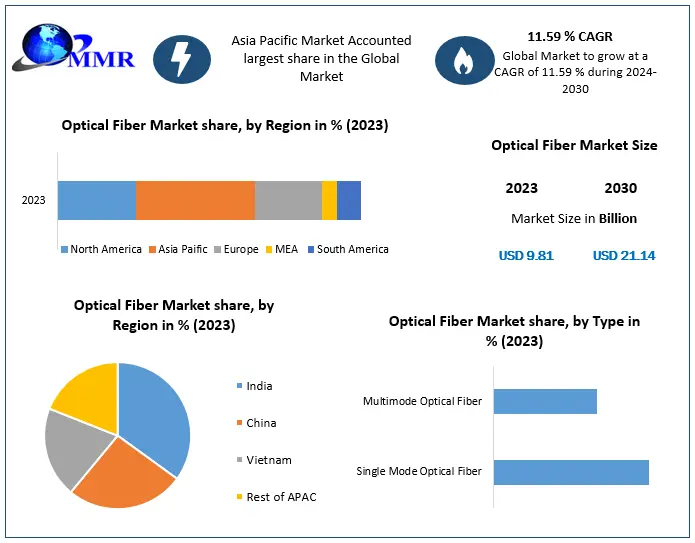 To know about the Research Methodology :- Request Free Sample Report
Optical Fiber Market Dynamics
Rising Demand for High-Speed Internet to boost Optical Fiber Market growth
With the proliferation of bandwidth-intensive applications such as video streaming, online gaming, and cloud computing, consumers and businesses alike require faster and more reliable internet connections, which significantly boost the Optical Fiber Market growth. Optical fibers enable the transmission of large volumes of data at high speeds over long distances, making them essential for meeting the increasing bandwidth requirements of modern communication networks. The rollout of 5G wireless networks is driving demand for optical fibers as they form the backbone infrastructure for delivering high-speed, low-latency connectivity required by 5G technologies. Optical fibers are used to connect 5G base stations to the core network, enabling the efficient transmission of data between mobile devices and network servers. As 5G adoption continues to expand globally, the demand for optical fiber-based solutions is expected to grow significantly. The rapid growth of cloud computing, big data analytics, and IoT applications is fueling the expansion of data centers worldwide. Optical fibers play a crucial role in data center connectivity, providing high-speed interconnections between servers, storage systems, and networking equipment. As data center operators strive to enhance performance, scalability, and reliability, they are investing in fiber optic infrastructure to support the increasing volume of data traffic and ensure seamless connectivity.
Many governments are implementing initiatives to improve broadband connectivity and digital infrastructure as part of their economic development strategies. These initiatives often involve the deployment of fiber optic networks in urban and rural areas to expand internet access and support digital transformation across various sectors. Government investments in fiber optic infrastructure projects stimulate Optical Fiber market growth by creating opportunities for optical fiber manufacturers, network operators, and technology providers to supply products and services for broadband expansion projects. Ongoing advancements in optical fiber technology drive Optical Fiber market growth by improving fiber optic performance, reliability, and cost-effectiveness. Innovations such as bend-insensitive fibers, low-loss fibers, and hollow-core fibers enable new applications and address challenges related to installation, maintenance, and signal transmission. Research and development efforts focused on enhancing optical fiber materials, manufacturing processes, and signal processing techniques contribute to the development of next-generation fiber optic solutions with higher bandwidth, lower latency, and improved signal quality.
High Installation Costs to limit Optical Fiber Market growth
The adoption of optical fiber networks is the high upfront installation costs. Deploying fiber optic infrastructure requires significant investment in materials, labor, and equipment for laying cables, splicing fibers, and installing network components. The initial capital expenditure associated with fiber optic deployment is prohibitive for some organizations, especially in areas with challenging terrain or limited resources, which is expected to limit the Optical Fiber market growth. Installing optical fiber networks is complex and time-consuming, particularly in urban areas with existing infrastructure and underground utilities. The process involves trenching, boring, and laying cables, which require coordination with local authorities, property owners, and utility companies. Delays and disruptions during the installation process increase project costs and extend deployment timelines, posing challenges for network operators and service providers.
Despite advancements in optical fiber technology, there are still limitations and challenges that need to be addressed. For example, signal attenuation and dispersion affect the performance of fiber optic networks over long distances, requiring amplification and signal regeneration to maintain signal integrity. Fiber optic cables are susceptible to damage from environmental factors such as moisture, temperature fluctuations, and physical stress, which degrade signal quality and reliability, which is expected to restrain Optical Fiber Market growth. While optical fiber offers high-speed, high-bandwidth connectivity, it faces competition from alternative technologies such as wireless broadband, satellite internet, and traditional copper-based networks. These alternative solutions offer cost advantages, easier deployment, or greater flexibility in certain scenarios, posing a competitive threat to optical fiber providers. Advancements in wireless technologies such as 5G and Wi-Fi 6 are expanding the range of options for broadband connectivity, creating additional competition for optical fiber networks.
Optical Fiber Market Segment Analysis
Based on Type, the market is segmented into Single Mode Optical Fiber and Multimode Optical Fiber. Single Mode Optical Fiber segment dominated the market in 2023 and is expected to hold the largest Optical Fiber Market share over the forecast period. Single mode optical fibers have a smaller core diameter compared to multimode fibers, typically around 8 to 10 microns. This small core size allows for the transmission of a single mode of light, resulting in lower signal dispersion and higher bandwidth efficiency. Single mode fibers exhibit low dispersion and attenuation, which means that light signals travel long distances with minimal distortion or loss of signal strength. This characteristic makes single mode fibers ideal for long-haul telecommunications applications, such as intercity and transoceanic communication links.
Single mode fibers are typically used with laser-based transmission systems, where light signals are generated and modulated using semiconductor lasers. The coherent nature of laser light allows for precise control of the optical signal, enabling high-speed data transmission and dense wavelength division multiplexing (DWDM) for increasing the capacity of optical networks, which is expected to boost the Optical Fiber Market growth. Single mode optical fibers are widely used in telecommunications networks for both terrestrial and submarine communication links. They provide the backbone infrastructure for long-distance voice, data, and video transmission, connecting cities, countries, and continents through high-capacity fiber optic cables.
Based on the End-Use Industry, the market is segmented into Telecom & IT, Public Sector, Healthcare, Energy & Utilities, Aerospace & Defense, Manufacturing, and Others. Telecom & IT segment dominated the market in 2023 and is expected to hold the largest Optical Fiber Market share over the forecast period. Fiber optic technology is extensively used in telecommunications networks for transmitting voice, data, and video signals over long distances with high speed and reliability. Optical fibers serve as the backbone infrastructure for telecommunication networks, connecting central offices, switching centers, and data hubs. Telecom operators deploy optical fiber cables for various applications, including long-haul, metro, and access networks, to deliver broadband internet, mobile services, and other communication services to residential, commercial, and industrial customers.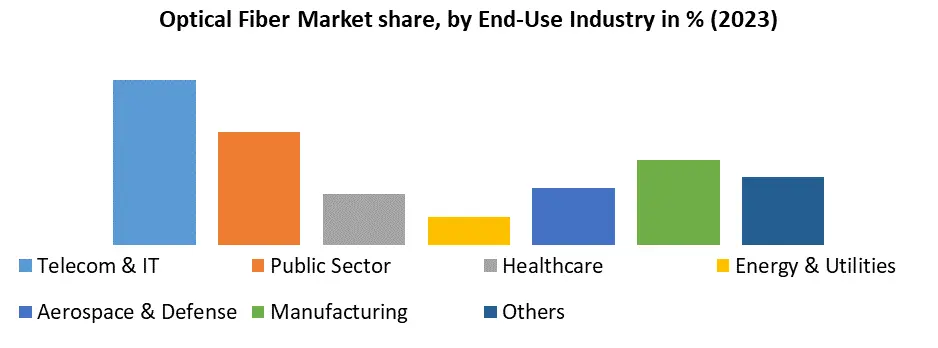 Fiber optic technology plays a crucial role in data centers for interconnecting servers, storage systems, and networking equipment. Optical fibers provide high-speed, low-latency connectivity within data centers, supporting the transmission of large volumes of data between servers and enabling real-time access to cloud services and applications. Data center operators deploy fiber optic links for network backbone, storage area networks (SANs), and high-performance computing (HPC) clusters to meet the growing demand for scalable and reliable data processing and storage infrastructure.
Optical Fiber Market Regional Insight
Government Investments in Broadband Infrastructure to boost Asia Pacific Optical Fiber Market growth
Many governments in the Asia Pacific region are investing heavily in the development of broadband infrastructure as part of their economic development agendas. These investments aim to improve internet access, bridge the digital divide between urban and rural areas, and support the growth of digital economies. Government-led initiatives such as China's Broadband China strategy, India's BharatNet program, and Australia's National Broadband Network (NBN) are driving the deployment of fiber optic networks and stimulating demand for optical fiber cables, components, and equipment, which significantly boosts the Optical Fiber market growth. The deployment of 5G wireless networks is accelerating in the Asia Pacific region, driven by the increasing demand for high-speed mobile broadband services, IoT applications, and emerging technologies such as autonomous vehicles and smart cities. Optical fiber infrastructure is essential for 5G deployment as it provides the high-capacity backhaul and fronthaul connections needed to support the ultra-low latency and high bandwidth requirements of 5G networks. As 5G adoption continues to expand, the demand for optical fiber solutions for backhaul and fronthaul connectivity is expected to grow significantly.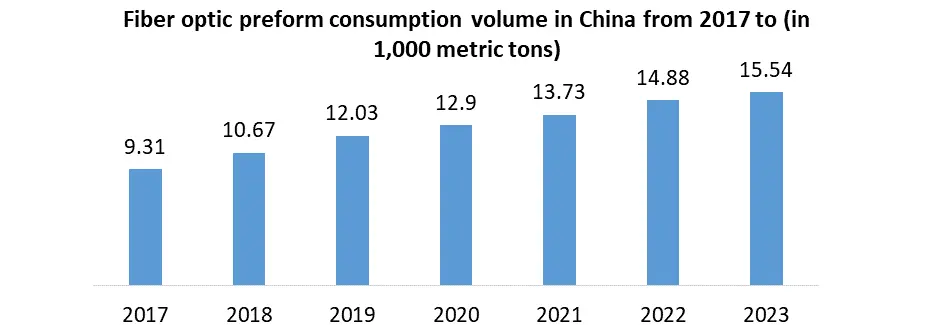 The Asia Pacific region is experiencing rapid growth in data center construction and expansion, fueled by the increasing adoption of cloud computing, big data analytics, and digital services. Optical fibers are critical for connecting data centers to support high-speed data transmission, interconnection between cloud providers, and access to cloud services for businesses and consumers. As hyperscale cloud providers, colocation companies, and enterprises continue to invest in data center infrastructure, the demand for optical fiber connectivity solutions is expected to rise. Emerging Optical Fiber markets in the Asia Pacific region, such as Southeast Asia, Vietnam, and Bangladesh, are witnessing a surge in infrastructure development projects, including the construction of new roads, railways, airports, and smart cities. Optical fiber networks are integral to these infrastructure projects, providing essential connectivity for transportation systems, surveillance cameras, smart grids, and public services. The growing urbanization and industrialization in emerging markets are driving demand for optical fiber solutions to support digital transformation and sustainable development initiatives.
Optical Fiber Market Market Scope: Inquiry Before Buying
| Optical Fiber Market | |||
|---|---|---|---|
| Report Coverage | Details | ||
| Base Year: | 2023 | Forecast Period: | 2024-2030 |
| Historical Data: | 2018 to 2023 | Market Size in 2023: | US $ 9.81 Bn. |
| Forecast Period 2024 to 2030 CAGR: | 11.59% | Market Size in 2030: | US $ 21.14 Bn. |
| Segments Covered: | by Type | Single Mode Optical Fiber Multimode Optical Fiber |
|
| by End-Use Industry | Telecom & IT Public Sector Healthcare Energy & Utilities Aerospace & Defense Manufacturing Others |
||
Optical Fiber Market by Region
North America (United States, Canada and Mexico)
Europe (UK, France, Germany, Italy, Spain, Sweden, Austria and Rest of Europe)
Asia Pacific (China, South Korea, Japan, India, Australia, Indonesia, Malaysia, Vietnam, Taiwan, and Rest of APAC)
Middle East and Africa (South Africa, GCC, Egypt, Nigeria and Rest of ME&A)
South America (Brazil, Argentina Rest of South America)
North America:
1. Corning Incorporated : Corning, New York, USA
2. OFS Fitel, LLC : Norcross, Georgia, USA
3. CommScope : Hickory, North Carolina, USA
4. AFL : Spartanburg, South Carolina, USA
5. Finisar Corporation : Sunnyvale, California, USA
Europe:
6. Prysmian Group : Milan, Italy
7. Nexans : Paris, France
8. Draka Communications : Amsterdam, Netherlands
9. Leoni AG : Nuremberg, Germany
10. Emtelle : Hawick, Scotland, UK
11. Alcatel-Lucent (Nokia Networks) : Espoo, Finland
Asia Pacific:
12. Fujikura Ltd. : Tokyo, Japan
13. Sumitomo Electric Industries : Osaka, Japan
14. Sterlite Technologies Limited : Pune, India
15. YOFC (Yangtze Optical Fibre and Cable) : Wuhan, China
16. Tongding Interconnection Information Co., Ltd. : Beijing, China
17. LS Cable & System : Anyang, South Korea
18. Furukawa Electric Co., Ltd. : Tokyo, Japan
Frequently asked Questions:
1. What is optical fiber?
Ans: Optical fiber is a flexible, transparent fiber made of high-quality glass or plastic used to transmit light between two ends. It's widely used in telecommunications and computer networking for high-speed data transmission over long distances.
2. What are the drivers of the optical fiber market?
Ans: The optical fiber market is driven by the rising demand for high-speed internet, the rollout of 5G networks, growth in data centers, government investments in broadband infrastructure, and technological advancements in fiber optic technology.
3. What are the challenges facing the optical fiber market?
Ans: Challenges in the optical fiber market include high installation costs, complex installation processes, technological limitations, competition from alternative technologies, and regulatory hurdles.
4. Which industries dominate the optical fiber market?
Ans: The telecommunications and IT industries are the largest consumers of optical fibers, followed by the public sector, healthcare, energy & utilities, aerospace & defense, manufacturing, and others.
5. What are the regional insights into the optical fiber market?
Ans: Government investments in broadband infrastructure are boosting the Asia Pacific market, while the rollout of 5G networks and data center growth are driving demand in North America and Europe. Emerging markets in Latin America and the Middle East & Africa are witnessing infrastructure development projects fueling market growth.