
Off-grid Solar PV Panels Market Size – Industry Structure Evaluation, Demand Drivers Analysis, Regional Growth Analysis and Identification, Competitive Positioning Review & Global Market Size Forecast to 2034
Overview
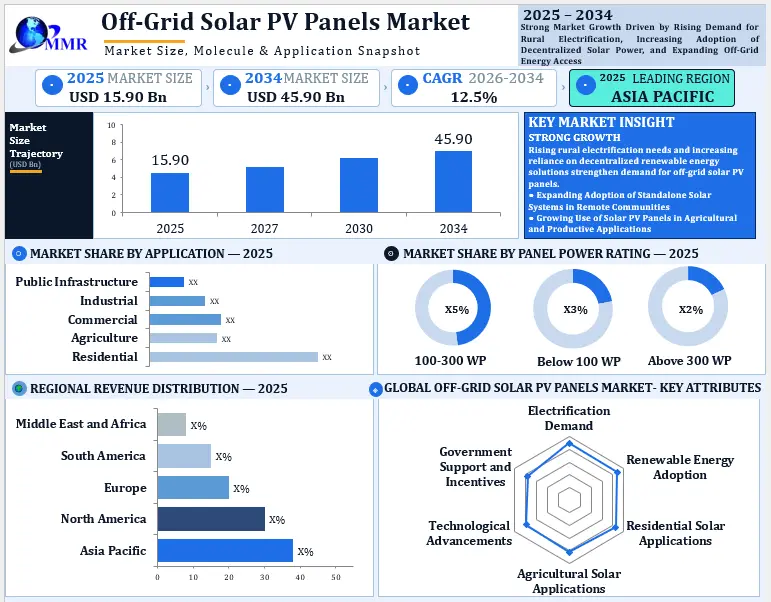
The Global Off-Grid Solar PV Panels Market size was valued at USD 15.90 Billion in 2025 and the total Off-Grid Solar PV Panels revenue is expected to grow at a CAGR of 12.5% from 2026 to 2034, approaching to USD 45.90 Billion.
Global Off-Grid Solar PV Panels Market Overview:
The increasing number of PV panel manufacturing companies along with growing off-grid solar PV panel’s capacities is anticipated to drive the market growth towards the north. Tax paybacks & subsidies offered by the governments towards the installation of off-grid solar PV panels along with rent profits offered to the reservoir owners are anticipated to push market growth. Sufficient availability of water resources like rivers, canals, reservoirs, & ponds is estimated to have a positive influence on the total market development. Dam-reservoir used for hydroelectric power generation can be simply used for off-grid solar power as the infrastructure used for electricity generation & transportation is already developed. The less dusty & dry environment along water reservoirs positively affect the PV cell working productivity.
Low maintenance & management cost incurred for installing off-grid solar PV panel is also anticipated to increase product demand during the forecast period. Off-grid solar PV panels can be simply adjusted as per the place of the sun to harness maximum energy & output. Off-grid solar PV panel also supports in endorsing self-sustaining infrastructure, particularly in remote areas. Off-grid solar PV panels deliver higher efficiency along with maintaining a constant temperature of silicon panels, therefore maintaining the output level.
Global Off-Grid Solar PV Panels Market Growth Outlook
To know about the Research Methodology :- Request Free Sample Report
Global Off-grid Solar PV Panels Market – Key Highlights
• The global off-grid solar PV panels market is valued at USD 15.90 billion in 2025 and reaches USD 45.90 billion by 2034, registering a CAGR of 12.5% during 2026–2034.
• Asia Pacific dominates the market due to rural electrification initiatives and increasing adoption of decentralized solar energy solutions.
• Monocrystalline silicon panels gain demand through high conversion efficiency, compact designs, and suitability for standalone installations.
• Growing applications in residential electrification, solar-powered agriculture, telecommunications, and public infrastructure support market expansion.
• Leading companies, including LONGi, JinkoSolar, Trina Solar, JA Solar, and Canadian Solar, compete through advanced photovoltaic technologies, product reliability, and manufacturing capabilities.
Global Off-grid Solar PV Panels Market Dynamics
Global Off-grid Solar PV Panels Market Drivers
Growing Demand for Rural Electrification: Increasing demand for reliable electricity in remote and underserved communities drives the adoption of off-grid solar PV panels. According to the MMR, off-grid solar represents the least-cost electricity solution for 398 million people without access to electricity, creating significant demand for standalone solar installations.
Rising Adoption of Solar-Powered Agricultural Equipment: Growing use of solar-powered irrigation and water pumping systems supports demand for off-grid photovoltaic panels. In India, more than 9.42 lakh standalone solar agricultural pumps operate under the PM-KUSUM scheme as of November 2025, demonstrating the increasing adoption of standalone solar applications in agriculture.
Global Off-grid Solar PV Panels Market Restraints
High Initial Installation Costs: The upfront cost of solar panels, batteries, inverters, and installation limits adoption among low-income households and small businesses. The MMR reports that only one-third of households without electricity can afford an entry-level solar home system through pay-as-you-go financing, highlighting affordability constraints.
Dependence on Battery Storage: Off-grid solar installations require battery storage to maintain electricity availability during nighttime and periods of low sunlight. Battery replacement expenses, storage limitations, and maintenance requirements increase the overall ownership cost and restrict adoption among price-sensitive consumers.
Global Off-grid Solar PV Panels Market Opportunities
Expansion Across Emerging Economies: Limited grid infrastructure and increasing electricity requirements create opportunities for off-grid solar PV panel manufacturers across Africa, Asia Pacific, and South America. The MMR Identifies, 398 million people for whom off-grid solar represents the least-cost electricity access solution, creating substantial opportunities for standalone solar deployment.
Growing Demand for Productive-Use Solar Applications: Increasing deployment of solar-powered irrigation pumps, refrigeration systems, telecommunications infrastructure, and rural businesses creates opportunities beyond household electrification. These applications encourage demand for higher-capacity and more efficient photovoltaic panels.
Global Off-grid Solar PV Panels Market Challenges
Limited Financing and Investment Access: Insufficient access to affordable credit, subsidies, and working capital creates challenges for manufacturers, distributors, and consumers. The MMR estimates that USD 11.4 billion in investment is required between 2027 and 2030 to reach the populations for whom off-grid solar represents the least-cost electricity solution.
Maintenance and Distribution Infrastructure: Remote installations require dependable distribution networks, trained technicians, replacement components, and after-sales services. Limited-service availability and transportation difficulties increase maintenance costs and affect the long-term reliability of off-grid solar installations.
Global Off-grid Solar PV Panels Market, Latest Market Trends
• Increasing Adoption of Solar Home Systems: Off-grid solar increasingly supports household electricity requirements beyond basic lighting. The MMR reports that affiliate off-grid solar products serve 149 million people in 2025, representing a 26% increase from 2023. This expansion supports demand for photovoltaic panels used in standalone residential systems.
• Growth of Pay-As-You-Go Financing: Solar companies increasingly use pay-as-you-go (PAYGo) models to reduce upfront installation costs and improve access among low-income consumers. GOGLA reports a 48% increase in PAYGo sales in 2025, highlighting the growing importance of flexible financing in off-grid solar adoption.
• Focus on Module Efficiency and Durability: Manufacturers increasingly focus on high-efficiency photovoltaic modules, improved weather resistance, and longer operating life to enhance standalone system performance. The MMR reports that 95% of surveyed customers indicate that their solar home systems remain functional for four or more years, reinforcing the importance of product reliability.
Global Off-grid Solar PV Panels Market Segment Analysis
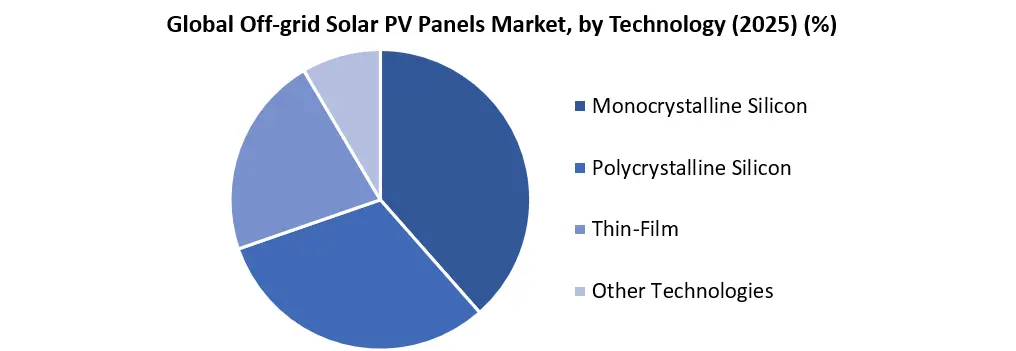
By Technology, the market is segmented into Monocrystalline Silicon, Polycrystalline Silicon, Thin-Film, and Other Technologies. Monocrystalline silicon panels gain demand due to their high conversion efficiency, compact design, and suitability for installations with limited space. Polycrystalline silicon panels serve cost-conscious consumers seeking reliable electricity generation for standalone applications. Thin-film panels offer lightweight and flexible configurations for specialized installations, while other technologies address specific performance and application requirements.
By Application, the market is segmented into Residential, Agriculture, Commercial, Industrial, and Public Infrastructure. Residential applications generate demand through standalone household electricity systems, particularly in rural and remote locations. Agriculture represents an important application through solar-powered irrigation, water pumping, and farm operations. Commercial installations support shops, offices, and small businesses, while industrial applications use off-grid solar panels to supply electricity to remote facilities and operational sites. Public infrastructure includes healthcare centres, educational institutions, street lighting, and community facilities that require reliable electricity without conventional grid connectivity.
By Sales Channel, the market is segmented into Direct Sales, Distributors and Dealers, and Online Sales. Direct sales support large-scale installations and institutional projects through direct transactions between manufacturers and project developers or end users. Distributors and dealers strengthen market penetration by supplying panels to regional installers, retailers, and local solar businesses. Online sales provide customers with access to different panel products, specifications, and pricing, supporting purchases by residential consumers and small-scale installers.
Global Off-grid Solar PV Panels Market Regional Insights
Asia Pacific dominates the global off-grid solar PV panels market, supported by expanding rural electrification programs, rising demand for decentralized electricity, and increasing adoption of standalone solar power systems across developing economies. Countries such as India, Bangladesh, Indonesia, and the Philippines promote off-grid solar installations to improve electricity access in remote villages, agricultural communities, and island regions. Government initiatives, renewable energy targets, and growing applications in solar-powered irrigation, rural households, telecommunications, and public infrastructure support regional demand for off-grid photovoltaic panels. India’s expanding solar pumping and decentralized renewable energy programs further strengthen the region’s market potential.
North America experiences demand for off-grid solar PV panels through remote residential properties, telecommunications infrastructure, recreational facilities, and industrial installations. The United States and Canada use standalone solar systems in remote locations where grid extension is costly or impractical. Growing interest in energy independence, backup electricity, and renewable power solutions supports the adoption of high-efficiency photovoltaic panels. The market also benefits from demand for off-grid systems in remote monitoring, rural infrastructure, and selected agricultural applications.
Europe demonstrates steady adoption of off-grid solar PV panels across remote homes, rural properties, telecommunications sites, and isolated infrastructure. Countries with remote settlements and island communities use standalone photovoltaic installations to reduce dependence on conventional electricity networks and diesel-based power generation. Increasing emphasis on renewable energy integration, energy resilience, and sustainable power generation supports demand for durable and efficient solar panels. Off-grid applications also gain relevance in mobile facilities, remote industrial sites, and rural electrification projects.
South America experiences growing demand for off-grid solar PV panels across remote communities, agricultural regions, and geographically isolated locations. Countries such as Brazil, Peru, Colombia, and Chile use decentralized solar energy solutions to improve electricity access in rural and off-grid areas. Solar-powered water pumping, remote telecommunications, community facilities, and standalone residential systems support market development. The region's abundant solar resources and continued focus on renewable energy adoption create opportunities for off-grid photovoltaic panel deployment.
Middle East and Africa with Africa discussed separately above—has additional demand across the Middle East, particularly in remote desert settlements, isolated industrial facilities, telecommunications infrastructure, and rural communities. High solar irradiation levels support photovoltaic power generation, while off-grid installations provide electricity in locations with limited grid connectivity. Growing interest in energy diversification and reliable decentralized electricity creates opportunities for standalone solar PV panels across the region.
Global Off-grid Solar PV Panels Market Competitive Landscape
The global off-grid solar PV panels market is competitive, with established photovoltaic manufacturers, specialized solar suppliers, and regional players focusing on panel efficiency, durability, pricing, product quality, and distribution networks.
Leading companies such as LONGi Green Energy, JinkoSolar, Trina Solar, JA Solar, and Canadian Solar strengthen their positions through advanced photovoltaic technologies, high-efficiency modules, and large-scale manufacturing capabilities. Regional manufacturers, including Waaree Energies, Vikram Solar, and Adani Solar, support market growth through domestic production and distribution networks, particularly across emerging economies.
Specialized suppliers such as Renogy target residential, recreational, and remote installations with portable solar panels and off-grid solutions. Companies such as d.light, M-KOPA, and Greenlight Planet contribute to the broader off-grid solar ecosystem through solar home systems and decentralized energy services.
Overall, competition emphasizes high-efficiency solar modules, affordable pricing, product reliability, and regional distribution. However, company-specific market shares for the standalone off-grid solar PV panel segment remain insufficiently established.
Competitive Positioning of Key Companies
| Company | Key Competitive Focus |
| LONGi Green Energy | High-efficiency monocrystalline solar modules |
| JinkoSolar | Advanced photovoltaic cell and module technologies |
| Trina Solar | High-performance solar modules and global distribution |
| JA Solar | Monocrystalline and advanced cell technology modules |
| Canadian Solar | Broad solar module portfolio and international presence |
| Waaree Energies | Diverse solar module portfolio and domestic manufacturing |
| Vikram Solar | High-efficiency photovoltaic modules |
| Adani Solar | Integrated solar manufacturing capabilities |
| Renogy | Portable panels and off-grid solar products |
Recent Developments in the Global Off-grid Solar PV Panels Market
| Date | Company | Development | Impact |
| 22 January 2026 | LONGi | Introduces the Hi-MO X10 Anti-Dust Pro solar module, designed for dust-prone environments. | Improves energy generation and reduces maintenance requirements in remote and arid installations. |
| 3 June 2026 | JinkoSolar | Unveils its next-generation Tiger Neo 5.0 TOPCon modules with power output reaching 700 W and module efficiency of 25.91%. | Strengthens high-efficiency module technology and supports applications requiring higher power output. |
| 12 June 2026 | Renogy | Launches its N-Type Bifacial Solar Panel Series in 100 W, 200 W, and 400 W configurations. | Expands panel options for residential, mobile, and standalone off-grid solar installations. |
| 15 June 2026 | LONGi | Reports that its Back Contact technology surpasses 60 GW in cumulative commercial sales and shipments. | Highlights growing commercialization of advanced, high-efficiency photovoltaic modules. |
| 11 June 2026 | Trinasolar | Launches the Vertex N Shield module in North America, focusing on improved reliability and performance. | Strengthens its advanced module portfolio for demanding installation environments. |
Global Off-grid Solar PV Panels Market Scope: Inquire before buying
| Off-grid Solar PV Panels Market | |||
|---|---|---|---|
| Report Coverage | Details | ||
| Base Year: | 2025 | Forecast Period: | 2026-2034 |
| Historical Data: | 2020 to 2025 | Market Size in 2025: | USD 15.9 Billion |
| Forecast Period 2026 to 2034 CAGR: | 12.5% | Market Size in 2034: | USD 45.9 Billion |
| Segments Covered: | by Technology | Monocrystalline Silicon Polycrystalline Silicon Thin-Film Other Technologies |
|
| by Panel Power Rating | Below 100 Wp 100–300 Wp Above 300 Wp |
||
| by Application | Residential Agriculture Commercial Industrial Public Infrastructure |
||
| by Sales Channel | Direct Sales Distributors and Dealers Online Sales |
||
Global Off-grid Solar PV Panels Market, by Region
North America (United States, Canada and Mexico)
Europe (UK, France, Germany, Italy, Spain, Sweden, Austria, Turkey, Russia and Rest of Europe)
Asia Pacific (China, India, Japan, South Korea, Australia, ASEAN and Rest of APAC)
Middle East and Africa (South Africa, GCC, Egypt, Nigeria and Rest of ME&A)
South America (Brazil, Argentina, Columbia and Rest of South America)
Global Off-grid Solar PV Panels Market, Key Players are
1. Canadian Solar
2. Yingli Solar
3. JinkoSolar Holding Co. Ltd.
4. LONGi Green Energy Technology
5. Trina Solar
6. JA Solar Technology Co. Ltd.
7. Hanwha Qcells
8. First Solar
9. Maxeon Solar Technologies
10. Renogy
11. Waaree Energies
12. Vikram Solar
13. Adani Solar
14. Premier Energies
15. Emmvee Photovoltaic Power
16. Goldi Solar
17. Saatvik Green Energy
18. RenewSys India
19. Solex Energy
20. Loom Solar
21. Boviet Solar
22. AE Solar
23. Astronergy
24. Risen Energy
25. Talesun Solar
26. DAS Solar
27. DMEGC Solar
28. Aiko Solar
29. GCL System Integration
30. VSUN Solar
31. Heliene
32. Silfab Solar
33. Mission Solar Energy
34. SEG Solar
35. FuturaSun
36. BISOL Group
37. Solarwatt
38. Luxor Solar
39. AXITEC Energy
40. OffgridSun
Frequently Asked Questions:
1. What is the global off-grid solar PV panels market size in 2025?
Ans. The market reaches USD 15.90 billion in 2025.
2. What is the expected market size by 2034?
Ans. The market is projected to reach USD 45.90 billion by 2034.
3. What is the CAGR of the global off-grid solar PV panels market?
Ans. The market registers a CAGR of 12.5% during the forecast period 2026–2034.
4. Which region dominates the off-grid solar PV panels market?
Ans. Asia Pacific dominates the market due to increasing rural electrification and decentralized solar energy adoption.
5. What are the key applications of off-grid solar PV panels?
Ans. Major applications include residential electricity, agricultural irrigation, commercial facilities, industrial operations, and public infrastructure.