
Nuclear Response Robot Market Size – Industry Structure Evaluation, Demand Drivers Analysis, Regional Growth Analysis and Identification, Competitive Positioning Review & Global Market Size Forecast to 2032
Overview
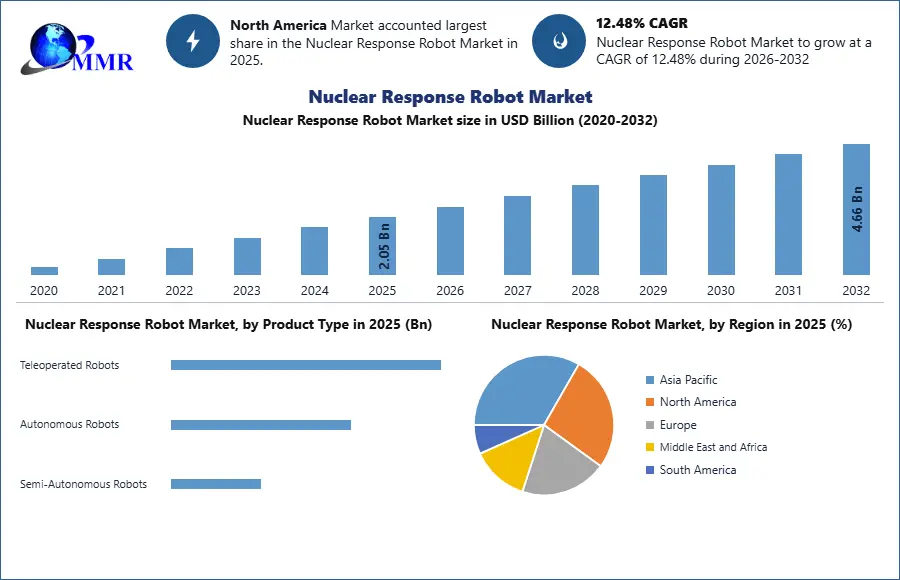
Nuclear Response Robot Market was valued at USD 2.05 Bn. in 2025, and total global Nuclear Response Robot Market revenue is expected to grow at a CAGR of 12.48% from 2026 to 2032, reaching nearly USD 4.66 Bn. Rising Nuclear Safety Concerns
The global Nuclear Response Robot market report is a comprehensive analysis of the industry, market, and key players. The report has covered the market by demand and supply-side by segments. The global Nuclear Response Robot report also provides trends by market segments, technology, and investment with a competitive landscape.
Overview of Nuclear Response Robot:
The Global Nuclear Response Robot Market is witnessing substantial growth due to increasing concerns regarding nuclear safety, radioactive hazard management, and emergency response preparedness across nuclear power plants and defense sectors. Nuclear response robots are specialized robotic systems designed to operate in highly hazardous and radioactive environments where direct human intervention can pose severe health risks. These robots are increasingly being utilized for radiation detection, remote inspection, decontamination, nuclear facility maintenance, bomb disposal, and disaster response operations. Governments and energy organizations worldwide are investing heavily in advanced robotic technologies to strengthen operational safety and reduce human exposure to radiation during critical nuclear operations.
Technological advancements in artificial intelligence (AI), autonomous mobility, thermal imaging, remote sensing, and machine learning are significantly improving the capabilities of nuclear response robots. The increasing modernization of aging nuclear infrastructure and rising focus on nuclear decommissioning projects are also creating strong market demand. In addition, growing defense expenditure, strict nuclear safety regulations, and expansion of nuclear energy projects are further accelerating market growth globally. North America currently dominates the market due to high investment in nuclear safety technologies, while Asia-Pacific is emerging rapidly because of increasing industrial automation and nuclear energy development initiatives.
 To know about the Research Methodology :- Request Free Sample Report
Global Nuclear Response Robot Market Dynamics:
Rising Demand for Nuclear Safety and Hazardous Environment Automation
The increasing global focus on nuclear safety, radiation risk reduction, and hazardous environment management is a major driver for the Nuclear Response Robot Market. Governments, defense agencies, and nuclear power operators are rapidly adopting robotic systems to improve safety standards and reduce human exposure to radioactive environments. Nuclear response robots are capable of performing critical operations such as radiation monitoring, remote surveillance, nuclear facility inspection, hazardous material handling, and emergency response tasks in areas unsafe for human workers. The growing number of aging nuclear power plants worldwide is also creating demand for robotic inspection and maintenance systems capable of operating in high-radiation conditions.
Technological advancements in AI-powered robotics, autonomous navigation, thermal imaging, and remote-control technologies are improving operational efficiency and enabling robots to function more accurately in hazardous environments. In addition, increasing concerns regarding nuclear accidents, radioactive waste management, and disaster preparedness are encouraging governments and industrial operators to invest in advanced nuclear robotics systems. The expansion of nuclear energy infrastructure and rising defense spending on unmanned robotic technologies continue to support long-term market growth globally.
High Development Costs and Complex Technical Requirements
The Nuclear Response Robot Market faces significant challenges due to the high development, deployment, and maintenance costs associated with advanced nuclear robotic systems. These robots are specifically engineered to withstand extreme radiation exposure, hazardous environments, and difficult operational conditions, requiring the use of specialized radiation-resistant materials, durable sensors, high-performance processors, and secure communication systems. The integration of AI, autonomous navigation, thermal imaging, and remote-control technologies further increases manufacturing complexity and overall system costs. As a result, many small nuclear facilities and developing countries face budget limitations in adopting advanced nuclear robotics solutions.
In addition, maintaining reliable robotic performance in high-radiation environments remains technically challenging, as radiation exposure can affect electronic components and operational stability. Strict nuclear safety regulations and compliance requirements also increase the complexity of product development and deployment. Limited technical expertise, cybersecurity concerns, and integration challenges with existing nuclear infrastructure may further restrain market growth. Furthermore, high research and development expenses and long product testing cycles continue to create barriers for new market entrants and smaller robotics manufacturers operating in the industry.
Advancements in AI, Autonomous Robotics, and Nuclear Decommissioning Projects
Rapid advancements in artificial intelligence (AI), autonomous robotics, and smart inspection technologies are creating significant growth opportunities in the Global Nuclear Response Robot Market. AI-powered nuclear robots are increasingly capable of performing autonomous navigation, radiation mapping, predictive diagnostics, remote surveillance, and hazardous material handling with improved efficiency and precision. The integration of machine learning, IoT-enabled sensors, cloud computing, and real-time analytics is enabling robotic systems to make faster operational decisions in highly dangerous nuclear environments. These technological innovations are improving the effectiveness of emergency response operations and nuclear facility inspections.
In addition, the growing number of nuclear decommissioning projects worldwide is creating strong demand for advanced robotic systems capable of handling radioactive waste, dismantling hazardous infrastructure, and conducting remote maintenance operations. Governments and nuclear energy companies are investing heavily in robotic automation to improve safety and reduce operational risks during decommissioning activities. The increasing expansion of smart nuclear facilities, rising defense investments in unmanned robotic systems, and development of next-generation autonomous response robots are expected to further accelerate market growth opportunities over the coming years.
Global Nuclear Response Robot Market Segment Analysis
Teleoperated robots dominate the Global Nuclear Response Robot Market due to their high reliability, precision control, and strong operational safety in hazardous radioactive environments. These robots are remotely controlled by operators, allowing critical tasks to be performed from safe distances without exposing human workers to harmful radiation. Nuclear facilities, defense agencies, and emergency response teams widely use teleoperated robots for radiation detection, nuclear inspection, hazardous material handling, bomb disposal, and disaster response operations. Their ability to provide real-time human decision-making makes them highly effective in unpredictable and high-risk nuclear environments where fully autonomous systems may face operational limitations.
The increasing focus on nuclear safety regulations, emergency preparedness, and radioactive waste management is significantly driving demand for teleoperated robotic systems. Advanced features such as thermal imaging cameras, radiation-resistant sensors, robotic manipulation arms, and secure wireless communication technologies are further supporting market growth. In addition, rising investments in nuclear infrastructure modernization and defense robotics continue to strengthen the dominance of teleoperated robots globally.

Global Nuclear Response Robot Market Regional Insights:
North America dominates the Global Nuclear Response Robot Market due to strong investments in nuclear safety infrastructure, advanced defense technologies, and hazardous environment robotics systems. The United States represents the largest regional market because of increasing deployment of nuclear inspection robots, radiation monitoring systems, and autonomous emergency response technologies across nuclear power plants and defense facilities. Government agencies and defense organizations are continuously investing in robotic systems capable of operating in radioactive environments to improve operational safety and disaster preparedness. The presence of leading robotics companies and strong research and development activities further strengthen regional market growth.
The region also benefits from strict nuclear safety regulations, modernization of aging nuclear infrastructure, and rising investments in AI-powered robotics and autonomous systems. Canada is increasingly adopting robotic inspection and remote maintenance technologies for nuclear power facilities to reduce worker exposure to radiation. Furthermore, the growing focus on national security, industrial automation, and emergency response preparedness is supporting continued demand for nuclear response robots across North America. Strong technological infrastructure and increasing adoption of unmanned robotic systems continue to reinforce the region’s market leadership position globally.
Global Nuclear Response Robot Market Recent Development:
Global Nuclear Response Robot Market Scope: Inquire before buying
| Nuclear Response Robot Market | |||
|---|---|---|---|
| Report Coverage | Details | ||
| Base Year: | 2025 | Forecast Period: | 2026-2032 |
| Historical Data: | 2020 to 2025 | Market Size in 2025: | 2.05 USD Billion |
| Forecast Period 2026-2032 CAGR: | 12.48% | Market Size in 2032: | 4.66 USD Billion |
| Segments Covered: | by Product Type | Teleoperated Robots Autonomous Robots Semi-Autonomous Robots |
|
| by Material Type | Tracked Robots Wheeled Robots Legged Robots Hybrid Robots |
||
| by Application | Radiation Detection and Monitoring Search and Rescue Operations Hazardous Material Handling Reconnaissance and Surveillance Decontamination Tasks Remote Inspection |
||
| by End-User | Defense and Military Nuclear Power Plants Emergency Services Government Agencies Research Institutions |
||
Global Nuclear Response Robot Market, By Region
North America (United States, Canada and Mexico)
Europe (UK, France, Germany, Italy, Spain, Sweden, Austria and the Rest of Europe)
Asia Pacific (China, South Korea, Japan, India, Australia, Indonesia, Malaysia, Vietnam, Taiwan, Bangladesh, Pakistan and the Rest of APAC)
South America (Brazil, Argentina Rest of South America)
Middle East & Africa (South Africa, GCC, Egypt, Nigeria and the Rest of ME&A)
Global Nuclear Response Robot Market, Key Players are
- iRobot Corporation
- QinetiQ Group plc
- FLIR Systems
- Boston Dynamics
- KUKA AG
- Fukushima SiC Applied Engineering Inc.
- Hitachi Ltd.
- Toshiba Corporation
- Mitsubishi Heavy Industries
- Honeybee Robotics
- Northrop Grumman Corporation
- Lockheed Martin Corporation
- General Dynamics Corporation
- Sarcos Technology and Robotics Corporation
- ECA Group
- Endeavor Robotics
- Brokk AB
- Clearpath Robotics
- SuperDroid Robots
- Robosoft Systems
- Caterpillar Inc.
- ABB Ltd.
- FANUC Corporation
- Yaskawa Electric Corporation
- Doosan Robotics
- Teradyne Inc.
- Cybernet Systems Corporation
- AeroVironment Inc.
- Teledyne Technologies
- BAE Systems plc