Nitrogenous Fertilizers Market Size by Type, Crop, Form, Region – Revenue Pool Analysis, Margin Structure Assessment, Capital Flow Trends, Competitive Benchmarking & Forecast to 2032

5.7%
CAGR (2025-2032)
67.54 USD Bn.
Market Size
330
Report Pages
135
Market Tables

Overview

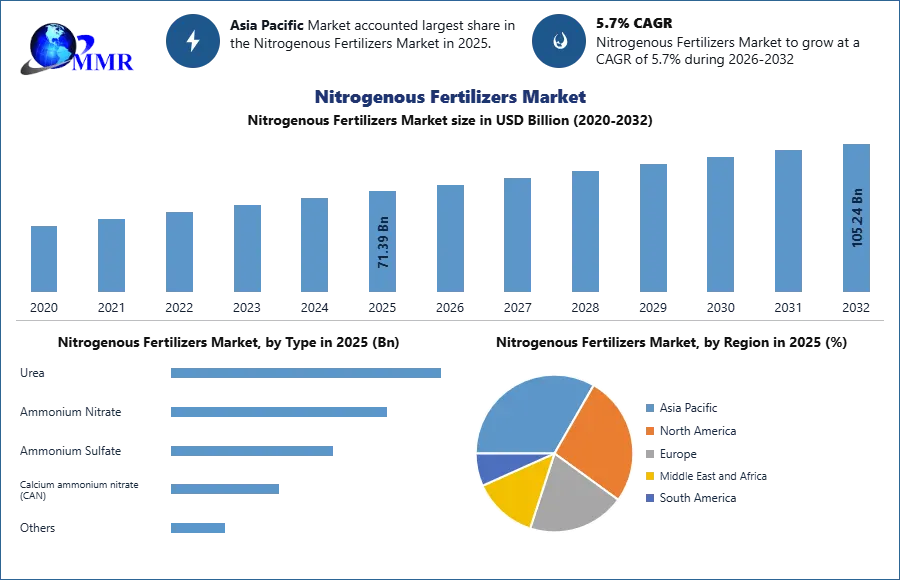
The Global Nitrogenous Fertilizers Market was valued at USD 71.39 Billion in 2025 and is projected to reach USD 105.24 Billion by 2032, growing at a CAGR of 5.7% during the forecast period (2026–2032).

Nitrogenous Fertilizers Market Overview:

The Nitrogenous Fertilizers Market report provides a comprehensive assessment of key segments, including Type, Crop Type, Form, and Region. The regional analysis covers North America, Asia Pacific, Europe, the Middle East & Africa, and South America, with data compiled from industry participants and validated sources. The study evaluates structural developments across the agricultural input industry and presents quantitative insights for the historical period from 2019 to 2024 using verified statistics, graphical representations, and analytical models.

The report further examines the core growth drivers, restraints, opportunities, and competitive challenges influencing the Nitrogenous Fertilizers Market. It delivers strategic insights into production trends, demand patterns, pricing dynamics, and regulatory frameworks shaping the industry landscape. Additionally, the analysis outlines the competitive positioning of key manufacturers and provides investor-focused recommendations based on a detailed evaluation of the current market structure and future growth outlook.
Nitrogenous Fertilizers MarketTo know about the Research Methodology :- Request Free Sample Report

Nitrogenous Fertilizers Market Dynamics:

Rising Global Food Demand and Crop Yield Optimization

The growth of the Nitrogenous Fertilizers Market is primarily driven by increasing global food demand due to rapid population expansion and changing dietary patterns. Nitrogen fertilizers, including urea, ammonia, ammonium sulfate, and calcium ammonium nitrate, play a critical role in enhancing soil fertility and crop productivity. Since nitrogen is an essential nutrient for plant growth and is not readily available to most crops in absorbable form, synthetic nitrogenous fertilizers are widely applied to improve yield, crop texture, and overall quality. Expanding cultivation of cereals, grains, fruits, vegetables, and commercial crops such as cotton continues to strengthen demand for nitrogen-based nutrient solutions across both developed and emerging agricultural economies.

Raw Material Price Volatility and Environmental Concerns

Despite strong demand fundamentals, the Nitrogenous Fertilizers Market faces restraints related to fluctuating raw material prices and environmental sustainability issues. Natural gas, a key feedstock in the Haber-Bosch process for ammonia production, accounts for a substantial portion of overall production costs. Variations in natural gas prices directly impact fertilizer manufacturing margins and pricing stability. Additionally, excessive or imbalanced application of nitrogen fertilizers can lead to soil degradation, groundwater contamination, and greenhouse gas emissions. Increasing regulatory scrutiny and environmental compliance requirements may limit unrestricted fertilizer usage and compel manufacturers to invest in cleaner and more efficient production technologies.

Technological Advancements and Precision Agriculture

The increasing adoption of precision agriculture and advanced nutrient management practices presents significant opportunities for the Nitrogenous Fertilizers Market. Farmers are becoming more aware of optimized fertilizer application techniques that enhance crop productivity while minimizing environmental impact. Digital farming tools, soil testing technologies, and controlled-release nitrogen products are enabling efficient nutrient utilization. Emerging economies such as India and China are witnessing rising awareness regarding balanced fertilizer usage, supported by government initiatives and institutional programs promoting sustainable agriculture. Furthermore, innovation in bio-based and enhanced-efficiency fertilizers is expected to create long-term growth avenues for manufacturers.

Expanding Agricultural Investments in India and the U.S.

India remains a key growth engine for the Nitrogenous Fertilizers Market, supported by its vast arable land base, diverse agro-climatic zones, and increasing focus on food security. Government initiatives aimed at improving supply chains, promoting agricultural mechanization, and offering fiscal incentives are strengthening fertilizer consumption. Simultaneously, the U.S. market benefits from abundant natural gas availability due to shale gas exploration, reducing production costs and limiting import dependency. Rising commercial farming activities and cost-effective domestic fertilizer production continue to support steady demand in North America, while emerging economies across Africa and Asia are increasingly recognizing the importance of nitrogen fertilizers in enhancing agricultural output.

Nitrogenous Fertilizers Market Segment Analysis:

On the basis of Type, the market is segmented into Urea, Ammonium Nitrate, Ammonium Sulfate, Calcium ammonium nitrate (CAN) and others. Urea and ammonia together recorded for more than half of the complete nitrogenous compost portion of the overall industry regarding both volume and income in 2025. Urea is additionally driving the item type portion in the market regarding development inferable from its higher volume of utilization and moderate expense contrasted with different items. It is significantly liked for acidic soil for harvests like corn, strawberries, and blueberries. The response of ammonia with carbon dioxide prompts the arrangement of urea. Subsequently, the cost of the crude materials is among the central point affecting the value patterns of urea compost. Alongside this, the public authority endowments in agricultural nations and a minute ago purchasing patterns in the U.S. what's more, nations in Europe additionally influence the costs of the items in the worldwide market.

Ammonia is the most usually and customarily utilized nitrogenous manure. It is viewed as the most extravagant wellspring of nitrogen with around 82% of the component and thus is expected to grow at a CAGR of 4.4% from 2026 to 2032 as far as income. It keeps up the pH esteem in soil and makes the dirt basic. Such kind of soil is reasonable for the development of carrots, cauliflower, potatoes, peanuts, and a couple of different harvests, which require pH esteem more noteworthy than seven.

On the basis of Crop, the market is segmented into Cereals & grains, Oilseeds & pulses, Fruits & vegetables and others. Cereals and grains are the main application fragment in the market attributable to the developing interest from food and creature feed enterprises. Contracting farmland and developing interest for food harvests like wheat, maize, rice, grain, and oats, are boosting the interest in agrarian synthetics. Among the grains burned around the world, wheat is the biggest shopper of nitrogen-based soil nourishes followed by grain. Nitrogen is applied to cereals and grains as soil added substances or sprinklers. The oilseed is one of the greatest income creating crops inferable from its interest in the creation of consumable oil. Mustard and soybean are the most exceptionally devoured eatable oilseeds. The soil needed for the development of these yields needs to have an equilibrium of nitrogen, sulfur, and calcium. These variables are expected to expand the use of nitrogenous manures for the creation of oilseeds.

Nitrogenous Fertilizers Market Regional Analysis:

Asia Pacific accounted for the largest share of 39% in 2025 in the Nitrogenous Fertilizers Market, supported by extensive agricultural land availability, a large rural population base, and continuous advancements in farming practices. The region includes major agricultural economies such as China, India, Indonesia, Philippines, Malaysia, and Thailand, where food security remains a strategic priority. Favorable climatic conditions, expanding crop intensity, and increasing adoption of yield-enhancing inputs continue to drive fertilizer consumption across cereals, grains, fruits, and cash crops. The presence of large-scale fertilizer production facilities and government-backed agricultural subsidy programs further strengthens regional demand. As a result, Asia Pacific is projected to witness the fastest growth in both revenue and volume terms over the forecast period.

Europe represents another significant regional market, driven by the cultivation of a diverse range of crops across multiple climatic zones. Countries across Western and Eastern Europe emphasize balanced nutrient management and high agricultural productivity standards, supporting consistent nitrogen fertilizer usage. However, stringent environmental regulations related to nitrogen runoff and greenhouse gas emissions influence application rates and encourage the adoption of controlled-release and efficiency-enhanced fertilizers.

Recent Industry Developments (2025–2026)

Exact Date Company Development Impact
18 February 2026 Nutrien Ltd. Announced its 2026 strategic guidance, prioritizing an increase in upstream nitrogen sales volumes by leveraging its low-cost North American production base. The company aims to capture rising global demand while maintaining a competitive cost advantage over higher-cost marginal producers in Europe and Asia.
11 February 2026 Yara International ASA Reported a 4.1% year-on-year increase in total fertilizer deliveries for 2025, specifically highlighting strong recovery in nitrate and UAN volumes in the Americas. This growth signals a stabilization of nitrogenous fertilizer consumption following previous periods of high price volatility and supply chain disruption.
29 January 2026 ICL Group Introduced a new targeted nitrogen solution designed to maximize crop uptake and significantly reduce leaching and volatilization in corn production. This R&D milestone addresses stricter environmental regulations while improving Nutrient Use Efficiency (NUE) for large-scale farmers.
18 November 2025 EuroChem Group Confirmed the successful market rollout of its "Next-Generation" stabilized nitrogen products designed to minimize environmental impact. The deployment is expected to reduce ammonia emissions by up to 80%, aligning the company's portfolio with global sustainable agriculture targets.

The objective of the report is to present a comprehensive analysis of the global Nitrogenous Fertilizers Market to the stakeholders in the industry. The past and current status of the industry with the forecasted market size and trends are presented in the report with the analysis of complicated data in simple language. The report covers all the aspects of the industry with a dedicated study of key players that include market leaders, followers, and new entrants. PORTER, PESTEL analysis with the potential impact of micro-economic factors of the market have been presented in the report. External as well as internal factors that are supposed to affect the business positively or negatively have been analyzed, which will give a clear futuristic view of the industry to the decision-makers.

The reports also help in understanding the Nitrogenous Fertilizers Market dynamic, and structure by analyzing the market segments and projecting the Nitrogenous Fertilizers Market size. Clear representation of competitive analysis of key players by Design, price, financial position, Type portfolio, growth strategies, and regional presence in the Nitrogenous Fertilizers Market make the report investor’s guide.

Nitrogenous Fertilizers Industry EcosystemNitrogenous Fertilizers Industry Ecosystem Market

Nitrogenous Fertilizers Market Scope: Inquire before buying

Nitrogenous Fertilizers Market
Report Coverage Details
Base Year: 2025 Forecast Period: 2026-2032
Historical Data: 2020 to 2025 Market Size in 2025: 71.39 USD Billion
Forecast Period 2026-2032 CAGR: 5.7% Market Size in 2032: 105.24 USD Billion
Segments Covered: by Type Urea
Ammonium Nitrate
Ammonium Sulfate
Calcium ammonium nitrate (CAN)
Others
by Crop Cereals & grains
Oilseeds & pulses
Fruits & vegetables
Others
by Form Liquid
Dry
Others

Nitrogenous Fertilizers Market, by Region

North America (United States, Canada and Mexico)
Europe (UK, France, Germany, Italy, Spain, Sweden, Austria and Rest of Europe)
Asia Pacific (China, South Korea, Japan, India, Australia, Indonesia, Malaysia, Vietnam, Taiwan, Bangladesh, Pakistan and Rest of APAC)
Middle East and Africa (South Africa, GCC, Egypt, Nigeria and Rest of ME&A)
South America (Brazil, Argentina Rest of South America)

Key Players/Competitors Profiles Covered in Brief Nitrogenous Fertilizers Market Report in Strategic Perspective

  1. Nutrien Ltd.
  2. Yara International ASA
  3. CF Industries Holdings, Inc.
  4. EuroChem Group
  5. SABIC Group
  6. OCI Nitrogen
  7. Koch Fertilizer, LLC
  8.  Bunge Limited
  9. Coromandel International Limited
  10. The Mosaic Company
  11. PotashCorp (Nutrien)
  12. Agrium Inc. (Nutrien)
  13. K+S Aktiengesellschaft
  14. Israel Chemicals Ltd. (ICL Group)
  15. Mitsubishi Chemical Corporation
  16. Toxedo (Sinofert)
  17. CNPC (PetroChina)
  18. CVR Energy, Inc.
  19. Tessenderlo Group
  20. Uralchem JSC
  21. Acron Group
  22. Haifa Group
  23. Dyno Nobel (Incitec Pivot)
  24. Qatar Fertilizer Company (QAFCO)
  25. Fertiberia S.A.

Table of Contents

1. Nitrogenous Fertilizers Market Introduction
1.1. Study Assumption and Market Definition
1.2. Scope of the Study
1.3. Executive Summary
2. Global Nitrogenous Fertilizers Market: Competitive Landscape
2.1. MMR Competition Matrix
2.2. Competitive Landscape
2.3. Key Players Benchmarking
2.3.1. Company Name
2.3.2. Business Segment
2.3.3. End-user Segment
2.3.4. Revenue (2025)
2.3.5. Company Locations
2.4. Leading Nitrogenous Fertilizers Market Companies, by market capitalization
2.5. Market Structure
2.5.1. Market Leaders
2.5.2. Market Followers
2.5.3. Emerging Players
2.6. Mergers and Acquisitions Details
3. Nitrogenous Fertilizers Market: Dynamics
3.1. Nitrogenous Fertilizers Market Trends by Region
3.1.1. North America Nitrogenous Fertilizers Market Trends
3.1.2. Europe Nitrogenous Fertilizers Market Trends
3.1.3. Asia Pacific Nitrogenous Fertilizers Market Trends
3.1.4. Middle East and Africa Nitrogenous Fertilizers Market Trends
3.1.5. South America Nitrogenous Fertilizers Market Trends
3.2. Nitrogenous Fertilizers Market Dynamics by Region
3.2.1. North America
3.2.1.1. North America Nitrogenous Fertilizers Market Drivers
3.2.1.2. North America Nitrogenous Fertilizers Market Restraints
3.2.1.3. North America Nitrogenous Fertilizers Market Opportunities
3.2.1.4. North America Nitrogenous Fertilizers Market Challenges
3.2.2. Europe
3.2.2.1. Europe Nitrogenous Fertilizers Market Drivers
3.2.2.2. Europe Nitrogenous Fertilizers Market Restraints
3.2.2.3. Europe Nitrogenous Fertilizers Market Opportunities
3.2.2.4. Europe Nitrogenous Fertilizers Market Challenges
3.2.3. Asia Pacific
3.2.3.1. Asia Pacific Nitrogenous Fertilizers Market Drivers
3.2.3.2. Asia Pacific Nitrogenous Fertilizers Market Restraints
3.2.3.3. Asia Pacific Nitrogenous Fertilizers Market Opportunities
3.2.3.4. Asia Pacific Nitrogenous Fertilizers Market Challenges
3.2.4. Middle East and Africa
3.2.4.1. Middle East and Africa Nitrogenous Fertilizers Market Drivers
3.2.4.2. Middle East and Africa Nitrogenous Fertilizers Market Restraints
3.2.4.3. Middle East and Africa Nitrogenous Fertilizers Market Opportunities
3.2.4.4. Middle East and Africa Nitrogenous Fertilizers Market Challenges
3.2.5. South America
3.2.5.1. South America Nitrogenous Fertilizers Market Drivers
3.2.5.2. South America Nitrogenous Fertilizers Market Restraints
3.2.5.3. South America Nitrogenous Fertilizers Market Opportunities
3.2.5.4. South America Nitrogenous Fertilizers Market Challenges
3.3. PORTER's Five Forces Analysis
3.4. PESTLE Analysis
3.5. Technology Roadmap
3.6. Regulatory Landscape by Region
3.6.1. North America
3.6.2. Europe
3.6.3. Asia Pacific
3.6.4. Middle East and Africa
3.6.5. South America
3.7. Key Opinion Leader Analysis For Nitrogenous Fertilizers Industry
3.8. Analysis of Government Schemes and Initiatives For Nitrogenous Fertilizers Industry
3.9. Nitrogenous Fertilizers Market Trade Analysis
3.10. The Global Pandemic Impact on Nitrogenous Fertilizers Market
4. Nitrogenous Fertilizers Market: Global Market Size and Forecast by Segmentation (in USD Billion) 2025-2032
4.1. Nitrogenous Fertilizers Market Size and Forecast, by Type (2025-2032)
4.1.1. Urea
4.1.2. Ammonium Nitrate
4.1.3. Ammonium Sulfate
4.1.4. Calcium ammonium nitrate (CAN)
4.1.5. Others
4.2. Nitrogenous Fertilizers Market Size and Forecast, by Crop (2025-2032)
4.2.1. Cereals & grains
4.2.2. Oilseeds & pulses
4.2.3. Fruits & vegetables
4.2.4. Others
4.3. Nitrogenous Fertilizers Market Size and Forecast, by Form (2025-2032)
4.3.1. Liquid
4.3.2. Dry
4.3.3. Others
4.4. Nitrogenous Fertilizers Market Size and Forecast, by Region (2025-2032)
4.4.1. North America
4.4.2. Europe
4.4.3. Asia Pacific
4.4.4. Middle East and Africa
4.4.5. South America
5. North America Nitrogenous Fertilizers Market Size and Forecast by Segmentation (in USD Billion) 2025-2032
5.1. North America Nitrogenous Fertilizers Market Size and Forecast, by Type (2025-2032)
5.1.1. Urea
5.1.2. Ammonium Nitrate
5.1.3. Ammonium Sulfate
5.1.4. Calcium ammonium nitrate (CAN)
5.1.5. Others
5.2. North America Nitrogenous Fertilizers Market Size and Forecast, by Crop (2025-2032)
5.2.1. Cereals & grains
5.2.2. Oilseeds & pulses
5.2.3. Fruits & vegetables
5.2.4. Others
5.3. North America Nitrogenous Fertilizers Market Size and Forecast, by Form (2025-2032)
5.3.1. Liquid
5.3.2. Dry
5.3.3. Others
5.4. North America Nitrogenous Fertilizers Market Size and Forecast, by Country (2025-2032)
5.4.1. United States
5.4.1.1. United States Nitrogenous Fertilizers Market Size and Forecast, by Type (2025-2032)
5.4.1.1.1. Urea
5.4.1.1.2. Ammonium Nitrate
5.4.1.1.3. Ammonium Sulfate
5.4.1.1.4. Calcium ammonium nitrate (CAN)
5.4.1.1.5. Others
5.4.1.2. United States Nitrogenous Fertilizers Market Size and Forecast, by Crop (2025-2032)
5.4.1.2.1. Cereals & grains
5.4.1.2.2. Oilseeds & pulses
5.4.1.2.3. Fruits & vegetables
5.4.1.2.4. Others
5.4.1.3. United States Nitrogenous Fertilizers Market Size and Forecast, by Form (2025-2032)
5.4.1.3.1. Liquid
5.4.1.3.2. Dry
5.4.1.3.3. Others
5.4.2. Canada
5.4.2.1. Canada Nitrogenous Fertilizers Market Size and Forecast, by Type (2025-2032)
5.4.2.1.1. Urea
5.4.2.1.2. Ammonium Nitrate
5.4.2.1.3. Ammonium Sulfate
5.4.2.1.4. Calcium ammonium nitrate (CAN)
5.4.2.1.5. Others
5.4.2.2. Canada Nitrogenous Fertilizers Market Size and Forecast, by Crop (2025-2032)
5.4.2.2.1. Cereals & grains
5.4.2.2.2. Oilseeds & pulses
5.4.2.2.3. Fruits & vegetables
5.4.2.2.4. Others
5.4.2.3. Canada Nitrogenous Fertilizers Market Size and Forecast, by Form (2025-2032)
5.4.2.3.1. Liquid
5.4.2.3.2. Dry
5.4.2.3.3. Others
5.4.3. Mexico
5.4.3.1. Mexico Nitrogenous Fertilizers Market Size and Forecast, by Type (2025-2032)
5.4.3.1.1. Urea
5.4.3.1.2. Ammonium Nitrate
5.4.3.1.3. Ammonium Sulfate
5.4.3.1.4. Calcium ammonium nitrate (CAN)
5.4.3.1.5. Others
5.4.3.2. Mexico Nitrogenous Fertilizers Market Size and Forecast, by Crop (2025-2032)
5.4.3.2.1. Cereals & grains
5.4.3.2.2. Oilseeds & pulses
5.4.3.2.3. Fruits & vegetables
5.4.3.2.4. Others
5.4.3.3. Mexico Nitrogenous Fertilizers Market Size and Forecast, by Form (2025-2032)
5.4.3.3.1. Liquid
5.4.3.3.2. Dry
5.4.3.3.3. Others
6. Europe Nitrogenous Fertilizers Market Size and Forecast by Segmentation (in USD Billion) 2025-2032
6.1. Europe Nitrogenous Fertilizers Market Size and Forecast, by Type (2025-2032)
6.2. Europe Nitrogenous Fertilizers Market Size and Forecast, by Crop (2025-2032)
6.3. Europe Nitrogenous Fertilizers Market Size and Forecast, by Form (2025-2032)
6.4. Europe Nitrogenous Fertilizers Market Size and Forecast, by Country (2025-2032)
6.4.1. United Kingdom
6.4.1.1. United Kingdom Nitrogenous Fertilizers Market Size and Forecast, by Type (2025-2032)
6.4.1.2. United Kingdom Nitrogenous Fertilizers Market Size and Forecast, by Crop (2025-2032)
6.4.1.3. United Kingdom Nitrogenous Fertilizers Market Size and Forecast, by Form (2025-2032)
6.4.2. France
6.4.2.1. France Nitrogenous Fertilizers Market Size and Forecast, by Type (2025-2032)
6.4.2.2. France Nitrogenous Fertilizers Market Size and Forecast, by Crop (2025-2032)
6.4.2.3. France Nitrogenous Fertilizers Market Size and Forecast, by Form (2025-2032)
6.4.3. Germany
6.4.3.1. Germany Nitrogenous Fertilizers Market Size and Forecast, by Type (2025-2032)
6.4.3.2. Germany Nitrogenous Fertilizers Market Size and Forecast, by Crop (2025-2032)
6.4.3.3. Germany Nitrogenous Fertilizers Market Size and Forecast, by Form (2025-2032)
6.4.4. Italy
6.4.4.1. Italy Nitrogenous Fertilizers Market Size and Forecast, by Type (2025-2032)
6.4.4.2. Italy Nitrogenous Fertilizers Market Size and Forecast, by Crop (2025-2032)
6.4.4.3. Italy Nitrogenous Fertilizers Market Size and Forecast, by Form (2025-2032)
6.4.5. Spain
6.4.5.1. Spain Nitrogenous Fertilizers Market Size and Forecast, by Type (2025-2032)
6.4.5.2. Spain Nitrogenous Fertilizers Market Size and Forecast, by Crop (2025-2032)
6.4.5.3. Spain Nitrogenous Fertilizers Market Size and Forecast, by Form (2025-2032)
6.4.6. Sweden
6.4.6.1. Sweden Nitrogenous Fertilizers Market Size and Forecast, by Type (2025-2032)
6.4.6.2. Sweden Nitrogenous Fertilizers Market Size and Forecast, by Crop (2025-2032)
6.4.6.3. Sweden Nitrogenous Fertilizers Market Size and Forecast, by Form (2025-2032)
6.4.7. Austria
6.4.7.1. Austria Nitrogenous Fertilizers Market Size and Forecast, by Type (2025-2032)
6.4.7.2. Austria Nitrogenous Fertilizers Market Size and Forecast, by Crop (2025-2032)
6.4.7.3. Austria Nitrogenous Fertilizers Market Size and Forecast, by Form (2025-2032)
6.4.8. Rest of Europe
6.4.8.1. Rest of Europe Nitrogenous Fertilizers Market Size and Forecast, by Type (2025-2032)
6.4.8.2. Rest of Europe Nitrogenous Fertilizers Market Size and Forecast, by Crop (2025-2032)
6.4.8.3. Rest of Europe Nitrogenous Fertilizers Market Size and Forecast, by Form (2025-2032)
7. Asia Pacific Nitrogenous Fertilizers Market Size and Forecast by Segmentation (in USD Billion) 2025-2032
7.1. Asia Pacific Nitrogenous Fertilizers Market Size and Forecast, by Type (2025-2032)
7.2. Asia Pacific Nitrogenous Fertilizers Market Size and Forecast, by Crop (2025-2032)
7.3. Asia Pacific Nitrogenous Fertilizers Market Size and Forecast, by Form (2025-2032)
7.4. Asia Pacific Nitrogenous Fertilizers Market Size and Forecast, by Country (2025-2032)
7.4.1. China
7.4.1.1. China Nitrogenous Fertilizers Market Size and Forecast, by Type (2025-2032)
7.4.1.2. China Nitrogenous Fertilizers Market Size and Forecast, by Crop (2025-2032)
7.4.1.3. China Nitrogenous Fertilizers Market Size and Forecast, by Form (2025-2032)
7.4.2. S Korea
7.4.2.1. S Korea Nitrogenous Fertilizers Market Size and Forecast, by Type (2025-2032)
7.4.2.2. S Korea Nitrogenous Fertilizers Market Size and Forecast, by Crop (2025-2032)
7.4.2.3. S Korea Nitrogenous Fertilizers Market Size and Forecast, by Form (2025-2032)
7.4.3. Japan
7.4.3.1. Japan Nitrogenous Fertilizers Market Size and Forecast, by Type (2025-2032)
7.4.3.2. Japan Nitrogenous Fertilizers Market Size and Forecast, by Crop (2025-2032)
7.4.3.3. Japan Nitrogenous Fertilizers Market Size and Forecast, by Form (2025-2032)
7.4.4. India
7.4.4.1. India Nitrogenous Fertilizers Market Size and Forecast, by Type (2025-2032)
7.4.4.2. India Nitrogenous Fertilizers Market Size and Forecast, by Crop (2025-2032)
7.4.4.3. India Nitrogenous Fertilizers Market Size and Forecast, by Form (2025-2032)
7.4.5. Australia
7.4.5.1. Australia Nitrogenous Fertilizers Market Size and Forecast, by Type (2025-2032)
7.4.5.2. Australia Nitrogenous Fertilizers Market Size and Forecast, by Crop (2025-2032)
7.4.5.3. Australia Nitrogenous Fertilizers Market Size and Forecast, by Form (2025-2032)
7.4.6. Indonesia
7.4.6.1. Indonesia Nitrogenous Fertilizers Market Size and Forecast, by Type (2025-2032)
7.4.6.2. Indonesia Nitrogenous Fertilizers Market Size and Forecast, by Crop (2025-2032)
7.4.6.3. Indonesia Nitrogenous Fertilizers Market Size and Forecast, by Form (2025-2032)
7.4.7. Malaysia
7.4.7.1. Malaysia Nitrogenous Fertilizers Market Size and Forecast, by Type (2025-2032)
7.4.7.2. Malaysia Nitrogenous Fertilizers Market Size and Forecast, by Crop (2025-2032)
7.4.7.3. Malaysia Nitrogenous Fertilizers Market Size and Forecast, by Form (2025-2032)
7.4.8. Vietnam
7.4.8.1. Vietnam Nitrogenous Fertilizers Market Size and Forecast, by Type (2025-2032)
7.4.8.2. Vietnam Nitrogenous Fertilizers Market Size and Forecast, by Crop (2025-2032)
7.4.8.3. Vietnam Nitrogenous Fertilizers Market Size and Forecast, by Form (2025-2032)
7.4.9. Taiwan
7.4.9.1. Taiwan Nitrogenous Fertilizers Market Size and Forecast, by Type (2025-2032)
7.4.9.2. Taiwan Nitrogenous Fertilizers Market Size and Forecast, by Crop (2025-2032)
7.4.9.3. Taiwan Nitrogenous Fertilizers Market Size and Forecast, by Form (2025-2032)
7.4.10. Rest of Asia Pacific
7.4.10.1. Rest of Asia Pacific Nitrogenous Fertilizers Market Size and Forecast, by Type (2025-2032)
7.4.10.2. Rest of Asia Pacific Nitrogenous Fertilizers Market Size and Forecast, by Crop (2025-2032)
7.4.10.3. Rest of Asia Pacific Nitrogenous Fertilizers Market Size and Forecast, by Form (2025-2032)
8. Middle East and Africa Nitrogenous Fertilizers Market Size and Forecast by Segmentation (in USD Billion) 2025-2032
8.1. Middle East and Africa Nitrogenous Fertilizers Market Size and Forecast, by Type (2025-2032)
8.2. Middle East and Africa Nitrogenous Fertilizers Market Size and Forecast, by Crop (2025-2032)
8.3. Middle East and Africa Nitrogenous Fertilizers Market Size and Forecast, by Form (2025-2032)
8.4. Middle East and Africa Nitrogenous Fertilizers Market Size and Forecast, by Country (2025-2032)
8.4.1. South Africa
8.4.1.1. South Africa Nitrogenous Fertilizers Market Size and Forecast, by Type (2025-2032)
8.4.1.2. South Africa Nitrogenous Fertilizers Market Size and Forecast, by Crop (2025-2032)
8.4.1.3. South Africa Nitrogenous Fertilizers Market Size and Forecast, by Form (2025-2032)
8.4.2. GCC
8.4.2.1. GCC Nitrogenous Fertilizers Market Size and Forecast, by Type (2025-2032)
8.4.2.2. GCC Nitrogenous Fertilizers Market Size and Forecast, by Crop (2025-2032)
8.4.2.3. GCC Nitrogenous Fertilizers Market Size and Forecast, by Form (2025-2032)
8.4.3. Nigeria
8.4.3.1. Nigeria Nitrogenous Fertilizers Market Size and Forecast, by Type (2025-2032)
8.4.3.2. Nigeria Nitrogenous Fertilizers Market Size and Forecast, by Crop (2025-2032)
8.4.3.3. Nigeria Nitrogenous Fertilizers Market Size and Forecast, by Form (2025-2032)
8.4.4. Rest of ME&A
8.4.4.1. Rest of ME&A Nitrogenous Fertilizers Market Size and Forecast, by Type (2025-2032)
8.4.4.2. Rest of ME&A Nitrogenous Fertilizers Market Size and Forecast, by Crop (2025-2032)
8.4.4.3. Rest of ME&A Nitrogenous Fertilizers Market Size and Forecast, by Form (2025-2032)
9. South America Nitrogenous Fertilizers Market Size and Forecast by Segmentation (in USD Billion) 2025-2032
9.1. South America Nitrogenous Fertilizers Market Size and Forecast, by Type (2025-2032)
9.2. South America Nitrogenous Fertilizers Market Size and Forecast, by Crop (2025-2032)
9.3. South America Nitrogenous Fertilizers Market Size and Forecast, by Form (2025-2032)
9.4. South America Nitrogenous Fertilizers Market Size and Forecast, by Country (2025-2032)
9.4.1. Brazil
9.4.1.1. Brazil Nitrogenous Fertilizers Market Size and Forecast, by Type (2025-2032)
9.4.1.2. Brazil Nitrogenous Fertilizers Market Size and Forecast, by Crop (2025-2032)
9.4.1.3. Brazil Nitrogenous Fertilizers Market Size and Forecast, by Form (2025-2032)
9.4.2. Argentina
9.4.2.1. Argentina Nitrogenous Fertilizers Market Size and Forecast, by Type (2025-2032)
9.4.2.2. Argentina Nitrogenous Fertilizers Market Size and Forecast, by Crop (2025-2032)
9.4.2.3. Argentina Nitrogenous Fertilizers Market Size and Forecast, by Form (2025-2032)
9.4.3. Rest Of South America
9.4.3.1. Rest Of South America Nitrogenous Fertilizers Market Size and Forecast, by Type (2025-2032)
9.4.3.2. Rest Of South America Nitrogenous Fertilizers Market Size and Forecast, by Crop (2025-2032)
9.4.3.3. Rest Of South America Nitrogenous Fertilizers Market Size and Forecast, by Form (2025-2032)
10. Company Profile: Key Players
10.1. Nutrien Ltd.
10.1.1. Company Overview
10.1.2. Business Portfolio
10.1.3. Financial Overview
10.1.4. SWOT Analysis
10.1.5. Strategic Analysis
10.1.6. Scale of Operation (small, medium, and large)
10.1.7. Details on Partnership
10.1.8. Regulatory Accreditations and Certifications Received by Them
10.1.9. Awards Received by the Firm
10.1.10. Recent Developments
10.2. Yara International ASA
10.3. CF Industries Holdings Inc.
10.4. EuroChem Group
10.5. SABIC Group
10.6. OCI Nitrogen
10.7. Koch Fertilizer LLC
10.8. Bunge Limited
10.9. Coromandel International Limited
10.10. The Mosaic Company
10.11. PotashCorp (Nutrien)
10.12. Agrium Inc. (Nutrien)
10.13. K+S Aktiengesellschaft
10.14. Israel Chemicals Ltd. (ICL Group)
10.15. Mitsubishi Chemical Corporation
10.16. Toxedo (Sinofert)
10.17. CNPC (PetroChina)
10.18. CVR Energy Inc.
10.19. Tessenderlo Group
10.20. Uralchem JSC
10.21. Acron Group
10.22. Haifa Group
10.23. Dyno Nobel (Incitec Pivot)
10.24. Qatar Fertilizer Company (QAFCO)
10.25. Fertiberia S.A.
11. Key Findings
12. Industry Recommendations
13. Nitrogenous Fertilizers Market: Research Methodology
14. Terms and Glossary

Custom Market Research Services

We Will Customise The Research For You, In Case The Report Listed Above Does Not Meet With Your Requirements