
Nitrochlorobenzene Market by Product, Application, End User, and Region – Global Market Size Estimation, Industry-Wide Analysis, Competitive Landscape Assessment & Long-Term Forecast to 2032
Overview
Global Nitrochlorobenzene Market size was valued at USD 1.28 Bn in 2025 and is expected to reach USD 1.7 Bn by 2032, at a CAGR of 4.13% during a forecast period.
Nitrochlorobenzene is an organic compound used as an intermediate and precursor for the production of chemicals and numerous derivatives in agriculture, pharmaceutical, paints, and coatings industries. Nitrochlorobenzene finds its applications in various end-use industries such as in rubber chemicals, intermediates for azo & sulfur dyes photo chemicals, and insecticides.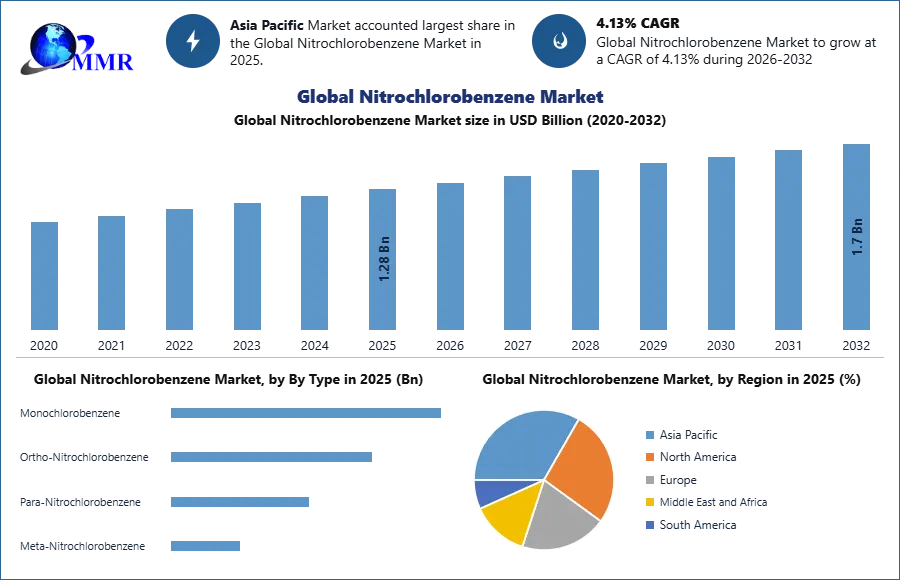
To Know About The Research Methodology :- Request Free Sample Report
Nitrochlorobenzene Market Dynamics:
Increasing usage of nitrochlorobenzene in automotive industry to drive nitrochlorobenzene market
Rising trends towards manufacturing of specialty chemical has encouraged many key manufactures to invest more in the research & development activity. The automobile industry is witnessing an exponential growth in recent years the market is fuelled by increasing Foreign Direct Investment (FDI) for example in 2020 the investment was US$ 24.53 billion between April 2000 and June 2020. Nitrochlorobenzene is the main ingredient in the manufacturing of rubbers besides, rubber has a robust use in the automobile industry which in turn has made a positive impact on the market. Nitrochlorobenzene is extensively used in the medical & pharmaceutical industry for the treatment of Leprosy, continuous research & development activities and the growth in the medical & pharmaceutical industry has fuelled the market growth of Nitrochlorobenzene.
However, Environmental regulations are becoming more stringent in all regions to limit emissions of volatile organic compounds (VOCs) and hazardous air pollutants (HAPs), not only in the industrialized world but also in developing countries like China, India. Furthermore, Nitrochlorobenzene can affect severely when contact with skin or breath it irritates the nose and throat causing wheezing and coughing causing serious damage to the nervous system which may slow down the growth of the market.
Government regulations will continue to be a driving force behind the adoption of new coating technologies. Paint and coating manufacturers are primarily focused on decoration and protection as well as paint and coating industry is showing a northward direction with the growth in the construction industry especially in countries like India, China, Malaysia, and Vietnam thus, this has created many lucrative opportunities for the key players operating in this market.
The report has profiled ten key players in the market from different regions. However, the report has considered all market leaders, followers, and new entrants with investors while analyzing the market and estimation the size of the same. The manufacturing environment in each region is different and focus is given on the regional impact on the cost of manufacturing, supply chain, availability of raw materials, labor cost, availability of advanced technology, trusted vendors are analysis and report has come up with recommendations for a future hot spot in the North America. Major country’s policies about manufacturing and their impact on Cytokine Based Therapies and Inhibitors demand are covered in the report.
Nitrochlorobenzene Market Segment Analysis
In 2025, monochlorobenzene dominated the global market, holding the largest share due to its extensive use as a solvent and intermediate in the production of dyes, herbicides, and various industrial chemicals. Its high production volumes in Asia-Pacific, particularly in China and India, supported both regional and global demand. Ortho-, meta-, and para-nitrochlorobenzenes held smaller shares, catering to more specialized applications such as dye intermediates, agrochemicals, and specialty chemicals. Among these, para-nitrochlorobenzene experienced slightly higher demand because of its use in herbicide synthesis. Overall, production and consumption patterns in 2025 reflected a balance between large-volume industrial use and niche, high-value applications.
In 2025, agriculture chemicals and dyes & pigments were the leading applications for chlorobenzene and its derivatives, driven by strong demand for herbicides, insecticides, and synthetic dyes. Pharmaceuticals accounted for a moderate share, focusing on high-purity intermediates for drug synthesis. Polymer additives contributed to specialty plastics, coatings, and industrial materials, while specialty chemicals represented a smaller but high-value segment. Growth in agriculture chemicals was fueled by global crop production, particularly in Asia-Pacific, while dye and pigment demand remained robust due to the textile industry. Overall, these applications shaped market dynamics, balancing high-volume industrial uses with niche, high-value sectors worldwide.
Nitrochlorobenzene Market Regional Insights:
In 2025, Asia-Pacific was the largest region for chlorobenzene production and consumption. Countries like China, India, Japan, and South Korea drove the market, supported by large-scale chemical manufacturing, textile dye production, and agrochemical industries. The region’s dominance was due to the availability of cost-effective raw materials, skilled labor, and established industrial infrastructure, enabling high-volume production of both monochlorobenzene and nitrochlorobenzene derivatives. Demand was driven primarily by industrial-scale applications, including dyes, pigments, and herbicides. Asia-Pacific’s market growth reflected a combination of volume-driven industrial use, emerging domestic consumption, and exports to other regions, making it the global leader in 2025.
In 2025, North America was the second-largest region, led by the United States and Canada. The market focused on high-value, specialty chemical production, including pharmaceutical intermediates and high-purity derivatives. Unlike Asia-Pacific’s volume-driven growth, North America emphasized regulatory compliance, environmental safety, and technological innovation in production processes. Chemical manufacturers in the region catered to pharmaceutical, agrochemical, and specialty applications that required consistent quality and precision. Market expansion in 2025 was fueled by advanced chemical synthesis, growing pharmaceutical R&D, and niche industrial applications, establishing North America as the secondary, high-value market after Asia-Pacific.
The objective of the report is to present a comprehensive analysis of the global Nitrochlorobenzenemarket including all the stakeholders of the industry. The past and current status of the industry with forecasted market size and trends are presented in the report with the analysis of complicated data in simple language.
The report covers all the aspects of the industry with a dedicated study of key players that includes market leaders, followers, and new entrants. PORTER, SVOR, PESTEL analysis with the potential impact of micro-economic factors of the market have been presented in the report. External as well as internal factors that are supposed to affect the business positively or negatively have been analyzed, which will give a clear futuristic view of the industry to the decision-makers.
The report also helps in understanding global nitrochlorobenzene market dynamics, structure by analyzing the market segments and project global nitrochlorobenzene market clear representation of competitive analysis of key players by price, financial position, by detection and equipment portfolio, growth strategies, and regional presence in the global nitrochlorobenzene market make the report investor’s guide.
Nitrochlorobenzene Market Scope: Inquire before buying
| Global Nitrochlorobenzene Market | |||
|---|---|---|---|
| Report Coverage | Details | ||
| Base Year: | 2025 | Forecast Period: | 2026-2032 |
| Historical Data: | 2020 to 2025 | Market Size in 2025: | 1.28 USD Billion |
| Forecast Period 2026-2032 CAGR: | 4.13% | Market Size in 2032: | 1.7 USD Billion |
| Segments Covered: | By Type | Monochlorobenzene Ortho-Nitrochlorobenzene Para-Nitrochlorobenzene Meta-Nitrochlorobenzene |
|
| By Purity Level | Standard Grade High Purity Grade |
||
| By Distribution Channel | Direct Distributors Online Retailers B2B eCommerce Platforms Chemical Trading Companies |
||
| By Application | Agriculture Chemicals Dyes & Pigments Pharmaceuticals Polymer Additives Specialty Chemicals |
||
| By End-User Industry | Chemical Industry Pesticide & Fertilizer Industry Textile Industry Pharmaceutical Industry Automotive Industry |
||
Key Players/Competitors Profile, Covered in Global Nitrochlorobenzene Market Report, From A Strategic Perspective.
1. BASF SE
2. Dow Chemical Company
3. Mitsubishi Chemical Corporation
4. LG Chem Ltd.
5. AkzoNobel N.V.
6. Toray Industries, Inc.
7. Eastman Chemical Company
8. Evonik Industries AG
9. Aarti Industries Limited
10. Seya Industries Ltd.
11. Jiangsu Yangnong Chemical Group Co., Ltd.
12. Anhui Bayi Chemical Industry Co., Ltd.
13. Valiant Organics Limited
14. Deepak Nitrite Company Limited
15. Panoli Intermediates India Pvt. Ltd.
16. Sarna Chemicals
17. Hemani Intermediates Pvt Ltd
18. Hangzhou Meite Industry Co., Ltd.
19. Charkit Chemical Company LLC
20. Shandong Jinling Group Co., Ltd.
21. Nantong Jiangshan Agrochemical & Chemicals Co., Ltd.
22. Solvay S.A.
23. Sumitomo Chemical Co., Ltd.
24. Clariant AG
25. Hindustan Organic Chemicals Limited (HOCL)