
Nanotechnology Drug Delivery Market Size – Industry Structure Evaluation, Demand Drivers Analysis, Regional Growth Analysis and Identification, Competitive Positioning Review & Global Market Size Forecast to 2034
Overview
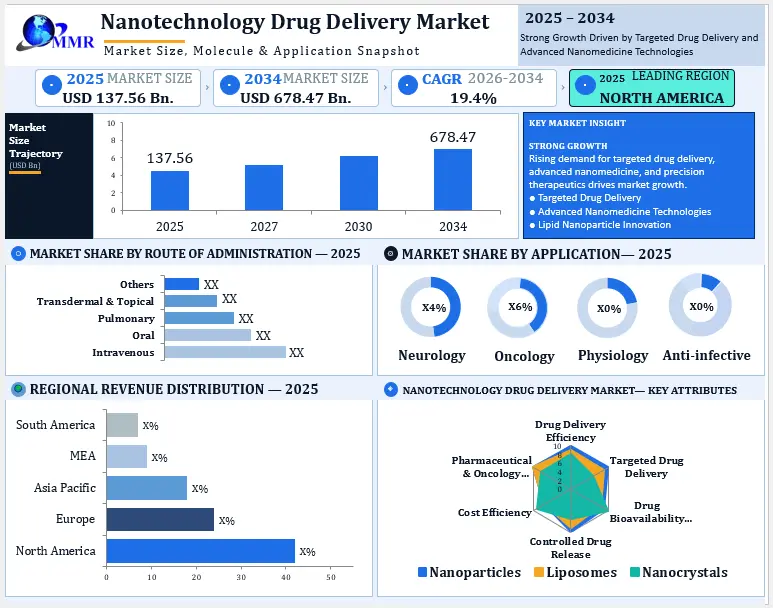
The Global Nanotechnology Drug Delivery Market was valued at USD 137.56 Billion in 2025 and is projected to reach USD 678.47 Billion by 2034, growing at a CAGR of 19.4% during the forecast period 2026–2034.
| Parameter | Value |
| Market Size (2025) | USD 137.56 Billion |
| Market Size (2034) | USD 678.47 Billion |
| CAGR | 19.4% |
| Historical Period | 2020 to 2025 |
| Forecast Period | 2026 to 2034 |
Global Nanotechnology Drug Delivery Market Overview
The Nanotechnology Drug Delivery Market includes advanced pharmaceutical technologies that use nanoscale carriers, including nanoparticles, liposomes, nanocrystals, micelles, and nanotubes, to transport therapeutic compounds and improve drug delivery performance. The Global Nanotechnology Drug Delivery Market is valued at USD 137.56 Billion in 2025 and is projected to reach USD 678.47 Billion by 2034, growing at a CAGR of 19.4% during 2026–2034. Nanotechnology-based drug delivery plays an important role in modern healthcare by supporting targeted drug delivery, improved drug solubility, controlled drug release, and reduced exposure of healthy tissues to certain medications. Pharmaceutical and biotechnology companies adopt nanomedicine, lipid nanoparticle drug delivery, polymeric nanocarriers, and advanced pharmaceutical nanoformulations to develop innovative treatments for cancer, neurological disorders, cardiovascular diseases, and infectious diseases. Increasing demand for precision medicine, effective cancer therapeutics, and novel drug delivery systems strengthens nanotechnology Drug Delivery Market growth.
The Nanotechnology Drug Delivery Industry is evolving through advancements in lipid nanoparticles (LNPs), liposomal drug formulations, biodegradable polymeric nanoparticles, RNA delivery platforms, and smart drug delivery technologies. Pharmaceutical manufacturers increasingly focus on targeted cancer drug delivery, nanoparticle-based chemotherapy, mRNA delivery systems, and controlled-release nanomedicine to address limitations associated with conventional pharmaceutical formulations. Major buyers and adopters include pharmaceutical companies, biotechnology developers, contract development and manufacturing organizations (CDMOs), research institutions, and hospitals using approved nanomedicines. Growing investment in pharmaceutical nanotechnology research, clinical development, and advanced drug formulation services creates opportunities across oncology, gene therapy, anti-infective treatments, and personalized medicine. Expanding biotechnology infrastructure, nanomedicine manufacturing capabilities, and research collaborations further support Nanoparticle Drug Delivery Systems Market growth, commercial nanomedicine development, and pharmaceutical technology innovation.
North America leads the Global Nanotechnology Drug Delivery Market, supported by advanced pharmaceutical research, established biotechnology companies, healthcare investment, and technological innovation. The United States and Canada strengthen regional demand for lipid nanoparticle technology, targeted therapeutics, and next-generation drug delivery platforms, while Asia Pacific presents the fastest regional growth outlook, supported by expanding pharmaceutical manufacturing and biotechnology research across China, India, Japan, and South Korea.
Leading Nanotechnology Drug Delivery Market key players identified in the MMR report include Johnson & Johnson, Merck & Co., Roche, Bayer AG, Novartis, Pfizer, AstraZeneca, and Amgen. For example, Pfizer uses lipid nanoparticle delivery technology in its COMIRNATY mRNA vaccine, demonstrating the commercial application of nanoparticle-based delivery systems. Maximize Market Research (MMR) evaluates Nanotechnology Drug Delivery Market size, share, CAGR, technology segmentation, oncology and other therapeutic applications, regional demand, competitive positioning, industry challenges, and investment opportunities. Its research identifies growing nanomedicine development, increasing demand for targeted therapies, and expanding pharmaceutical research as major factors shaping Global Nanotechnology Drug Delivery Market opportunities through 2034.
Nanotechnology Drug Delivery Market Growth Outlook
To know about the Research Methodology:- Request Free Sample Report
Global Nanotechnology Drug Delivery Market Key Insights
• Market Size: The Global Nanotechnology Drug Delivery Market is valued at USD 137.56 Billion in 2025 and is projected to reach USD 678.47 Billion by 2034.
• Market Growth: The market registers a 19.4% CAGR during 2026–2034, driven by increasing adoption of nanomedicine, targeted drug delivery, and advanced pharmaceutical technologies.
• Key Growth Drivers: Rising cancer prevalence, increasing demand for precision medicine, and expanding pharmaceutical R&D investments accelerate nanoparticle drug delivery market growth.
• Leading Region: North America dominates the global market, while Asia Pacific presents the fastest regional growth outlook, supported by expanding biotechnology research and pharmaceutical manufacturing.
• Emerging Market Trends: Growing adoption of lipid nanoparticles, RNA therapeutics, liposomal drug delivery, smart nanocarriers, and targeted cancer treatments transforms pharmaceutical innovation.
Global Nanotechnology Drug Delivery Market Dynamics
Drivers: Rising Cancer Prevalence, Chronic Diseases and Demand for Targeted Drug Delivery Accelerate Nanotechnology Drug Delivery Market Growth
The Global Nanotechnology Drug Delivery Market is driven by increasing demand for targeted cancer therapeutics, advanced drug delivery systems, and effective treatments for chronic and infectious diseases. Pharmaceutical companies adopt nanoparticle drug delivery systems, liposomal formulations, polymeric nanocarriers, and precision medicine technologies to improve drug bioavailability, therapeutic distribution, and controlled drug release. For example, DOXIL liposomal doxorubicin injection contains 2 mg/mL of doxorubicin hydrochloride, demonstrating the commercial use of nanotechnology in oncology drug formulations. Expanding pharmaceutical research, increasing cancer treatment requirements, and growing investment in nanomedicine strengthen Nanotechnology Drug Delivery Market demand and global pharmaceutical nanotechnology industry growth.
Restraints: High Nanomedicine Development Costs, Specialized Infrastructure and Treatment Safety Concerns Restrict Market Expansion
The Nanotechnology Drug Delivery Market faces restraints from high research and development expenditure, expensive pharmaceutical-grade nanomaterials, specialized production equipment, and complex formulation requirements. Developing lipid nanoparticles, biodegradable polymeric nanocarriers, and liposomal drug delivery systems requires substantial investment compared with many conventional formulations. Certain nanomedicines also require controlled storage conditions; for example, DOXIL liposomal injection requires refrigerated storage at 2°C–8°C, increasing pharmaceutical cold-chain requirements. Potential immune reactions, material toxicity, and limited long-term safety information for emerging formulations further influence clinical adoption and commercialization. These factors restrict nanomedicine accessibility, nanoparticle drug delivery market penetration, and pharmaceutical product affordability.
Opportunities: Expanding RNA Therapeutics, Gene Delivery Platforms and Nanomedicine Manufacturing Services Create New Market Potential
The Global Nanotechnology Drug Delivery Market presents significant opportunities through expanding applications of lipid nanoparticle drug delivery, RNA therapeutics, gene silencing technologies, and personalized medicine. Pharmaceutical and biotechnology companies invest in nanoparticle platforms for transporting small interfering RNA (siRNA), messenger RNA (mRNA), and other therapeutic molecules. For example, ONPATTRO (patisiran) lipid complex injection is available as a 10 mg/5 mL formulation, demonstrating the commercial application of lipid-based RNA delivery for hereditary transthyretin-mediated amyloidosis. Increasing demand for nanomedicine contract development and manufacturing services (CDMO), GMP nanoparticle production, formulation development, and pharmaceutical technology licensing creates growth opportunities across North America, Europe, and Asia Pacific.
Challenges: Nanoparticle Stability, Manufacturing Scalability and Regulatory Compliance Increase Drug Development Complexity
The Nanotechnology Drug Delivery Industry faces challenges involving nanoparticle characterization, batch-to-batch consistency, manufacturing scale-up, regulatory approval, and pharmaceutical quality control. Manufacturers must maintain reliable particle size distribution, drug encapsulation efficiency, surface charge, carrier composition, and controlled-release performance throughout production. Nanotechnology commonly involves engineered structures within approximately 1–100 nanometers (nm), although pharmaceutical nanocarriers can operate beyond this range depending on their design and function. Maintaining consistent nanoparticle characteristics during laboratory-to-commercial production requires specialized analytical testing and manufacturing controls. Compliance with Good Manufacturing Practice (GMP), nanomedicine regulatory standards, product stability testing, and pharmaceutical quality assurance remains essential for successful commercialization.
Trends: Smart Nanocarriers, Stimuli-Responsive Drug Delivery and Advanced Nano formulation Technologies Transform the Market
The Global Nanotechnology Drug Delivery Market is witnessing growing research interest in smart drug delivery systems, stimuli-responsive nanoparticles, surface-engineered nanocarriers, nanocrystal formulations, and advanced liposomal drug delivery technologies. Pharmaceutical researchers develop nanocarriers that respond to specific biological conditions, including changes in pH, temperature, and enzyme activity, to support more selective drug release. Emerging microfluidic nanoparticle manufacturing, PEGylated nanocarriers, ligand-functionalized nanoparticles, and biodegradable nanoformulations support advances in pharmaceutical formulation design. Development programs investigate nanocarriers with particle sizes around 50–200 nm, depending on the therapeutic application and delivery requirements. Increasing focus on precision nanomedicine, controlled-release therapeutics, and next-generation nanoparticle drug delivery platforms shapes industry innovation and Nanotechnology Drug Delivery Market trends through 2034.
Global Nanotechnology Drug Delivery Market Segment Analysis
Global Nanotechnology Drug Delivery Market, by Technology
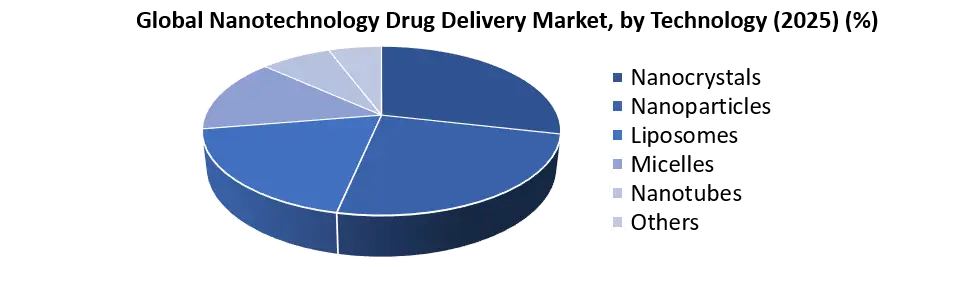
The Global Nanotechnology Drug Delivery Market is segmented by technology into Nanocrystals, Nanoparticles, Liposomes, Micelles, Nanotubes, and Others. Nanocrystals improve the dissolution and bioavailability of poorly water-soluble drugs, while Nanoparticles support targeted drug delivery, controlled drug release, and precision medicine applications. Liposomes provide lipid-based drug encapsulation for oncology treatments and advanced pharmaceutical formulations. Micelles enhance the solubility and delivery of therapeutic compounds, while Nanotubes offer emerging research opportunities in targeted drug transport and nanomedicine development. Increasing investment in lipid nanoparticle technology, polymeric nanocarriers, liposomal drug delivery systems, cancer nanomedicine, and smart drug delivery technologies strengthen Nanotechnology Drug Delivery Market growth, pharmaceutical innovation, and industry opportunities through 2034.
Global Nanotechnology Drug Delivery Market, by End User
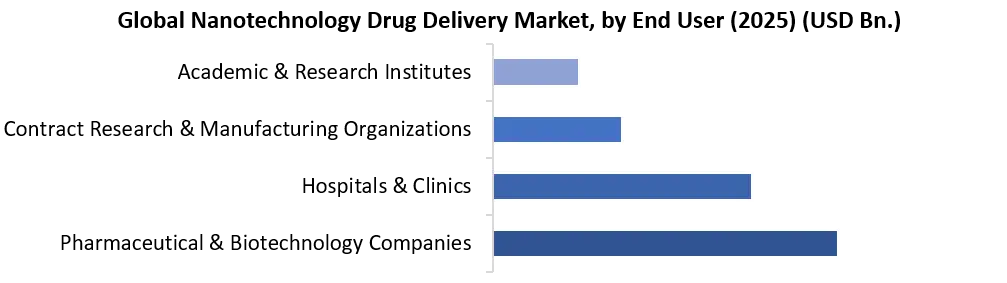
The Global Nanotechnology Drug Delivery Market is segmented by end user into Pharmaceutical & Biotechnology Companies, Hospitals & Clinics, Contract Research & Manufacturing Organizations, and Academic & Research Institutes. Pharmaceutical & Biotechnology Companies drive demand for advanced nanoparticle drug delivery systems, lipid nanoparticles, targeted drug delivery technologies, and nanomedicine development. Hospitals & Clinics utilize approved nanotechnology-based therapeutics for cancer treatment and other specialized medical applications. Contract Research & Manufacturing Organizations (CROs & CMOs) provide nanoparticle formulation development, clinical research, GMP manufacturing, and drug delivery commercialization services. Academic & Research Institutes focus on nanocarrier innovation, controlled drug release, and pharmaceutical nanotechnology research. Increasing investment in precision medicine, nanomedicine research, targeted cancer therapeutics, and advanced drug delivery platforms supports Nanotechnology Drug Delivery Market growth and industry opportunities through 2034.
Global Nanotechnology Drug Delivery Market Regional Insights
North America dominates the Global Nanotechnology Drug Delivery Market, supported by advanced pharmaceutical research, strong biotechnology investment, and established healthcare infrastructure. The United States and Canada drive demand for lipid nanoparticle drug delivery, targeted cancer therapeutics, and precision nanomedicine, strengthening regional market leadership.
The Europe Nanotechnology Drug Delivery Market benefits from pharmaceutical innovation, nanomedicine research, and increasing demand for advanced drug delivery technologies. Germany, the UK, France, and Switzerland support liposomal drug delivery, polymeric nanoparticles, targeted therapeutics, and pharmaceutical nanotechnology development.
The Asia Pacific Nanotechnology Drug Delivery Market presents the fastest regional growth outlook, driven by expanding pharmaceutical manufacturing, biotechnology research, and healthcare investment. China, India, Japan, and South Korea strengthen demand for nanoparticle drug delivery systems, lipid nanoparticles, cancer nanomedicine, and advanced drug formulations.
The Middle East & Africa Nanotechnology Drug Delivery Market experiences emerging opportunities through healthcare modernization, pharmaceutical research investment, and growing interest in innovative therapeutics. Saudi Arabia, the UAE, and South Africa support the development of nanomedicine research, targeted drug delivery technologies, and advanced pharmaceutical healthcare solutions.
The South America Nanotechnology Drug Delivery Market expands through growing pharmaceutical research capabilities, biotechnology collaborations, and demand for improved treatment technologies. Brazil, Argentina, and Colombia present opportunities for nanoparticle-based drug delivery, oncology nanomedicine, controlled-release formulations, and pharmaceutical nanotechnology innovation.
Global Nanotechnology Drug Delivery Market Recent Developments
| Published Date | Recent Developments |
| 19 October 2026 | Eli Lilly and METiS TechBio announce a strategic collaboration worth up to approximately USD 1.1 billion in milestone payments to develop AI-powered lipid nanoparticle (LNP) technologies for tissue-specific drug delivery. |
| 24 September 2026 | Novo Nordisk and Nanexa enter a global licensing and collaboration agreement worth up to EUR 1.165 billion for Pharma Shell drug delivery technology, targeting long-acting injectable treatments for obesity and diabetes. |
| 27 August 2026 | Evonik announces an expansion of its lipid-based drug delivery manufacturing capabilities with a new GMP facility in Vancouver, Canada, supporting lipid nanoparticle production for mRNA therapeutics and gene therapies. |
| 29 July 2026 | Johnson & Johnson and Sail Biomedicines announce a strategic collaboration to develop targeted nanoparticle-based RNA delivery technologies for next-generation in vivo CAR-T therapies, including an exclusive acquisition option. |
| 12 May 2026 | Nanoform Finland announces an exclusive technology agreement with a U.S. biopharmaceutical company to develop ultra-high-concentration subcutaneous biologic formulations using proprietary nanoparticle technology. |
Global Nanotechnology Drug Delivery Market Competitive Landscape
The Global Nanotechnology Drug Delivery Market competitive landscape reflects increasing competition among pharmaceutical companies, biotechnology manufacturers, nanomedicine developers, and advanced drug delivery technology providers. Leading Nanotechnology Drug Delivery Market key players, including Johnson & Johnson, Merck & Co., Roche, Bayer AG, Novartis, Pfizer, AstraZeneca, and Amgen, focus on innovative nanoparticle drug delivery systems, targeted therapeutics, pharmaceutical research, and strategic collaborations. Pfizer utilizes lipid nanoparticle (LNP) technology in its COMIRNATY mRNA vaccine, while Evonik provides lipid nanoparticle formulation development, specialized lipid manufacturing, and pharmaceutical CDMO services. Increasing demand for lipid nanoparticle drug delivery, liposomal formulations, polymeric nanoparticles, targeted cancer therapeutics, RNA delivery systems, and precision nanomedicine strengthens global market competition. Pharmaceutical and biotechnology companies prioritize drug bioavailability, controlled drug release, nanoparticle manufacturing scalability, and next-generation therapeutic delivery platforms. Maximize Market Research's competitive analysis examines company market positioning, product portfolios, technological innovations, pharmaceutical partnerships, mergers and acquisitions, regional presence, investment strategies, and emerging Nanotechnology Drug Delivery Market growth opportunities through 2034.
Nanotechnology Drug Delivery Market Scope : Inquire before buying
| Global Nanotechnology Drug Delivery Market | |||
|---|---|---|---|
| Report Coverage | Details | ||
| Base Year: | 2025 | Forecast Period: | 2026-2034 |
| Historical Data: | 2020 to 2025 | Market Size in 2025: | USD 137.56 Bn. |
| Forecast Period 2026 to 2034 CAGR: | 19.4% | Market Size in 2034: | USD 678.47 Bn. |
| Segments Covered: | by Technology | Nanocrystals Nanoparticles Liposomes Micelles Nanotubes Others |
|
| by Application | Neurology Oncology Cardiovascular/Physiology Anti-infective Others |
||
Global Nanotechnology Drug Delivery Market, by Region
North America (United States, Canada and Mexico)
Europe (UK, France, Germany, Italy, Spain, Sweden, Austria, Turkey, Russia and Rest of Europe)
Asia Pacific (China, India, Japan, South Korea, Australia, ASEAN and Rest of APAC)
Middle East and Africa (South Africa, GCC, Egypt, Nigeria and Rest of ME&A)
South America (Brazil, Argentina, Columbia and Rest of South America)
Global Nanotechnology Drug Delivery Market Key Players
1. Johnson & Johnson – United States
2. Merck & Co., Inc. – United States
3. F. Hoffmann-La Roche Ltd. – Switzerland
4. Bayer AG – Germany
5. Novartis AG – Switzerland
6. Pfizer Inc. – United States
7. AstraZeneca plc – United Kingdom
8. Amgen Inc. – United States
9. Moderna, Inc. – United States
10. BioNTech SE – Germany
11. Alnylam Pharmaceuticals, Inc. – United States
12. Arcturus Therapeutics Holdings Inc. – United States
13. Intellia Therapeutics, Inc. – United States
14. Beam Therapeutics Inc. – United States
15. Eli Lilly and Company – United States
16. AbbVie Inc. – United States
17. Sanofi S.A. – France
18. Novo Nordisk A/S – Denmark
19. Bristol Myers Squibb Company – United States
20. Gilead Sciences, Inc. – United States
21. Jazz Pharmaceuticals plc – Ireland
22. Ipsen S.A. – France
23. Servier – France
24. Pacira BioSciences, Inc. – United States
25. Novavax, Inc. – United States
26. Acuitas Therapeutics Inc. – Canada
27. Genevant Sciences Corporation – Canada
28. ReCode Therapeutics, Inc. – United States
29. Evox Therapeutics Limited – United Kingdom
30. Capricor Therapeutics, Inc. – United States
31. Entos Pharmaceuticals Inc. – Canada
32. NanoVation Therapeutics, Inc. – Canada
33. METiS TechBio – China
34. Sail Biomedicines – United States
35. Nanoform Finland Plc – Finland
36. Evonik Industries AG – Germany
37. Croda International Plc – United Kingdom
38. Merck KGaA – Germany
39. Lipoid GmbH – Germany
40. CordenPharma International GmbH – Germany
41. Lonza Group AG – Switzerland
42. Samsung Biologics Co., Ltd. – South Korea
43. WuXi AppTec Co., Ltd. – China
44. Cytiva – United States
45. Thermo Fisher Scientific Inc. – United States
46. Catalent, Inc. – United States
47. FUJIFILM Holdings Corporation – Japan
48. Curia Global, Inc. – United States
49. Sartorius AG – Germany
50. eXmoor Pharma – United Kingdom
Frequently Asked Questions
1. What is the Global Nanotechnology Drug Delivery Market size in 2025?
The Global Nanotechnology Drug Delivery Market is valued at USD 137.56 Billion in 2025, supported by increasing demand for nanoparticle drug delivery systems, targeted therapeutics, lipid nanoparticles, and advanced nanomedicine.
2. What is the Nanotechnology Drug Delivery Market CAGR and forecast for 2034?
The Nanotechnology Drug Delivery Market is projected to reach USD 678.47 Billion by 2034, growing at a CAGR of 19.4% during 2026–2034, driven by pharmaceutical nanotechnology innovation and precision medicine demand.
3. What are the major drivers of Nanotechnology Drug Delivery Market growth?
Rising cancer prevalence, chronic disease treatment demand, pharmaceutical R&D investment, and increasing adoption of targeted drug delivery, controlled-release therapeutics, and nanoparticle-based medicines drive global market growth.
4. What are the key technologies in the Nanotechnology Drug Delivery Market?
The Nanotechnology Drug Delivery Market includes Nanocrystals, Nanoparticles, Liposomes, Micelles, Nanotubes, and Others. Lipid nanoparticles, polymeric nanocarriers, and liposomal drug delivery systems support advanced pharmaceutical applications.
5. What are the major applications and end users of nanotechnology drug delivery systems?
Major applications include Oncology, Neurology, Physiology, and Anti-infective Treatments. Key end users include Pharmaceutical & Biotechnology Companies, Hospitals & Clinics, Contract Research & Manufacturing Organizations, and Academic & Research Institutes.
6. Which region dominates the Global Nanotechnology Drug Delivery Market?
North America leads the Nanotechnology Drug Delivery Market, supported by advanced biotechnology research and pharmaceutical innovation, while Asia Pacific presents the fastest regional growth outlook, with expanding opportunities across China, India, Japan, and South Korea.
7. Who are the leading Nanotechnology Drug Delivery Market companies, and what are the emerging trends?
Leading Nanotechnology Drug Delivery Market key players include Johnson & Johnson, Pfizer, Roche, Novartis, Merck & Co., AstraZeneca, Moderna, and BioNTech. Major market trends include lipid nanoparticle drug delivery, targeted cancer nanomedicine, RNA therapeutics, smart nanocarriers, and personalized drug delivery technologies.