Nanofiltration Membrane Market Size by Type, Application, Membrane Type, Region – Revenue Pool Analysis, Margin Structure Assessment, Capital Flow Trends, Competitive Benchmarking & Forecast to 2032

18.3%
CAGR (2026-2032)
0.77 USD Bn.
Market Size
312
Report Pages
148
Market Tables

Overview

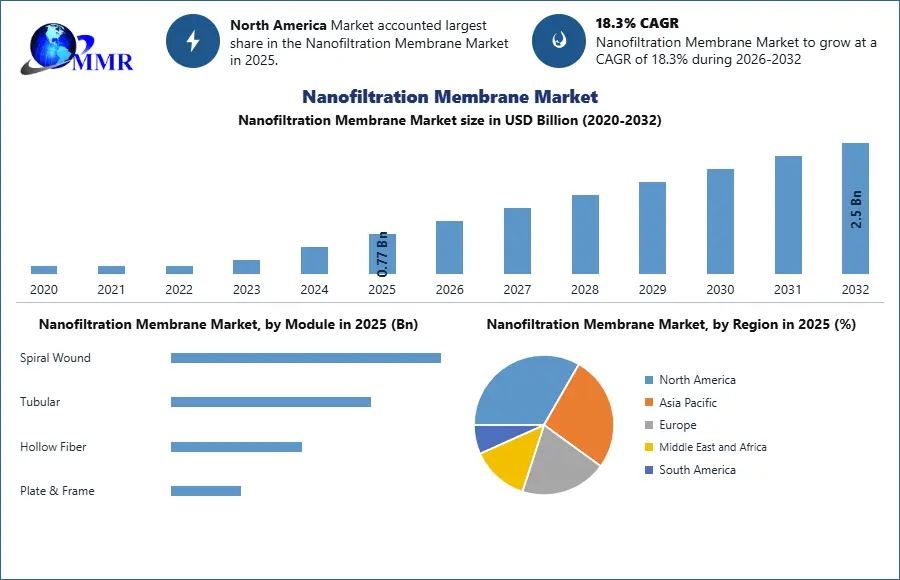
Nanofiltration Membrane Market size is expected to reach 2.5 US$ Bn in year 2032, at a CAGR of 18.3% during the forecast period.

Nanofiltration is the recent advancement in the membrane filtration process in surface water filtration and fresh groundwater filtration process. This type of filtration helps in water softening and sterilisation of water. The global nanofiltration membrane market is driven by its applications and demand from end users, which include water & wastewater treatment, food & beverages, chemical & petrochemicals, pharmaceutical & biomedical, textile and metalworking industry.Nanofiltration Membrane Market SnapshotTo know about the Research Methodology :- Request Free Sample Report
In the food & beverage industry, nanofiltration membrane is used to concentrate food & beverages naturally without degrading the products. At the same time, increase in disposable income of individual and high standard of living across developed and emerging economies leads to an increase in demand for fast food & beverages. This makes way for an increase in demand for nanofiltration membrane for the concentration of food & beverages.The report study has analyzed revenue impact of COVID -19 pandemic on the sales revenue of market leaders, market followers and market disrupters in the report and same is reflected in our analysis.

Nanofiltration membrane finds application in water and wastewater treatment that includes water softening and colour removal, industrial wastewater treatment, water reuse, and desalination. Rapid urbanization and industrialization across emerging economies such as India and China and an increase in demand for water for domestic and industrial purposes are expected to boost the growth of the  market. Expansion of the pharmaceutical industry across developing nations such as India, China, and Brazil also increase the demand for nanofiltration membrane in the market. In addition, an increase in sales of generic medicines, developments in medical infrastructure, and the rise in demand for low-cost drugs are expected to drive boost the growth of the nanofiltration membrane market.

At the same time, high installation costs and lack of funds in the emerging economies such as India restrict market growth. Furthermore, nanofiltration membranes are highly sensitive to free chlorine inability in treatment of chlorine concentration is expected to hinder the growth of the market. Increase in the use of chemical free water treatment procedures across various industries provides potential growth opportunities for market expansion.

According to type, the polymeric segment dominated the market in 2023, on account of its demand in wastewater treatment and water purification plants as these membranes operate on low pressure and provide higher filtration rate. There is a significant increase in the demand for water filtration techniques due to the increase in scarcity for pure water in regions such as North America and the Middle East. This, in turn, increases the requirement of nanofiltration membrane in the water filter technology.

Among the regions, North America is a leading region in the market. It is expected to maintain its dominance in the nanofiltration membrane market during the forecast period and Asia-Pacific is expected to be the fastest growing region because of increase in usage of nanofiltration membranes in water treatment systems and high government regulations regarding water pollutions and environment safety.

The nanofiltration membranemarket report contains in-depth analysis of major drivers, opportunities, challenges, industry trends and their impact on the market. The nanofiltration membrane Market report also provides data about the company and its strategy. This report also provides information on the competitive landscape section of the report provides a clear insight into the market share analysis of key industry players. The nanofiltration membrane Market report also provides a company overview, financial overview, product portfolio, new project launched, and recent development analysis is the parameters included in the report. This research report also adds a snapshot of key competition, market trends during the forecast period, expected growth rates and the primary factors driving and impacting growth market data. This information will be beneficial or helpful to the decision makers.

The objective of the report is to present a comprehensive assessment of the market and contains thoughtful insights, facts, historical data, industry-validated market data and projections with a suitable set of assumptions and methodology. The report also helps in understanding the global nanofiltration membrane market dynamics, structure by identifying and analysing the market segments and project the global market size. Further, the report also focuses on the competitive analysis of key players by product, price, financial position, product portfolio, growth strategies, and regional presence. The report also provides PEST analysis, PORTER’s analysis, and SWOT analysis to address questions of shareholders to prioritizing the efforts and investment in the near future to the emerging segment in the global nanofiltration membrane market.

Nanofiltration Membrane Market Scope: Inquire before buying

Nanofiltration Membrane Market
Report Coverage Details
Base Year: 2025 Forecast Period: 2026-2032
Historical Data: 2020 to 2025 Market Size in 2025: 0.77 USD Billion
Forecast Period 2026-2032 CAGR: 18.3% Market Size in 2032: 2.5 USD Billion
Segments Covered: by Type Polymeric
    Polyamide
    Polysulfone & Polyethersulfone
    Others
    Ceramic
    Zircon ia
    Alumina
    Titania
    Others
Composite
Others
by Module Spiral Wound
Tubular
Hollow Fiber
Plate & Frame
by Application Municipal Treatment
    Desalination
    Utility Water Treatment
    Wastewater Reuse
Industrial Treatment
    Food & Beverage Processing
    Pharmaceutical & Biotechnology
    Chemical & Petrochemical
    Others

Nanofiltration Membrane Market, by Region:

Asia Pacific (China, South Korea, Japan, India, Australia, Indonesia, Malaysia, Vietnam, Taiwan, Bangladesh, Pakistan and Rest of APAC)
Europe (UK, France, Germany, Italy, Spain, Sweden, Austria and Rest of Europe)
North America (United States, Canada and Mexico)
Middle East and Africa (South Africa, GCC, Egypt, Nigeria and Rest of ME&A)
South America (Brazil, Argentina Rest of South America)

Nanofiltration Membrane Market, Key Players:

1. DuPont
2. Toray Industries
3. NX Filtration
0. Pentair Plc
5. LG Chem (LG Water Solutions)
6. Hydranautics (Nitto Denko Corporation)
7. ALFA LAVAL
8. Applied Membranes Inc.
9. GE Water & Process Technologies
10.Aquatech
11.Koch Membrane Systems Inc.
12.Microdyn-Nadir (MANN+HUMMEL Group)
13.Inopor GmbH
14.Solecta Inc.
15.Seppure Technologies
16.Sitration Inc.
17.Nematiq
18.MOLYMEM
19.Trucent
20.UltraClean Membrane Technology
21.Vontron Membrane Technology
22.Envirogen Technologies
23.Wigen Water Technologies
24.Pall Corporation
25.GEA Group
26.Synder Filtration
27.Veolia Water Technologies
28.Others

Frequently Asked Questions:

1. Which region has the largest share in Global Nanofiltration Membrane Market?
Ans: North America region held the highest share in 2025.

2. What is the growth rate of Global Nanofiltration Membrane Market?
Ans: The Global Nanofiltration Membrane Market is growing at a CAGR of 18.3% during forecasting period 2026-2032.

3. What is scope of the Global Nanofiltration Membrane market report?
Ans: Global Nanofiltration Membrane Market report helps with the PESTEL, PORTER, COVID-19 Impact analysis, Recommendations for Investors & Leaders, and market estimation of the forecast period.

4. Who are the key players in Global Nanofiltration Membrane market?
Ans: The important key players in the Global Nanofiltration Membrane Market are – Alfa Laval, Applied Membranes, Inc., Argonide Corporation, Danaher, DowDuPont Inc., GEA Group Aktiengesellschaft, Inopor, Koch Membrane Systems, Inc., Nitto Denko Corporation, Toray Industries, Inc., Pall Water, Synder Filtration, DOW Chemical, Toray Water, Culligan, Synder Filtration, and Linde.

5. What is the study period of this market?
Ans: The Global Nanofiltration Membrane Market is studied from 2025 to 2032.

Table of Contents

SECTION A – GLOBAL NANOFILTRATION MEMBRANE MARKET INTRODUCTION A1. Executive Market Landscape and Industry Overview 1.1. Global Nanofiltration Membrane Market Size (USD Billion), 2025–2032 1.2. Market Definition, Scope, and Key Segmentation Criteria for Global Nanofiltration Membrane Market 1.3. Global Nanofiltration Membrane Market Ecosystem 1.4. Competitive Landscape Overview: Key Players, Innovators, and Emerging Participants in Global Nanofiltration Membrane Market A2. Global Nanofiltration Membrane Market Dynamics 2.1. Global Nanofiltration Membrane Market Trends 2.2. Global Nanofiltration Membrane Market DROC Analysis 2.2.1. Drivers 2.2.2. Restraints 2.2.3. Opportunities 2.2.4. Challenges 2.3. PORTER’s Five Forces Analysis 2.3.1. Supplier power 2.3.2. Buyer power 2.3.3. Threat of substitutes 2.3.4. Threat of new entrants 2.3.5. Competitive rivalry 2.4. PESTLE Analysis A3. Global Supply Chain and Ecosystem Analysis 3.1. Nanofiltration Membrane Market Ecosystem Overview 3.2. Raw material suppliers and their offerings (polyamide, polysulfone, ceramic materials such as alumina, zirconia, titania) 3.3. Role of nanofiltration membranes in water purification, industrial separation, and wastewater treatment processes A4. Technology Landscape 4.1. Key technological trends in nanofiltration membranes (TFC, nanocomposite membranes) 4.2. Emerging materials such as graphene-based and ceramic membranes 4.3. Integration with AI, IoT, and automation in filtration systems 4.4. Use of predictive maintenance and smart monitoring technologies 4.5. Advancements in anti-fouling, high-flux, and energy-efficient membranes 4.6. Development of hybrid systems combining NF with RO, UF, and MBR A5. Pricing and Revenue Analysis (2025) 5.1. Historic price trends of nanofiltration membranes (2020–2025) 5.2. Average selling price (ASP) by membrane type (polymeric, ceramic, composite) 5.3. Pricing variation across modules (spiral wound, tubular, hollow fiber) 5.4. Impact of industrial applications (ETP, MBR, ZLD) on pricing structures 5.5. Regional pricing differences across North America, Europe, and Asia-Pacific 5.6. Cost breakdown including membrane, module, installation, and maintenance A6. Water Infrastructure and Adoption Analysis 6.1. Analysis of water treatment infrastructure readiness across regions 6.2. Adoption of nanofiltration in municipal and industrial sectors 6.3. Integration with existing water treatment systems (RO, UF, ETP, MBR) 6.4. Comparison of adoption rates in developed and developing regions 6.5. Growth of industrial wastewater treatment infrastructure 6.6. Increasing focus on water reuse and recycling initiatives A7. Adoption in Developing Regions 7.1. Growth of nanofiltration adoption in Asia-Pacific, Middle East, and Africa 7.2. Drivers such as water scarcity and industrialization 7.3. Challenges including cost, technical expertise, and infrastructure gaps 7.4. Government initiatives promoting wastewater treatment and reuse 7.5. Adoption of NF membranes in ETP and ZLD applications 7.6. Expansion of desalination and reuse projects A8. Adoption by Country (2025–2032) 8.1. Adoption trends in major countries (US, Germany, China, India, Japan) 8.2. Number of treatment plants using nanofiltration membranes 8.3. Industrial vs municipal adoption rates by country 8.4. Adoption of ETP, MBR, and ZLD systems by region 8.5. Growth outlook in emerging markets (Africa, South America, Southeast Asia) 8.6. Country-wise regulatory impact on adoption A9. Adoption Rate by Application (2025–2032) 9.1. Adoption rates in municipal utilities, industries, and commercial sectors 9.2. Industrial sector demand (chemicals, pharmaceuticals, food & beverage) 9.3. Regional adoption rates across North America, Europe, APAC, South America, and MEA 9.4. Growth in advanced treatment systems (ETP, MBR, ZLD) 9.5. Adoption by small, medium, and large-scale industries 9.6. Demand from water-intensive industries A10. System Configuration and Integration 10.1. Integration of nanofiltration with RO, UF, MBR, and ZLD systems 10.2. Modular system configurations for scalable water treatment 10.3. Use of automation and control systems in filtration processes 10.4. Real-time monitoring and system optimization 10.5. Hybrid system design for enhanced efficiency 10.6. Post-installation integration and system upgrades A11. Post-Implementation Support and Maintenance 11.1. Importance of maintenance in membrane lifecycle performance 11.2. Cleaning, replacement, and fouling management strategies 11.3. Breakdown of maintenance and operational costs 11.4. Technical support and service provider ecosystem 11.5. Monitoring system performance and efficiency optimization 11.6. Long-term cost management strategies A12. System Integration Challenges 12.1. High capital investment and operational complexity 12.2. Fouling, scaling, and membrane degradation issues 12.3. Integration challenges with legacy water treatment systems 12.4. Variability in feedwater quality affecting performance 12.5. Operational inefficiencies in industrial applications 12.6. Solutions for improving system efficiency and performance A13. Transition Toward Smart and Digital Water Systems 13.1. Growth of smart water management systems across regions 13.2. Adoption of IoT-enabled filtration systems 13.3. Real-time monitoring and predictive analytics 13.4. Automation in water treatment operations 13.5. Remote monitoring and control capabilities 13.6. Digital transformation in industrial water management A14. Automation and Scalability in Water Treatment Systems 14.1. Adoption of automated filtration systems 14.2. Scalable system design for industrial and municipal use 14.3. Advantages of automation in reducing operational costs 14.4. Challenges in automation adoption 14.5. Integration with smart infrastructure systems 14.6. Future outlook for automated water treatment A15. Demand Insights 15.1. Municipal utilities as major consumers of nanofiltration membranes 15.2. Industrial demand driven by regulatory compliance (ETP, ZLD) 15.3. Growth in pharmaceutical and food processing industries 15.4. Focus on water reuse and sustainability 15.5. Increasing adoption in high water consumption industries 15.6. Demand from emerging industrial sectors A16. Remote Monitoring and System Integration 16.1. Role of digital systems in monitoring membrane performance 16.2. Integration with remote monitoring technologies 16.3. Benefits of predictive maintenance 16.4. Growth of smart filtration systems 16.5. Adoption of cloud-based monitoring platforms 16.6. Real-time operational optimization A17. Artificial Intelligence (AI) in Membrane Systems 17.1. Use of AI in predictive maintenance and fouling detection 17.2. Machine learning for system optimization 17.3. Automation of filtration processes 17.4. AI-based performance monitoring 17.5. Integration with industrial IoT systems 17.6. Challenges in AI adoption A18. Digital Transformation in Water Treatment 18.1. Impact of digital technologies on water management 18.2. Integration with industrial IoT and smart systems 18.3. Role of data analytics in system optimization 18.4. Digital platforms for water treatment monitoring 18.5. Transformation of industrial wastewater management 18.6. Future outlook for digital water ecosystems A19. User-Centric Solutions 19.1. Customization of filtration systems based on industry requirements 19.2. Focus on improving water reuse efficiency 19.3. Development of application-specific solutions 19.4. Integration with industrial processes 19.5. Enhancing operational efficiency 19.6. Reducing overall treatment costs A20. Integration with Decision Support Systems 20.1. Use of analytics for decision-making in water treatment 20.2. Integration with monitoring and control systems 20.3. AI-driven predictive analytics 20.4. Optimization of operational efficiency 20.5. Real-time data-driven decision support 20.6. Adoption in industrial applications A21. Public vs Private Sector Adoption 21.1. Adoption trends in municipal (public) sector 21.2. Private sector demand from industrial applications 21.3. Differences in investment and infrastructure 21.4. Government funding and support 21.5. Role in improving water sustainability 21.6. Future outlook for adoption A22. Sustainability and Environmental Impact Assessment 22.1. Reduction in wastewater discharge through reuse 22.2. Energy-efficient filtration technologies 22.3. Use of eco-friendly materials 22.4. Contribution to circular water economy 22.5. Reduction in environmental impact 22.6. Alignment with ESG and sustainability goals A23. Investment Landscape & Growth Opportunities 23.1. Investment trends in water treatment infrastructure 23.2. Growth in ZLD and wastewater reuse projects 23.3. Government incentives and funding 23.4. Private sector investments 23.5. Expansion opportunities in emerging markets 23.6. Innovation-driven growth opportunities A24. Regulatory Landscape 24.1. Global wastewater treatment regulations 24.2. Regional compliance requirements 24.3. ZLD mandates in countries like India and China 24.4. Industrial discharge standards 24.5. Water reuse regulations 24.6. Impact of environmental policies on market growth A25. Patent Analysis 25.1. Global patent trends in nanofiltration membranes 25.2. R&D focus areas (materials, efficiency, durability) 25.3. Innovation in anti-fouling technologies 25.4. Patent activity by key players 25.5. Emerging technologies in filtration 25.6. Investment in research and development A26. Nanofiltration Membrane Role in Zero Liquid Discharge (ZLD) Systems 26.1. Role in concentration and recovery stages 26.2. Integration with RO and evaporation systems 26.3. Adoption in industries with strict discharge regulations 26.4. Reduction in brine volume 26.5. Achievement of complete water recovery 26.6. Contribution to sustainability and circular water economy A27. Nanofiltration Membrane Application in ETP (Effluent Treatment Plants) 27.1. Role in tertiary treatment of industrial effluents 27.2. Removal of dissolved solids, heavy metals, and organics 27.3. Integration with primary and secondary treatment systems 27.4. Adoption across chemicals, textiles, and pharma industries 27.5. Enhancement of water reuse efficiency 27.6. Reduction in chemical consumption and operational costs A28. Nanofiltration Membrane Integration in MBR Systems (Membrane Bioreactors) 28.1. Role in advanced biological treatment systems 28.2. Integration with MBR for improved filtration performance 28.3. Application in compact wastewater treatment systems 28.4. Reduction in plant footprint and operational cost 28.5. Improved effluent quality for reuse 28.6. Enhancement of sludge separation efficiency A29. Risk Assessment and Mitigation Framework 29.1. Operational risks (fouling, scaling, system failure) 29.2. High capital and maintenance costs 29.3. Regulatory and compliance risks 29.4. Supply chain disruptions 29.5. Market sensitivity to raw material prices 29.6. Risk mitigation strategies 29.7. Global Nanofiltration Membrane Market Size and Forecast, By Type 29.7.1. Polymeric 29.7.1.1. Polyamide 29.7.1.2. Polysulfone & Polyethersulfone 29.7.1.3. Others 29.7.1.4. Ceramic 29.7.1.5. Zirconia 29.7.1.6. Alumina 29.7.1.7. Titania 29.7.1.8. Others 29.7.2. Composite 29.7.3. Others 29.8. Global Nanofiltration Membrane Market Size and Forecast, By Module 29.8.1. Spiral Wound 29.8.2. Tubular 29.8.3. Hollow Fiber 29.8.4. Plate & Frame 29.9. Global Nanofiltration Membrane Market Size and Forecast, By Application 29.9.1. Municipal Treatment 29.9.1.1. Desalination 29.9.1.2. Utility Water Treatment 29.9.1.3. Wastewater Reuse 29.9.2. Industrial Treatment 29.9.2.1. Food & Beverage Processing 29.9.2.2. Pharmaceutical & Biotechnology 29.9.2.3. Chemical & Petrochemical 29.9.2.4. Others 29.10. Global Nanofiltration Membrane Market Size and Forecast, By Region 29.10.1. North America 29.10.1.1. United States 29.10.1.2. Canada 29.10.1.3. Mexico 29.10.2. Europe 29.10.2.1. United Kingdom 29.10.2.2. France 29.10.2.3. Germany 29.10.2.4. Italy 29.10.2.5. Spain 29.10.2.6. Sweden 29.10.2.7. Russia 29.10.2.8. Rest of Europe 29.10.3. Asia Pacific 29.10.3.1. China 29.10.3.2. S. Korea 29.10.3.3. India 29.10.3.4. Japan 29.10.3.5. Australia 29.10.3.6. Indonesia 29.10.3.7. Philippines 29.10.3.8. Malaysia 29.10.3.9. Vietnam 29.10.3.10. Thailand 29.10.3.11. Rest of Asia Pacific 29.10.4. Middle East and Africa 29.10.4.1. South Africa 29.10.4.2. GCC 29.10.4.3. Egypt 29.10.4.4. Nigeria 29.10.4.5. Rest of ME&A 29.10.5. South America 29.10.5.1. Brazil 29.10.5.2. Argentina 29.10.5.3. Chile 29.10.5.4. Colombia 29.10.5.5. Rest Of South America SECTION B – COMPETITIVE INTELLIGENCE & INDUSTRIAL ECOSYSTEM B1. Company Profiles: Key Players 1.0.1. Overview 1.0.2. Business Portfolio 1.0.3. Financial Overview 1.0.4. SWOT Analysis 1.0.5. Strategic Analysis 1.0.6. Recent Developments 1.1. DuPont 1.2. Toray Industries 1.3. NX Filtration 1.4. Pentair Plc 1.5. LG Chem (LG Water Solutions) 1.6. Hydranautics (Nitto Denko Corporation) 1.7. ALFA LAVAL 1.8. Applied Membranes Inc. 1.9. GE Water & Process Technologies 1.10. Aquatech 1.11. Koch Membrane Systems Inc. 1.12. Microdyn-Nadir (MANN+HUMMEL Group) 1.13. Inopor GmbH 1.14. Solecta Inc. 1.15. Seppure Technologies 1.16. Sitration Inc. 1.17. Nematiq 1.18. MOLYMEM 1.19. Trucent 1.20. UltraClean Membrane Technology 1.21. Vontron Membrane Technology 1.22. Envirogen Technologies 1.23. Wigen Water Technologies 1.24. Pall Corporation 1.25. GEA Group 1.26. Synder Filtration 1.27. Veolia Water Technologies B2. Company Evaluation Matrix: Key Players (2025) 2.1. Stars category representing high-growth players with strong presence in municipal and industrial water treatment 2.2. Emerging leaders expanding in ETP, MBR, and ZLD system applications 2.3. Pervasive players with stable operations across membrane types and regional markets 2.4. Participants category including regional and niche membrane manufacturers 2.5. Company footprint analysis across production capacity, technology, and geographic reach 2.6. Market footprint based on application segments such as desalination, wastewater reuse, and industrial filtration B3. Key Player Strategies / Right to Win (2020–2025) 3.1. Strategic positioning of players in water treatment and industrial filtration markets 3.2. Focus on advanced membrane technologies (TFC, nanocomposite membranes) 3.3. Expansion strategies in ETP, MBR, and ZLD systems 3.4. Partnerships with EPC contractors and system integrators 3.5. Investment in R&D for fouling resistance and energy efficiency 3.6. Regional expansion in high-growth markets such as Asia-Pacific and Middle East B4. Market Share Analysis (2025) 4.1. Global market share distribution among leading membrane manufacturers 4.2. Regional share analysis across North America, Europe, Asia-Pacific, and MEA 4.3. Market concentration across municipal vs industrial applications 4.4. Share comparison across membrane types (polymeric, ceramic, composite) 4.5. Application-based share in ETP, MBR, ZLD, desalination, and water reuse 4.6. Contribution of top players vs regional manufacturers B5. Market Evaluation Framework (2020–2025) 5.1. Evaluation criteria including production capacity, technology innovation, and application coverage 5.2. Benchmarking based on membrane efficiency, durability, and cost performance 5.3. Comparative assessment across global and regional players 5.4. Key insights on competitive differentiation and positioning 5.5. Assessment of system integration capabilities (ETP, MBR, ZLD) 5.6. Performance benchmarking across industrial and municipal sectors B6. R&D and Innovation Strategy Analysis by Key Players 6.1. R&D investment (% of revenue) in membrane development and material innovation 6.2. Focus areas (nanocomposite membranes, anti-fouling coatings, energy-efficient filtration) 6.3. Patent activity in membrane technology and water treatment solutions 6.4. Investment in smart monitoring, AI-based optimization, and automation systems 6.5. Development of next-generation high-flux and low-pressure membranes 6.6. Innovation in membrane durability, lifecycle extension, and performance optimization B7. Competitive Strengths and Weaknesses Analysis 7.1. Product and technology strengths across membrane types and applications 7.2. Integration capabilities with water treatment systems (RO, UF, MBR, ZLD) 7.3. Scalability across municipal and industrial installations 7.4. Pricing and service model comparison across regions 7.5. Regional strengths and limitations in manufacturing and distribution 7.6. Customer support, installation, and maintenance capabilities 7.7. Strength in large-scale industrial projects vs small and mid-scale installations B8. Global Geographic Expansion Strategies 8.1. Vendor presence by region (North America, Europe, Asia-Pacific, MEA, South America) 8.2. Expansion into emerging markets driven by water scarcity and industrial growth 8.3. Localization strategies based on regulatory compliance and water standards 8.4. Regional partnerships with EPC contractors and distributors 8.5. Cross-border project execution capabilities 8.6. Growth focus in municipal infrastructure vs industrial wastewater treatment B9. Startup and Emerging Player Analysis 9.1. Emerging membrane technology startups globally 9.2. Venture capital investments in water treatment and filtration technologies 9.3. AI-driven and smart filtration system innovators 9.4. Specialty membrane developers focusing on niche applications 9.5. Competitive threat from low-cost regional manufacturers 9.6. Emerging vendors in industrial wastewater and ZLD applications B10. Strategic Partnerships and Collaborations 10.1. Partnerships with EPC contractors and water treatment companies 10.2. Alliances with industrial players for wastewater treatment solutions 10.3. Integration partnerships with RO, UF, and MBR system providers 10.4. Public-private partnerships in municipal water infrastructure 10.5. Collaborations with technology providers for smart monitoring systems 10.6. Ecosystem partnerships for sustainable water management solutions B11. Mergers and Acquisitions Analysis 11.1. Strategic acquisitions in membrane technology and water treatment companies 11.2. Market consolidation trends in filtration and water treatment industry 11.3. Technology acquisition strategies (advanced materials, automation, AI integration) 11.4. Acquisitions to strengthen industrial and municipal market presence 11.5. Portfolio expansion through integration of treatment solutions (ETP, ZLD) 11.6. Regional M&A activity to expand manufacturing and distribution footprint C. STRATEGIC OUTLOOK C1. Key Findings C2. Strategic Moves & Industry Outlook C3. Research Methodology

Custom Market Research Services

We Will Customise The Research For You, In Case The Report Listed Above Does Not Meet With Your Requirements