
Mining Services Market By Mineral Type, By Mining Type, By Services, By End-Use Industry and Regional Insights 2034
Overview
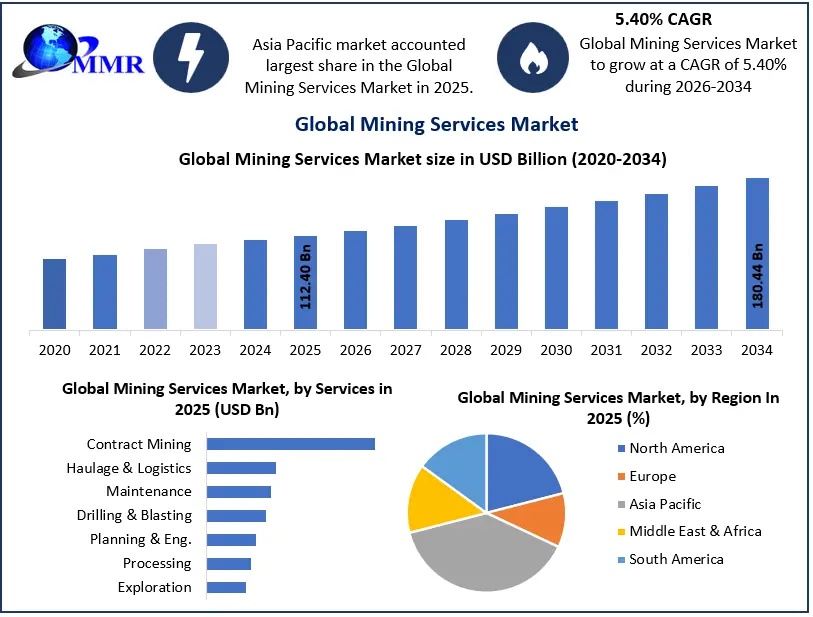
The Global Mining Services Market size was valued at USD 112.40 Billion in 2025 and the total market revenue is expected to grow at a CAGR of 5.40% from 2026 to 2034, reaching USD 180.44 Billion by 2034.
Mining Services Market Overview
The Global Mining Services Market covers the outsourced technical, operational and support activities that enable mineral exploration, mine development, extraction, processing and closure across surface and underground operations. The market spans exploration and geological services, mine planning and engineering consulting, drilling and blasting, contract mining, material handling and transportation, mineral processing and beneficiation, equipment maintenance and repair, environmental and rehabilitation services, and mining technology and workforce solutions, delivered by specialist contractors, engineering firms, equipment manufacturers and integrated service providers. The market is influenced by rising demand for copper, lithium, nickel, cobalt and gold, growing outsourcing of non-core mining activities, pressure on mine productivity and operating costs, wider adoption of automation and digital mining support, and stricter environmental, safety and mine closure requirements.
The Global Mining Services Market size was valued at USD 112.40 Billion in 2025 and the total market revenue is expected to grow at a CAGR of 5.40% from 2026 to 2034, reaching USD 180.44 Billion by 2034. Contract mining remains the largest service category, followed by material handling and transportation, equipment maintenance and repair, and drilling and blasting services, while exploration services and mineral processing support are gaining momentum as producers accelerate critical mineral projects. Demand is also being reshaped by the shift toward long-term, performance-based and integrated contracts, in which providers take responsibility for productivity, equipment availability and safety outcomes. Metal mining accounts for the largest share of service spending, while underground mining is expected to grow faster than surface mining as operators move toward deeper and more complex orebodies. Service providers are therefore investing in autonomous equipment, remote operations, predictive maintenance and low-emission fleets to differentiate their offerings and secure multi-year contracts.
The MMR report on the Global Mining Services Market provides a structured assessment of the industry, covering mining contractors, engineering and consulting firms, drilling and blasting specialists, equipment maintenance providers and mineral processing service companies. The report evaluates market size and growth trends, examines demand across mineral types, mining methods, service categories and end-use industries, and assesses regional performance and competitive positioning. It also includes company profiling and competitive benchmarking to help readers understand the strategies, service portfolios and geographic presence of leading participants, supporting decisions related to market entry, service expansion, partnerships and investment.
Mining Services Market Size, Growth & Share Analysis
To know about the Research Methodology :- Request Free Sample Report
| Parameter | Value |
| Market Size (2025) | USD 112.40 Billion |
| Market Size (2034) | USD 180.44 Billion |
| CAGR | 5.40% |
| Historical Period | 2020 to 2025 |
| Forecast Period | 2026 to 2034 |
Global Mining Services Market Key Highlights
• Strong Market Growth: The Global Mining Services Market was valued at USD 112.40 Billion in 2025 and is projected to reach USD 180.44 Billion by 2034, growing at a CAGR of 5.40% during the forecast period.
• Critical Minerals Driving Service Demand: Rising demand for copper, lithium, nickel, cobalt and graphite for electrification and clean energy technologies is expanding exploration, mine development and production support requirements worldwide.
• Outsourcing and Integrated Contracts Gaining Ground: Mining companies are outsourcing drilling, haulage, maintenance, processing and underground development, and are moving toward long-term, performance-based and end-to-end service agreements.
• Contract Mining Leads the Services Landscape: Contract mining services hold the largest share of the market, supported by the outsourcing of excavation, loading, hauling, mine development and production management across surface and underground sites.
• Metal Mining Dominates Commodity Demand: Copper, iron ore, gold, nickel and lithium projects generate the highest service intensity owing to extensive drilling, development, haulage and processing requirements.
• Underground Mining Gaining Momentum: Deeper, narrow-vein and geologically complex deposits are increasing demand for underground development, ground support, ventilation and dewatering specialists.
• Automation and Digital Services Expanding: Autonomous equipment support, fleet management, remote operating centres and AI-enabled predictive maintenance are improving productivity and strengthening provider differentiation.
• Asia Pacific Leads While Middle East & Africa Grows Fastest: Asia Pacific holds the largest regional share, whereas Middle East & Africa is projected to record the fastest growth, supported by new gold, copper and phosphate developments.
• Sustainability, Safety and Closure Services Strengthening: Water management, tailings oversight, decarbonization advisory, mine rehabilitation and safety compliance services are becoming standard components of mining service scopes.
Global Mining Services Market Dynamics:
Rising Demand for Critical Minerals and Expanding Mine Development Pipelines to Drive Global Mining Services Market
Global mining activity is being reshaped by the energy transition, electrification and infrastructure investment, all of which depend on a steady supply of copper, lithium, nickel, cobalt, graphite and other critical minerals. As new mines are developed and existing operations are expanded, producers require exploration, mine planning, drilling, contract mining, processing and maintenance support at a scale that is often beyond the capacity of in-house teams. Mining services providers benefit directly from this pipeline, as outsourced expertise helps mine owners compress development timelines, manage capital intensity and maintain production continuity.
According to the World Bank, production of minerals such as graphite, lithium and cobalt may need to rise by nearly 500% by 2050 to meet demand from clean energy technologies. Such projections point to a prolonged cycle of exploration spending, greenfield development and brownfield expansion across Australia, Canada, Chile, Peru, Indonesia, the Democratic Republic of the Congo and other mineral-rich economies, creating a sustained order book for drilling, underground development and contract mining providers.
Growing Outsourcing and Integrated Service Contracts to Create Market Opportunities
Mining companies are increasingly outsourcing activities such as production drilling, load-and-haul, underground development, equipment maintenance and mineral processing to specialist contractors so that they can concentrate capital and management attention on resource strategy and asset optimization. Outsourcing converts fixed costs into variable costs, provides access to specialized fleets and skilled labour, and allows operators to scale activity up or down in response to commodity prices and project stage.
The market is also witnessing a transition from single-scope, short-term work orders to integrated, long-term agreements that bundle mine planning, operations, maintenance and technology support under performance-based pricing. Recent contract awards across gold, copper and coal operations in Australia, North America, Africa and Asia show that mine owners are favouring contractors with proven safety records, financial strength and the ability to deliver across the full mine lifecycle. Providers that can combine contract mining with maintenance, processing and digital capabilities are expected to capture a growing share of this opportunity.
Technological Advancements in Automation, Digitalization and Sustainable Mining Support
Mining operations are becoming more data-driven as operators seek higher equipment utilization, lower unit costs and safer working environments. Service providers are deploying autonomous haulage and drilling support, fleet management and dispatch optimization, remote operating centres, drone and geospatial surveying, AI-enabled predictive maintenance and integrated operational technology platforms. These capabilities reduce unplanned downtime, improve drill-and-blast accuracy and enable continuous performance monitoring across dispersed sites.
Sustainability is shaping service demand in parallel. Water management, tailings oversight, dust and emissions monitoring, decarbonization advisory, battery-electric and hybrid fleet integration, and progressive rehabilitation are becoming standard components of mining service scopes. Stricter permitting, closure-cost assurance and ESG disclosure requirements are encouraging mine owners to rely on specialist environmental and closure service providers throughout the mine life rather than only at end-of-life.
Skilled Labour Shortages, Commodity Price Volatility and Contract Risk as Market Challenges
Despite a favourable demand outlook, the market faces several constraints. Remote mine sites, competition for qualified engineers, geologists, operators and maintenance technicians, and rising wage and fuel costs place pressure on contractor margins, particularly under fixed-price or unit-rate agreements. Commodity price swings can also delay project approvals, defer capital expenditure and reduce discretionary spending on exploration and expansion services, making contractor revenue cyclical.
Contract risk, regulatory complexity and project-execution uncertainty add further challenges. Escalating equipment costs, supply-chain delays for tyres, spare parts and consumables, lengthy permitting timelines, community and environmental scrutiny, and resource-nationalism risks in certain jurisdictions can affect service delivery and profitability. Mining companies also retain the option to bring selected activities in-house when markets tighten. Service providers that invest in workforce development, fleet reliability, transparent cost structures and flexible contract terms are better positioned to manage these challenges.
Global Mining Services Market Segment Analysis
The Global Mining Services Market is segmented into mineral type, mining type, services, end-use industry, and region. Each segment reflects distinct technical requirements, contract structures, capital intensity and demand patterns across the mining value chain.
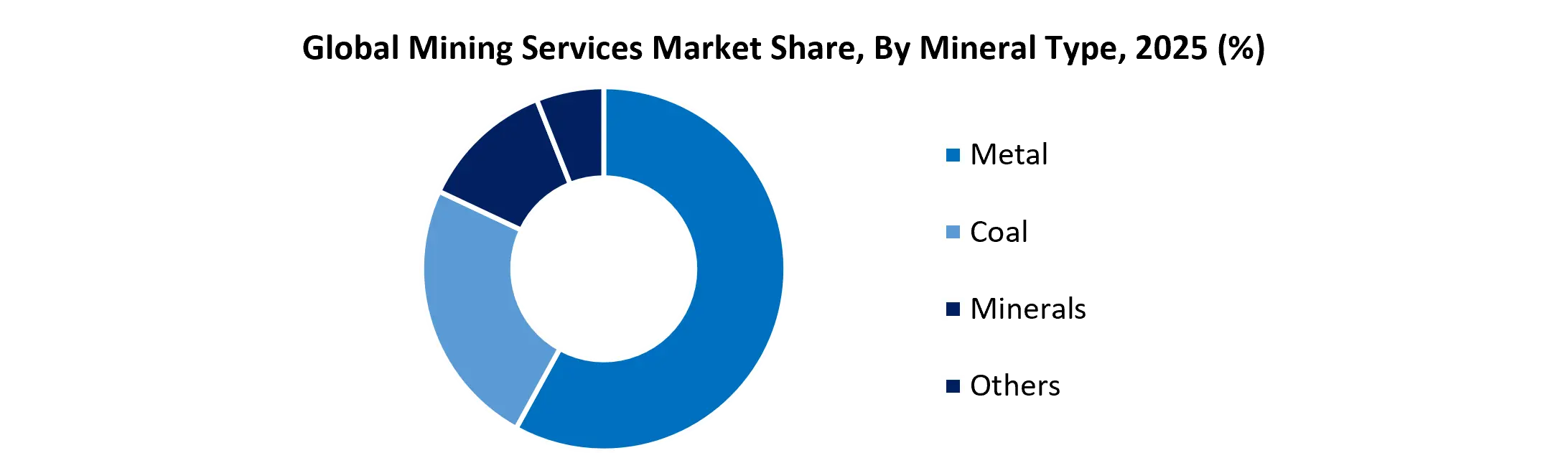
Based on Mineral Type, the global market is segmented into metal, coal, minerals, and others. Metal is further segmented into copper, iron, aluminum, gold, nickel, lithium, cobalt, magnesium, zinc, titanium and others, while minerals include bauxite, phosphate, graphite and others.
The metal segment is expected to hold the largest share of the global market owing to sustained demand for copper, iron ore, gold, nickel and battery minerals, which require intensive exploration, drilling, underground development, haulage and processing support. Copper and gold projects in particular rely heavily on contract mining and specialized engineering services, while lithium, nickel and cobalt developments are expanding demand for exploration drilling, resource definition and beneficiation support.
The coal segment continues to generate a substantial volume of mining service activity, especially in Indonesia, India, China, Australia and South Africa, where contract mining, overburden removal, coal haulage and coal handling and preparation plant operation are widely outsourced. Although energy-transition policies influence new investment, existing thermal and metallurgical coal operations continue to require maintenance, mine operations and rehabilitation services.
The minerals and others segments include bauxite, phosphate, graphite, potash, uranium and industrial minerals, along with quarrying activity. These segments are gaining importance as supply chains for aluminum, fertilizers and battery materials expand, creating opportunities for drilling, processing, logistics and environmental service providers.
Based on Services, the market is segmented into exploration services, mine planning and engineering services, drilling and blasting services, contract mining services, material handling and transportation services, mineral processing and beneficiation services, and mining equipment maintenance and repair services.
Contract mining services are expected to account for the largest share of the segment, supported by growing outsourcing of surface and underground mining operations, including excavation, loading, hauling, mine development and production management. Long-term, production-linked and integrated contracts are strengthening revenue visibility for contractors. Material handling and transportation services and mining equipment maintenance and repair services follow, as fleet productivity, haulage efficiency and equipment availability remain central to mine economics.
Exploration services are projected to register the fastest growth, with an estimated CAGR of 6.4% during 2025 to 2034, as producers and junior miners expand drilling programmes, geophysical surveys and resource modelling for copper, lithium, gold and other critical minerals. Drilling and blasting services benefit from the emphasis on fragmentation optimization and safety, mine planning and engineering services from feasibility and optimization studies, and mineral processing and beneficiation services from the need to improve recovery and treat lower-grade ores.
By Mining Type
Based on Mining Type, the market is segmented into surface mining and underground mining.
Surface mining is expected to remain the larger segment, holding an estimated 62% share in 2025, supported by large open-pit coal, iron ore, copper and bauxite operations that require high volumes of drilling, blasting, excavation, haulage and equipment maintenance. Scale, fleet intensity and long operating lives make surface mines major generators of recurring contractor revenue.
Underground mining is projected to grow faster than surface mining as shallower deposits are depleted and operators move toward deeper, narrow-vein and geologically complex orebodies. Underground development, ground support, ventilation, dewatering and block-cave infrastructure demand specialized skills and equipment, encouraging mine owners to rely on experienced contractors and long-term partnerships.
By End-Use Industry
Based on end-use industry, the market is segmented into mining companies, government-owned mining enterprises, mineral processing companies, and others. Mining companies, including large diversified miners, mid-tier operators and junior explorers, represent the broadest demand base for exploration, contract mining and maintenance services. Government-owned mining enterprises are important buyers in coal, iron ore and base metals, often engaging contractors to add capacity, introduce technology and meet production targets. Mineral processing companies are expanding demand for plant operation, metallurgical testing, maintenance and process optimization services, while the others segment includes royalty-based operators, quarry operators and infrastructure-linked mining projects.
Global Mining Services Market Regional Insights:
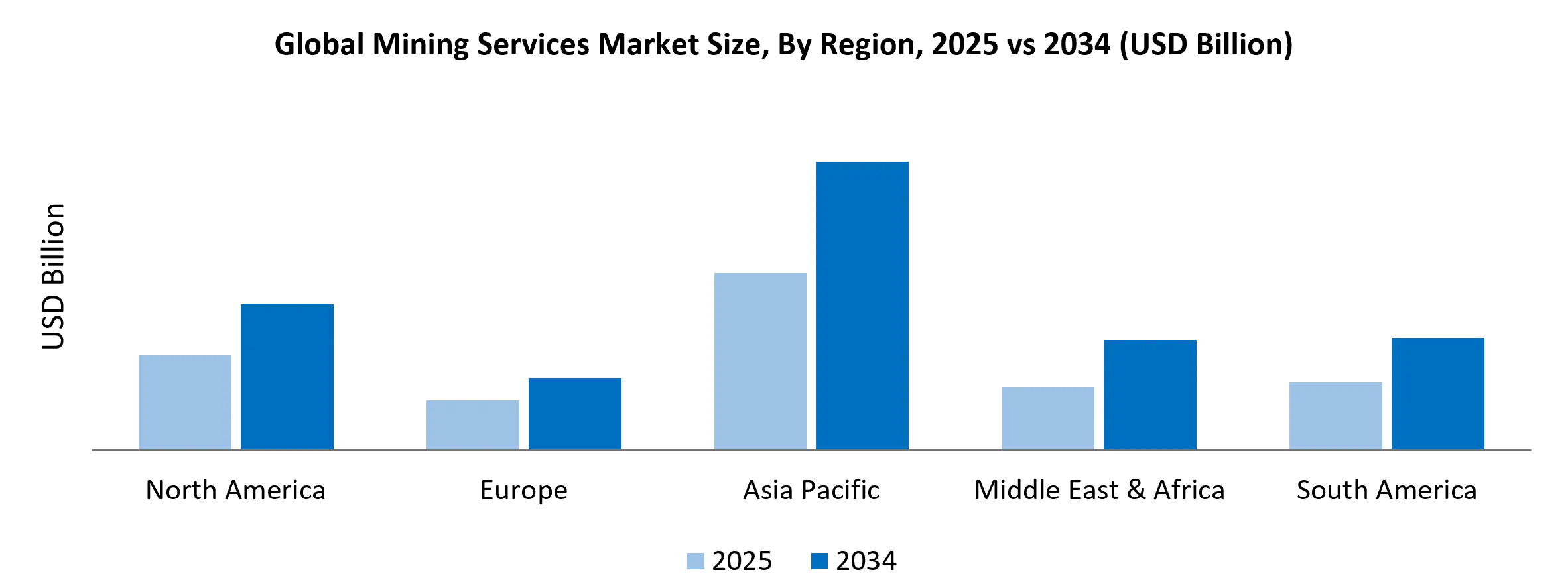
The Global Mining Services Market is segmented into North America, Europe, Asia Pacific, Middle East & Africa, and South America. Asia Pacific is expected to account for the largest market share of 39% in 2025, driven by large-scale coal, iron ore, gold and copper operations, a mature contract mining industry in Australia, extensive mine development in Indonesia, China and India, and the regional presence of several global mining contractors. Australia leads regional demand through its contractor ecosystem and underground gold and lithium activity, while Indonesia and India sustain high-volume coal contract mining and China continues to invest in mine modernization and smart mining services. Asia Pacific is projected to grow at a CAGR of 5.6% during 2025 to 2034.
 North America is a mature, technology-led market supported by copper, gold, iron ore, potash and coal operations in the United States and Canada, and silver and copper production in Mexico. The region is the largest hard-rock underground mining market globally, and it is attracting growing contractor interest as new copper, gold and critical mineral projects advance. Strong engineering, consulting, drilling and equipment service capabilities, together with rising automation adoption, continue to support demand.
Europe represents an engineering- and technology-driven market, anchored by the headquarters of leading mining equipment and process technology companies and by underground mining activity in Sweden, Finland, Norway and Poland. Demand is shaped by stringent environmental regulation, the push for secure critical raw material supply, mine modernization and electrification, and a strong base of consulting, testing and environmental service providers.
Middle East & Africa is projected to be the fastest-growing region, with a CAGR of 6.3% during 2025 to 2034, supported by gold, copper, cobalt, platinum group metals, phosphate and bauxite developments across South Africa, the Democratic Republic of the Congo, Zambia, Ghana, Guinea and Saudi Arabia. Mining diversification programmes in the Gulf region, expanding exploration activity and growing contractor participation in West and Central Africa are widening the addressable service market, although infrastructure gaps, logistics costs and regulatory variation remain important considerations.
South America is a major copper, lithium, iron ore and gold producing region, with Chile, Peru, Brazil, Argentina and Colombia driving service demand. Large open-pit copper operations, lithium brine and hard-rock developments, and sizeable brownfield expansion programmes require drilling, haulage, maintenance, water management and mineral processing support, while local content expectations and long-term supply agreements shape contractor participation.
Integrated Lifecycle Service Delivery as a Competitive Differentiator
The Global Mining Services Market is increasingly creating opportunities for providers that can support mine owners across the complete asset lifecycle, from exploration and feasibility through development, operations, processing, closure and rehabilitation. An emerging area of competitive differentiation is the integrated, technology-enabled service model, in which contractors combine contract mining, drilling and blasting, equipment maintenance, digital monitoring and sustainability services under a single performance-linked agreement. This approach can reduce interface risk for mine owners, improve equipment availability and unit costs, and give providers longer contract tenure and stronger customer relationships. Companies that integrate lifecycle capabilities with automation, workforce development, safety performance and low-emission fleets, particularly in critical minerals and underground operations, may strengthen their competitive positioning and expand their presence across exploration, contract mining, processing support and closure services.
Mining Services Market Recent Developments:
| Date | Recent Developments |
| 27-May-26 | Macmahon Holdings was awarded a 12-month contract extension by a subsidiary of Black Cat Syndicate for underground mining services at the Majestic gold mine in Western Australia, covering underground development, production and associated mining support. |
| 22-Jun-26 | Perenti’s underground mining business, Barminco, secured an approximately A$275 million contract from Barrick for the Fourmile Project in Nevada, USA. The 45-month contract, effective from 1 July 2026, covers underground development, ground support and surface facilities. |
| 11-Aug-26 | Macmahon Holdings, through its New Zealand subsidiary, was awarded a five-year underground mining services contract valued at around A$406 million at the Snowy River gold mine for Endura, covering mine development, production and backfill operations from October 2026. |
| 29-Sep-26 | Perenti announced contract awards across its five drilling businesses, expected to contribute about A$185 million of revenue in FY2027, and its underground mining business AUMS won a contract with Endeavour Mining at the Sabodala-Massawa Mining Complex in Senegal. Combined awards exceeded A$200 million. |
| 22-Oct-26 | Thiess was awarded two five-year contracts in Mongolia, covering underground mining services at the Rio Tinto-managed Oyu Tolgoi mine and coal handling and preparation plant asset management services at the Ukhaa Khudag mine for Energy Resources. |
Global Mining Services Market Scope:Inquire before buying
| Mining Services Market | |||
|---|---|---|---|
| Report Coverage | Details | ||
| Base Year: | 2025 | Forecast Period: | 2026-2034 |
| Historical Data: | 2020 to 2025 | Market Size in 2025: | 112.40 USD Billion |
| Forecast Period 2026-2034 CAGR: | 5.40% | Market Size in 2034: | 180.44 USD Billion |
| Segments Covered: | by Mineral Type | Metal Copper Iron Aluminum Gold Nickel Lithium Cobalt Magnesium Zinc Titanium Others Coal Minerals Bauxite Phosphate Graphite Others Others |
|
| by Mining Type | Surface Mining Underground Mining |
||
| by Services | Exploration Services Mine Planning and Engineering Services Drilling and Blasting Services Contract Mining Services Material Handling and Transportation Services Mineral Processing and Beneficiation Services Mining Equipment Maintenance and Repair Services |
||
| by End-Use Industry | Mining Companies Government-Owned Mining Enterprises Mineral Processing Companies Others |
||
Mining Services Market, by Region
North America (United States, Canada and Mexico)
Europe (Germany, Italy, UK, France, Netherlands, Norway, Denmark, Sweden, Finland, Spain, Poland, Switzerland, Russia and Rest of Europe)
Asia Pacific (China, Japan, South Korea, India, Australia, Singapore, Indonesia, Malaysia, Thailand, Vietnam, Taiwan, Philippines and Rest of Asia Pacific)
Middle East and Africa (Saudi Arabia, UAE, Turkey, South Africa, Qatar, Egypt, Oman and Rest of Middle East & Africa)
South America (Brazil, Argentina, Chile, Colombia and Rest of South America)
Mining Services Market Key Players:
1. Boart Longyear Group Ltd.
2. Major Drilling Group International Inc.
3. Redpath Mining (Murray & Roberts Holdings Limited)
4. Cementation USA Inc. (Murray & Roberts Holdings Limited)
5. Ledcor Group
6. Kiewit Corporation
7. GMS Mine Repair & Maintenance
8. DMC Mining Services
9. MacLean Engineering & Marketing Co. Limited
10. Hatch Ltd.
11. AtkinsRéalis Group Inc. (formerly SNC-Lavalin)
12. WSP Global Inc. (acquired Golder, 2021)
13. Austin Powder Company
14. Sandvik AB (Sandvik Mining and Construction)
15. Epiroc AB
16. Metso Corporation
17. FLSmidth & Co. A/S
18. Weir Group plc
19. Maxam Corp.
20. Mota-Engil, S.A.
21. SGS SA
22. Normet Group Oy
23. Thiess (CIMIC Group Limited, part-owned by Elliott Advisors)
24. CIMIC Group Limited (HOCHTIEF AG / ACS Group)
25. Sedgman Limited (CIMIC Group Limited)
26. Macmahon Holdings Limited
27. Perenti Global Limited
28. Ausdrill (Perenti Global Limited)
29. Barminco (Perenti Global Limited, acquired 2021)
30. Byrnecut Australia Pty Ltd
31. Downer Group (Downer EDI Limited)
32. NRW Holdings Limited
33. BGC Contracting
34. Action Drill & Blast
35. PYBAR Mining Services
36. Teichmann Group
37. Exact Mining Group
38. Mining Plus
39. Orica Limited
40. Dyno Nobel (Incitec Pivot Limited)
41. Emeco Holdings Limited
42. Mineral Resources Limited
43. Worley Limited
44. PT United Tractors Tbk (PT Astra International Tbk)
45. PT Pamapersada Nusantara (PT United Tractors Tbk)
46. PT Delta Dunia Makmur Tbk (BUMA)
47. Adani Enterprises Limited (Adani Mining)
48. Thriveni Earthmovers Pvt. Ltd.
49. Laxyo Group
50. JCHX Mining Management Co., Ltd.
51. Murray & Roberts Holdings Limited
52. Master Drilling Group Limited
53. Moolmans
54. Aveng Limited
55. Capital Limited (Capital Drilling)
56. Enaex S.A. (Sigdo Koppers S.A.)
Others
Frequently Asked Questions:
1. What is the Global Mining Services Market size?
Ans: The Global Mining Services Market was valued at USD 112.40 Billion in 2025 and is projected to reach USD 180.44 Billion by 2034, growing at a CAGR of 5.40% during 2026 to 2034.
2. Which service segments are covered in the mining services market?
Ans: The market is segmented by services into exploration services, mine planning and engineering services, drilling and blasting services, contract mining services, material handling and transportation services, mineral processing and beneficiation services, and mining equipment maintenance and repair services. It is also segmented by mineral type, mining type, end-use industry and region.
3. Which region is expected to dominate the Global Mining Services Market?
Ans: Asia Pacific is expected to dominate the global market in 2025, while Middle East & Africa is projected to be the fastest-growing region during the forecast period.
4. What are the key growth drivers of the mining services industry?
Ans: Key drivers include rising demand for critical minerals, expanding mine development and exploration pipelines, growing outsourcing and integrated service contracts, adoption of automation and digital mining support, and increasing environmental, safety and mine closure requirements.
5. Who are the major key players in the Global Mining Services Market?
Ans: Major companies include Thiess, CIMIC Group, Perenti Global, Macmahon Holdings, Boart Longyear, Major Drilling, Redpath Mining, Sandvik, Epiroc, Metso, FLSmidth, Orica, Downer Group, NRW Holdings, Master Drilling, Murray & Roberts, Hatch, Worley, SGS, and others.
6. What is the forecast period for the Global Mining Services Market?
Ans: The report considers 2020–2025 as the historical period and 2026–2034 as the forecast period, with 2025 as the base year.