Milk Alternatives Market Size by Type, Distribution Channel, Region, Industry-Wide Analysis, Competitive Landscape Assessment & Long-Term Forecast to 2034

10%
CAGR (2026-2034)
36.99 USD Bn.
Forecast Market Size
310
Report Pages
125
Market Tables

Overview

The Milk Alternatives Market size was valued at USD 36.99 Billion in 2025 and the total Milk Alternatives revenue is expected to grow at a CAGR of 10% from 2026 to 2034, reaching nearly USD 87.22 Billion.

The Global Milk Alternatives market report is a comprehensive analysis of the industry, market, and key players. The report has covered the market by demand and supply-side by segments. The global Hominy Feed market report also provides trends by market segments, technology, and investment with a competitive landscape.

Milk Alternatives Market  Growth and Share Analysis
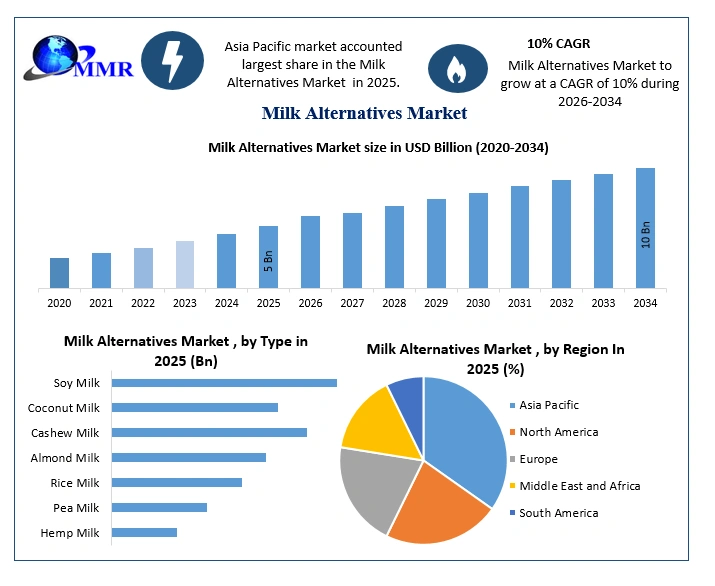

Milk Alternatives Market Growth
To know about the Research Methodology :- Request Free Sample Report

Milk Alternatives Market Overview

Prevalence of health issues caused due to consumption of high-calorie milk impacted positive growth of milk alternatives. Milk alternatives are substitutes or replacements of original milk that people drink. many people have stopped taking cow milk because of a variety of reasons such as some are allergic, some follow vegan & ethical diet, some found ethical issues while consuming animals based product, and many others According to the reports of the National Institutes of Health around 65% of the human population finds it difficult to digest lactose, a type of sugar found in milk.

Milk alternatives are low in fat, calories, sugar, and more water content. Being available in different types, milk alternatives are gaining popularity over cow milk and other dairy products but are expensive. Each alternative has its own nutritional, calcium, mineral, texture, and protein value making people choose from a wide range of available milk alternatives. Different brand will have different compositions of nutrition.

Milk Alternatives Market Dynamics

Rising consumer awareness and added health benefits of consumption of milk alternatives’ impacted positively on markets growth. With rapid urbanization and increasing incidences of health problems like obesity, diabetes, high cholesterol level, blood sugar especially in the Asian pacific region the market for milk alternatives has grown. Development in the production of more milk substitutes in developed nations has led to more demand for organic, natural and healthy milk alternatives. Because of its compositions, milk alternatives are consumed in different quantities. Moreover, increased per capita income and shift in lifestyle with high availability of milk alternatives has fueled the market growth.

Perceiving increased demand in the market for milk alternatives, investment by key market players for innovation and development has increased resulting in the production of new milk substitutes, with means of new technologically advanced methods has driven the growth of the milk alternatives market. Increased use of Milk Alternatives in various end-user industry owning to its benefits and mineral properties combined with growing consumer and end-user knowledge about the presence of natural and genetically modified hormones in milk has impacted cow’s milk to be considered as a part of a healthy diet and has grown milk alternatives market.

Furthermore, consumption of every type of milk whether it's of cow, ox, goat, or any other alternative has a negative impact on the body. Although milk alternatives are low in calories and sugar but still have some amount of sugar which can lead to several health issues like heart disease, Type 2 diabetes, obesity, increased risk of ovarian & breast cancer, and others that are affecting markets growth.

Milk Alternatives Market Segment Analysis:

By type, soy milk dominated the global milk alternative market for over a decade due to its health benefits such as lowering heart disease and having nutritional value similar to cow milk. Soy milk is the most preferred choice of the consumer as a milk alternative because of its high protein richness, soy milk offers 7 grams of protein per cup served as compared to of cow milk at 8 grams per cup. It is available in different varieties and calorie versions which makes it the most preferred choice of milk alternative. Followed by almond milk which is gaining popularity among the young population due to its richness in iron, zinc, phosphorus, and copper.

Coconut milk and cashew milk are witnessing growth as well and high preference as a milk alternative. Though they both are new in the market but offer yielded nutritional value and fewer fats. Cashew milk is the newest type of alternative in the market. A creamy liquid obtained by blending cashew with water, offering calcium and vitamin A, D, and B12. Coconut milk is creamy and sweet, offering 30% of daily needed vitamin D and 50% of Vitamin B-12 making it a part of a healthy diet.

By distribution channel, indirect sales held the largest market share in recent years due to market expansion, increased population and rising demand of all types of consumers. Moreover, availability of alternatives, space, and low cost of commencing the segment of a supermarket and departmental stores dominated the market. With indirect channel companies gain more competitive advantage, more access to the large consumer base without disturbing consumer choices to gain more insight on product and market development. The retail segment is growing as well due to the increased preference of customers to buy from a near and local store at affordable prices.

Regional Insights:

Asia-Pacific held the largest market share for milk alternatives for more than 40% of global revenue. Rising per capita income in developing economies like India, japan impacted positively on market growth. Moreover, the prevalence of health issues like blood sugar, high blood pressure, obesity, and cardiovascular problems in these nations are high which prompted the consumption of lactose-free, chemical, and fat-free milk in the region. Milk alternatives can play a part as inexpensive substitutes of milk for the poor class in these economies which played a role of catalyzer for the market growth of the region.

North America and Europe are the developing regions in the market due to an increase in the consumption of milk alternatives by the young population owing to its nutritional and mineral value. Increased demand for flavored milk alternatives such as almond milk, soy milk, coconut milk, and others and further use of milk alternatives for the production of various food items has grown the North American region's market. The European market is anticipated to yield the fastest market growth because of increased demand for flavored milk and the prevalence of chronic health problems in the region.

South America and the Middle East and Africa are witnessing growth as well primarily due to rapid urbanization in the region. Increased consumer choice for consuming less calorie beverage, rise in industrial development and preference for more non-dairy-based product impacted positively market growth of South America. Moreover, more consumption of milk alternatives as a beverage in the Middle East nation due to its tastes and health benefits has grown the market.

The objective of the report is to present a comprehensive analysis of the Global Market to the stakeholders in the industry. The past and current status of the industry with the forecasted market size and trends are presented in the report with the analysis of complicated data in simple language. The report covers all the aspects of the industry with a dedicated study of key players that include market leaders, followers, and new entrants.

PORTER, SVOR, PESTEL analysis with the potential impact of micro-economic factors of the market have been presented in the report. External as well as internal factors that are supposed to affect the business positively or negatively have been analyzed, which will give a clear futuristic view of the industry to the decision-makers.

The report also helps in understanding the Global Market dynamics, structure by analyzing the market segments and project the Global Market size. Clear representation of competitive analysis of key players by product, price, financial position, product portfolio, growth strategies, and regional presence in the Global Market make the report investor’s guide.

Milk Alternatives Market Recent Industry Developments

Date Company Development Impact
08 January 2025 Oatly Group AB Oatly introduced its **500 mL oat drink packs** across selected European retail markets to improve **affordability and accessibility** for consumers. The launch is expected to **increase household penetration** and strengthen demand in the **milk alternatives market**.
14 January 2025 Danone (Alpro) Alpro announced the transition of its flagship oat drink range to **100% British-grown oats**, reinforcing its **local sourcing strategy**. The initiative enhances **supply-chain resilience** and strengthens the brand's **sustainability positioning** in plant-based beverages.
17 March 2025 Califia Farms Califia Farms launched **Califia Creamy Refreshers**, combining **plant-based milk alternatives with fruit juice** for a new refrigerated beverage category. The innovation broadens **consumer occasions** for dairy alternatives and supports category expansion beyond conventional plant-based milk.
22 April 2025 Oatly Group AB Oatly expanded distribution of its **Barista Edition oat milk** through additional foodservice partnerships across Europe and North America. The expansion supports **higher foodservice consumption** and reinforces oat milk's position in the **specialty coffee segment**.


Milk Alternatives Market Scope: Inquire before buying

Milk Alternatives Market
Report Coverage Details
Base Year: 2025 Forecast Period: 2026-2034
Historical Data: 2020 to 2025 Market Size in 2025: USD 36.99 Bn.
Forecast Period 2026 to 2034 CAGR: 10% Market Size in 2034: USD 87.22 Bn.
Segments Covered: by Type Soy Milk
Coconut Milk
Cashew Milk
Almond Milk
Rice Milk
Pea Milk
Hemp Milk
by Distribution Channel Direct Sales
Indirect Sales
Supermarkets
Hypermarkets
Departmental Stores
Retailers

Milk Alternatives Market, by Region:

North America (United States, Canada and Mexico)
Europe (UK, France, Germany, Italy, Spain, Sweden, Austria, Holland, Turkey, Russia and Rest of Europe)
Asia Pacific (China, India, Japan, South Korea, New Zealand, Australia, ASEAN and Rest of APAC)
Middle East and Africa (South Africa, GCC, Egypt, Nigeria and Rest of ME&A)
South America (Brazil, Argentina, Columbia and Rest of South America)

Milk Alternatives Market, Key Players

1. Edward & Sons Trading Co.
2. Earth's Own Food Company
3. Goya Foods Inc.
4. Eden Foods Inc.
5. Califia Farms
6. Ripple Foods
7. Hudson River Foods
8. Freedom Fruit Group Ltd
9. Kikkoman Corporation
10 Campbell soup Company
11 Vitasoy International Holdings
12 Group Danone
13 The Whitewaves Food Company
14 Living Harvest Food

Frequently Asked Questions:

1. Which region has the largest share in Global Milk Alternatives Market?
Ans: Asia Pacific region holds the highest share in 2025.

2. What was the Global Milk Alternatives Market size in 2025?
Ans: The Global Milk Alternatives Market size was USD 36.99 Billion in 2025.

3. What is scope of the Global Milk Alternatives market report?
Ans: Global Milk Alternatives Market report helps with the PESTEL, PORTER, COVID-19 Impact analysis, Recommendations for Investors & Leaders, and market estimation of the forecast period.

4. Who are the key players in Global Milk Alternatives market?
Ans: The important key players in the Global Milk Alternatives Market are –
Edward & Sons Trading Co., Earth's Own Food Company, Goya Foods Inc., Eden Foods Inc., Califia Farms, Ripple Foods, Hudson River Foods, Freedom Fruit Group Ltd, Kikkoman Corporation, Campbell soup Company.

5. What is the study period of this market?
Ans: The Global Milk Alternatives Market is studied from 2020 to 2034.

Table of Contents

1. Milk Alternatives Market Introduction 1.1. Study Assumption and Market Definition 1.2. Scope of the Study 1.3. Executive Summary 2. Global Milk Alternatives Market: Competitive Landscape 2.1. MMR Competition Matrix 2.2. Competitive Landscape 2.3. Key Players Benchmarking 2.3.1. Company Name 2.3.2. Business Segment 2.3.3. End-user Segment 2.3.4. Revenue (2025) 2.3.5. Company Locations 2.4. Leading Milk Alternatives Market Companies, by market capitalization 2.5. Market Structure 2.5.1. Market Leaders 2.5.2. Market Followers 2.5.3. Emerging Players 2.6. Mergers and Acquisitions Details 3. Milk Alternatives Market: Dynamics 3.1. Milk Alternatives Market Trends by Region 3.1.1. North America Milk Alternatives Market Trends 3.1.2. Europe Milk Alternatives Market Trends 3.1.3. Asia Pacific Milk Alternatives Market Trends 3.1.4. Middle East and Africa Milk Alternatives Market Trends 3.1.5. South America Milk Alternatives Market Trends 3.2. Milk Alternatives Market Dynamics by Region 3.2.1. North America 3.2.1.1. North America Milk Alternatives Market Drivers 3.2.1.2. North America Milk Alternatives Market Restraints 3.2.1.3. North America Milk Alternatives Market Opportunities 3.2.1.4. North America Milk Alternatives Market Challenges 3.2.2. Europe 3.2.2.1. Europe Milk Alternatives Market Drivers 3.2.2.2. Europe Milk Alternatives Market Restraints 3.2.2.3. Europe Milk Alternatives Market Opportunities 3.2.2.4. Europe Milk Alternatives Market Challenges 3.2.3. Asia Pacific 3.2.3.1. Asia Pacific Milk Alternatives Market Drivers 3.2.3.2. Asia Pacific Milk Alternatives Market Restraints 3.2.3.3. Asia Pacific Milk Alternatives Market Opportunities 3.2.3.4. Asia Pacific Milk Alternatives Market Challenges 3.2.4. Middle East and Africa 3.2.4.1. Middle East and Africa Milk Alternatives Market Drivers 3.2.4.2. Middle East and Africa Milk Alternatives Market Restraints 3.2.4.3. Middle East and Africa Milk Alternatives Market Opportunities 3.2.4.4. Middle East and Africa Milk Alternatives Market Challenges 3.2.5. South America 3.2.5.1. South America Milk Alternatives Market Drivers 3.2.5.2. South America Milk Alternatives Market Restraints 3.2.5.3. South America Milk Alternatives Market Opportunities 3.2.5.4. South America Milk Alternatives Market Challenges 3.3. PORTER's Five Forces Analysis 3.4. PESTLE Analysis 3.5. Technology Roadmap 3.6. Regulatory Landscape by Region 3.6.1. North America 3.6.2. Europe 3.6.3. Asia Pacific 3.6.4. Middle East and Africa 3.6.5. South America 3.7. Key Opinion Leader Analysis For Milk Alternatives Industry 3.8. Analysis of Government Schemes and Initiatives For Milk Alternatives Industry 3.9. Milk Alternatives Market Trade Analysis 3.10. The Global Pandemic Impact on Milk Alternatives Market 4. Milk Alternatives Market: Global Market Size and Forecast by Segmentation (in USD Billion) 2025-2034 4.1. Milk Alternatives Market Size and Forecast, by Type (2025-2034) 4.1.1. Soy Milk 4.1.2. Coconut Milk 4.1.3. Cashew Milk 4.1.4. Almond Milk 4.1.5. Rice Milk 4.1.6. Pea Milk 4.1.7. Hemp Milk 4.2. Milk Alternatives Market Size and Forecast, by Distribution Channel (2025-2034) 4.2.1. Direct Sales 4.2.2. Indirect Sales 4.2.3. Supermarkets 4.2.4. Hypermarkets 4.2.5. Departmental Stores 4.2.6. Retailers 4.3. Milk Alternatives Market Size and Forecast, by Region (2025-2034) 4.3.1. North America 4.3.2. Europe 4.3.3. Asia Pacific 4.3.4. Middle East and Africa 4.3.5. South America 5. North America Milk Alternatives Market Size and Forecast by Segmentation (in USD Billion) 2025-2034 5.1. North America Milk Alternatives Market Size and Forecast, by Type (2025-2034) 5.1.1. Soy Milk 5.1.2. Coconut Milk 5.1.3. Cashew Milk 5.1.4. Almond Milk 5.1.5. Rice Milk 5.1.6. Pea Milk 5.1.7. Hemp Milk 5.2. North America Milk Alternatives Market Size and Forecast, by Distribution Channel (2025-2034) 5.2.1. Direct Sales 5.2.2. Indirect Sales 5.2.3. Supermarkets 5.2.4. Hypermarkets 5.2.5. Departmental Stores 5.2.6. Retailers 5.3. North America Milk Alternatives Market Size and Forecast, by Country (2025-2034) 5.3.1. United States 5.3.1.1. United States Milk Alternatives Market Size and Forecast, by Type (2025-2034) 5.3.1.1.1. Soy Milk 5.3.1.1.2. Coconut Milk 5.3.1.1.3. Cashew Milk 5.3.1.1.4. Almond Milk 5.3.1.1.5. Rice Milk 5.3.1.1.6. Pea Milk 5.3.1.1.7. Hemp Milk 5.3.1.2. United States Milk Alternatives Market Size and Forecast, by Distribution Channel (2025-2034) 5.3.1.2.1. Direct Sales 5.3.1.2.2. Indirect Sales 5.3.1.2.3. Supermarkets 5.3.1.2.4. Hypermarkets 5.3.1.2.5. Departmental Stores 5.3.1.2.6. Retailers 5.3.2. Canada 5.3.2.1. Canada Milk Alternatives Market Size and Forecast, by Type (2025-2034) 5.3.2.1.1. Soy Milk 5.3.2.1.2. Coconut Milk 5.3.2.1.3. Cashew Milk 5.3.2.1.4. Almond Milk 5.3.2.1.5. Rice Milk 5.3.2.1.6. Pea Milk 5.3.2.1.7. Hemp Milk 5.3.2.2. Canada Milk Alternatives Market Size and Forecast, by Distribution Channel (2025-2034) 5.3.2.2.1. Direct Sales 5.3.2.2.2. Indirect Sales 5.3.2.2.3. Supermarkets 5.3.2.2.4. Hypermarkets 5.3.2.2.5. Departmental Stores 5.3.2.2.6. Retailers 5.3.3. Mexico 5.3.3.1. Mexico Milk Alternatives Market Size and Forecast, by Type (2025-2034) 5.3.3.1.1. Soy Milk 5.3.3.1.2. Coconut Milk 5.3.3.1.3. Cashew Milk 5.3.3.1.4. Almond Milk 5.3.3.1.5. Rice Milk 5.3.3.1.6. Pea Milk 5.3.3.1.7. Hemp Milk 5.3.3.2. Mexico Milk Alternatives Market Size and Forecast, by Distribution Channel (2025-2034) 5.3.3.2.1. Direct Sales 5.3.3.2.2. Indirect Sales 5.3.3.2.3. Supermarkets 5.3.3.2.4. Hypermarkets 5.3.3.2.5. Departmental Stores 5.3.3.2.6. Retailers 6. Europe Milk Alternatives Market Size and Forecast by Segmentation (in USD Billion) 2025-2034 6.1. Europe Milk Alternatives Market Size and Forecast, by Type (2025-2034) 6.2. Europe Milk Alternatives Market Size and Forecast, by Distribution Channel (2025-2034) 6.3. Europe Milk Alternatives Market Size and Forecast, by Country (2025-2034) 6.3.1. United Kingdom 6.3.1.1. United Kingdom Milk Alternatives Market Size and Forecast, by Type (2025-2034) 6.3.1.2. United Kingdom Milk Alternatives Market Size and Forecast, by Distribution Channel (2025-2034) 6.3.2. France 6.3.2.1. France Milk Alternatives Market Size and Forecast, by Type (2025-2034) 6.3.2.2. France Milk Alternatives Market Size and Forecast, by Distribution Channel (2025-2034) 6.3.3. Germany 6.3.3.1. Germany Milk Alternatives Market Size and Forecast, by Type (2025-2034) 6.3.3.2. Germany Milk Alternatives Market Size and Forecast, by Distribution Channel (2025-2034) 6.3.4. Italy 6.3.4.1. Italy Milk Alternatives Market Size and Forecast, by Type (2025-2034) 6.3.4.2. Italy Milk Alternatives Market Size and Forecast, by Distribution Channel (2025-2034) 6.3.5. Spain 6.3.5.1. Spain Milk Alternatives Market Size and Forecast, by Type (2025-2034) 6.3.5.2. Spain Milk Alternatives Market Size and Forecast, by Distribution Channel (2025-2034) 6.3.6. Sweden 6.3.6.1. Sweden Milk Alternatives Market Size and Forecast, by Type (2025-2034) 6.3.6.2. Sweden Milk Alternatives Market Size and Forecast, by Distribution Channel (2025-2034) 6.3.7. Austria 6.3.7.1. Austria Milk Alternatives Market Size and Forecast, by Type (2025-2034) 6.3.7.2. Austria Milk Alternatives Market Size and Forecast, by Distribution Channel (2025-2034) 6.3.8. Rest of Europe 6.3.8.1. Rest of Europe Milk Alternatives Market Size and Forecast, by Type (2025-2034) 6.3.8.2. Rest of Europe Milk Alternatives Market Size and Forecast, by Distribution Channel (2025-2034) 7. Asia Pacific Milk Alternatives Market Size and Forecast by Segmentation (in USD Billion) 2025-2034 7.1. Asia Pacific Milk Alternatives Market Size and Forecast, by Type (2025-2034) 7.2. Asia Pacific Milk Alternatives Market Size and Forecast, by Distribution Channel (2025-2034) 7.3. Asia Pacific Milk Alternatives Market Size and Forecast, by Country (2025-2034) 7.3.1. China 7.3.1.1. China Milk Alternatives Market Size and Forecast, by Type (2025-2034) 7.3.1.2. China Milk Alternatives Market Size and Forecast, by Distribution Channel (2025-2034) 7.3.2. S Korea 7.3.2.1. S Korea Milk Alternatives Market Size and Forecast, by Type (2025-2034) 7.3.2.2. S Korea Milk Alternatives Market Size and Forecast, by Distribution Channel (2025-2034) 7.3.3. Japan 7.3.3.1. Japan Milk Alternatives Market Size and Forecast, by Type (2025-2034) 7.3.3.2. Japan Milk Alternatives Market Size and Forecast, by Distribution Channel (2025-2034) 7.3.4. India 7.3.4.1. India Milk Alternatives Market Size and Forecast, by Type (2025-2034) 7.3.4.2. India Milk Alternatives Market Size and Forecast, by Distribution Channel (2025-2034) 7.3.5. Australia 7.3.5.1. Australia Milk Alternatives Market Size and Forecast, by Type (2025-2034) 7.3.5.2. Australia Milk Alternatives Market Size and Forecast, by Distribution Channel (2025-2034) 7.3.6. Indonesia 7.3.6.1. Indonesia Milk Alternatives Market Size and Forecast, by Type (2025-2034) 7.3.6.2. Indonesia Milk Alternatives Market Size and Forecast, by Distribution Channel (2025-2034) 7.3.7. Malaysia 7.3.7.1. Malaysia Milk Alternatives Market Size and Forecast, by Type (2025-2034) 7.3.7.2. Malaysia Milk Alternatives Market Size and Forecast, by Distribution Channel (2025-2034) 7.3.8. Vietnam 7.3.8.1. Vietnam Milk Alternatives Market Size and Forecast, by Type (2025-2034) 7.3.8.2. Vietnam Milk Alternatives Market Size and Forecast, by Distribution Channel (2025-2034) 7.3.9. Taiwan 7.3.9.1. Taiwan Milk Alternatives Market Size and Forecast, by Type (2025-2034) 7.3.9.2. Taiwan Milk Alternatives Market Size and Forecast, by Distribution Channel (2025-2034) 7.3.10. Rest of Asia Pacific 7.3.10.1. Rest of Asia Pacific Milk Alternatives Market Size and Forecast, by Type (2025-2034) 7.3.10.2. Rest of Asia Pacific Milk Alternatives Market Size and Forecast, by Distribution Channel (2025-2034) 8. Middle East and Africa Milk Alternatives Market Size and Forecast by Segmentation (in USD Billion) 2025-2034 8.1. Middle East and Africa Milk Alternatives Market Size and Forecast, by Type (2025-2034) 8.2. Middle East and Africa Milk Alternatives Market Size and Forecast, by Distribution Channel (2025-2034) 8.3. Middle East and Africa Milk Alternatives Market Size and Forecast, by Country (2025-2034) 8.3.1. South Africa 8.3.1.1. South Africa Milk Alternatives Market Size and Forecast, by Type (2025-2034) 8.3.1.2. South Africa Milk Alternatives Market Size and Forecast, by Distribution Channel (2025-2034) 8.3.2. GCC 8.3.2.1. GCC Milk Alternatives Market Size and Forecast, by Type (2025-2034) 8.3.2.2. GCC Milk Alternatives Market Size and Forecast, by Distribution Channel (2025-2034) 8.3.3. Nigeria 8.3.3.1. Nigeria Milk Alternatives Market Size and Forecast, by Type (2025-2034) 8.3.3.2. Nigeria Milk Alternatives Market Size and Forecast, by Distribution Channel (2025-2034) 8.3.4. Rest of ME&A 8.3.4.1. Rest of ME&A Milk Alternatives Market Size and Forecast, by Type (2025-2034) 8.3.4.2. Rest of ME&A Milk Alternatives Market Size and Forecast, by Distribution Channel (2025-2034) 9. South America Milk Alternatives Market Size and Forecast by Segmentation (in USD Billion) 2025-2034 9.1. South America Milk Alternatives Market Size and Forecast, by Type (2025-2034) 9.2. South America Milk Alternatives Market Size and Forecast, by Distribution Channel (2025-2034) 9.3. South America Milk Alternatives Market Size and Forecast, by Country (2025-2034) 9.3.1. Brazil 9.3.1.1. Brazil Milk Alternatives Market Size and Forecast, by Type (2025-2034) 9.3.1.2. Brazil Milk Alternatives Market Size and Forecast, by Distribution Channel (2025-2034) 9.3.2. Argentina 9.3.2.1. Argentina Milk Alternatives Market Size and Forecast, by Type (2025-2034) 9.3.2.2. Argentina Milk Alternatives Market Size and Forecast, by Distribution Channel (2025-2034) 9.3.3. Rest Of South America 9.3.3.1. Rest Of South America Milk Alternatives Market Size and Forecast, by Type (2025-2034) 9.3.3.2. Rest Of South America Milk Alternatives Market Size and Forecast, by Distribution Channel (2025-2034) 10. Company Profile: Key Players 10.1. Edward & Sons Trading Co. 10.1.1. Company Overview 10.1.2. Business Portfolio 10.1.3. Financial Overview 10.1.4. SWOT Analysis 10.1.5. Strategic Analysis 10.1.6. Scale of Operation (small, medium, and large) 10.1.7. Details on Partnership 10.1.8. Regulatory Accreditations and Certifications Received by Them 10.1.9. Awards Received by the Firm 10.1.10. Recent Developments 10.2. Earth's Own Food Company 10.3. Goya Foods Inc. 10.4. Eden Foods Inc. 10.5. Califia Farms 10.6. Ripple Foods 10.7. Hudson River Foods 10.8. Freedom Fruit Group Ltd 10.9. Kikkoman Corporation 10.10. Campbell soup Company 10.11. Vitasoy International Holdings 10.12. Group Danone 10.13. The Whitewaves Food Company 10.14. Living Harvest Food 11. Key Findings 12. Industry Recommendations 13. Milk Alternatives Market: Research Methodology 14. Terms and Glossary

Custom Market Research Services

We Will Customise The Research For You, In Case The Report Listed Above Does Not Meet With Your Requirements