
Military Personal Protective Equipment Market Size – Industry Structure Evaluation, Demand Drivers Analysis, Regional Growth Analysis and Identification, Competitive Positioning Review & Global Market Size Forecast to 2032
Overview
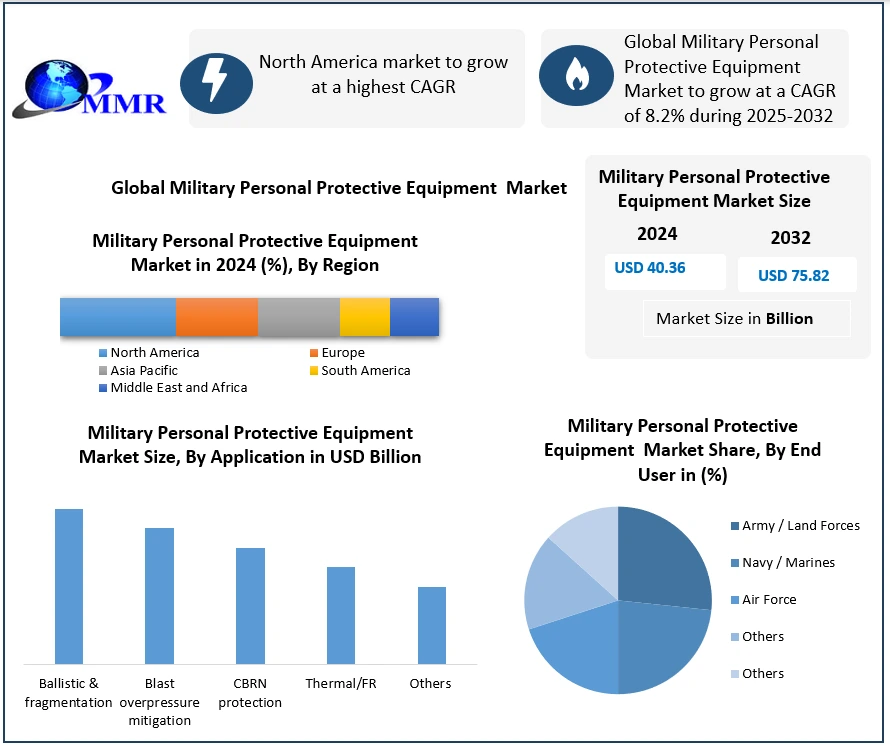
The Military Personal Protective Equipment Market size was valued at USD 40.36 billion in 2024, and the total revenue is expected to grow at a CAGR of 8.2% from 2025 to 2032, reaching nearly USD 75.82 billion by 2032.
The Military Personal Protective Equipment Market Overview
Military Personal Protective Equipment (MPPE) refers to the specialized gear and apparel designed to safeguard armed forces personnel from a variety of combat and operational threats, including ballistic impacts, blast injuries, chemical, biological, radiological, and nuclear (CBRN) hazards, extreme environmental conditions, and other battlefield risks. It encompasses helmets, body armor, eye and face protection, respiratory protection systems, hearing protection, combat uniforms, and protective footwear. These products are engineered using advanced materials such as aramid fibers, ultra-high-molecular-weight polyethylene (UHMWPE), ceramics, and composite laminates to deliver optimal protection while minimizing weight and enhancing soldier mobility. The rising incidence of asymmetric warfare, insurgencies, and cross-border tensions, alongside the increasing deployment of military forces in peacekeeping missions and counter-terrorism operations, drives the Military Personal Protective Equipment Market. Modern battlefields present multifaceted threats, including high-velocity projectiles, improvised explosive devices (IEDs), and toxic industrial chemicals, compelling defense agencies to continually upgrade their protective gear.
 To know about the Research Methodology :- Request Free Sample Report
North America continues to hold the largest Military Personal Protective Equipment Industry share due to a well-established defense sector, continued modernization by identifying suppliers, as well as new advances in combat uniforms, while the Asia-Pacific region is experiencing the fastest growth based on regional conflicts and enhancements in the quality of military equipment. The report sets forth key players in the PPE market, including 3M, Avon Protection, BAE Systems, Honeywell and DuPont, along with a detailed assessment of all end users, including the army, navy and air force, contributing to the trajectory of the Military Personal Protective Equipment Market growth.
Global Military Personal Protective Equipment Market Dynamics
Rising Global Defense Spending And Increasing Investments In Soldier Modernization Programs To Boost the Military Personal Protective Equipment Market Growth
Countries such as the United States, China, India, and Russia are significantly enhancing their defense budgets to ensure national security, which includes the procurement of advanced PPE for their armed forces. Growing geopolitical tensions, regional conflicts, and cross-border threats are further compelling nations to upgrade their military gear, prioritizing soldier safety and operational effectiveness. The technological advancements in materials such as lightweight ballistic fabrics, integrated communication systems, and modular armor are making military PPE more effective and user-friendly, thereby encouraging widespread adoption. The market is also supported by heightened participation in international peacekeeping missions and intensified border security operations, which necessitate the use of reliable and high-performance protective gear. the implementation of stringent safety regulations and international standardization efforts is driving consistent procurement, ensuring sustained growth in the global military Personal Protective Equipment market.
High Cost of Development and Production to Hamper Military Personal Protective Equipment Market
The high cost of development and production, driven by the use of advanced materials such as aramid fibers, ceramics, and smart technologies. These expenses restrict adoption, especially in countries with constrained defense budgets. In addition, complex and lengthy procurement procedures, combined with strict regulatory standards, slow down the introduction of new and improved protective systems. There is also a trade-off between protection and usability. Heavy and bulky Personal Protective Equipment can reduce mobility and comfort for soldiers, affecting their performance in the field. The limited adoption of modern PPE in developing nations, which often rely on outdated gear due to financial and logistical challenges. Furthermore, frequent maintenance needs and the fast pace of technological change increase operational costs and lead to rapid product obsolescence. Supply chain disruptions and raw material price volatility further exacerbate these issues, creating uncertainty in product availability. These factors collectively act as roadblocks to the sustained growth of the global Military Personal Protective Equipment Market.
Opportunities: Military Personal Protective Equipment (PPE) Market
The evolving defense strategies, technological advancements, and rising geopolitical tensions. The increasing demand for lightweight, modular, and multi-functional PPE that enhances soldier mobility without compromising protection. Innovations such as integrated sensor systems, augmented reality (AR)-enabled helmets, and advanced ballistic materials are paving the way for smart PPE solutions. These not only improve situational awareness but also enable real-time health and performance monitoring, aligning with modern combat needs. The growing adoption of unmanned systems and hybrid warfare tactics necessitates specialized protective gear tailored to cyber-physical and electronic warfare environments. The rising trend toward domestic manufacturing and public-private partnerships to enhance self-reliance and reduce dependency on imports. The investments in research and development, along with government support for indigenous defense production, are likely to open new avenues for innovation and market penetration.
Global Military Personal Protective Equipment Market Segment Analysis
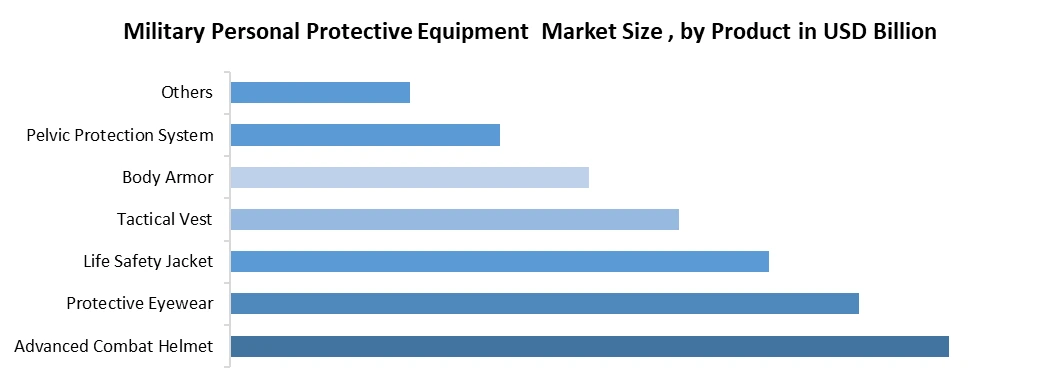
Based on Product, the market is segmented into the Advanced Combat Helmet, Protective Eyewear, Life Safety Jacket, Tactical Vest, Body Armor, Pelvic Protection System, and Others. Body armor is expected to dominate the Military Personal Protective Equipment Market over the forecast period. They have an essential role in safeguarding personnel against ballistic, stab, and fragmentation threats. Modern warfare and counterterrorism operations demand enhanced protection for soldiers in both combat and peacekeeping missions, leading to consistent investment in advanced body armor systems. The segment benefits from ongoing innovations in lightweight materials such as ultra-high molecular weight polyethylene (UHMWPE) and ceramic composites, which maintain high ballistic resistance while improving mobility. Governments worldwide are increasingly procuring modular body armor solutions that allow customization based on mission profiles. The rising geopolitical tensions and border conflicts, especially in regions like Eastern Europe, the Middle East, and the Asia-Pacific, have accelerated procurement programs. Manufacturers are also integrating load-bearing capabilities and compatibility with tactical gear into body armor designs, enhancing their utility. Programs such as the U.S. Army’s Soldier Protection System (SPS) and similar initiatives in NATO countries boost the Military Personal Protective Equipment Market growth.
Based on the Material, the market is categorized into the Aramids, UHMWPE , Ceramics, Metals, and Others. Aramids dominate the Market with the highest CAGR in 2024. Aramids such as Kevlar and Twaron dominate the material segment of the global Military Personal Protective Equipment Market due to their exceptional balance of strength, weight, and versatility. These synthetic fibers offer high tensile strength-to-weight ratios, making them ideal for ballistic-resistant vests, helmets, and protective gloves. Aramids are inherently flame-resistant and maintain performance in extreme temperatures, which is critical in military operations. Their ability to disperse impact energy effectively without adding excessive bulk has made them a standard choice in body armor and tactical gear for decades. The segment’s dominance is reinforced by continuous advancements in fiber technology, enabling thinner, lighter, and more flexible protective layers without compromising safety. Global defense organizations prefer aramid-based solutions for their proven battlefield reliability and long service life, which helps optimize procurement costs.
Global Military Personal Protective Equipment Market Regional Insights
North America dominated the Military Personal Protective Equipment Market in 2024 and is expected to continue its dominanace over the forecast period. The strong defense budgets, strong domestic manufacturing base, and notable technological advancements in defense and warfighting systems, Military Personal Protective Equipment drive industry growth. The US is the largest defense spender in the world, which has a big impact on why this area is a leader in military PPE. The US Department of Defense invests consistently in soldier modernization programs such as the Integrated Visual Augmentation System (IVAS) and body armor development programs, which generate ongoing demand for advanced protective gear.
The North America Military Personal Protective Equipment key players, such as Honeywell International Inc., Avon Protection Systems Inc., etc. The PPE industry has a focus on research and development, and these organizations work closely with defense authorities to provide their customers with next-generation soldier protective solutions. The respective governments' geopolitical focuses on soldier survivability and readiness, the region has provided sustainable procurement cycles and upgrades for Military Personal Protective Equipment.
Global Military Personal Protective Equipment Market Competitive Landscape
The global Military Personal Protective Equipment (PPE) market is competitive, with globally recognized defense equipment manufacturers that are committed to innovation, strategic contracting, and introducing their products into new global markets. Avon Protection plc (UK), and 3M Company (USA) are two of the major players testing the competitive environment. Avon Protection designs and produces CBRN (chemical, biological, radiological, and nuclear) protective gear, ballistic helmets, and respiratory protection, and has strong defense partnerships, including NATO and the U.S. military. Its flagship product is the M50 gas mask, which has been widely adopted across allied forces globally, and the company is generally a leader in R&D and has developed a strong worldwide supply chain.
3M Company is a much larger company that focuses on a wide range of military PPE, including headborne systems, integrated acoustics, integrated comms, eye protection, hearing conservation, and integrated communication products. In 3M Company's acquisition of Ceradyne enhanced its focus on ballistic protection, as its products, like the 3M Combat Helmet and PELTOR Tactical Headsets, pertain to integrated safety solutions. Avon Protection is better represented in specialized protective systems, while 3M is best positioned with an extensive range of products and worldwide distribution in a much larger market, although both of these firms are portfolio companies in the developing military PPE landscape.
Recent Developments in the Military Personal Protective Equipment Market
• February 5, 2025 – The military personal protection equipment (PPE) sector has seen notable developments, driven by modernization programs and advanced material innovations. The U.S. Department of Defense awarded multiple contracts for next-generation body armor, blast-resistant helmets, and improved chemical-biological protective gear. European defense agencies have also accelerated procurement of lightweight, high-durability ballistic vests and modular helmet systems to enhance soldier mobility. The leading suppliers are integrating smart textiles and embedded sensors to monitor soldiers' vitals in real time.
• July 15, 2025 – The military personal protection equipment market is witnessing rapid advancements, highlighted by MKU Limited’s landmark multi-year contract to supply over 200,000 advanced ballistic helmets to a Southeast Asian nation. Certified to NIJ Level IIIA standards, these helmets feature lightweight construction, enhanced comfort, and specialised configurations for paratrooper and airborne units. Globally, defence forces are increasingly adopting smart systems, modular designs, and next-generation ballistic materials such as UHMWPE and advanced ceramics to improve soldier protection without compromising mobility.
Key Trends of the Military Personal Protective Equipment Market
| Trend | Description |
| Integration of Smart Systems | Adoption of technologies such as real-time monitoring sensors, integrated communication, and night vision to enhance situational awareness and operational efficiency. |
| Shift to Lightweight and Modular Designs | Development of ergonomically optimized, modular-sized body armor using advanced materials like ceramic composites to balance protection with mobility. |
| Sustainability and Advanced Material Innovation | Use of eco-friendly, recyclable, and high-performance materials to create durable yet sustainable protective gear, reducing environmental impact without compromising safety. |
Military Personal Protective Equipment Market Scope: Inquire before buying
| Global Military Personal Protective Equipment Market | |||
|---|---|---|---|
| Report Coverage | Details | ||
| Base Year: | 2024 | Forecast Period: | 2025-2032 |
| Historical Data: | 2019 to 2024 | Market Size in 2024: | USD 40.36 Bn. |
| Forecast Period 2025 to 2032 CAGR: | 8.2% | Market Size in 2032: | USD 75.82 Bn. |
| Segments Covered: | by Product | Advanced Combat Helmet Protective Eyewear Life Safety Jacket Tactical Vest Body Armor Pelvic Protection System Others |
|
| by Material | Aramids UHMWPE Ceramics Metals Others |
||
| by Platform | Infantry & dismounted troops Vehicle crew Aircrew Naval/Marines Others |
||
| by Application | Ballistic & fragmentation Blast overpressure mitigation CBRN protection Thermal/FR Others |
||
| by End User | Army / Land Forces Navy / Marines Air Force Others |
||
Global Military Personal Protection Equipment Market by Region
North America (United States, Canada, Mexico)
Europe (United Kingdom, France, Germany, Italy, Spain, Sweden, Russia, the Rest of Europe)
Asia Pacific (China, South Korea, Japan, India, Australia, Indonesia, Malaysia, Philippines, Thailand, Vietnam, Rest of Asia Pacific)
Middle East and Africa (MEA) (South Africa, GCC, Nigeria, Rest of MEA)
South America (Brazil, Argentina, Colombia, Chile, Rest of South America)
Military Personal Protection Equipment Key Players
North America
1. 3M Company (USA)
2. BAE Systems Inc. (USA)
3. Honeywell International Inc. (USA)
4. DuPont de Nemours, Inc. (USA)
5. Point Blank Enterprises, Inc. (USA)
6. Revision Military (USA)
7. Gentex Corporation (USA)
8. Armor Express (USA)
Europe
1. Rheinmetall AG (Germany)
2. Thales Group (France)
3. MKU Ltd. (Germany)
4. Avon Protection Systems (UK)
5. Mehler Vario System GmbH (Germany)
6. Safariland Europe (Germany)
7. CQC Ltd. (UK)
8. NP Aerospace Ltd. (UK)
Asia-Pacific
1. Hyosung Corporation (South Korea)
2. Zhejiang Huaan Security Equipment Co., Ltd. (China)
3. Tata Advanced Systems (India)
4. MKU Ltd. (India)
5. Jiangsu Jianheng Protective Products Co., Ltd. (China)
6. China Xinxing Guangzhou Import & Export Co., Ltd. (China)
7. Hard Shell FZE (India)
8. Royal DSM (Netherlands)
Frequently Asked Questions:
1. Which region has the largest share in the Global Military Personal Protective Equipment Market?
Ans: The North America region held the highest share in 2024.
2. What is the growth rate of the global Military Personal Protection Equipment Market?
Ans: The global market is growing at a CAGR of 8.2% during the forecasting period 2025-2032.
3. What is the scope of the Global Military Personal Protective Equipment Market report?
Ans: The Global Military Personal Protection Equipment Market report helps with the PESTEL, PORTER, Recommendations for Investors & Leaders, and market estimation of the forecast period.
4. Who are the key players in the Global Military Personal Protective Equipment Market?
Ans: The key players in the global market are 3M Ceradyne, ArmorWorks, Eagle Industries Unlimited Inc., BAE Systems, Armorsource, DuPont, Honeywell Advanced Fibres and Composites, Revision Military Inc. and Others.
5. What is the study period of the Military Personal Protective Equipment Market?
Ans: The global market is studied from 2024 to 2032.