
Global Micro-Hybrid Vehicles Market: by Battery Type, by Battery Capacity, by Vehicle Type - Forecast to 2032
Overview
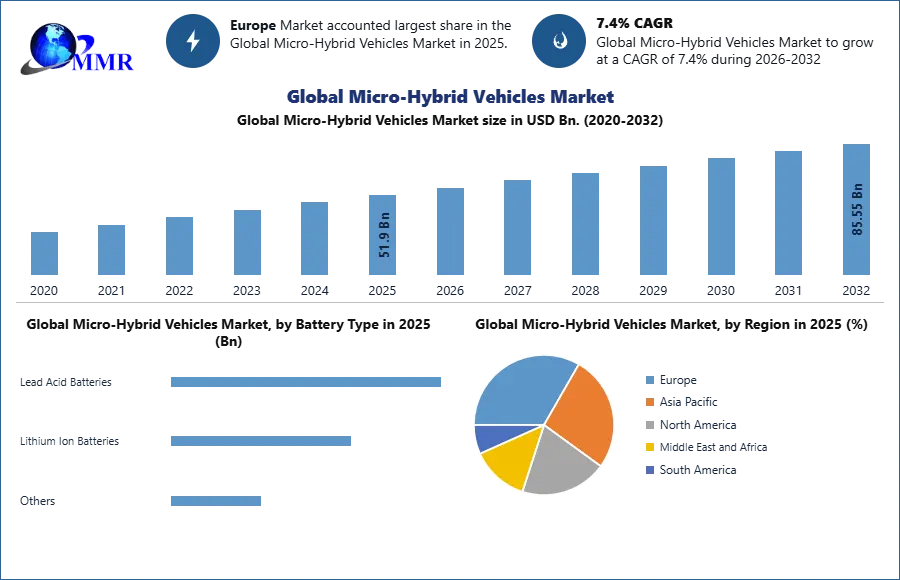
Global Micro-Hybrid Vehicles Market was valued at USD 51.9 Bn. in 2025 and is expected to grow USD 85.55 Bn. by 2032, at a CAGR of 7.4% during the forecast period.
To know about the Research Methodology :- Request Free Sample Report
The report study has analyzed revenue impact of COVID-19 pandemic on the sales revenue of market leaders, market followers and market disrupters in the report and same is reflected in our analysis.
Global Micro-Hybrid Vehicles Market Overview:
A micro-hybrid vehicle uses 'start-stop system,' where regenerative braking technology helps to stop a combustion engine when the vehicle pulls to a stop, and to restart it when the driver accelerates. A micro-hybrid vehicle has the lowest battery size as they support only in the start-stop function. There are numerous different versions of the system, which some are now calling the 'simplest hybrid technology' on the global market. Micro hybrid promoters say the cars can deliver 5-10% better fuel economy and so lower tailpipe emissions. The report presents an overview of the development of the market for vehicles with micro-hybrid technology. Rising sales of consumer vehicles across regional markets with emerging economies, like India and China, are presenting huge growth opportunities for the micro-hybrid vehicles market.
The global micro-hybrid vehicles market report delivers the market share analysis of the key players operating in the industry. These players are profiled and their business overview, financial overview, business strategies, and recent developments have been covered in the profile. Some of the key players operating in the global micro-hybrid vehicles market include Audi AG, General Motors Company, BMW AG, Toyota Motor Corporation, and others.
Global Micro-Hybrid Vehicles Market Dynamics:
The development of high-performance lithium-ion batteries is the factor studied and analyzed in the report with their prospects of growth curve in the forecast period. These vehicles have small batteries and motors that do not need technical requirements for manufacturing batteries. The increased focus of manufacturers on improvements in battery technology and cost reduction are supplementing developments in the market of micro-hybrid vehicles. These batteries have design enhancements, which improve the overall life cycle of the vehicle and enable them to perform a start-stop function at a minimal cost. Thus, it can be said that the development of high capacity lithium-ion batteries is expected to fuel the growth of the market in the future. The advanced generation micro-hybrid vehicles have features, like energy harvesting and regeneration, which help keep the air conditioning running when the engine is not under function. The concerns to protect the environment and reduce greenhouse gas emissions, mainly carbon dioxide, will play a major role in driving the growth of the market.
Global Micro-Hybrid Vehicles Market Segment Analysis:
By Battery Type, Lead-acid batteries dominate due to low cost and wide compatibility with 12V start-stop systems. Lithium-ion batteries are expanding faster, driven by 48V architectures and higher performance requirements. Other advanced variants (AGM/EFB) act as intermediate solutions.
By Vehicle Type, Light vehicles account for the largest share, supported by emission regulations and mass adoption of start-stop technology. Heavy vehicles show gradual growth as fleet operators seek fuel efficiency improvements.
By Battery Capacity, 12V micro-hybrid systems remain widely used in entry-level configurations. 48V systems are growing more rapidly due to improved efficiency, regenerative capability, and better performance-to-cost balance.
By Sales Channel, OEM sales dominate, as systems are factory-installed to meet regulatory standards. The aftermarket is smaller, mainly driven by battery replacements and component upgrades.
Global Micro-Hybrid Vehicles Market Region Analysis:
Region-wise, Europe region is expected to hold the largest market share of the global micro-hybrid vehicles market by 2032 and its demand & supply analysis is covered in the report by region. Because of the presence of lucrative countries, like Germany, the U.K., France, and Norway. In developed countries, people are willing to pay for such micro-hybrid vehicles with high quality and performance. Also, the presence of key players in the region, such as Daimler AG, Audi AG, and BMW AG are driving the market growth.
The Asia-Pacific region is expected to grow at highest CAGR throughout 2032. Thanks to the rising sales of consumer vehicles into developing countries, like China and India and Asian countries they present lucrative opportunity for the regional market. The rising population of people with high disposable incomes and the willingness to spend more on eco-friendly automobiles in these countries is compelling car manufacturers to introduce micro-hybrid vehicles. In the future, a significant share of total car sales in these countries is expected to have hybrid technology.
The objective of the report is to present a comprehensive analysis of the Global Micro-Hybrid Vehicles Market including all the stakeholders of the industry. The past and current status of the industry with forecasted market size and trends are presented in the report with the analysis of complicated data in simple language. The report covers all the aspects of the industry with a dedicated study of key players that includes market leaders, followers and new entrants. PORTER, SVOR, PESTEL analysis with the potential impact of micro-economic factors of the market have been presented in the report. External as well as internal factors that are supposed to affect the business positively or negatively have been analyzed, which will give a clear futuristic view of the industry to the decision-makers.
The report also helps in understanding Global Micro-Hybrid Vehicles Market dynamics, structure by analyzing the market segments and project the Global Micro-Hybrid Vehicles Market size. Clear representation of competitive analysis of key players by product type, price, financial position, product portfolio, growth strategies, and regional presence in the Global Micro-Hybrid Vehicles Market make the report investor’s guide.
Scope of the Global Micro-Hybrid Vehicles Market: Inquire before buying
| Global Micro-Hybrid Vehicles Market | |||
|---|---|---|---|
| Report Coverage | Details | ||
| Base Year: | 2025 | Forecast Period: | 2026-2032 |
| Historical Data: | 2020 to 2025 | Market Size in 2025: | 51.9 USD Bn. |
| Forecast Period 2026-2032 CAGR: | 7.4% | Market Size in 2032: | 85.55 USD Bn. |
| Segments Covered: | by Battery Type | Lead Acid Batteries Lithium Ion Batteries Others |
|
| by Vehicle Type | Light Vehicles Heavy Vehicles |
||
| by Battery Capacity | 12-V Micro-Hybrid 48-V Micro-Hybrid Others |
||
| by Sales Channel | OEM (Original Equipment Manufacturer) Aftermarket |
||
Global Micro-Hybrid Vehicles Market, By Region:
• North America (United States, Canada and Mexico)
• Europe (UK, France, Germany, Italy, Spain, Sweden, Austria and Rest of Europe)
• Asia Pacific (China, South Korea, Japan, India, Australia, Indonesia, Malaysia, Vietnam, Taiwan, Bangladesh, Pakistan and Rest of APAC)
• Middle East and Africa (South Africa, GCC, Egypt, Nigeria and Rest of ME&A)
• South America (Brazil, Argentina Rest of South America)
Key Players / Competitors Profiles Covered in Brief in Global Micro-Hybrid Vehicles Market Report in Strategic Perspective:
- Audi AG
- General Motors Company
- BMW AG
- Toyota Motor Corporation
- Daimler AG
- Fuji Motor Corp
- Hyundai Motor Company
- Fiat Automobiles S.p.A.
- Jaguar Land Rover
- Nissan Motor Corporation
- Mahindra & Mahindra
- Porsche AG
- Mazda Motor Corporation
- Subaru Corporation
- Kia Motors Corporation
- Suzuki Motor Corporation
- Volkswagen AG
- Ford Motor Company
- Honda Motor Co., Ltd.
- Renault Group
- Volvo Car Corporation
- Mitsubishi Motors Corporation
- Maruti Suzuki India Limited
- BYD Company Ltd.
- Tata Motors Limited
Recent Industry Developments (2025–2026)
| Exact Date | Company | Development | Impact |
|---|---|---|---|
| 18 February 2026 | PTC Inc. | Launched the Windchill AI Parts Rationalization capability, integrating generative AI directly into the cloud-native PLM environment. | Reduces part duplication and inventory costs by autonomously identifying similar components across global design repositories. |
| 06 February 2026 | Toyota Motor Corporation | Announced a leadership reshuffle with Kenta Kon appointed as CEO to spearhead the company’s business transformation and subsidiary integration. | Strengthens financial oversight and strategic focus as the company accelerates its global hybrid and electric vehicle transition. |
| 28 January 2026 | SAP SE | Deployed the SAP Cloud ERP 2602 update, featuring advanced integration for SAP Integrated Product Development. | Enables real-time enterprise collaboration by unifying finance, project staffing, and design processes on a single cloud thread. |
| 21 November 2025 | Autodesk, Inc. | Released Autodesk Vault 2026.2, featuring a new Fusion Manage Panel for seamless bi-directional cloud PLM connectivity. | Streamlines the design-to-release process by allowing engineers to sync items and manage changes without leaving the CAD environment. |
| 15 November 2025 | Clarios | Expanded its South Carolina facility to increase production by 30 million battery components annually to support micro-hybrid demand. | Secures the supply chain for high-performance lead-acid batteries required for advanced start-stop and 12V micro-hybrid systems. |
| 15 August 2025 | Clarios | Acquired the lead-battery recycling units of Ecobat in Germany and Austria to internalize lead and polypropylene processing. | Reinforces sustainability credentials and lowers raw material costs for mobility battery operations in the European market. |