
Master Data Management Market Size by Component, Deployment Model, Organization Size, Application, End-User Industry, Region – Segment-Level Market Assessment, Growth Opportunity Analysis, Competitive Mapping & Forecast to 2032
Overview
The Master Data Management Market size was valued at USD 13.63 Billion in 2024 and the total Master Data Management revenue is expected to grow at a CAGR of 14.5% from 2025 to 2032, reaching nearly USD 40.27 Billion.
Master Data Management Market Overview:
Master, data management is a technology-enabled discipline in which business and information technology work together to ensure the uniformity, accuracy, stewardship, semantic consistency, and accountability of the enterprise's official shared master data assets. The Master data management (or MDM) in business consists of different solutions, services, and standards that help enterprises manage their master data.
Master data comprises confidential and critical business data regarding customers, products, financial transactions, suppliers, and others. The emergence of MDM has enabled enterprises to collate and manage master data and utilize it for data analytics and effective decision-making. MDM enhances the operational efficiency of organizations along with improved decision-making capabilities. MDM makes it convenient to use data for different business operations to boost operational as well as business performance and offer enhanced customer services.
The report explores the Global Master Data Management Market's segments (Application, Deployment Model, Industrial Application, End-Users, and Region). Data has been provided by market participants and regions (North America, Asia Pacific, Europe, Middle East & Africa, and South America). This market report provides a thorough analysis of the rapid advances that are currently taking place across all industry sectors.
Facts and figures, illustrations, and presentations are used to provide key data analysis for the historical period from 2019 to 2032. The report investigates the Global Master Data Management Market's drivers, limitations, prospects, and barriers. This MMR report includes investor recommendations based on a thorough examination of the Global Master Data Management Market's contemporary competitive scenario.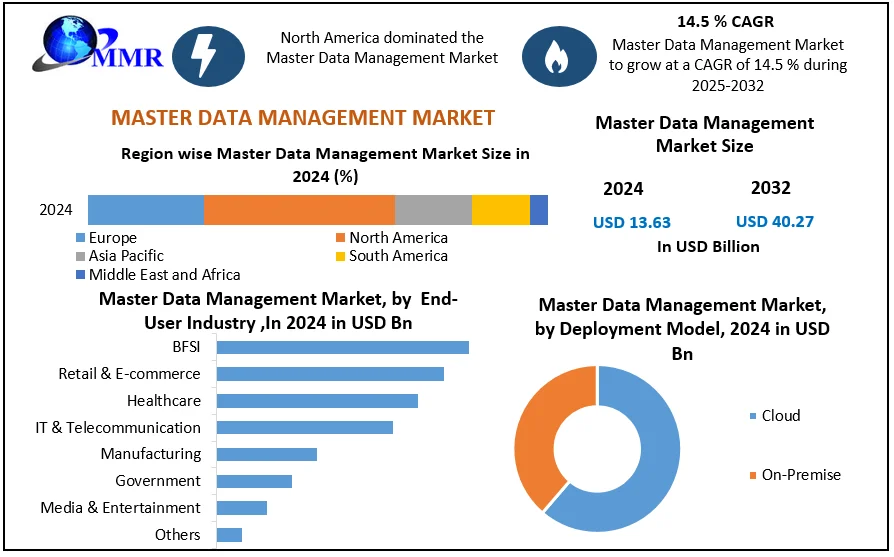 To know about the Research Methodology:-Request Free Sample Report
The MMR report provides an in-depth assessment of the Master Data Management (MDM) market, covering regional pricing models including licensing trends, SaaS benchmarks, and vendor-specific pricing strategies. It further explores key technology and innovation trends such as AI/ML integration, blockchain use cases, cloud-native architectures, API-driven systems, and low-code deployment frameworks. the report evaluates the global tariff and regulatory landscape, analyzing the impact of data privacy laws (e.g., GDPR, CCPA), cross-border compliance, industry-specific mandates, and trade-related challenges including tariffs, IP restrictions, and geopolitical tensions affecting MDM vendors.
Master Data Management Market Dynamics:
Increasing Use of Data Management Tools Drives the Market Growth- Master data Management solutions and services channel massive volumes of data generated across an enterprise to store data in a single location and guarantee data security. To improve operational excellence, the increased data churn necessitates sophisticated data quality technologies.
Data quality is the first step toward implementing MDM, a powerful tool that allows businesses to trace the stages of information flow and document data transformation. Data quality technologies assure data accuracy, while MDM solutions automatically update records and clear superfluous data. This has allowed businesses to combine the adoption of MDM solutions and data quality technologies. For instance, maintaining data integrity is critical for businesses in the financial service industry. In 2022, Northern Europe and IT users regarded master data and data quality management as very important, according to BI-Survey. Data quality technologies aid in the reduction of data duplication, rework, and the maintenance of reliable data records. Data consolidation is becoming increasingly critical for firms that have realized the value of data quality. These factors are boosting the master data management market by creating a high demand for MDM solutions.
Incorporation of Advanced Technologies with MDM Solutions- New technologies such as artificial intelligence (AI), big data, and machine learning (ML) are propelling the MDM market forward. This technology provides new technical capabilities for data storage and processing, as well as huge dataset availability. Customers have a broad range of requirements as new technologies capabilities in managing multi-domain, and multi-faced data have improved. The most common request has been to integrate MDM solutions with technologies like as big data, analytics, and business intelligence. Duplicate records are identified, and data quality is assured, which are common data challenges. It also verified records based on information outside the master data management application, such as transactional data, CAD data, and previous data exchanges.
The use of machine learning in MDM is growing, allowing fresh data to be considered while relying on previous data exchanges. Organizations can use machine learning to detect patterns in data, as well as propose linkage, personalization, social commerce, and offline activity with the help of these technologies, resulting in a single data source for all channels. Innovative players such as Amazon, Google, and Facebook are using new technologies to accelerate development. To avoid inflicting any damage to their brand, they’re combining MDM with other modern technologies to give complete, consistent, and accurate information across all channels.
Master Data Management Market Trends:
Organizations today must deal with massive volumes of data and, as a result, must handle a large amount of data. Appropriate master data management is critical in this data-driven environment. The availability of consistent and reliable source data for transactions and other business activities is ensured by effective master data management in businesses. To avoid the costs of processing raw master data, organizations have expanded their IT and IT infrastructure spending. With the advent of the Internet of Things (IoT) technology and the penetration of social media, the need to process data efficiently has become vital or in trend across the industries and also driving the growth in the MDM market.
Master Data Management Market Segment Analysis:
Based on End-User Industry, the Global Master Data Management Market is segmented into BFSI, Healthcare, IT & Telecommunication, Retail, Manufacturing, Media & Entertainment, and Others. BFSI is the major segment that dominates the market and gives growth of 2.5% in a year, and the factors contributing to the growth in the next five years will exhibit an impressive uptake in the adoption of MDM solutions in the banking & finance industry. By the end of 2024, the BFSI sector will be observed as the largest end-use industry for master data management, accounting for more than US$ 2,100 Million in global revenues. During this period, the adoption of software for master data management will be considerably higher than that of MDS services. Throughout the forecast period, over 50% of global revenues raked in the master data management market will be arising from sales of MDM software.
IT & Telecommunication is the second segment that holds a market share of more than 20% and provides an annual growth of 1.5% in a year. The factors influencing the market are used in IT and Telecommunications to improve data quality, reduce the cost of data management, and improve decision-making. MDM helps organizations identify a duplicate customer and product data, consolidate information from different sources, standardize formats, and ensure that all corporate data meets regulatory requirements. MDM also enables businesses to create a single view of their customers and products across multiple channels (e.g., online, call center, retail store), which improves customer service and marketing effectiveness.
Based on Application, the Global Master Data Management Market is segmented into Supplier Data, Product Data, Customer Data, and Others. Product Data is the major segment and held the largest market share accounting for 42% in 2024. The factor attributing to the growth of this segment is it provides a digital representation of a product. It includes all the relevant information about a product, such as its name description, images, and other associated metadata. Product data is used to manage and track products through their entire lifecycle, from design to delivery to disposal, and this provides growth to the segment because major end-users are associated with product data and promote the segment of the Master Data Management Market. Customer is the second major dominant factor, which held more than 30% of the market share in 2024. This includes customer contact information, purchase history and preference, and demographic information. The purpose of managing customer data is to ensure that all customer-related information is accurate and up-to-date. This allows a better understanding of their customers and provides them with a more personalized experience.
Based on Deployment Model, the Global Master Data Management Market is segmented into On-Premise and Cloud. Cloud-based is the major segment that dominates the market by the various factors contributing to the growth is; by creating a unique customer database is critical for managing the new application suites in an IT-oriented business. Other enterprises are also boosting the importance of the non-barricaded, open-ended deployment of MDM solutions. The market for master data management across the globe will continue to witness the predominance of public-level data disposal through cloud networking. By the end of 2024, nearly three-fourths of the global market for master data management value will be accounted for by public cloud deployment. The adoption of MDM solutions through on-premise deployment will dwindle towards the end of 2024.
Regional Insights:
The North America region held the largest market share accounting for 37% in 2024. Key factors favoring the growth of the MDM market include the increasing technological advancements in the region. The growing number of MDM players across regions is expected to further drive market growth.
Major MDM solution providers such as IBM Corporation, Teradata Corporation, Oracle Corporation, SAS Institute, Informatica Corporation, Talend, TIBCO Software, and Riversand, as well as several start-ups in this region, are providing improved MDM solutions and services to satisfy the needs of customers. The development of new technologies in the North American master data management market, on the other hand, is aided by increased investments in R&D activities by important economies in the region. The U.S. in particular, has stringent data privacy and security laws that mandate the use of MDM for organizations operating in certain sectors such as banking and healthcare. In addition, the growing need to improve operational efficiency and reduce data redundancy is also driving the market.
South America is gaining traction in Master Data Management because of the increasing demand for better customer experience and compliance with regulatory requirements. Brazilian companies are investing heavily in MDM solutions to improve their competitive edge in the global marketplace.
The objective of the report is to present a comprehensive analysis of the Global Master Data Management to the stakeholders in the industry. The past and current status of the industry with the forecasted market size and trends are presented in the report with the analysis of complicated data in simple language. The report covers all the aspects of the industry with a dedicated study of key players that include market leaders, followers, and new entrants.
PORTER, PESTEL analysis with the potential impact of micro-economic factors of the market have been presented in the report. External as well as internal factors that are supposed to affect the business positively or negatively have been analyzed, which will give a clear futuristic view of the industry to the decision-makers.
The reports also help in understanding the Global Master Data Management dynamic and structure by analyzing the market segments and projecting the Global Master Data Management size. Clear representation of competitive analysis of key players by Design, price, financial position, product portfolio, growth strategies, and regional presence in the Global Master Data Management make the report investor’s guide.
Master Data Management Scope: Inquire before buying
| Master Data Management | |||
|---|---|---|---|
| Report Coverage | Details | ||
| Base Year: | 2024 | Forecast Period: | 2025-2032 |
| Historical Data: | 2019 to 2024 | Market Size in 2024: | USD 13.63 Billion |
| Forecast Period 2025 to 2032 CAGR: | 14.5% | Market Size in 2032: | USD 40.27 Billion |
| Segments Covered: | by Component | Software Services Consulting Integration Training & Support Others |
|
| by Deployment Model | On-Premise Cloud |
||
| by Organization Size | Large Business SMEs |
||
| by Application | Supplier Product Customer Others |
||
| by End-User Industry | BFSI Healthcare IT & Telecommunication Retail & E-commerce Media & Entertainment Manufacturing Government Others |
||
Master Data Management by Region
North America (United States, Canada and Mexico)
Europe (UK, France, Germany, Italy, Spain, Sweden, Austria and Rest of Europe)
Asia Pacific (China, South Korea, Japan, India, Australia, Indonesia, Malaysia, Vietnam, Taiwan, Bangladesh, Pakistan and Rest of APAC)
Middle East and Africa (South Africa, GCC, Egypt, Nigeria and Rest)
Master Data Management Market Key Players:
1. IBM Corporation
2. Oracle Corporation
3. SAP SE (Germany)
4. IQVIA Inc.
5. Syniti
6. SAS Institute Inc.
7. TIBCO Software Inc. (US)
8. Informatica Inc.
9. Semarchy
10. Talend (US)
11. Manch
12. Cloudera (US)
13. Riversand Technologies Inc. (US)
14. Tamr, Inc
15. Civica
16. Stibo Systems (Denmark)
17. Profisee.
18. Reltio (US)
19. Ataccama.
20. Ataccama (Canada)
21. Teradata Corporation (US)
22. Syndigo LLC (US)
23. Pimcore
24. Ivalua Inc
25. Tata Consultancy Services Limited
26. Amplifi Group Limited
27. Datactics (UK)
28. Contentserv (Switzerland)
29. GoldenSource (US)
30. Artha Solutions
31. Others
Frequently Asked Questions:
1] What segments are covered in the Master Data Management Market report?
Ans. The segments covered in the Master Data Management Market report are based on Component, Deployment Model, Organization Size, Application, End-User Industry, and region
2] Which region is expected to hold the highest share of the Master Data Management Market?
Ans. The North America region is expected to hold the highest share of the Master Data Management Market.
3] What is the market size of the Master Data Management Market by 2032?
Ans. The market size of the Master Data Management Market by 2032 is USD 40.27 Bn.
4] What is the growth rate of the Master Data Management Market?
Ans. The Global Master Data Management Market is growing at a CAGR of 14.5 % during the forecasting period 2025-2032.
5] What was the market size of the Master Data Management Market in 2024?
Ans. The market size of the Master Data Management Market in 2024 was USD 13.63 Bn.