Lupus Market – Global Market Size, Strategic Growth Drivers, Risk Assessment Framework, Regulatory Landscape Review, Competitive Intensity Mapping & Long-Term Industry Outlook to 2034

12.41%
CAGR (2026-2034)
3.38 USD Bn.
Forecast Market Size
308
Report Pages
130
Market Tables

Overview

The Global Lupus Market was valued at USD 3.38 Billion in 2025 and is projected to reach USD 9.69 Billion by 2034, growing at a CAGR of 12.41% during 2026–2034.

Lupus Market Overview:

The Lupus Market focused on medicines, therapies, and healthcare solutions related to diagnosing, treating, and managing lupus. This includes systemic lupus erythematosus (SLE) and lupus nephritis and relevant treatment options such as: corticosteroids, antimalarial drugs, immunosuppressants, biologic, and innovative therapies to manage inflammation, treat disease activity, and protect against organ damage. Lupus is a chronic autoimmune disease with the potential to affect multiple organs, including: skin, joints, kidneys, heart, lungs, and other organs, necessitating a sustained approach to disease management. The Lupus Market Size is driven by the prevalence of lupus, the need for continued treatment, and the demand for effective therapies.

Lupus treatments provide therapeutic benefits in terms of managing inflammation, reducing disease flares, alleviating symptoms, and protecting against damage to vital organs. Traditional treatment modalities continue to play a critical role in disease control, while biologic therapies and new treatment options are being increasingly utilized in active or refractory cases. Clinical research is also contributing towards the development of novel treatment approaches targeting specific immune pathways and fostering more individualized treatment strategies. However, Lupus Market Gap is significant due to the limitations of current therapies in terms of achieving optimal disease control, and the potential for adverse effects and complications associated with chronic treatment.

North America is the leading region , supported by a well-established healthcare system, specialist care, and extensive research and development activity. Europe is an equally important market for lupus therapies due to the well-developed healthcare infrastructure and accessibility to specialized treatments, while the Asia Pacific region represents a region with significant potential driven by population size, healthcare infrastructure, and the need for enhanced diagnosis and specialized care. Major market players include GlaxoSmithKline (GSK), AstraZeneca, Roche, Bristol Myers Squibb, Johnson & Johnson, and other companies developing therapies for SLE and lupus nephritis. Expansion of clinical research, novel treatment approaches, improved disease management, and addressing unmet patient needs are all contributing to new market opportunities and supporting the Lupus Market Forecast.

Lupus Market Growth and Share Analysis
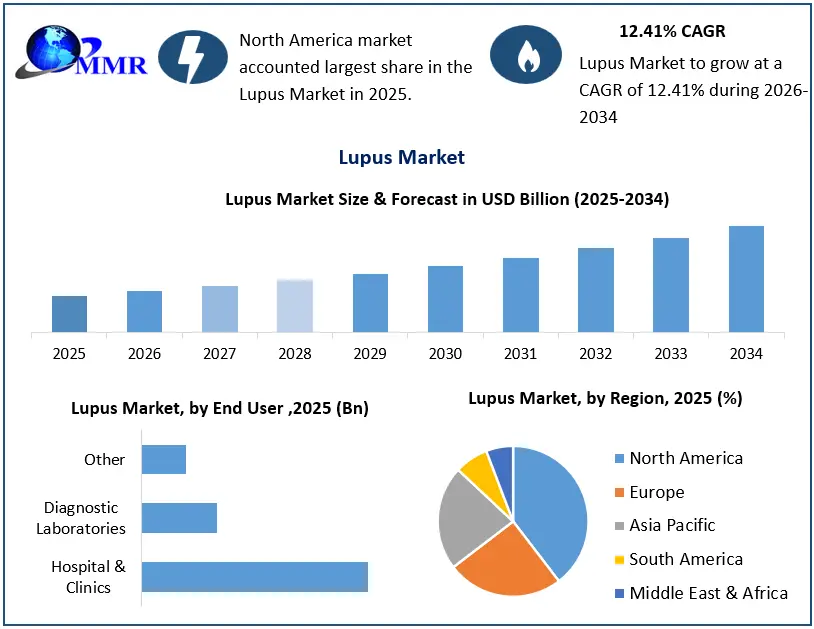
Lupus Market Growth Analysis

To know about the Research Methodology :- Request Free Sample Report

Lupus Market Dynamics

Rising Disease Burden and Demand for Effective Long-Term Therapies Drive Market Growth

The rising clinical burden of systemic lupus erythematosus (SLE), its multisystem manifestation and the requirement for long term disease management drive demand in the Lupus Market. Persistent disease activity, frequent flares, organ involvement and treatment related complications drive ongoing requirements for immunosuppressive therapies, biologics, targeted medicines and supportive care. The growing emphasis on controlling disease activity while reducing treatment related toxicity drives earlier and more individualized therapeutic intervention. These trends drive the Lupus Market Size and support sustained demand and expand the market potential for advanced treatment options.

High Treatment Costs and Unequal Access Restrain Market Expansion

The high cost of advanced biologic and targeted therapies can limit access to newer lupus treatments, especially in healthcare systems with limited reimbursement coverage or substantial out-of-pocket expenditure. Treatment accessibility also varies based on specialist availability, diagnostic infrastructure, insurance coverage and healthcare resources resulting in variations in adoption between developed and resource constrained markets. Real World evidence has identified barriers to biological treatment even among patients considered eligible for such therapies. These affordability and access constraints can limit broader treatment penetration and create challenges for the Lupus Market Forecast.

Advancements in Targeted Therapies and Precision Disease Management Create Market Opportunities

The development of biologics, targeted immunotherapies, improved disease monitoring approaches and therapies targeting specific immune pathways present new Lupus Market Opportunities. The expanding therapeutic pipeline and the growing clinical understanding of lupus pathogenesis support research into treatments that can provide better disease control while reducing dependence on long term corticosteroid use. Improved patient stratification, biomarker research, specialty diagnostics and personalized treatment strategies can address existing treatment gaps. These developments present significant market potential for innovative pharmaceutical companies and expand opportunities across both systemic lupus and organ specific manifestations such as lupus nephritis.

Diagnostic Delays and Complex Disease Heterogeneity Challenge Market Development

The clinical heterogeneity of lupus, absence of highly specific diagnostic biomarkers, variable symptoms and differences in disease presentation can make timely diagnosis and treatment initiation challenging. Diagnostic delays can result in irreversible organ damage while disparities in disease awareness, specialist training and access to rheumatology services can add to the complexity of disease management. Patients also experience substantial unmet needs despite available therapies particularly in areas such as fatigue, disease flares and non-pharmacological support. These factors represent an important market gap and may limit consistent treatment adoption, creating challenges for long term market growth and market forecast.

Lupus Market Segment Analysis:

The Global Lupus Market is segmented into Technique, Product, and End-user.

Based on technique, the systemic lupus erythematous segment held largest share of 12.41% in 2025, owing to treatment can help you manage your symptoms, avoid flare-ups, and avoid other lupus-related health issues. No steroidal anti-inflammatory drugs (NSAIDs) are the most widely utilised medications to treat lupus (NSAIDs). Pain, edoema, and fever associated with lupus can be treated with over-the-counter NSAIDs such as naproxen sodium (Aleve) and ibuprofen (Advil, Motrin IB, and others).
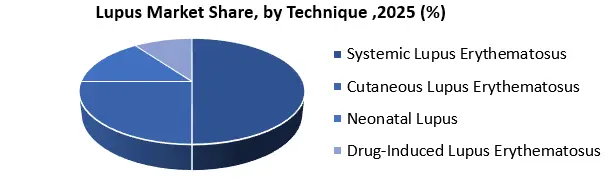
Lupus Market by Technique

Based on product, the biologics segment is currently leading the market, with a CAGR of 7.2% expected during the forecast period. The introduction of new biologics with improved efficacy, such as Benlysta and Rituximab, is projected to drive category growth. Benlysta is used to treat moderate SLE (Systemic Lupus Erythematous), however its safety and efficiency in severe Lupus are still unknown. Immunosuppressants and corticosteroids, on the other hand, have a long list of negative effects. Rituximab, on the other hand, has none.
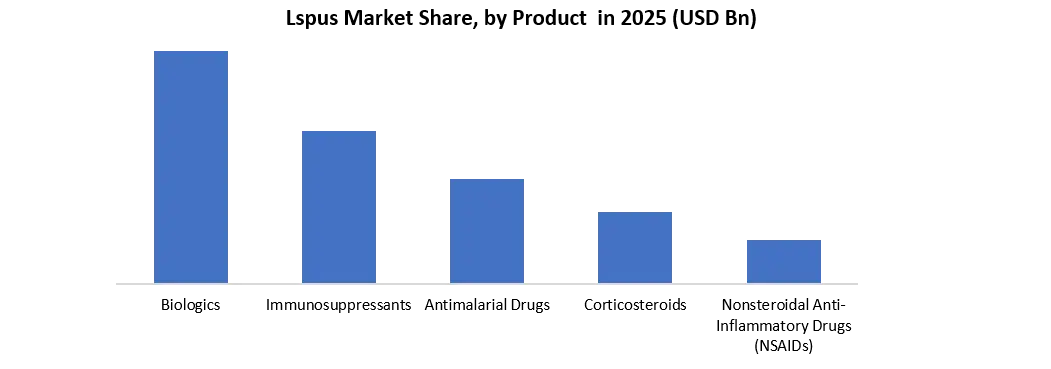
Lspus Market by Product

Lupus Market Regional Insight:

North America has the biggest share of the Lupus Market due to the region’s strong healthcare system, which focuses on diagnosis and treatment, a high number of specialists, the widespread use of biologic therapies, and high healthcare spending. Europe is also a key region for the lupus market due to its established treatment system for autoimmune diseases and the availability of specialist care. Asia Pacific is an attractive market with a growing number of patients, increasing access to care, and expanding treatment options. Latin America and the Middle East & Africa have a small share of the global lupus market but offer potential growth areas as treatment accessibility, diagnosis rates, and specialist care develop. Published research suggests that North America has the largest share of the global market for lupus, accounting for approximately 39% to 47% of total sales through 2025, depending on the definitions used and methods employed.

The objective of the report is to present a comprehensive analysis of the global Lupus market to the stakeholders in the industry. The past and current status of the industry with the forecasted market size and trends are presented in the report with the analysis of complicated data in simple language. The report covers all the aspects of the industry with a dedicated study of key players that include market leaders, followers, and new entrants.

PORTER, PESTEL analysis with the potential impact of micro-economic factors of the market have been presented in the report. External as well as internal factors that are supposed to affect the business positively or negatively have been analyzed, which will give a clear futuristic view of the industry to the decision-makers.

The report also helps in understanding the global Lupus market dynamics, structure by analyzing the market segments and projects the global market size. Clear representation of competitive analysis of key players by product, price, financial position, product portfolio, growth strategies, and regional presence in the global market make the report investor’s guide.

Lupus Market Recent Industry Development

Date Company / Source Development Impact
06 March 2026 Genentech / Lupus Therapeutics New Phase 3 clinical trial data published in the New England Journal of Medicine demonstrated that Gazyva (obinutuzumab) significantly reduces lupus disease activity in patients with systemic lupus erythematosus. The successful trial provides a clinical pathway to lower steroid dependency and achieve higher disease remission rates for severe lupus patients.
04 March 2026 Johnson & Johnson / Roots Analysis The U.S. FDA granted Fast Track designation to Johnson & Johnson's investigational drug nipocalimab for the treatment of adults with systemic lupus erythematosus. This regulatory milestone will expedite clinical review timelines, accelerating the commercialization of new targeted biologics in the global market.
28 January 2026 Biogen Inc. / Lupus Therapeutics The U.S. FDA granted Breakthrough Therapy designation to Biogen's clinical asset litifilimab (BIIB059) for the treatment of cutaneous lupus erythematosus. The designation speeds up the development pipeline for a chronic skin variant of lupus that currently lacks specifically approved targeted therapies.
20 December 2025 AstraZeneca / Roots Analysis AstraZeneca received regulatory approval in the European Union for a user-friendly, subcutaneous self-administration formulation of Saphnelo using a pre-filled pen. This approval shifts the administration landscape from clinical intravenous infusions to home-based self-injection, maximizing patient compliance and market accessibility.
20 October 2025 Genentech / Lupus Therapeutics The U.S. FDA approved Genentech's Gazyva (obinutuzumab) for the treatment of adult patients with active lupus nephritis in combination with standard of care. This establishes the first and only anti-CD20 monoclonal antibody targeting severe kidney-related inflammation within the lupus market segment.
15 July 2025 Bristol-Myers Squibb / InsightAce Analytic Bristol-Myers Squibb partnered with Bain Capital to establish a new immunology-focused company tasked with advancing late-stage therapy candidates for lupus. This strategic collaboration combines financial scale with clinical expertise to accelerate multi-asset pipeline pipelines toward commercialization.

Lupus Market Scope: Inquire before buying

Lupus Market
Report Coverage Details
Base Year: 2025 Forecast Period: 2026-2034
Historical Data: 2020 to 2025 Market Size in 2025: USD 3.38 Bn.
Forecast Period 2026 to 2034 CAGR: 12.41% Market Size in 2034: USD 9.69 Bn.
Segments Covered: by Technique Systemic Lupus Erythematosus
Cutaneous Lupus Erythematosus
Drug-Induced Lupus Erythematosus
Neonatal Lupus
by Product Nonsteroidal Anti-Inflammatory Drugs (NSAIDs)
Antimalarial Drugs
Corticosteroids
Immunosuppressants
Biologics
Others
by End User Hospital & Clinics
Diagnostic Laboratories
Other

Lupus Market, by Region

North America (United States, Canada and Mexico)
Europe (UK, France, Germany, Italy, Spain, Sweden, Austria and Rest of Europe)
Asia Pacific (China, South Korea, Japan, India, Australia, Indonesia, Malaysia, Vietnam, Taiwan, Bangladesh, Pakistan and Rest of APAC)
Middle East and Africa (South Africa, GCC, Egypt, Nigeria and Rest of ME&A)
South America (Brazil, Argentina Rest of South America)

Lupus Market, Key Players:

1. Aurinia Pharmaceuticals
2. Bristol-Myers Squibb
3. Cadila Healthcare
4. GlaxoSmithKline plc
5. Mylan N.V.
6. F. Hoffmann-La
7. Pfizer, Inc.
8. Sanofi
9. Lycera Corporation
10. Merck KGaA
11. Eli Lily
12. ImmuPharma LLC
13. Anthera Pharmaceuticals
14. Lycera
15. Sandoz International GmbH
16. Novartis AG,
17. Bayer AG
18. Trinity Biotech

Frequently Asked Questions:

1. Which region has the largest share in Global Lupus Market?
Ans: North America region holds the highest share in 2025.

2. What was the Global Lupus Market size in 2025?
Ans: The Global Lupus Market size was USD 3.38 Billion in 2025.

3. What segments are covered in Global Lupus market?
Ans: Global Lupus Market is segmented into technique, product, end-user and region.

4. Who are the key players in Global Lupus market?
Ans: The important key players in the Global Lupus Market are – Aurinia Pharmaceuticals, Bristol-Myers Squibb, Cadila Healthcare, GlaxoSmithKline plc, Mylan N.V., F. Hoffmann-La , Pfizer, Inc., Sanofi, Lycera Corporation, Merck KGaA, Eli Lily , ImmuPharma LLC, Anthera Pharmaceuticals.

5. What is the study period of this market?
Ans: The Global Lupus Market is studied from 2020 to 2034.

Table of Contents

1. Lspus Market Introduction 1.1. Study Assumption and Market Definition 1.2. Scope of the Study 1.3. Executive Summary 2. Global Lspus Market: Competitive Landscape 2.1. MMR Competition Matrix 2.2. Competitive Landscape 2.3. Key Players Benchmarking 2.3.1. Company Name 2.3.2. Business Segment 2.3.3. End-user Segment 2.3.4. Revenue (2025) 2.3.5. Company Locations 2.4. Leading Lspus Market Companies, by market capitalization 2.5. Market Structure 2.5.1. Market Leaders 2.5.2. Market Followers 2.5.3. Emerging Players 2.6. Mergers and Acquisitions Details 3. Lspus Market: Dynamics 3.1. Lspus Market Trends by Region 3.1.1. North America Lspus Market Trends 3.1.2. Europe Lspus Market Trends 3.1.3. Asia Pacific Lspus Market Trends 3.1.4. Middle East and Africa Lspus Market Trends 3.1.5. South America Lspus Market Trends 3.2. Lspus Market Dynamics by Region 3.2.1. North America 3.2.1.1. North America Lspus Market Drivers 3.2.1.2. North America Lspus Market Restraints 3.2.1.3. North America Lspus Market Opportunities 3.2.1.4. North America Lspus Market Challenges 3.2.2. Europe 3.2.2.1. Europe Lspus Market Drivers 3.2.2.2. Europe Lspus Market Restraints 3.2.2.3. Europe Lspus Market Opportunities 3.2.2.4. Europe Lspus Market Challenges 3.2.3. Asia Pacific 3.2.3.1. Asia Pacific Lspus Market Drivers 3.2.3.2. Asia Pacific Lspus Market Restraints 3.2.3.3. Asia Pacific Lspus Market Opportunities 3.2.3.4. Asia Pacific Lspus Market Challenges 3.2.4. Middle East and Africa 3.2.4.1. Middle East and Africa Lspus Market Drivers 3.2.4.2. Middle East and Africa Lspus Market Restraints 3.2.4.3. Middle East and Africa Lspus Market Opportunities 3.2.4.4. Middle East and Africa Lspus Market Challenges 3.2.5. South America 3.2.5.1. South America Lspus Market Drivers 3.2.5.2. South America Lspus Market Restraints 3.2.5.3. South America Lspus Market Opportunities 3.2.5.4. South America Lspus Market Challenges 3.3. PORTER's Five Forces Analysis 3.4. PESTLE Analysis 3.5. Technology Roadmap 3.6. Regulatory Landscape by Region 3.6.1. North America 3.6.2. Europe 3.6.3. Asia Pacific 3.6.4. Middle East and Africa 3.6.5. South America 3.7. Key Opinion Leader Analysis For Lspus Industry 3.8. Analysis of Government Schemes and Initiatives For Lspus Industry 3.9. Lspus Market Trade Analysis 3.10. The Global Pandemic Impact on Lspus Market 4. Lspus Market: Global Market Size and Forecast by Segmentation (in USD Billion) 2025-2034 4.1. Lspus Market Size and Forecast, by Technique (2025-2034) 4.1.1. Systemic Lupus Erythematosus 4.1.2. Cutaneous Lupus Erythematosus 4.1.3. Drug-Induced Lupus Erythematosus 4.1.4. Neonatal Lupus 4.2. Lspus Market Size and Forecast, by Product (2025-2034) 4.2.1. Nonsteroidal Anti-Inflammatory Drugs (NSAIDs) 4.2.2. Antimalarial Drugs 4.2.3. Corticosteroids 4.2.4. Immunosuppressants 4.2.5. Biologics 4.2.6. Others 4.3. Lspus Market Size and Forecast, by End User (2025-2034) 4.3.1. Hospital & Clinics 4.3.2. Diagnostic Laboratories 4.3.3. Other 4.4. Lspus Market Size and Forecast, by Region (2025-2034) 4.4.1. North America 4.4.2. Europe 4.4.3. Asia Pacific 4.4.4. Middle East and Africa 4.4.5. South America 5. North America Lspus Market Size and Forecast by Segmentation (in USD Billion) 2025-2034 5.1. North America Lspus Market Size and Forecast, by Technique (2025-2034) 5.1.1. Systemic Lupus Erythematosus 5.1.2. Cutaneous Lupus Erythematosus 5.1.3. Drug-Induced Lupus Erythematosus 5.1.4. Neonatal Lupus 5.2. North America Lspus Market Size and Forecast, by Product (2025-2034) 5.2.1. Nonsteroidal Anti-Inflammatory Drugs (NSAIDs) 5.2.2. Antimalarial Drugs 5.2.3. Corticosteroids 5.2.4. Immunosuppressants 5.2.5. Biologics 5.2.6. Others 5.3. North America Lspus Market Size and Forecast, by End User (2025-2034) 5.3.1. Hospital & Clinics 5.3.2. Diagnostic Laboratories 5.3.3. Other 5.4. North America Lspus Market Size and Forecast, by Country (2025-2034) 5.4.1. United States 5.4.1.1. United States Lspus Market Size and Forecast, by Technique (2025-2034) 5.4.1.1.1. Systemic Lupus Erythematosus 5.4.1.1.2. Cutaneous Lupus Erythematosus 5.4.1.1.3. Drug-Induced Lupus Erythematosus 5.4.1.1.4. Neonatal Lupus 5.4.1.2. United States Lspus Market Size and Forecast, by Product (2025-2034) 5.4.1.2.1. Nonsteroidal Anti-Inflammatory Drugs (NSAIDs) 5.4.1.2.2. Antimalarial Drugs 5.4.1.2.3. Corticosteroids 5.4.1.2.4. Immunosuppressants 5.4.1.2.5. Biologics 5.4.1.2.6. Others 5.4.1.3. United States Lspus Market Size and Forecast, by End User (2025-2034) 5.4.1.3.1. Hospital & Clinics 5.4.1.3.2. Diagnostic Laboratories 5.4.1.3.3. Other 5.4.2. Canada 5.4.2.1. Canada Lspus Market Size and Forecast, by Technique (2025-2034) 5.4.2.1.1. Systemic Lupus Erythematosus 5.4.2.1.2. Cutaneous Lupus Erythematosus 5.4.2.1.3. Drug-Induced Lupus Erythematosus 5.4.2.1.4. Neonatal Lupus 5.4.2.2. Canada Lspus Market Size and Forecast, by Product (2025-2034) 5.4.2.2.1. Nonsteroidal Anti-Inflammatory Drugs (NSAIDs) 5.4.2.2.2. Antimalarial Drugs 5.4.2.2.3. Corticosteroids 5.4.2.2.4. Immunosuppressants 5.4.2.2.5. Biologics 5.4.2.2.6. Others 5.4.2.3. Canada Lspus Market Size and Forecast, by End User (2025-2034) 5.4.2.3.1. Hospital & Clinics 5.4.2.3.2. Diagnostic Laboratories 5.4.2.3.3. Other 5.4.3. Mexico 5.4.3.1. Mexico Lspus Market Size and Forecast, by Technique (2025-2034) 5.4.3.1.1. Systemic Lupus Erythematosus 5.4.3.1.2. Cutaneous Lupus Erythematosus 5.4.3.1.3. Drug-Induced Lupus Erythematosus 5.4.3.1.4. Neonatal Lupus 5.4.3.2. Mexico Lspus Market Size and Forecast, by Product (2025-2034) 5.4.3.2.1. Nonsteroidal Anti-Inflammatory Drugs (NSAIDs) 5.4.3.2.2. Antimalarial Drugs 5.4.3.2.3. Corticosteroids 5.4.3.2.4. Immunosuppressants 5.4.3.2.5. Biologics 5.4.3.2.6. Others 5.4.3.3. Mexico Lspus Market Size and Forecast, by End User (2025-2034) 5.4.3.3.1. Hospital & Clinics 5.4.3.3.2. Diagnostic Laboratories 5.4.3.3.3. Other 6. Europe Lspus Market Size and Forecast by Segmentation (in USD Billion) 2025-2034 6.1. Europe Lspus Market Size and Forecast, by Technique (2025-2034) 6.2. Europe Lspus Market Size and Forecast, by Product (2025-2034) 6.3. Europe Lspus Market Size and Forecast, by End User (2025-2034) 6.4. Europe Lspus Market Size and Forecast, by Country (2025-2034) 6.4.1. United Kingdom 6.4.1.1. United Kingdom Lspus Market Size and Forecast, by Technique (2025-2034) 6.4.1.2. United Kingdom Lspus Market Size and Forecast, by Product (2025-2034) 6.4.1.3. United Kingdom Lspus Market Size and Forecast, by End User (2025-2034) 6.4.2. France 6.4.2.1. France Lspus Market Size and Forecast, by Technique (2025-2034) 6.4.2.2. France Lspus Market Size and Forecast, by Product (2025-2034) 6.4.2.3. France Lspus Market Size and Forecast, by End User (2025-2034) 6.4.3. Germany 6.4.3.1. Germany Lspus Market Size and Forecast, by Technique (2025-2034) 6.4.3.2. Germany Lspus Market Size and Forecast, by Product (2025-2034) 6.4.3.3. Germany Lspus Market Size and Forecast, by End User (2025-2034) 6.4.4. Italy 6.4.4.1. Italy Lspus Market Size and Forecast, by Technique (2025-2034) 6.4.4.2. Italy Lspus Market Size and Forecast, by Product (2025-2034) 6.4.4.3. Italy Lspus Market Size and Forecast, by End User (2025-2034) 6.4.5. Spain 6.4.5.1. Spain Lspus Market Size and Forecast, by Technique (2025-2034) 6.4.5.2. Spain Lspus Market Size and Forecast, by Product (2025-2034) 6.4.5.3. Spain Lspus Market Size and Forecast, by End User (2025-2034) 6.4.6. Sweden 6.4.6.1. Sweden Lspus Market Size and Forecast, by Technique (2025-2034) 6.4.6.2. Sweden Lspus Market Size and Forecast, by Product (2025-2034) 6.4.6.3. Sweden Lspus Market Size and Forecast, by End User (2025-2034) 6.4.7. Austria 6.4.7.1. Austria Lspus Market Size and Forecast, by Technique (2025-2034) 6.4.7.2. Austria Lspus Market Size and Forecast, by Product (2025-2034) 6.4.7.3. Austria Lspus Market Size and Forecast, by End User (2025-2034) 6.4.8. Rest of Europe 6.4.8.1. Rest of Europe Lspus Market Size and Forecast, by Technique (2025-2034) 6.4.8.2. Rest of Europe Lspus Market Size and Forecast, by Product (2025-2034) 6.4.8.3. Rest of Europe Lspus Market Size and Forecast, by End User (2025-2034) 7. Asia Pacific Lspus Market Size and Forecast by Segmentation (in USD Billion) 2025-2034 7.1. Asia Pacific Lspus Market Size and Forecast, by Technique (2025-2034) 7.2. Asia Pacific Lspus Market Size and Forecast, by Product (2025-2034) 7.3. Asia Pacific Lspus Market Size and Forecast, by End User (2025-2034) 7.4. Asia Pacific Lspus Market Size and Forecast, by Country (2025-2034) 7.4.1. China 7.4.1.1. China Lspus Market Size and Forecast, by Technique (2025-2034) 7.4.1.2. China Lspus Market Size and Forecast, by Product (2025-2034) 7.4.1.3. China Lspus Market Size and Forecast, by End User (2025-2034) 7.4.2. S Korea 7.4.2.1. S Korea Lspus Market Size and Forecast, by Technique (2025-2034) 7.4.2.2. S Korea Lspus Market Size and Forecast, by Product (2025-2034) 7.4.2.3. S Korea Lspus Market Size and Forecast, by End User (2025-2034) 7.4.3. Japan 7.4.3.1. Japan Lspus Market Size and Forecast, by Technique (2025-2034) 7.4.3.2. Japan Lspus Market Size and Forecast, by Product (2025-2034) 7.4.3.3. Japan Lspus Market Size and Forecast, by End User (2025-2034) 7.4.4. India 7.4.4.1. India Lspus Market Size and Forecast, by Technique (2025-2034) 7.4.4.2. India Lspus Market Size and Forecast, by Product (2025-2034) 7.4.4.3. India Lspus Market Size and Forecast, by End User (2025-2034) 7.4.5. Australia 7.4.5.1. Australia Lspus Market Size and Forecast, by Technique (2025-2034) 7.4.5.2. Australia Lspus Market Size and Forecast, by Product (2025-2034) 7.4.5.3. Australia Lspus Market Size and Forecast, by End User (2025-2034) 7.4.6. Indonesia 7.4.6.1. Indonesia Lspus Market Size and Forecast, by Technique (2025-2034) 7.4.6.2. Indonesia Lspus Market Size and Forecast, by Product (2025-2034) 7.4.6.3. Indonesia Lspus Market Size and Forecast, by End User (2025-2034) 7.4.7. Malaysia 7.4.7.1. Malaysia Lspus Market Size and Forecast, by Technique (2025-2034) 7.4.7.2. Malaysia Lspus Market Size and Forecast, by Product (2025-2034) 7.4.7.3. Malaysia Lspus Market Size and Forecast, by End User (2025-2034) 7.4.8. Vietnam 7.4.8.1. Vietnam Lspus Market Size and Forecast, by Technique (2025-2034) 7.4.8.2. Vietnam Lspus Market Size and Forecast, by Product (2025-2034) 7.4.8.3. Vietnam Lspus Market Size and Forecast, by End User (2025-2034) 7.4.9. Taiwan 7.4.9.1. Taiwan Lspus Market Size and Forecast, by Technique (2025-2034) 7.4.9.2. Taiwan Lspus Market Size and Forecast, by Product (2025-2034) 7.4.9.3. Taiwan Lspus Market Size and Forecast, by End User (2025-2034) 7.4.10. Rest of Asia Pacific 7.4.10.1. Rest of Asia Pacific Lspus Market Size and Forecast, by Technique (2025-2034) 7.4.10.2. Rest of Asia Pacific Lspus Market Size and Forecast, by Product (2025-2034) 7.4.10.3. Rest of Asia Pacific Lspus Market Size and Forecast, by End User (2025-2034) 8. Middle East and Africa Lspus Market Size and Forecast by Segmentation (in USD Billion) 2025-2034 8.1. Middle East and Africa Lspus Market Size and Forecast, by Technique (2025-2034) 8.2. Middle East and Africa Lspus Market Size and Forecast, by Product (2025-2034) 8.3. Middle East and Africa Lspus Market Size and Forecast, by End User (2025-2034) 8.4. Middle East and Africa Lspus Market Size and Forecast, by Country (2025-2034) 8.4.1. South Africa 8.4.1.1. South Africa Lspus Market Size and Forecast, by Technique (2025-2034) 8.4.1.2. South Africa Lspus Market Size and Forecast, by Product (2025-2034) 8.4.1.3. South Africa Lspus Market Size and Forecast, by End User (2025-2034) 8.4.2. GCC 8.4.2.1. GCC Lspus Market Size and Forecast, by Technique (2025-2034) 8.4.2.2. GCC Lspus Market Size and Forecast, by Product (2025-2034) 8.4.2.3. GCC Lspus Market Size and Forecast, by End User (2025-2034) 8.4.3. Nigeria 8.4.3.1. Nigeria Lspus Market Size and Forecast, by Technique (2025-2034) 8.4.3.2. Nigeria Lspus Market Size and Forecast, by Product (2025-2034) 8.4.3.3. Nigeria Lspus Market Size and Forecast, by End User (2025-2034) 8.4.4. Rest of ME&A 8.4.4.1. Rest of ME&A Lspus Market Size and Forecast, by Technique (2025-2034) 8.4.4.2. Rest of ME&A Lspus Market Size and Forecast, by Product (2025-2034) 8.4.4.3. Rest of ME&A Lspus Market Size and Forecast, by End User (2025-2034) 9. South America Lspus Market Size and Forecast by Segmentation (in USD Billion) 2025-2034 9.1. South America Lspus Market Size and Forecast, by Technique (2025-2034) 9.2. South America Lspus Market Size and Forecast, by Product (2025-2034) 9.3. South America Lspus Market Size and Forecast, by End User (2025-2034) 9.4. South America Lspus Market Size and Forecast, by Country (2025-2034) 9.4.1. Brazil 9.4.1.1. Brazil Lspus Market Size and Forecast, by Technique (2025-2034) 9.4.1.2. Brazil Lspus Market Size and Forecast, by Product (2025-2034) 9.4.1.3. Brazil Lspus Market Size and Forecast, by End User (2025-2034) 9.4.2. Argentina 9.4.2.1. Argentina Lspus Market Size and Forecast, by Technique (2025-2034) 9.4.2.2. Argentina Lspus Market Size and Forecast, by Product (2025-2034) 9.4.2.3. Argentina Lspus Market Size and Forecast, by End User (2025-2034) 9.4.3. Rest Of South America 9.4.3.1. Rest Of South America Lspus Market Size and Forecast, by Technique (2025-2034) 9.4.3.2. Rest Of South America Lspus Market Size and Forecast, by Product (2025-2034) 9.4.3.3. Rest Of South America Lspus Market Size and Forecast, by End User (2025-2034) 10. Company Profile: Key Players 10.1. Aurinia Pharmaceuticals 10.1.1. Company Overview 10.1.2. Business Portfolio 10.1.3. Financial Overview 10.1.4. SWOT Analysis 10.1.5. Strategic Analysis 10.1.6. Scale of Operation (small, medium, and large) 10.1.7. Details on Partnership 10.1.8. Regulatory Accreditations and Certifications Received by Them 10.1.9. Awards Received by the Firm 10.1.10. Recent Developments 10.2. Bristol-Myers Squibb 10.3. Cadila Healthcare 10.4. GlaxoSmithKline plc 10.5. Mylan N.V. 10.6. F. Hoffmann-La 10.7. Pfizer, Inc. 10.8. Sanofi 10.9. Lycera Corporation 10.10. Merck KGaA 10.11. Eli Lily 10.12. ImmuPharma LLC 10.13. Anthera Pharmaceuticals 10.14. Lycera 10.15. Sandoz International GmbH 10.16. Novartis AG, 10.17. Bayer AG 10.18. Trinity Biotech 11. Key Findings 12. Industry Recommendations 13. Lspus Market: Research Methodology 14. Terms and Glossary

Custom Market Research Services

We Will Customise The Research For You, In Case The Report Listed Above Does Not Meet With Your Requirements