
Lithium Ion Battery Market - Industry Structure Evaluation, Demand Drivers Analysis, Regional Growth Analysis and Identification, Competitive Positioning Review & Global Market Size Forecast to 2032
Overview
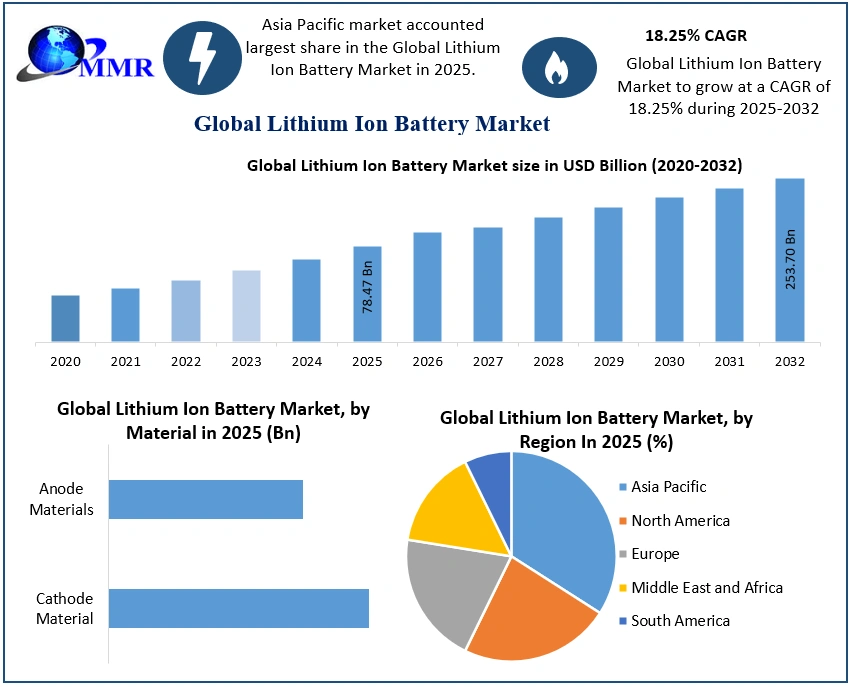
The Lithium Ion Battery Market size was valued at USD 78.47 Billion in 2025 and the total Lithium Ion Battery revenue is expected to grow at a CAGR of 18.25% from 2026 to 2032, reaching nearly USD 253.70 Billion by 2032.
Lithium Ion Battery Market Overview:
A lithium-ion battery, often abbreviated as Li-ion battery, is a rechargeable battery type widely used in modern electronics and transportation. The surge in demand for electric vehicles, including electric cars and motorcycles, has heightened the necessity for Lithium Ion Battery Market. Furthermore, the widespread adoption of lithium-ion cells in consumer electronics, such as laptops and mobile phones, has led to a substantial uptick in the demand for these batteries. Recognized as the industry standard for portable rechargeable batteries owing to their recharging capabilities, lithium-ion batteries are now essential for various products. The Asia Pacific Lithium Ion Battery Market is expected to experience the most substantial growth during the forecast period, driven by regional governments' initiatives to promote electric vehicle usage.
To know about the Research Methodology :- Request Free Sample Report
Li-ion batteries provide a variety of advantages over other high-quality rechargeable battery technologies. They offer one of the highest energy densities (100-265 Wh/kg or 250-670 Wh/L) of any battery technology available today. Li-ion battery cells can deliver up to 3.6 Volts, which is three times higher than Ni-Cd or Ni-MH technology. In addition, Li-ion batteries have a low self-discharge rate of 1.5-2% each month.
Lithium Ion Battery Market Dynamics:
Growing Adoption of Electric Vehicles across the globe:
Lithium-ion batteries serve as the power source for electric vehicles. The increasing adoption of electric vehicles (EVs) and plug-in hybrid electric vehicles (PHEVs) has led to a growing prominence of lithium-ion batteries, and this trend is anticipated to persist throughout the forecast period in the Lithium Ion Battery Market. The rising number of electric vehicles can be attributed to various advantages, including reduced vehicle engine maintenance, minimized usage of environmentally harmful oil waste, and decreased pollution resulting from fuel combustion engines, coupled with continuous advancements in battery technology. In 2022, global EV sales witnessed a significant 39% year-over-year increase, reaching 3.1 million units. The report suggests that this number is poised to continue its ascent, projecting the sale of 28 million electric vehicles by 2029. As electric vehicles emerge as the future of the automotive industry and transportation networks, the demand for the Lithium Ion Battery Market is expected to experience substantial growth throughout the forecast period.
Growing demand of Cathode Material across the globe:
In recent years, the lithium ion battery market has seen significant advancements in terms of component quality. Lithium-ion battery components include electrolytes, aluminum foil, copper foil, anode, and cathode. The global demand for cathode material has increased significantly, thanks to the lower raw material costs and increased demand for NCA, LFP, and LMO batteries. These lithium-ion battery modules have a wide range of applications in consumer electronics items that are in high demand. The need for cathode materials is expected to boost demand for lithium ion battery market during the forecast period.
Growing Applications of Lithium-Ion Batteries:
Lithium-ion batteries play a vital role in powering electronic devices like smartphones, power tools, and digital cameras, serving as efficient storage and backup solutions. The surging demand for lithium-ion batteries extends beyond consumer electronics, influencing industries such as railways, manufacturing, and solar power globally. The distinctive features of extended lifespan, competitive battery prices, and high energy density are anticipated to elevate the indispensability of lithium-ion batteries, consequently propelling the global growth of the lithium ion battery market.
Nevertheless, the lithium ion battery market faces challenges due to the demand for various battery types in sectors such as energy storage, consumer electronics, and electric vehicles, including lithium-air, flow batteries, sodium nickel chloride, and lead-acid batteries. This diversity is projected to impede lithium ion battery market growth in the forecast period. The shift toward renewable energy sources is driven by factors such as government subsidies, heightened awareness of climate change, declining battery costs, and the decreasing price of solar photovoltaic cells.
Lithium Ion Battery Market Trends:
1.Electric Vehicle Adoption:The increasing adoption of electric vehicles (EVs) is a major driver for the lithium ion battery market. As more countries and industries focus on reducing carbon emissions, the demand for lithium-ion batteries in the automotive sector continues to grow.
2.Energy Storage Systems:The growth of renewable energy sources like solar and wind has led to an increased need for energy storage systems. Lithium-ion batteries play a crucial role in storing energy generated from intermittent renewable sources, contributing to the growth of the lithium ion battery market.
3.Declining Battery Costs: Technological advancements and economies of scale have contributed to a decline in the cost of lithium-ion batteries. This reduction in costs makes electric vehicles and energy storage solutions more economically viable, further driving lithium ion battery market growth.
4.Advancements in Battery Technology: Ongoing research and development efforts are focused on improving the performance and safety of lithium-ion batteries. Innovations in materials and designs aim to enhance energy density, increase lifespan, and address safety concerns related with battery technology.
Lithium Ion Battery Market Segment Analysis:
By Type, the Lithium Ion Battery Market is segmented into Li-NMC, LFP, LCO, and LTO. The LCO (Lithium Cobalt Oxide) segment held the largest market share, accounting for 34.14% in 2025. The growing adoption of LCO batteries in electric bikes, power tools, and other electric powering trains is driving the product demand for this segment. In addition, their lower cost, longer cycle life, and higher energy density are also expected to increase their demand during the forecast period.
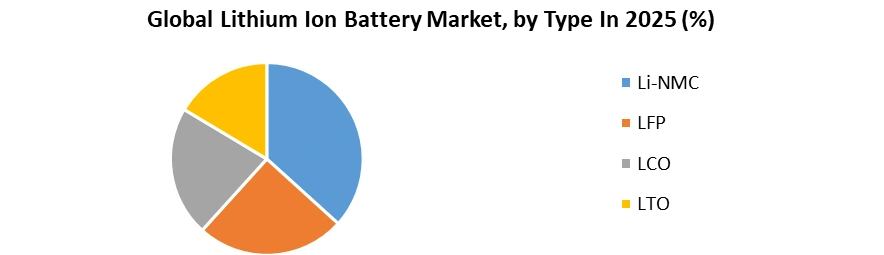
The LFP (Lithium-ion Phosphate) segment is expected to witness a significant growth rate at a CAGR of 19.46% during the forecast period. These batteries have a long life span and provide extraordinary product safety. The growing demand for LFP batteries in stationary and portable devices, which require high load currents and durability, is expected to boost the Lithium Ion Battery Market growth during the forecast period.
Based on the Application, the Lithium Ion Battery Market is segmented into Automotive, Marine, Aerospace and Defense, Industrial, Consumer Electronics, and Others. The Automotive segment held the largest market share, accounting for 35.12% in 2025. The segment growth is attributed to rising awareness of the benefits of battery-powered vehicles along with rising fossil fuel prices, particularly in Asia Pacific, Europe, and North America. The growing environmental concerns about carbon emissions in the automotive industry as a result of the usage of fossil fuels have prompted an increase in electric vehicle usages across the globe. In addition, government incentives and subsidies to encourage the usage of electric vehicles have significantly reduced their cost. The availability of publicly accessible charging stations, notably in Europe and North America, has boosted the popularity of Electric vehicles, which in turn rising the usage of lithium-ion batteries.
Lithium Ion Battery Market Regional Analysis:
In 2025, the Asia-Pacific Market reached a valuation of USD xx billion with largest market share of 38.67%. China, driven by escalating environmental concerns, has implemented a ban on traditional fossil fuel-powered scooters in major cities, resulting in a surge in e-scooter sales. The adoption of tools powered by lithium-ion batteries has expanded significantly, propelled by Asia Pacific's emergence as a global manufacturing hub. Notably, the China Lithium-Ion Battery market dominated with the largest Lithium Ion Battery Market share, while the India Lithium Ion Battery Market emerged as the fastest-growing market in the Asia-Pacific region.
The North America Lithium Ion Battery Market secures the second-largest market share, primarily propelled by the increasing sales of consumer electronics and vehicles. Notably, the US Lithium-Ion Battery market leads with the largest market share, while the Canada Lithium-Ion Battery market emerges as the fastest-growing market in the North American region. Expected to exhibit the fastest CAGR from 2025 to 2032, the Europe Lithium Ion Battery Market is experiencing notable growth. This growth is facilitated by the heightened focus of government bodies on reducing greenhouse gas emissions in the European environment. Several nations in the region, including Germany, Argentina, France, among others, have set ambitious targets of achieving zero carbon dioxide emissions by 2050. Furthermore, the Germany Lithium-Ion Battery market dominates with the largest Market share, while the UK Lithium-Ion Battery market takes the lead as the fastest-growing market in the Europe region.
Market Competitive Landscapes:
Several market manufacturers are focused on enhancing and expanding their core business through the launch of additional efficient products in order to keep up with conventional cheese sales. Several Lithium Ion Battery firms are broadening their product portfolios beyond traditional cheese varieties.
1. In October 5, 2023, the significance of Photoionisation Detection (PID) sensors in identifying potential issues in lithium-ion (Li-ion) battery production and usage was highlighted. Li-ion batteries power various devices, including electric vehicles, e-bikes, mobile phones, and laptops, and safety concerns have led to recalls and incidents such as overheating and exploding batteries. PID sensors play a vital role in detecting volatile organic compounds (VOCs) emitted by faulty Li-ion batteries. This aids in early fault detection, enhances safety measures, and meets the increasing demand for battery monitoring technology. The technology proves especially critical in preventing battery ignition and toxic gas emissions.
2. In October 21, 2023, Japanese researchers achieved a significant milestone by developing lithium-ion batteries that eliminate the dependence on cobalt, a costly and limited resource often present in conventional lithium-ion batteries. Their inventive approach incorporates a blend of elements in the electrodes, including lithium, nickel, manganese, silicon, and oxygen. This breakthrough results in batteries that are 60% more energy-dense and more powerful, boasting a voltage of 4.4 volts. Notably, the experimental batteries exhibited commendable longevity, retaining 80% of their capacity after over 1,000 charging and discharging cycles. This advancement holds the potential to enhance the environmental, economic, and social dimensions of battery production.
3. In on October 5, 2023, researchers unveiled a breakthrough method utilizing manganese, a more abundant mineral, to create cost-effective, high-performance lithium-ion (Li-ion) batteries. This offers an alternative to the limited nickel and cobalt resources traditionally used in battery production. The synthesized manganese-based materials, featuring a unique nanostructure, exhibit the high stability and energy density required for Li-ion batteries. This innovation addresses resource challenges in battery production, lowers costs, and reduces dependence on scarce metals like nickel and cobalt, thereby potentially meeting future energy demands.
Lithium-Ion Battery Market Scope: Inquiry Before Buying
| Lithium Ion Battery Market | |||
|---|---|---|---|
| Report Coverage | Details | ||
| Base Year: | 2025 | Forecast Period: | 2026-2032 |
| Historical Data: | 2020 to 2025 | Market Size in 2025: | USD 78.47 Bn. |
| Forecast Period 2026 to 2032 CAGR: | 18.25% | Market Size in 2032: | USD 253.70 Bn. |
| Segments Covered: | by Type | Li-NMC LFP LCO LTO |
|
| by Application | Automotive Marine Aerospace and Defense Industrial Consumer Electronics Others |
||
| by Material | Cathode Material Anode Materials |
||
| by Capacity | 0 to 3,000 mAh 3,000 to 10,000 mAh 10,000 to 60,000 mAh 60,000 mAh and Above |
||
| by Voltage | Low (Below 12 V) Medium (12 V-36 V) High (Above 36 V) |
||
Lithium Ion Battery Market, by Region
North America (United States, Canada and Mexico)
Europe (UK, France, Germany, Italy, Spain, Sweden, Austria and Rest of Europe)
Asia Pacific (China, South Korea, Japan, India, Australia, Indonesia, Malaysia, Vietnam, Taiwan, Bangladesh, Pakistan and Rest of APAC)
Middle East and Africa (South Africa, GCC, Egypt, Nigeria and Rest of ME&A)
South America (Brazil, Argentina Rest of South America)
Lithium Ion Battery Market, Key Players:
North America Lithium Ion Battery Market:
1. A123 Systems LLC (United States)
2. Tesla Inc (United States)
3. Enphase Energy, Inc. (United States)
Europe Lithium Ion Battery Market:
1. JOHNSON CONTROLS (Ireland)
2. Saft (France)
3. VARTA AG (Germany)
4. LITHIUM WERKS (Netherlands)
Asia Pacific Lithium Ion Battery Market
North America
1. EnerSys
2. Livent
3. Ballard Power Systems
4. QuantumScape
5. East Penn
6. Electrovaya
Europe
7. Northvolt
8. Skeleton Technologies
9. EAS Batteries
10. Blue Solutions
11. Forsee Power
APAC
12. Panasonic Group
13. LG Chem
14. Samsung SDI
15. BYD Company
16. Toshiba
17. Envision AESC
18. Shenzhen Ace Battery
19. Mitsubishi Electric
20. GS Yuasa
21. SK On
22. Atlas Battery
23. Lishen Battery
South America
24. Argentina Lithium & Energy
25. Varta
FAQs:
1. What are the growth drivers for the market?
Ans. The increasing adoption of electric vehicles (EVs) is a major driver for the market.
2. What is the major restraint for the market growth?
Ans. The market faces challenges related to the supply chain, including access to raw materials such as lithium and cobalt. Supply constraints can impact production and pricing.
3. Which region is expected to lead the global market during the forecast period?
Ans. APAC is expected to lead the global market during the forecast period.
4. What is the projected market size & and growth rate of the Market?
Ans. The Lithium Ion Battery Market size was valued at USD 78.47 Billion in 2025 and the total Lithium Ion Battery revenue is expected to grow at a CAGR of 18.25% from 2026 to 2032, reaching nearly USD 253.70 Billion by 2032.
5. What segments are covered in the Market report?
Ans. The segments covered in the market report are Type, Application, Material, Capacity, Voltage and Region.