
Liquid Fertilizers Market Size by Type, Compounds, Crop Type, Application, Region – Segment-Level Market Assessment, Growth Opportunity Analysis, Competitive Mapping & Forecast to 2032
Overview
Global Liquid Fertilizers Market was valued at USD 3.87 Billion in 2025 and is projected to reach USD 5.26 Billion by 2032, growing at a CAGR of 4.5% during the forecast period (2026–2032).
Liquid Fertilizers Market Overview
Liquid fertilizers are an efficient technique for supplying essential nutrients to plants at the optimal timing and concentration. Plants absorb them through their leaf pores and roots. Liquid fertilizers are high in growth hormones and micronutrients and are commonly used on row crops like maize. They appear to operate as a catalyst enhancing nitrogen absorption in plants. Liquid fertilizers assist in seedling establishment and fast early development. Liquid fertilizers are made from natural components. They supply additional nutrients to the plants that allow them to develop healthier. The growing population along with the rising demand for precision farming to enhance total crop yield are key factors that are expected to drive the growth of the global liquid fertilizers market in the future.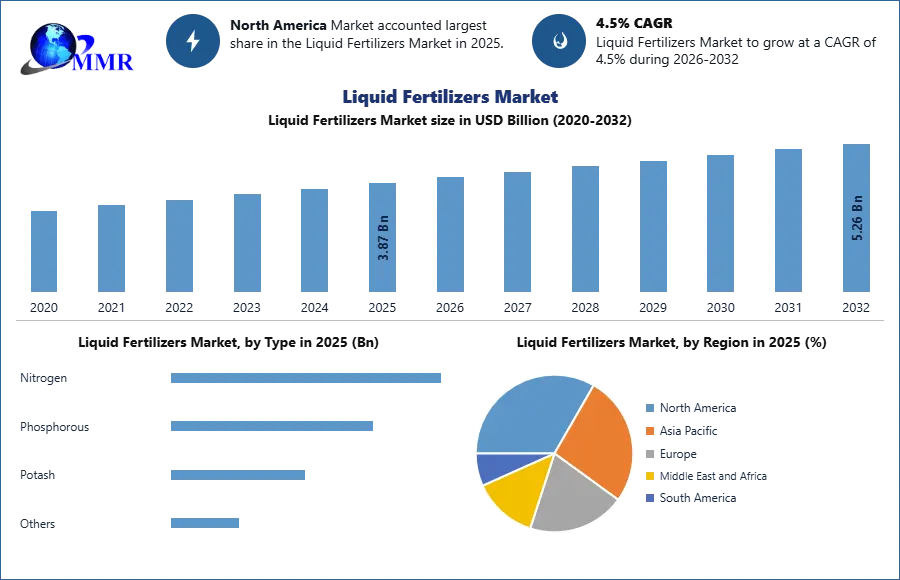 To know about the Research Methodology :- Request Free Sample Report
Liquid Fertilizers Market Dynamics
The Rising Population and Increasing Demand for More Food to Drive the Market Growth
The rising human population is expected to increase the demand for more food; this highlights the importance of agriculture and farming because it is the only way to produce food in huge quantities for humans. The land is limited now, and the prospect of creating additional agricultural land regions is limited. On the other hand, available agricultural land has decreased due to soil degradation, urbanization, and pollution. The only way to generate a significant amount of food for everyone is to increase the yield per area of accessible land. This is only achievable with the intelligent application of fertilizers, as well as other innovative farming techniques. The increased demand for high-value foods such as fresh fruits, nuts, vegetables, and coffee is accelerating.
However, climate change is having a significant impact on crop development. Farmers increase crop yield and profitability by using valuable irrigation systems and highly effective liquid fertilizers. The increased food security awareness and the growing population of emerging nations like India, Brazil, and Indonesia, among others are driving demand for highly efficient liquid fertilizers and boost the Liquid Fertilizers Market growth throughout the forecast period.
Hommak, renowned for its cutting-edge liquid fertilizer production lines, employs advanced technology for optimal productivity across diverse industries. Their comprehensive understanding of liquid fertilizer components ensures superior crop yields and cost-effectiveness. Liquid fertilizers, comprising nitrogen, phosphorus, potassium, and various additives, are applied seasonally for optimal results. The homogenization process guarantees uniformity, essential for balanced nutrient distribution and efficient plant growth. Organic Liquid Fertilizers, gaining traction in agriculture, offer eco-friendly nourishment for plants. Homogenization in production ensures uniform distribution, preventing clumping and enhancing nutrient delivery. Micron diameter and organic fermentation further enhance fertilizer quality and efficacy. Organic bacterial proliferation and fermentation are integral to our process, boosting potency and distribution efficiency.
The Dynamic Landscape of Liquid Fertilizers in Emerging Markets
The liquid fertilizers market is experiencing a remarkable surge in emerging economies, driven by increasing population, urbanization, and changing dietary preferences. One key opportunity lies in the customization and formulation of liquid fertilizers to suit specific soil conditions and crop requirements prevalent in diverse regions. This tailored approach enables farmers to optimize nutrient uptake and address localized challenges, ultimately boosting agricultural productivity and income levels.
The advent of precision agriculture technologies complements the adoption of liquid fertilizers in emerging markets. By leveraging data analytics, sensors, and automation, farmers can precisely monitor soil fertility and apply liquid fertilizers with pinpoint accuracy, minimizing resource wastage and maximizing crop yields. This integration of advanced technologies with liquid fertilizers not only enhances efficiency but also empowers smallholder farmers to compete in global markets.
Also, partnerships and collaborations between governments, agricultural organizations, and private sector players are driving awareness and adoption of liquid fertilizers in emerging markets. These initiatives focus on knowledge transfer, training, and infrastructure development, laying the groundwork for sustainable agricultural practices and economic growth. As emerging economies strive for food security and agricultural sustainability, the liquid fertilizers market presents a strategic opportunity for stakeholders to catalyze positive change and unlock new avenues for growth.
For instance, The EU ETS is one of the cornerstones of the European climate policy and could be a cost-effective way to reduce carbon emissions, if well implemented. The EU fertilizer industry is subject to a carbon cost via this system. The European industry is almost unique, globally, in facing this cost. Therefore, ensuring a level playing field for fertilizer production, energy and carbon costs is our priority. Also, the US’s Inflation Reduction Act (IRA), and Japan’s Hydrogen Strategy are likely to make cost competitive with these markets, or even cheaper.
Revolutionizing Agriculture to Drive the Growth Potential of Liquid Fertilizers
Liquid fertilizers present a compelling opportunity in the agricultural sector, offering innovative solutions to enhance crop yield and sustainability. These fertilizers provide a more efficient and convenient application method compared to traditional solid fertilizers. With liquid formulations, farmers can achieve better precision in nutrient delivery, reducing wastage and environmental impact while maximizing crop uptake. This efficiency translates into cost savings and improved productivity for farmers, making liquid fertilizers an attractive option in modern agricultural practices.
The increasing demand for organic and environmentally friendly farming practices has created a burgeoning Liquid Fertilizers Market for liquid organic fertilizers. These products offer a sustainable alternative to synthetic fertilizers, catering to eco-conscious consumers and meeting stringent regulatory standards. Liquid organic fertilizers, derived from natural sources such as compost, seaweed, and fish emulsion, provide essential nutrients while promoting soil health and microbial activity. As consumers prioritize sustainable food production, the demand for liquid organic fertilizers is poised to soar, presenting a lucrative opportunity for manufacturers and suppliers in the agricultural industry. Embracing liquid fertilizers can not only drive profitability but also contribute to a greener and more sustainable future for agriculture.
From precision agriculture to the use of drones, several technologies are transforming farming practices, with data and connectivity forming the core of the future revolution. For instance, artificial intelligence (AI) is rapidly dominating the world and advancing in the agriculture sector. One such AI-driven method is precision agriculture, which uses various technologies such as GPS, sensors, and drones to monitor crop growth and soil conditions. By collecting and analyzing data, it helps farmers make informed decisions about planting, fertilization, and irrigation. With precision farming, farmers detect problems early, reducing the use of pesticides and protecting the environment.
Significant growth in agricultural investment, the availability of low labor costs, flexible government regulations, and the increasing importance of agriculture as the only means of mass production for the world's rising population are likely to drive the global Liquid Fertilizers Market.
Importance of Liquid Fertilizer in Agriculture
Crop nutrition is becoming increasingly important in both food and commercial crops due to a variety of economic and environmental factors. Food demand has risen globally. As a result, high-efficiency fertilizers such as liquid fertilizers are becoming more popular, and this is a primary driver for the liquid fertilizer market. Many farmers, in general, desire better soil quality and nutrition in their fields. Liquid fertilizers assist farmers in increasing soil efficiency and improving the overall output produced by the soil, which is a key Liquid Fertilizers Market driver. Fertilizers play a major role in the productivity of farming, and therefore, meet the consumption requirements of humans globally. Without fertilizers, facing major shortages globally, with catastrophic effects on both human survival and the global economy. That said, not all fertilizers are created equal or for the same purpose. The efficacy of plant nutrition efforts also depends on using the best products for the relevant conditions at the right time and applying them accurately. This is one of the reasons why so many farmers prefer the use of liquid fertilizer. They offer numerous benefits that help to get plant nutrition right, every time. Liquid Fertilizer manufacturers like Euroliquids, affiliated with Van Iperen, operates Europe's largest liquid fertilizer facility in Rotterdam. With over 30 years of expertise, their automated plant ensures top-quality liquid fertilizers, meeting the stringent demands of hydroponic agriculture. Their laboratory develops innovative formulas, rigorously tested for stability and efficacy. Customized packaging options ensure product differentiation and compliance with local regulations. Featured products like FoliaStim and Iperen Algae cater to various crop needs, enhancing growth and stress resistance. Van Iperen's liquid NPK range, including Nitrofol Liquid and Pinta Liquid, offers tailored solutions for optimal crop development.
Environmental Concerns Pose Limitations on Liquid Fertilizers Market Growth
The burgeoning liquid fertilizers Industry encounters significant restraints, foremost among them being environmental concerns. Despite their efficacy in crop yield enhancement, liquid fertilizers contribute to environmental degradation through nutrient runoff, leading to the eutrophication of water bodies. Regulatory authorities increasingly impose stringent regulations on fertilizer applications to mitigate these adverse effects. Consequently, the liquid fertilizers Industry faces challenges in maintaining growth momentum amidst heightened environmental scrutiny. Innovative solutions such as slow-release formulations and precision application technologies are emerging to address these concerns, yet adoption remains limited due to higher costs and technological barriers. Thus, sustainable practices and eco-friendly formulations are imperative to overcome these constraints and foster sustainable growth in the liquid fertilizers market.
Infrastructure Limitations Hamper Liquid Fertilizers Market Growth
The liquid fertilizers market shows promising growth prospects, it grapples with infrastructural limitations hindering its widespread adoption. Transporting and storing liquid fertilizers necessitates specialized infrastructure, including tanks, pipelines, and handling equipment, which pose significant investment burdens for stakeholders. Moreover, in remote or underdeveloped regions, inadequate logistical support exacerbates these challenges, impeding market penetration. The inefficiency of existing infrastructure further escalates operational costs, thereby restraining market expansion. To surmount these hurdles, concerted efforts are required to invest in upgrading infrastructure and enhancing distribution networks. Collaborative initiatives between governments, industry players, and technology providers can facilitate the development of cost-effective solutions tailored to the unique requirements of the liquid fertilizers industry, overcoming infrastructure limitations and fostering sustained growth.
Liquid Fertilizers Market Segment Analysis
Based on the type, the nitrogen-liquid fertilizer segment dominated the largest Liquid Fertilizers Market share in 2025. The global market is primarily driven by the nitrogen segment, as both macro and micro elements play crucial roles in facilitating plant growth. Nitrogen, in particular, stands out as an essential nutrient extensively utilized in contemporary farming practices worldwide. Its significance lies in its role in synthesizing amino acids, the building blocks of proteins, and its involvement in almost every metabolic process within plants. However, farmers often encounter challenges associated with the low availability of nitrogen in the soil, necessitating the increased application of liquid nitrogen fertilizers to address this issue. Consequently, various nutrient mixtures are formulated and applied to nourish plants, leading to a sustained high demand for liquid nitrogen fertilizers on a global scale.
Based on the compounds, Calcium Ammonium Nitrate (CAN) captured a high revenue share in 2025 in the global Liquid Fertilizers Market as it is the significantly and widely used nitrogen fertilizer because of its comparatively high nutrient content along with physical properties, such as high solubility that help in the quick dissolving of the fertilizer into the soil. It contains magnesium and calcium that help in upgrading the efficiency of absorbing nitrogen by the roots along with reducing nitrogen losses that make fertilization more profitable; this also protects subsoil waters counter to pollution by nitrogen compounds. Henceforth, the aforementioned factors help in driving the market growth for CAN in the upcoming years as well.
By Application, Fertigation commands a significant portion of the revenue in the global liquid fertilizers market due to its multitude of advantages. This agricultural technique involves the simultaneous application of fertilizer and water through irrigation, offering profitability and efficiency. It presents a lucrative opportunity to enhance land yield while also mitigating environmental pollution. The growing attention from governmental bodies and increasing awareness among individuals contribute to the heightened demand and growth of fertigation techniques. Hence, these factors are expected to propel the market growth for fertigation in the foreseeable future.
Liquid Fertilizers Market Regional Insight
North America held the largest global liquid fertilizers market share in 2025, driven by the widespread adoption of sprinkler irrigation systems across the region. With approximately 55% (34,700 thousand acres) of irrigated land in the U.S. equipped with sprinkler systems, the demand for liquid fertilizers is expected to surge. The quest for efficient agricultural inputs, coupled with mounting concerns regarding residues from traditional agri-inputs, fuels the sales of liquid fertilizers in the region.
Asia Pacific is expected to experience robust growth in the global liquid fertilizers market. Escalating costs of traditional fertilizers and their adverse environmental impacts prompt a shift towards liquid fertilizers in the region. Advancements in automated irrigation systems play a pivotal role in driving market growth, along with increasing awareness about the benefits of nitrogenous liquid fertilizers in soil nutrient restoration and enhancement of overall soil fertility. These factors collectively propel the momentum in liquid fertilizers sales across Asia Pacific.
Liquid Fertilizers Market Scope: Inquiry Before Buying
| Liquid Fertilizers Market | |||
|---|---|---|---|
| Report Coverage | Details | ||
| Base Year: | 2025 | Forecast Period: | 2026-2032 |
| Historical Data: | 2020 to 2025 | Market Size in 2025: | 3.87 USD Billion |
| Forecast Period 2026-2032 CAGR: | 4.5% | Market Size in 2032: | 5.26 USD Billion |
| Segments Covered: | by Type | Nitrogen Phosphorous Potash Others |
|
| by Compounds | Calcium Ammonium Nitrate (CAN) Urea-Ammonium Nitrate (UAN) Potassium Nitrate Phosphorus Pentoxide (P205) Others (boron, chloride, and iron) |
||
| by Crop Type | Cereals & Grains Oilseeds & Pulses Fruits & Vegetables Others |
||
| by Application | Foliar Fertigation Soil Others |
||
Liquid Fertilizers Market, by Region
North America (United States, Canada and Mexico)
Europe (UK, France, Germany, Italy, Spain, Sweden, Austria and Rest of Europe)
Asia Pacific (China, South Korea, Japan, India, Australia, Indonesia, Malaysia, Vietnam, Taiwan, Bangladesh, Pakistan and Rest of APAC)
South America (Brazil, Argentina Rest of South America)
Middle East & Africa (South Africa, GCC, Egypt, Nigeria and Rest of ME&A)
Key Players/Competitors Profiles Covered in Brief Liquid Fertilizers Market Report in Strategic Perspective
- Nutrien, Ltd.
- Yara International ASA
- The Mosaic Company
- EuroChem Group
- Israel Chemicals Ltd. (ICL Group)
- K+S Aktiengesellschaft
- Sociedad Química y Minera de Chile (SQM)
- CF Industries Holdings, Inc.
- OCP Group
- OCI Nitrogen
- Wilbur-Ellis
- Compass Minerals
- AgroLiquid
- Kugler Company
- Haifa Group
- Compo Expert GmbH
- Plant Food Company, Inc.
- FoxFarm Soil & Fertilizer Co.
- Lawn and Garden Products, Inc.
- Verdesian Life Sciences
- Valagro S.p.A.
- Tessenderlo Group
- Growth Products Ltd.
- Miller Chemical & Fertilizer, LLC
- Van Iperen International (Euroliquids)