
Linalool Market Size by Type, Application End Use Industry and Region – Segment-Level Market Assessment, Growth Opportunity Analysis, Competitive Mapping & Forecast to 2032
Overview
The Linalool Market size was valued at USD 659.12 Million in 2024 and the total Linalool revenue is expected to grow at a CAGR of 4.2% from 2025 to 2032, reaching nearly USD 916.02 Million.
Linalool Market Overview:
Linalool is the name given to two enantiomers of a naturally occurring terpene alcohol found in a variety of flowers and spice plants. Linalool has a wide range of commercial uses, the vast majority of which are based on its pleasant aroma (floral, with a touch of spiciness). Linalool is an acyclic monoterpenoid and colourless oil. It is a metabolite, a volatile oil component, an antibacterial agent, and an aroma ingredient in plants. Linalool is used in the production of soaps, scents, flavouring agents in food, household products, and pesticides.
Linalool and linalool-rich essential oils have been found to have antibacterial, anti-inflammatory, anticancer, and anti-oxidant characteristics, and multiple in vivo investigations have validated the effects of linalool on the central nervous system. Linalool's applications extend beyond just adding or enhancing a certain aroma to household items such as soaps, detergents, and shampoos.
Linalool is particularly important since it is a vital molecule in the complicated pollination biology of numerous plant species, which is necessary for reproduction and survival. Linalool is also a major component in the commercial manufacturing of several scent compounds, including geraniol, nerol, citral, and its derivatives, as well as a vital component in the synthesis of vitamins A and E.
Linalool Market Report Scope:
The Linalool market is segmented based on Type, Application, End-User and Region. The growth of various segments helps reader in acquiring knowledge of the many growth factors expected to be prevalent throughout the market and develop different strategies to help identify core application areas and the gap in the target market.
The report provides an in-depth analysis of the market and contains meaningful insights, facts, historical data, and statistically supported and industry-validated market statistics. It also includes estimates based on an appropriate set of assumptions and methodologies.
The bottom-up approach has been used to estimate the market size. Major Key Players in the Linalool market are identified through secondary research and their market revenues are determined through primary and secondary research. Secondary research included a review of annual and financial reports of leading manufacturers, while primary research included interviews with important opinion leaders and industry experts such as skilled front-line personnel, entrepreneurs, and marketing professionals.
Some of the leading key players in the global Linalool market include Alpha Chemistry, US Biological Life Sciences, Molekula, Creative Enzymes and Vigon International. They are continuously strategizing on mergers and acquisitions, strategic alliances, joint ventures and partnerships for the growth of their market shares.
 To know about the Research Methodology :- Request Free Sample Report
Linalool Market Dynamics:
Fragrance-based applications of Linalool exhibit scope for future growth:
Fragrance-containing products are widespread. Fragrances are included in the majority of personal-care, home, and laundry products on the market. Fragrances are often included in cosmetic formulations to provide the user with a sense of well-being, to disguise the odour of other chemical components, or to add a specific cosmeceutical benefit (e.g. a soothing effect). Approximately 3000 chemical compounds (including essential oils and their components) are regularly used for this purpose, according to studies.
Linalool is produced by many plants, with members of the Lamiaceae (mints), Lauraceae (laurels, cinnamon, rosewood), and Rutaceae (citrus) families amassing a lot of it. Linalool is an unsaturated monoterpene alcohol with the odour "light and pleasant, floral-woody, with a subtle lemony undertone." Linalool is also a main component of several essential oils that have been shown to have biological actions such as antibacterial and antiplasmodial properties.
Linalool has also been shown to have anti-inflammatory, antihyperalgesic, and antinociceptive properties in animal models. Linalool has been intensively investigated since its discovery, however, the majority of the study is fragmented and obscured in multiple larger studies. The most important research discoveries about linalool especially emphasise its role in nature and the cosmetics sector.
Linalool has a high water solubility when compared to other essential oil components. Linalool has two enantiomeric forms, S-(+)- and the balance derived from natural plant terpenes. Approximately 95% of synthetic linalool is used in formulations to provide a specific scent in cosmetics, soaps, perfumes, and household cleaners, whereas only about 1% is added to food and beverages for aroma and flavouring.
Skin irritation and sensitization issues affiliated with Linalool might hinder the overall market growth.
The chemical has low acute toxicity following dermal exposure. The information available is not sufficient to derive a conclusion on acute inhalation toxicity of the chemical. However, the available information indicates that the chemical is a skin irritant, which warrants hazard classification. In three skin irritation studies conducted according to the OECD Test Guidelines, the chemical was applied on the skin of albino rabbits for four hours, with observation for up to seven days. Erythema was observed until day seven, with a mean value of two in one test.
In the other two tests, a score of two was recorded for 2/3 test subjects. Desquamation (peeling skin) was reported from days one to seven. The mean score for oedema was 3 in two studies and >2 in one. Based on the observations, the chemical was considered to be irritating to the skin.
The available human data indicate that the chemical causes slight skin irritation and at most, moderate eye irritation. In three patch tests, the chemical did not irritate the skin when applied (occlusive) at concentrations up to 20 % in petrolatum for 48 hours. In two other tests, the chemical (48 mg in one test and 32 % in acetone in another) was reported as mildly irritating to the skin. No other details are available. In a study with anosmic and normosmic human volunteers, the chemical caused eye irritation at a vapour concentration of ~320 ppm in two-thirds of the subjects.
The threshold for nasal pungency in anosmic humans was found to be close to this concentration. The chemical was concluded to be, at most, a moderate eye irritant in this study.
The chemical, in its highly purified form, might be a weak skin sensitiser. The chemical is auto-oxidised when exposed to air. This oxidised form is a potent skin sensitiser. Similarly to limonene (NICNAS), this is considered sufficient to warrant hazard classification for the chemical. Clinical studies have shown a direct association between contact dermatitis and the oxidised chemical or its hydroperoxide fraction. In a European multi-centre study conducted on 1511 consecutive patients, 1.3 % showed positive reactions to the oxidised chemical and 1.1 % to the hydroperoxide fraction.
A study conducted involving 2900 dermatitis patients at nine centres in six countries (Spain, Denmark, Sweden, the United Kingdom, Australia and Singapore) revealed a positive rate of 6.9 % to a patch test following exposure to the oxidising chemical.
The pharmacological applications of Linalool in treating infectious diseases are a major opportunity for market growth
Despite advances in understanding the life cycle and treatment of many infections, microorganisms cause the bulk of illnesses that harm millions of people in impoverished nations. Although there are several articles on the anti-infective activities of essential oils, relatively few researchers have looked into the activity of particular oil components (e.g. linalool). Bursera aloexylon essential oil, which contains high quantities of linalool (96%), has been proven to be effective against Rhodococcus equi and Staphylococcus epidermis.
Croton cajucara essential oil (linalool-rich chemotype) inhibits the development of Candida albicans, Lactobacillus casei, S. aureus, Streptococcus sobrinus, Porphyromonas gingivalis, and Streptococcus mutans cell suspensions. All of these infections are linked to oral cavity illness. These findings may give some scientific support for the inclusion of linalool as an ingredient in various mouthwash and gargle products that claim to provide symptomatic treatment of sore throats, mouth ulcers, and painful gums. Electron microscopy was used to investigate the impact of linalool on the cell biology of Candida albicans, which revealed that linalool reduced cell size and germination.
Linalool Market Segment Analysis:
By Application, the essential oil segment is expected to grow at a CAGR of 6.8% during the forecast period. Essential oils and fragrance compounds are utilized as medicinal agents in folk medicine and aromatherapy for pain relief, anxiety reduction, and energy augmentation. Acyclic monoterpenes are a notable family of chemicals helpful in the fragrance and aromatherapy industries due to their high volatility. Linalool, which accounts for around 70% of the terpenoids in floral smells, is one of the most significant acyclic monoterpene compounds.
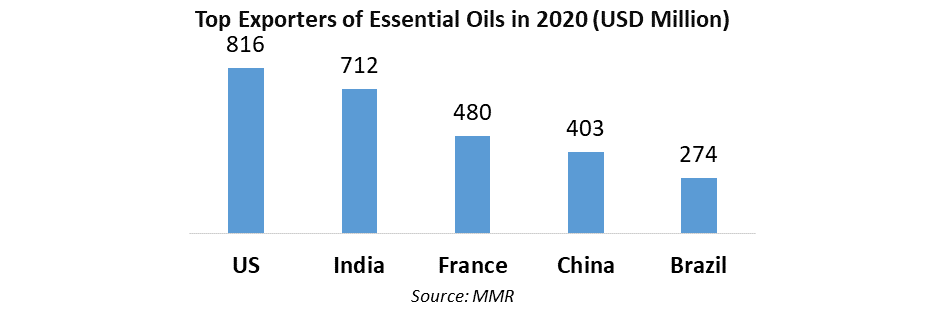
Linalool may be found in the essential oils of over 200 plant species from various families. Lavender oils are commonly used to improve sleep. As a result, lavender aromatics have been shown to promote sleep in the elderly and newborns. Also, exposure to lavender scents while sleeping increases the length of profound slow-wave sleep.
Anxiety reduction is a similarly related therapeutic benefit that has been documented for lavender essential oil use. Linalool has been shown to not only activate olfactory receptors but also to modify ion channel receptor potentials such as transient receptor potential channels and to enhance the -amino butanoic acid receptor.
Linalool, like other chemotherapeutic drugs, has pathogen specificity. An in vitro study of linalool exposed to Salmonella thyphimurium strains (Ames with and without S9 activation) revealed that linalool was not capable of preventing the development of this bacterium. Its anti-inflammatory properties assist various forms of inflammation, including swollen joints, lung inflammation, a bee sting, and inflammatory skin conditions such as psoriasis and dermatitis. Inflammation is frequently followed by pain. Linalool is well-known for its pain-relieving properties and may be administered topically to stiff joints, aching muscles, general pains, and more.
Linalool Market Regional Insights:
Europe dominated the essential oil sector, accounting for 45% of total sales in 2020. At the end of the forecast period, the region is expected to dominate the industry resulting in the high demand for Linalool. This is due to the presence of developed end-use industries, as well as increased consumer knowledge of the advantages of essential oils. The presence of organizations such as the European Federation of Essential Oils (EFEO) has aided the growth of the European essential oil sector. EFEO was established to promote and protect the interests of stakeholders along the market value chain. The organization is also in talks with the EU Commission and the EU Parliament about introducing or amending legislation governing essential oils. Such developments have aided regional market growth.
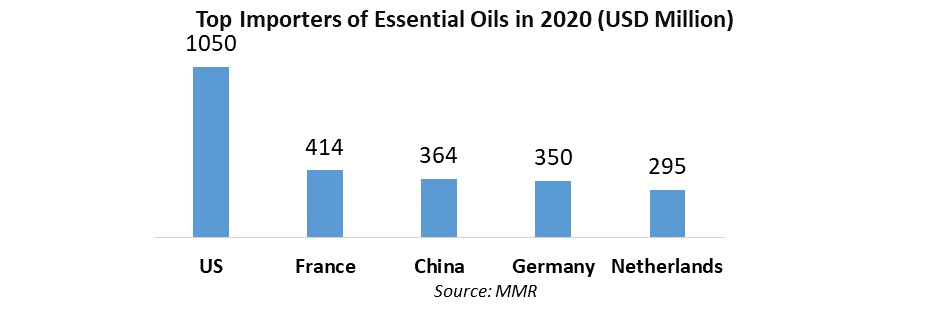
Over the forecast period, Asia Pacific is estimated to have the highest CAGR of 7.9% in the Linalool market. This is due to favorable climatic conditions for agriculture, low-cost labor, and an abundance of raw resources. Also, a movement in consumer preference in China and India toward healthy and nutritional food and drinks, as well as other food items, is expected to present attractive development prospects for global market players in the Asia Pacific market. In 2020, China led the Asia Pacific market. The availability of a huge customer base for the skincare business, along with the high demand for Chinese fragrances, is projected to drive demand for linalool in the nation.
Due to increased local demand for essential oils, the market for linalool in the Middle East and Africa has shown extraordinary growth in recent years. Consumer goods demand is strongly tied to population growth and improving living standards. Because of the availability of undiscovered market potential and continuous advances in the medical, food and beverage, and spa and relaxation industries, the regional market is expected to grow at a healthy rate during the forecast period.
Linalool Market Scope: Inquire before buying
| Linalool Market | |||
|---|---|---|---|
| Report Coverage | Details | ||
| Base Year: | 2024 | Forecast Period: | 2025-2032 |
| Historical Data: | 2019 to 2024 | Market Size in 2024: | USD 659.12 Mn. |
| Forecast Period 2025 to 2032 CAGR: | 4.2% | Market Size in 2032: | USD 916.02 Mn. |
| Segments Covered: | by Type | Natural Synthetic |
|
| by Application | Essential Oils Soap and Cleaning Compounds Fragrances and Perfumes Food Additives Insecticides Sedatives Other |
||
| by End-User | Pharmaceutical Chemical Cosmetics and Personal Care Others |
||
Linalool Market, by Region
North America (United States, Canada and Mexico)
Europe (UK, France, Germany, Italy, Spain, Sweden, Austria and Rest of Europe)
Asia Pacific (China, South Korea, Japan, India, Australia, Indonesia, Malaysia, Vietnam, Taiwan, Bangladesh, Pakistan and Rest of APAC)
Middle East and Africa (South Africa, GCC, Egypt, Nigeria and Rest of ME&A)
South America (Brazil, Argentina Rest of South America)
Linalool Market, Key Players are
1. Alpha Chemistry
2. US Biological Life Sciences
3. Molekula
4. Creative Enzymes
5. Vigon International
6. Bruchem Inc.
7. Silverline Chemicals
8. Parchem
9. Mane Kancor Ingredients Pvt. Ltd
10. Ottokemi
11. BASF
12. Royal DSM
13. Arora Aromatics Pvt. Ltd.
14. Chemical Point UG
15. Ernesto Ventós S.A.
16. Symrise
17. Axxence Aromatic GmbH
18. Menthaallied
19. Phoenix Aromas & Essential Oils LLC
20. Robertet Group
FAQs:
1. Which is the potential market for Linalool in terms of the region?
Ans. APAC is the potential market for Linalool in terms of the region.
2. What are the restraints for new market entrants?
Ans. Skin irritation and sensitization issues affiliated with Linalool might hinder the overall market growth.
3. What is expected to drive the growth of the Linalool market in the forecast period?
Ans. Fragrance-based applications of Linalool exhibit scope for future growth.
4. What is the projected market size & growth rate of the Linalool Market?
Ans. The Linalool Market size was valued at USD 659.12 Million in 2024 and the total Linalool revenue is expected to grow at a CAGR of 4.2% from 2025 to 2032, reaching nearly USD 916.02 Million.
5. What segments are covered in the Linalool Market report?
Ans. The segments covered are Type, Application, End-User and Region.