
Laboratory Equipment Services Market Size by Service Type, Equipment Type, Application, End-User Industry, Region – Segment-Level Market Assessment, Growth Opportunity Analysis, Competitive Mapping & Forecast to 2034
Overview
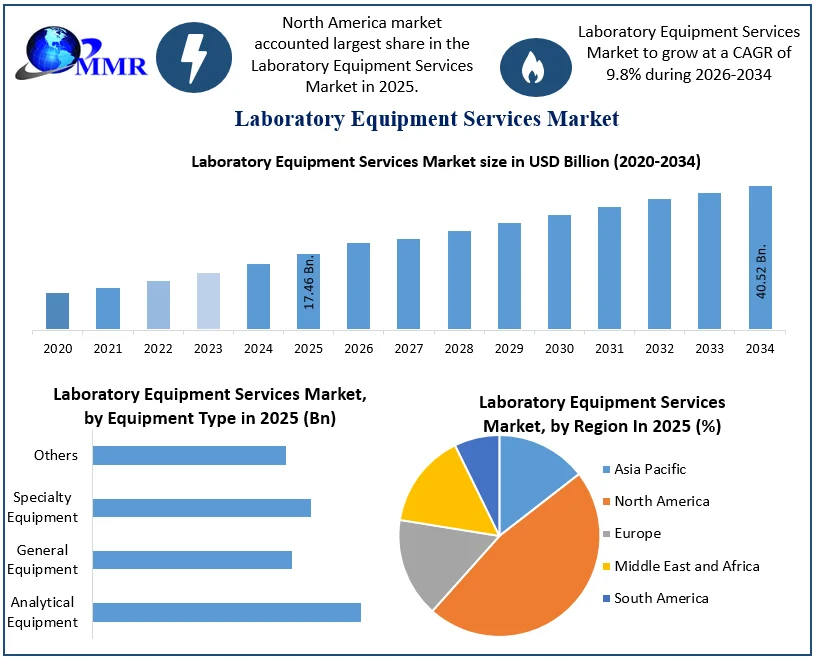
The Laboratory Equipment Services Market size was valued at USD 17.46 Billion in 2025 and the total Laboratory Equipment Services revenue is expected to grow at a CAGR of 9.8 % from 2026 to 2034, reaching nearly USD 40.52 Billion by 2034.
Laboratory Equipment Services are repair, calibration, and validation of scientific instruments, ensuring accuracy and reliability in various industries like biological, pharmaceutical, industrial, and commercial settings. Increasing demand for precise and reliable scientific instrumentation across various industries driving the growth of Laboratory Equipment Services Market. The current scenario reflects a robust market landscape characterized by a rising emphasis on ensuring equipment functionality, adherence to stringent regulatory standards, and cost-effective maintenance solutions. Continuous advancements in laboratory technologies, growing investments in research and development activities, and the increasing adoption of outsourcing services to streamline operations and focus on core competencies are some major key growth factors contributing to the Laboratory Equipment Services Market growth.
Laboratory Equipment Services Market Snapshot
To know about the Research Methodology:-Request Free Sample Report
The expanding biotechnology and pharmaceutical sectors, coupled with the need for accurate diagnostic solutions, are boosting the demand for laboratory equipment services. Recent developments by Laboratory Equipment Services Market key players underscore innovation and strategic collaborations aimed at enhancing service offerings and expanding global presence. Leading Laboratory Equipment Services Market players such as Agilent Technologies, Inc., Thermo Fisher Scientific Inc., and Waters Corporation have been actively engaged in acquisitions, partnerships, and product launches to strengthen their market position and cater to evolving customer needs. For instance, Agilent Technologies' acquisition of BioTek Instruments, Inc. in 2019 expanded its life sciences portfolio, enabling the company to offer a comprehensive range of laboratory equipment and services. Similarly, Thermo Fisher Scientific's collaboration with Illumina, Inc. in 2020 aimed to develop FDA-approved next-generation sequencing (NGS) based oncology companion diagnostics, highlighting the strategic focus on innovation and market expansion. The Laboratory Equipment Services Market is expected rapid growth, driven by technological advancements, increasing research activities, and strategic initiatives by key market players to capitalize on emerging opportunities and address evolving customer demands.
Laboratory Equipment Services Market Dynamics:
Development of Biotechnology and Pharmaceutical Sectors with Advancements in Laboratory Technologies Driving Laboratory Equipment Services Market Growth
Continuous innovation in laboratory equipment boosting the growth of Laboratory Equipment Services Market, for instance- the advancement in analytical instruments such as mass spectrometers and high-performance liquid chromatography (HPLC) systems, drives the need for specialized servicing. These sophisticated instruments require expert calibration and maintenance services to ensure optimal performance and accurate results. Stringent regulatory standards in industries such as pharmaceuticals and healthcare mandate regular calibration and validation of laboratory equipment. For example, adherence to ISO 17025 certification standards for calibration laboratories boosts demand for accredited calibration services, driving the growth of the calibration services market.
Worldwide forecast of pharmaceutical sector growth between 2018 and 2030, by Country
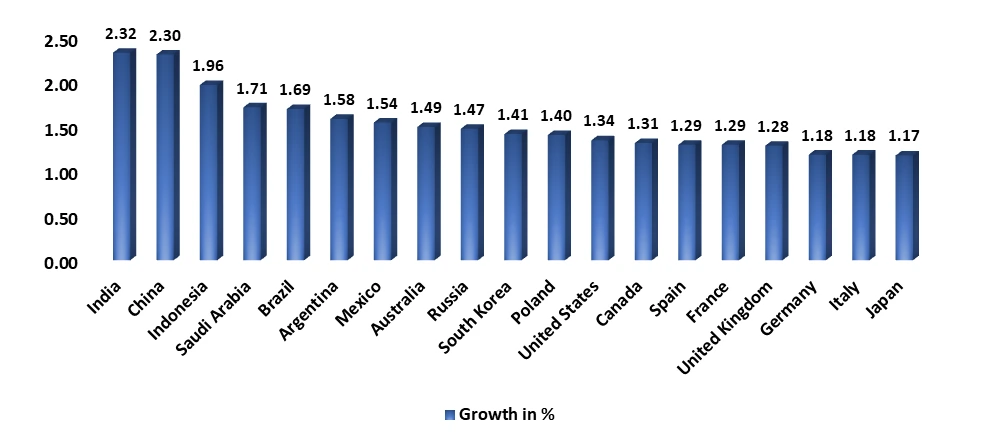
The expanding biopharmaceutical market boosts demand for laboratory equipment services to support research, development, and manufacturing activities. The increasing adoption of bioprocessing technologies, such as bioreactors for cell culture applications, underscores the need for specialized maintenance and validation services to ensure product quality and regulatory compliance. Rising investments in research and development across industries drive demand for laboratory equipment services. For example, the expansion of genomics research, facilitated by advancements in DNA sequencing technologies such as next-generation sequencing (NGS), necessitates calibration and maintenance services to ensure accurate and reliable experimental results. Globally, research and development spending reached $1.92 trillion in 2021, with the pharmaceutical industry accounting for a significant portion of this expenditure.
Genome UK: 2022 to 2025 implementation plan for England
| Investment Description | Funding (£ million) |
| Landmark research programme for studying the effectiveness of using WGS to speed up diagnosis and treatment of rare genetic diseases in newborns | £105 |
| Tackling health inequalities in genomic medicine through tailored sequencing of participants from diverse backgrounds | £22 |
| Innovative cancer programme to evaluate cutting-edge genomic sequencing technology and use AI for analysis | £26 |
| Medical Research Council-led funding for a 4-year functional genomics initiative | Up to £25 |
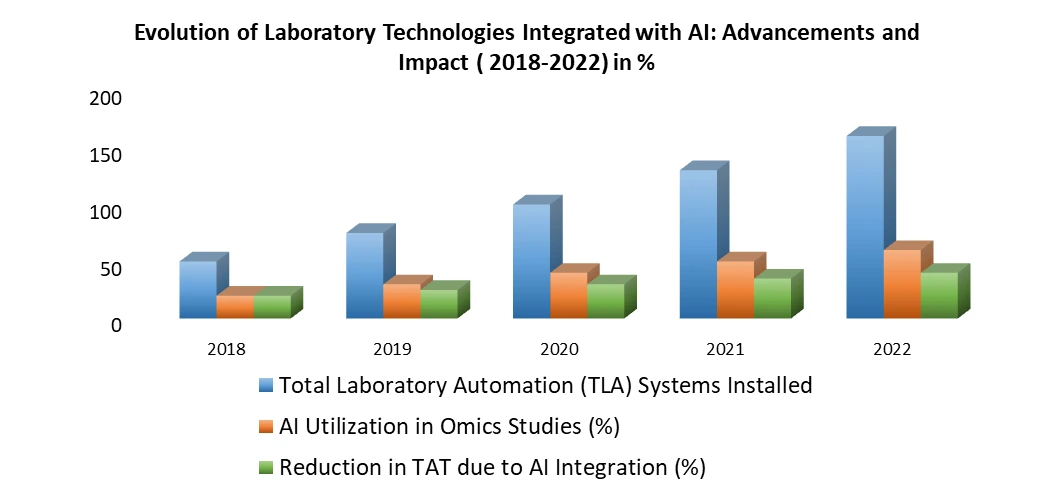
The integration of artificial intelligence (AI) with advancements in laboratory technologies has catalyzed a transformative era in healthcare. Traditionally, laboratory medicine relied on manual processes, but recent technological strides have revolutionized diagnostics and monitoring, enhancing patient care. Automation, exemplified by total laboratory automation (TLA) systems, streamlines processes, reducing errors and improving efficiency across clinical chemistry, hematology, and microbiology testing. Additionally, digitization and AI-driven analysis of culture plate images have automated microbiology, enhancing efficiency and accuracy. Meanwhile, omics technologies, including genomics and transcriptomics, have advanced with AI-driven data mining, enabling personalized medicine through single-cell sequencing and liquid biopsy for cancer detection and treatment prediction. Furthermore, advancements in metabolomics and proteomics, facilitated by AI-enabled analysis of mass spectrometry and nuclear magnetic resonance spectroscopy data, offer insights into disease biomarkers and therapeutic targets. Microfluidic devices, such as lab-on-a-chip systems, leverage AI for rapid and precise diagnostics, including single-cell analysis for cancer prognosis and immune cell profiling. The synergy between AI and laboratory technologies not only optimizes healthcare delivery but also paves the way for a future of precision and personalized medicine, enriching the critical role of the laboratory in patient care.
Balancing High Costs of Equipment Maintenance Contracts with Uncertain Healthcare Funding Impeding Growth of the Laboratory Equipment Services Market
The high cost of equipment maintenance contracts, particularly for specialized equipment such as mass spectrometers hindering the growth of Laboratory Equipment Services Market. These intricate servicing needs often lead to expensive service agreements, deterring smaller laboratories from investing in regular maintenance and risking equipment breakdowns, impacting their research or diagnostic capabilities. For instance, the average annual cost of maintenance contracts for specialized equipment exceeds $50,000, presenting a substantial financial burden for laboratories.
Managing High Costs of Laboratory Equipment and Services Amidst Pricing Variability
| Equipment/Service | Average Pricing | Description |
| Mass Spectrometer | $200,000 - $500,000 | A sophisticated analytical instrument used for identifying compounds in a sample based on their molecular masses. Maintenance costs include calibration and system checks. |
| High-Performance Liquid Chromatography (HPLC) System | $50,000 - $150,000 | Advanced analytical technique used to separate, identify, and quantify components in a mixture. Maintenance involves column replacement, pump calibration, and detector checks. |
| Next-Generation Sequencing (NGS) Platform | $500,000 - $1,000,000 | Cutting-edge technology for analyzing DNA and RNA sequences. Maintenance includes regular system calibration, reagent replenishment, and instrument validation. |
| Nuclear Magnetic Resonance (NMR) Spectrometer | $300,000 - $700,000 | Powerful analytical tool used for molecular structure determination. Maintenance includes cryogen refills, probe tuning, and software updates. |
| Automated Cell Culture System | $100,000 - $300,000 | Automated platform for growing and maintaining cell cultures. Maintenance involves routine system cleaning, sensor calibration, and software upgrades. |
| Laboratory Information Management System (LIMS) | $50,000 - $200,000 | Software solution for managing laboratory workflows, data, and resources. Maintenance includes system updates, database backups, and user training. |
Limited budget allocations for service contracts pose a challenge for many laboratories, especially academic research institutions. These institutions often prioritize research grants for equipment purchases over long-term service contracts, leading to ad-hoc repairs or in-house maintenance. Consequently, the efficiency and lifespan of critical laboratory equipment may be compromised. Data shows that over 40% of laboratories allocate less than 10% of their annual budgets to equipment maintenance contracts, highlighting the constraints they face in ensuring the reliability of their equipment. Compliance with complex regulatory standards, such as ISO 13485, presents another significant challenge for laboratory equipment services providers. Adhering to these stringent standards requires extensive documentation, audits, and employee training, increasing operational overheads and impacting profit margins. Furthermore, rapid technological advancements in laboratory equipment demand specialized technical expertise for maintenance and calibration, posing logistical challenges and increasing operational costs for service providers. These challenges collectively hinder the growth and efficiency of the laboratory equipment services market, impacting both service providers and their clients.
Laboratory Equipment Services Market Segment Analysis:
Based on Service Types, Calibration services dominated the Laboratory Equipment Services Market in 2025 as they are crucial for ensuring accurate measurements and compliance with regulatory standards across industries such as pharmaceuticals and environmental monitoring. Repair and maintenance services are widely adopted, particularly in healthcare and research settings, to minimize equipment downtime and maintain operational efficiency. Validation services are essential for verifying the performance and reliability of laboratory equipment, especially in highly regulated sectors like biotechnology and food testing. Equipment rental services are gaining traction among smaller laboratories and startups seeking cost-effective access to advanced equipment without substantial capital investment. Training services are increasingly in demand to enhance the proficiency of laboratory staff in operating and troubleshooting complex instruments. Other services, encompassing customizations, consulting, and technical support, cater to specific needs and challenges faced by laboratories across diverse sectors, contributing to the overall growth and functionality of the laboratory equipment services market.
Laboratory Equipment Services Market Recent Development
| Date | Company | Development | Impact |
|---|---|---|---|
| 15 January 2025 | Agilent Technologies, Inc. | The company launched an expanded **CrossLab Service portfolio** featuring **AI-driven predictive maintenance** for complex chromatography and mass spectrometry systems. | The upgrade significantly improves **instrument uptime** and reduces unplanned lab downtime by up to **25%** for high-throughput diagnostic facilities. |
| 11 March 2025 | Thermo Fisher Scientific Inc. | Thermo Fisher completed the acquisition of a regional asset management and validation services provider to strengthen its **Unity Lab Services** network in Europe. | This transaction scales up the company's **multivendor service capabilities**, offering seamless, unified maintenance contracts across diverse laboratory platforms. |
| 22 May 2025 | Waters Corporation | Waters introduced its new **FlexCHOICE Risk Tiered Service Plans** designed to provide customizable coverage levels for liquid chromatography instruments. | The scalable plans provide pharmaceutical labs with greater **cost-efficiency** and optimized operational control over compliance-heavy validation workflows. |
| 08 October 2025 | PerkinElmer Enterprise Solutions | The organization secured a multi-million dollar **OneSource laboratory asset management contract** with a major global biopharmaceutical consortium. | PerkinElmer will assume full operational maintenance, **qualification, and calibration services**, standardizing lab operations across **12 international R&D sites**. |
| 17 February 2026 | Eppendorf SE | Eppendorf opened a state-of-the-art, **ISO-certified calibration and pipetting service facility** in Bangalore, India, to target emerging biotech hubs. | The expansion shortens service turnaround times and supports regional adherence to strict **GLP/GMP regulatory compliance standards**. |
Laboratory Equipment Services Market Regional Insights:
North America Dominance in the Laboratory Equipment Services Market
North America dominated the Laboratory Equipment Services Market led by the presence of major manufacturers such as Thermo Fisher Scientific and Agilent Technologies, stands out as a key producer of laboratory equipment services. The region benefits from robust research and development infrastructure, particularly in biotechnology and pharmaceuticals. For instance, biopharmaceutical companies in North America invested over a trillion dollars in R&D until 2025, driving the demand for laboratory equipment services. The region's governments, such as Canada, are investing heavily in research, with initiatives like the JDRF-CIHR partnership receiving up to USD 15 million for diabetes research. Frequent product developments and launches by key market players, such as the Baker Company's launch of the ReCO2ver rapid recovery cell culture incubator, further contribute to market growth. The region is also witnessing strategic activities like the establishment of manufacturing facilities by companies like American Nitrile, further boosting the market.
Europe emerges as a major consumer of laboratory equipment services, particularly in countries such as Germany, France, and the UK, driven by advanced healthcare systems and extensive academic and industrial research facilities. The European biotechnology sector is expected to reach US$ 150 billion by 2025, highlighting the region's significant demand for laboratory equipment and services. Asia-Pacific, driven by rapid industrialization and healthcare infrastructure investments, plays a prominent role in both production and consumption. Countries like China, Japan, and South Korea are significant manufacturing hubs and consumers of laboratory equipment services. India, in particular, is witnessing substantial growth in its biotechnology sector, with investments in R&D and infrastructure. The country's biotechnology industry is expected to grow to around Rs. 440,000 crores (US$ 70.84 billion) by 2020, indicating a significant demand for laboratory equipment services. Initiatives like India's Genome Valley, a hub for life sciences R&D and manufacturing operations, are driving investments and innovation in the sector. The Genome Valley, with its world-class infrastructure and support from the government, is attracting investments from both domestic and international firms. For instance, Ferring Pharma plans to invest Rs. 500 crores (US$ 64.4 million) to set up a manufacturing facility, showcasing the region's potential for growth in laboratory equipment services.
Laboratory Equipment Services Market Scope: Inquire before buying
| Global Laboratory Equipment Services Market | |||
|---|---|---|---|
| Report Coverage | Details | ||
| Base Year: | 2025 | Forecast Period: | 2026-2034 |
| Historical Data: | 2020 to 2025 | Market Size in 2025: | US $ 17.46 Bn. |
| Forecast Period 2026 to 2034 CAGR: | 9.8% | Market Size in 2034: | US $ 40.52 Bn. |
| Segments Covered: | by Service Type | Calibration Services Repair and Maintenance Services Validation Services Equipment Rental Services Training Services Other Services |
|
| by Equipment Type | Analytical Equipment General Equipment Specialty Equipment Others |
||
| by Application | Clinical Diagnostics Drug Discovery & Development Biotechnology & Life Sciences Research Environmental Testing Food & Beverage Testing Academic Research Others |
||
| by End-User Industry | Pharmaceutical & Biotechnology Companies Contract Research Organizations (CROs) Academic & Research Institutes Hospitals & Diagnostic Laboratories Environmental Testing Laboratories Food & Beverage Companies Others |
||
Laboratory equipment services market, by Region:
North America (United States, Canada and Mexico)
Europe (UK, France, Germany, Italy, Spain, Sweden, Austria and Rest of Europe)
Asia Pacific (China, South Korea, Japan, India, Australia, Indonesia, Malaysia, Vietnam, Taiwan, Bangladesh, Pakistan and Rest of APAC)
Middle East and Africa (South Africa, GCC, Egypt, Nigeria and Rest of ME&A)
South America (Brazil, Argentina Rest of South America)
Laboratory Equipment Services Market Key Players:
Major Contributors in the Laboratory Equipment Services Industry in North America:
1. Thermo Fisher Scientific Inc. - Headquarters: Waltham, Massachusetts, United States
2. Agilent Technologies, Inc. - Headquarters: Santa Clara, California, United States
3. Waters Corporation - Headquarters: Milford, Massachusetts, United States
4. PerkinElmer, Inc. - Headquarters: Waltham, Massachusetts, United States
5. Bio-Rad Laboratories, Inc. - Headquarters: Hercules, California, United States
6. Bruker Corporation - Headquarters: Billerica, Massachusetts, United States
Leading Figures in the European Laboratory Equipment Services Sector:
1. Merck KGaA - Headquarters: Darmstadt, Germany
2. Eppendorf AG - Headquarters: Hamburg, Germany
3. Sartorius AG - Headquarters: Göttingen, Germany
4. F. Hoffmann-La Roche Ltd - Headquarters: Basel, Switzerland
5. Qiagen N.V. - Headquarters: Venlo, Netherlands
Key players driving the Asia-Pacific Laboratory Equipment Services Market:
1. Shimadzu Corporation - Headquarters: Kyoto, Japan
2. Hitachi High-Tech Corporation - Headquarters: Tokyo, Japan
3. PerkinElmer Pty Ltd. - Headquarters: Glen Waverley, Australia
4. Luminex Corporation - Headquarters: North Ryde, Australia
FAQs:
1] Which region is expected to hold the highest share in the Global Laboratory Equipment Services Market?
Ans. North America region is expected to hold the highest share in the Laboratory Equipment Services Market.
2] What is the market size of the Global Laboratory Equipment Services Market by 2034?
Ans. The market size of the Laboratory Equipment Services Market by 2034 is expected to reach US$ 40.52 Billion.
3] What is the forecast period for the Global Laboratory Equipment Services Market?
Ans. The forecast period for the Laboratory Equipment Services Market is 2026-2034.
4] What was the market size of the Global Laboratory Equipment Services Market in 2025?
Ans. The market size of the Laboratory Equipment Services Market in 2025 was valued at US$ 17.46 Billion.