
IoT Smart Cities Market Size by Component, Platform, Technology, Application, Region – Revenue Pool Analysis, Margin Structure Assessment, Capital Flow Trends, Competitive Benchmarking & Forecast to 2032
Overview
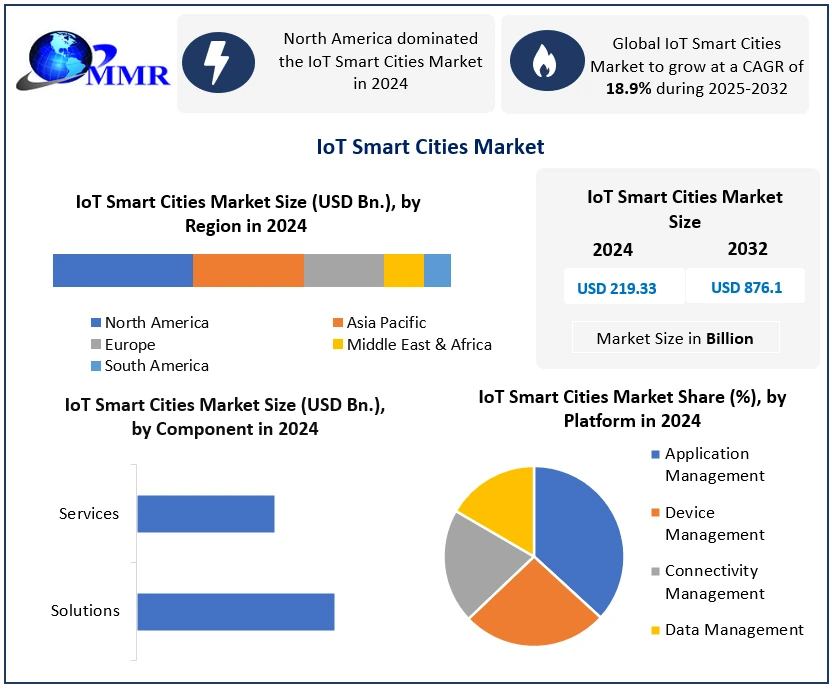
The IoT Smart Cities Market was valued at USD 219.33 Bn in 2024, and the total revenue of the IoT Smart Cities Market is expected to grow at a CAGR of 18.9% from 2025 to 2032, reaching nearly USD 876.1 Bn by 2032. Driven by rapid urbanization and the smart tech boom.
The report includes the analysis of impact of COVID-19 lock-down on the revenue of market leaders, followers, and disrupters. Since lock down was implemented differently in different regions and countries, impact of same is also different by regions and segments.
The report has covered the current short term and long term impact on the market, same will help decision makers to prepare the outline for short term and long term strategies for companies by region.
 To know about the Research Methodology:-Request Free Sample Report
The concept of smart city includes optimization of the efficiency of city operations and services, and connected citizens. Smart city technology enables city officials to interact directly with both communities and city infrastructure, and monitor what is happening in the city and how the city is developing.
Smart city initiatives are applicable to urban developed cities, for the efficient management of assets and resources, such as traffic and transportation systems, power plants, water supply networks, waste management, information systems, schools, libraries, hospitals, and other community services. Thus, with the world moving towards urbanization, there is an increasing number of smart city initiatives and projects, in the pipeline. Therefore, with growing urbanization, the need to manage infrastructure and assets are encouraging countries across the world to invest in smart city projects.
Main reason behind the growth of smart cities is need for an effective solution for managing the cities. Governments of various countries are expected to collaborate and partner with each other, in order to transform into a combined and integrated service delivery model, from the traditional silo-based model. Expansion of cities and urbanization, extensive adoption of green technology, increasing telecom penetration, and rising adoption of Artificial Intelligence (AI) and Internet of Things, are the factors driving the demand for smart cities.
Segment Analysis:
Based on the Platform, the Application Management segment is expected to dominate the IoT Smart Cities Market in 2032. This dominance is attributed to the growing adoption of IoT-based urban solutions such as smart traffic control, energy optimisation, waste management, and smart surveillance. Application management platforms play a critical role in orchestrating these services and ensuring seamless interaction between devices and users.
Based on Component, the Solutions segment dominated the IoT Smart Cities Market with the largest market share in 2024. This dominance is driven by the growing demand for integrated platforms that manage utilities, traffic, waste, and energy through centralised, data-driven systems. Cities are increasingly investing in IoT solutions like smart lighting, smart parking, intelligent transportation, and energy management to improve operational efficiency and urban living standards. These solutions provide real-time analytics and automation, which are critical for sustainable development and cost reduction.
Regional Analysis:
North America is expected to hold the largest market share and dominate the IoT in smart cities market from 2024 to 2030, with the growing number of smart city projects and increasing donations from the U.S. government. Asia-Pacific and Middle East & Africa offer potential growth opportunities due to large-scale infrastructure development and growing number of smart city projects.
The objective of the report is to present a comprehensive assessment of the market and contains thoughtful insights, facts, historical data, industry-validated market data and projections with a suitable set of assumptions and methodology. The report also helps in understanding IoT Smart Cities Market dynamics, structure by identifying and analyzing the market segments and project the global market size. Furth
er, report also focuses on competitive analysis of key players by product, price, financial position, product portfolio, growth strategies, and regional presence. The report also provides PEST analysis, PORTER’s analysis, SWOT analysis to address questions of shareholders to prioritizing the efforts and investment in near future to emerging segment in IoT Smart Cities Market.
IoT Smart Cities Market, Key Highlights:
Global IoT Smart Cities Market analysis and forecast, in terms of value.
Comprehensive study and analysis of market drivers, restraints and opportunities influencing the growth of the Global IoT Smart Cities Market
Global IoT Smart Cities Market segmentation on the basis of type, source, end-user, and region (country-wise) has been provided.
IoT Smart Cities Market strategic analysis with respect to individual growth trends, future prospects along with the contribution of various sub-market stakeholders have been considered under the scope of study.
Global IoT Smart Cities Market analysis and forecast for five major regions namely North America, Europe, Asia Pacific, the Middle East & Africa (MEA) and Latin America along with country-wise segmentation.
Profiles of key industry players, their strategic perspective, market positioning and analysis of core competencies are further profiled.
Competitive developments, investments, strategic expansion and competitive landscape of the key players operating in the Global IoT Smart Cities Market are also profiled.
IoT Smart Cities Market Scope: Inquire before buying
| Global IoT Smart Cities Market | |||
|---|---|---|---|
| Report Coverage | Details | ||
| Base Year: | 2024 | Forecast Period: | 2025-2032 |
| Historical Data: | 2019 to 2024 | Market Size in 2024: | USD 219.33 Bn. |
| Forecast Period 2025 to 2032 CAGR: | 18.9% | Market Size in 2032: | USD 876.1 Bn. |
| Segments Covered: | by Component | Solutions Services |
|
| by Platform | Device Management Application Management Connectivity Management Data Management |
||
| by Technology | Satellite Network Cellular Network Radio Frequency Identification Near Field Communication Wi-Fi |
||
| by Application | Transportation Infrastructure Management Building Automation Energy Management Intelligent Cities Services Emergency and Incident Management |
||
IoT Smart Cities Market, by Region:
North America (United States, Canada and Mexico)
Europe (UK, France, Germany, Italy, Spain, Sweden, Austria and Rest of Europe)
Asia Pacific (China, South Korea, Japan, India, Australia, Indonesia, Malaysia, Vietnam, Taiwan, Bangladesh, Pakistan and Rest of APAC)
Middle East and Africa (South Africa, GCC, Egypt, Nigeria and Rest)
IoT Smart Cities Market, Key Players are:
1.Intel
2.Microsoft
3.Tech Mahindra
4.Bosch Software Innovations
5.PTC
6.ARM
7.Quantela
8.Sierra Wireless
9.ABB Ltd
10.Cisco Systems Inc
11.Emerson Electric Co.
12.IBM Corporation
13.Ericsson Inc.
14.Schneider Electric SE
15.General Electric Co.
16.Siemens AG
17.Huawei Technologies Co. Ltd
18.Honeywell International Inc.
19.Hitachi Ltd
20.Nokia Corporation
21.Koninklijke Philips NV
Frequently Asked Questions:
1. Which region has the largest share in the Global IoT Smart Cities Market?
Ans: The North America region holds the highest share in 2024.
2. What is the growth rate of the Global Market?
Ans: The Global market is growing at a CAGR of 18.9 % during the forecasting period 2025-2032.
3. What is the scope of the Global market report?
Ans: Global market report helps with the PESTEL, PORTER, COVID-19 Impact analysis, Recommendations for Investors & Leaders, and market estimation of the forecast period.
4. Who are the key players in the Global market?
Ans: The important key players in the Global market are – Intel, Microsoft, Tech Mahindra, Bosch Software Innovations, PTC, ARM, Quantela.
5. What is the study period of market?
Ans: The Global market is studied from 2024 to 2032.