
InGaAs Image Sensors Market Size by Type, Wavelength, Application, End-Use Industry, Region, Industry-Wide Analysis, Competitive Landscape Assessment & Long-Term Forecast to 2032
Overview
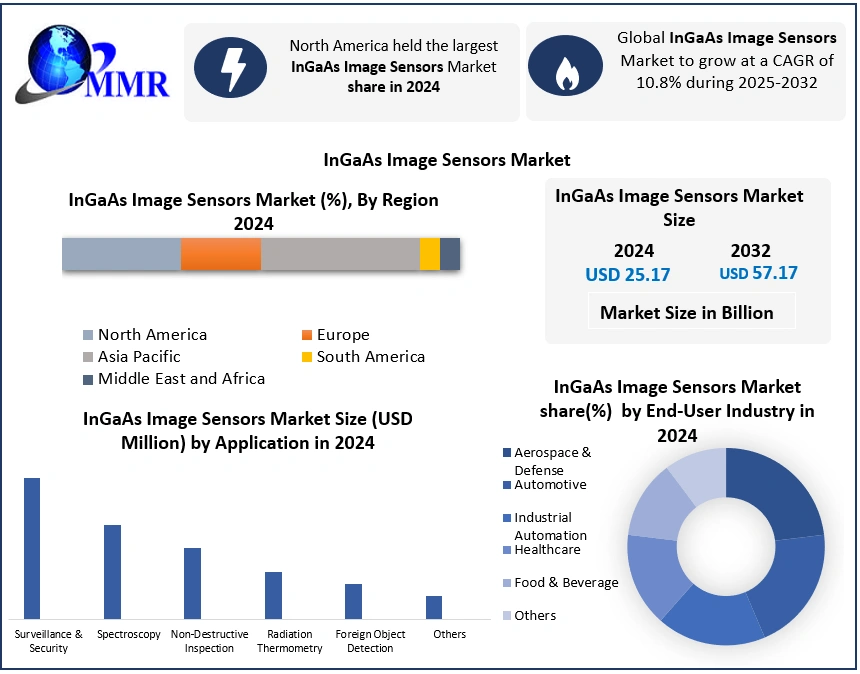
Global InGaAs Image Sensors Market size was valued at USD 25.17 Bn. in 2024, and the total InGaAs Image Sensors Market revenue is expected to grow by 10.8% from 2025 to 2032, reaching nearly USD 57.17 Bn.
InGaAs Image Sensors Market Overview:
InGaAs-based sensors offer distinct advantages over conventional silicon-based sensors, including superior sensitivity in low-light environments, enhanced ability to penetrate haze and fog, and the capability to detect and differentiate between materials based on their spectral signatures. These features make them indispensable in applications such as border surveillance, night vision, aerospace reconnaissance, semiconductor wafer inspection, pharmaceutical quality assurance, and precision agriculture.
 To know about the Research Methodology:- Request Free Sample Report
The growing adoption of hyperspectral and machine vision technologies, where InGaAs sensors play a pivotal role in enabling real-time analytics and defect detection. The advancements in sensor miniaturization and integration, such as the development of hybrid SenSWIR technology that combines InGaAs photodiodes with silicon readout circuits, are expanding performance while lowering costs. The increasing demand for advanced imaging in defense, aerospace, industrial inspection, and scientific research drives the InGaAs Image Sensors Market. These sensors, particularly in the short-wave infrared (SWIR) range, offer superior low-light sensitivity, material differentiation, and imaging through challenging conditions such as haze or fog, making them essential for surveillance, machine vision, and quality control.
InGaAs Image Sensors Market Dynamics
Increasing Demand for Advanced Imaging in Defense, Security, and Industrial Applications to drive the InGaAs Image Sensors Market Growth
InGaAs-based Short Wavelength Infrared (SWIR) sensors deliver unparalleled imaging capabilities under challenging conditions such as low light, fog, haze, or camouflage. This makes them indispensable for surveillance, border security, and military reconnaissance, boosting the InGaAs Image Sensors Market. Industrial sectors are rapidly adopting these sensors for semiconductor wafer inspection, precision agriculture, pharmaceutical quality control, and food sorting, due to their ability to differentiate materials, detect moisture, and ensure defect-free production. The convergence of SWIR imaging with AI and hyperspectral imaging technologies is enabling real-time analytics, process optimization, and non-destructive testing across industries. The government initiatives and R&D funding to advance photonics and semiconductor technologies are supporting the adoption of InGaAs sensors in both civilian and defense domains.
High Manufacturing Costs and Limited Commercial Penetration to Restraint the InGaAs Image Sensors Market
The production process involves complex materials such as indium, gallium, and arsenic, combined with advanced fabrication techniques such as epitaxial growth and Cu-Cu bonding, which significantly increase costs compared to silicon-based sensors. As a result, widespread commercialization in consumer electronics, automotive, and mass-market applications is still limited, restricting adoption mainly to high-value sectors such as defense, aerospace, and research laboratories. The supply chain constraints related to rare materials and specialized production equipment exacerbate cost challenges, making scaling difficult for emerging players. While ongoing R&D aims to reduce production expenses and enhance affordability, cost-sensitive industries may continue to rely on alternative imaging solutions such as silicon or emerging low-cost IR detectors. This cost barrier not only hinders InGaAs Image Sensors Market growth into mainstream applications but also intensifies competition, as only well-funded players and niche markets afford InGaAs-based solutions.
InGaAs Image Sensors Market Segment Analysis
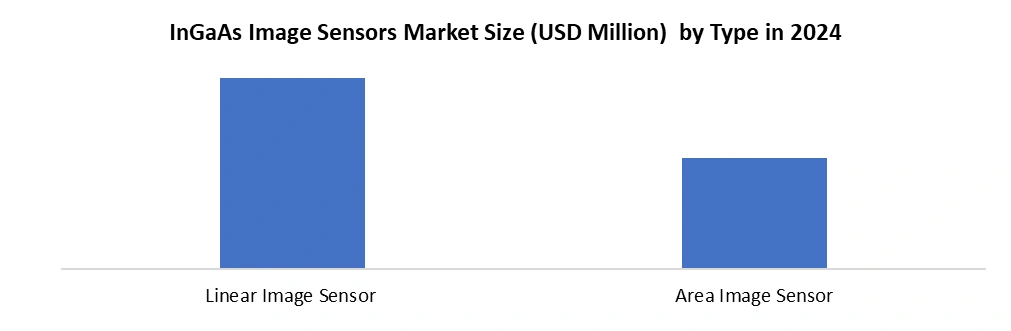
Based on Type, the market is segmented into the Linear Image Sensor and Area Image Sensor. Area image sensors hold the largest share of the InGaAs Image Sensors Market due to their widespread use in machine vision, defense, and security applications. Unlike linear sensors, which capture one line at a time, area sensors capture two-dimensional images in real time, making them ideal for surveillance, hyperspectral imaging, and astronomy. In North America and Europe, demand is being fueled by increasing investments in border security and aerospace monitoring, where area sensors enable high-resolution night vision and target detection in low-light environments. The semiconductor and electronics industry also relies on area sensors for wafer inspection, photonics research, and defect detection, which require wide field-of-view coverage and precise imaging in the short-wave infrared (SWIR) range.
Based on Wavelength, the InGaAs Image Sensors Market is categorized into the Visible, Near Infrared, Short Wavelength Infrared and Others. Short Wavelength Infrared is a wide-band and high-sensitivity SWIR image sensor technology developed through the integration of compound semiconductor InGaAs photodiodes and silicon readout circuits using Cu-Cu bonding. This advanced bonding approach ensures efficient signal transfer, reduced noise, and enhanced sensitivity across a broad spectral range. SWIR (Short Wavelength Infrared) light penetrates and is absorbed by substances differently compared to visible light, enabling imaging in conditions where conventional sensors fail. This makes SWIR technology particularly valuable in fields such as industrial inspection, food and agricultural sorting, medical imaging, defense, and security, boosting the InGaAs Image Sensors Market.
SWIR sensors (wavelength range ~0.9 to 1.7 μm, extendable up to 2.6 μm) enable material discrimination, moisture detection, and imaging through fog, haze, and plastics. This makes them indispensable for defense, semiconductor inspection, and industrial monitoring applications. In North America, SWIR sensors are heavily adopted by the U.S. Department of Defense for night vision, surveillance, and target recognition, supporting strategic investments in border security and battlefield imaging.
InGaAs Image Sensors Market Regional Insights:
North America dominated the InGaAs Image Sensors Market in 2024 and is expected to grow at the highest CAGR over the forecast period. The region has a strong presence of leading players such as Teledyne FLIR, Princeton Infrared Technologies, and Collins Aerospace (Sensors Unlimited), which continue to invest in high-resolution and high-speed SWIR imaging solutions. Growing adoption of advanced imaging for quality control in electronics and semiconductor manufacturing, coupled with increasing use of SWIR sensors in food safety inspections and precision agriculture, has strengthened the market position. Defense and homeland security applications, particularly for night vision, surveillance, and target recognition, are contributing significantly, supported by consistent government spending on advanced imaging technologies.
The universities and laboratories in North America, driving innovation in photonics and sensor technologies, fostering collaborations with industry leaders to accelerate commercialization. Rapid uptake of automation in industrial inspection and the expansion of smart manufacturing practices, boosting the InGaAs Image Sensors Market growth. The rapid uptake of automation in industrial inspection, particularly in semiconductor fabrication hubs such as Silicon Valley and Austin, Texas, and the expansion of smart manufacturing practices in automotive and aerospace clusters such as Detroit and Seattle, boost market growth.
InGaAs Image Sensors Market Competitive Landscape
The competitive landscape for InGaAs image sensors is characterized by a combination of established semiconductor giants, specialized sensor manufacturers, and agile machine-vision camera integrators competing across resolution, spectral range, noise performance, and system-level features; legacy players such as Sony (SenSWIR/IMX series), Teledyne (FLIR/IIS and Sensors Unlimited), Hamamatsu, and Xenics lead on R&D, manufacturing scale, and broad product portfolios, while niche firms (e.g., New Imaging Technologies, Raptor, First Light Imaging) differentiate through custom high-sensitivity designs, cooled detectors, or spectroscopy-optimized variants. Competition increasingly pivots from raw pixel counts to holistic system advantages thermoelectric cooling, on-board correction algorithms, high-bandwidth interfaces (5GigE/CoaXPress), and SDK/ecosystem supportwhich favors vendors offering turnkey solutions to OEMs.
Key developments in the InGaAs Image Sensors market
• November 29, 2023 — Sony Semiconductor Solutions (SSS) announced a major development in the InGaAs image sensor market with the launch of the IMX992 and IMX993 SWIR sensors, designed for industrial applications. The IMX992 delivers 5.32 effective megapixels, the highest pixel count among InGaAs SWIR sensors, while the IMX993 offers 3.21 megapixels, both featuring the industry’s smallest 3.45 μm pixel size through SSS’s proprietary Cu-Cu connection technology. Covering a broad spectral range from 0.4 to 1.7 μm, these sensors support high-resolution imaging, low-noise performance in dark environments, and advanced shooting modes.
• August 22, 2024 — Teledyne FLIR IIS announced the launch of its Forge 1GigE SWIR camera series, starting with a 1.3 MP model featuring the Sony SenSWIR IMX990 InGaAs sensor. The camera captures across the visible to SWIR spectrum (400–1700 nm) with 5 µm pixels, enabling enhanced anomaly detection and material analysis. Designed in a compact 40 × 40 × 43 mm form factor, it offers advanced features such as Pixel Correction, Sequencer with ROI, Logic Block, and Counter for precise control.
• July 14, 2025 — Allied Vision introduced the Goldeye Pro camera series, a new generation of 5GigE SWIR cameras featuring Sony’s IMX992/993 SenSWIR sensors with thermo-electric cooling (TEC1). The lineup includes the Goldeye Pro G5-530 SWIR TEC1 and Goldeye Pro G5-320 VSWIR TEC1, delivering resolutions up to 5.32 MP with 3.45 µm pixels and sensitivity from 400–1700 nm. Designed for industrial, scientific, and medical applications, these cameras combine high-resolution imaging, low-noise performance, and stable temperature control for reproducible results.
InGaAs Image Sensors Market Trends:
| Trend | Detailed Description |
| Progress in High-Resolution & High-Speed SWIR Imaging | Manufacturers are introducing sensors that move beyond the traditional VGA or megapixel formats, pushing into multi-megapixel ranges (e.g., 2 MP, Full HD, and even 5.2 MP). At the same time, high-speed performance is being emphasized with line-scan sensors reaching frame rates above 70–100 kHz. This dual progress allows industries to achieve faster throughput without compromising accuracy. The combination of high resolution and speed is especially critical for machine vision, electronics inspection, and scientific imaging, where both detail and efficiency are essential. |
| Expansion of Spectral Range & Sensitivity for Various Applications | Modern sensors cover wide bands such as 400–1700 nm, bridging the gap between visible and infrared, which significantly broadens application possibilities. Alongside spectral coverage, manufacturers are investing in improving ultra-low noise levels and maximizing signal-to-noise ratios (SNR). These features ensure more reliable performance in challenging environments such as low-light, high-contrast, or high-temperature conditions. With this, InGaAs sensors are gaining momentum in spectroscopy, semiconductor defect detection, and defense/security, where precise spectral information and sensitivity are mission-critical. |
| Precision Imaging for Industrial & Scientific Applications | InGaAs image sensor Manufacturers are focusing on enhancing sensor design for precision-driven applications, beyond raw resolution and speed. This includes innovations like ultra-fine pixel pitches (5 µm and 8 µm), higher quantum efficiency, wide dynamic range, and improved thermal stability. These optimizations enable extremely accurate measurements in fields such as semiconductor wafer inspection, aerospace surveillance, and advanced industrial metrology. Many newly launched cameras integrate low-noise electronics and cooling options, ensuring consistent and high-quality image output in sensitive experiments. |
InGaAs Image Sensors Market Scope: Inquire before buying
| Global InGaAs Image Sensors Market | |||
|---|---|---|---|
| Report Coverage | Details | ||
| Base Year: | 2024 | Forecast Period: | 2025-2032 |
| Historical Data: | 2019 to 2024 | Market Size in 2024: | USD 25.17 Bn. |
| Forecast Period 2025 to 2032 CAGR: | 10.8% | Market Size in 2032: | USD 57.17 Bn. |
| Segments Covered: | by Type | Linear Image Sensor Area Image Sensor |
|
| by Wavelength | Visible Near Infrared Short Wavelength Infrared Others |
||
| by Application | Surveillance & Security Spectroscopy Non-Destructive Inspection Radiation Thermometry Foreign Object Detection Others |
||
| by End-Use Industry | Aerospace & Defense Automotive Industrial Automation Healthcare Food & Beverage Others |
||
InGaAs Image Sensors Market, by Region
North America (United States, Canada and Mexico)
Europe (UK, France, Germany, Italy, Spain, Sweden, Austria and Rest of Europe)
Asia Pacific (China, South Korea, Japan, India, Australia, Indonesia, Malaysia, Vietnam, Taiwan, Bangladesh, Pakistan and Rest of APAC)
Middle East and Africa (South Africa, GCC, Egypt, Nigeria and Rest of ME&A)
South America (Brazil, Argentina Rest of South America)
InGaAs Image Sensors Key Players
North America
1. Teledyne FLIR (USA)
2. Collins Aerospace – Sensors Unlimited (USA)
3. Princeton Infrared Technologies (USA)
4. Sierra-Olympic Technologies (USA)
5. Infrared Cameras Inc. – ICI (USA)
6. Teledyne Princeton Instruments (USA)
7. Headwall Photonics (USA)
8. BaySpec (USA)
9. Thorlabs (USA)
10. Telops (Canada)
Europe
1. Xenics (Belgium)
2. New Imaging Technologies – NIT (France)
3. Raptor Photonics (UK)
4. Allied Vision (Germany)
5. First Light Imaging (France)
6. Photonic Science & Engineering (UK)
7. Andor Technology (UK)
8. Lynred (France)
9. Basler AG (Germany)
10. SCD – SemiConductor Devices (Israel)
Asia Pacific
1. Hamamatsu Photonics (Japan)
2. Sony Semiconductor Solutions (Japan)
3. Tokyo Electron Device Imaging (Japan)
4. Sentech (Japan)
5. Hikrobot (China)
6. Dahua Technology – (China)
7. Beijing Daheng Imaging (China)
8. Gpixel (China)
9. iRayple (China)
10. Vieworks (South Korea)
Frequently Asked Questions:
1. Which region has the largest share in the Global InGaAs Image Sensors Market?
Ans: North America held the largest Global InGaAs Image Sensors Market share in 2024.
2. What is the growth rate of the Global InGaAs Image Sensors Market?
Ans: The Global InGaAs Image Sensors Market is growing at a CAGR of 10.8% during the forecasting period 2025-2032.
3. What is the scope of the Global InGaAs Image Sensors Market report?
Ans: Global InGaAs Image Sensors Market report helps with the PESTEL, PORTER, COVID-19 Impact analysis, Recommendations for Investors & Leaders, and market estimation of the forecast period.
4. Who are the key players in the Global InGaAs Image Sensors Market?
Ans: The key players in the Global InGaAs Image Sensors Market are Teledyne FLIR (USA), Collins Aerospace – Sensors Unlimited (USA), Princeton Infrared Technologies (USA), Sierra-Olympic Technologies (USA), Infrared Cameras Inc. – ICI (USA) and Others.
5. What is the study period of this Market?
Ans: The Global InGaAs Image Sensors Market is studied from 2024 to 2032.