
InGaAs Camera Market Size by Camera Cooling Technology, Application, Scanning Type, Region – Segment-Level Market Assessment, Growth Opportunity Analysis, Competitive Mapping & Forecast to 2029
Overview
InGaAs Camera Market is expected to grow at a CAGR of 8.5% during the forecast period. Global InGaAs Camera Market is expected to reach US$ 241.73 Mn. by 2029.
InGaAs Camera Market Overview:
InGaAs cameras are used for various infrared (IR) applications including, IR reflectography, laser beam measurement, Si wafer inspection, and PV evaluation by several industry verticals. Also, they are widely used in the military & defense sector, because of their features including small, uncooled, target recognition, high-quality night vision, lightweight design, attached covert eye-safe lasers, and sensitivity to nightglows. Also, North America dominates the market, thanks to the existence of key players as well as the increasing adoption of InGaAs camera in various instruments.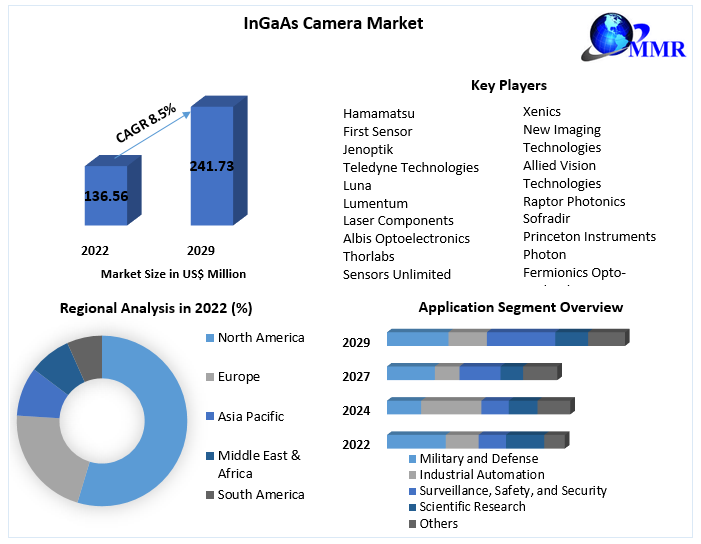 To know about the Research Methodology :- Request Free Sample Report
Interest in Thermal Imaging and SWIR InGaAs Cameras Will Grow as COVID-19 Rages On
Since COVID-19 started spreading through the globe before 2021, thermal camera and sensor manufacturers of the SWIR system started encouraging the devices as an efficient solution to test people for fever from a distance. Cameras that can interpret heat signatures on individuals and objects have usually been used in industrial and military environments. But, these cameras may also be used to support organizations to manage the pandemic and measure the disease. In other areas of the world, such as Europe and some parts of Asia, thermal scanning with InGaAs cameras is helping governments and medical authorities track human body temperatures. As well, prominent players are investing in R&D activities to launch new devices that will help governments during the COVID-19 pandemic. For instance, in April 2020, Hamamatsu and Kiko Knowledge Hub Join Inspirata’s effort to offer free remote pathology solutions for healthcare institutions affected by COVID-19.
Conversely, With the recent pandemic of Covid-19, the InGaAs cameras are expected to witness a fall in demand from several manufacturing industries, such as food & beverages, semiconductors, automation, and security. The food manufacturing and processing industry, which witnesses a prominent share of the industrial demand for InGaAs cameras, is seeing dropping sales. According to a barometer analysis by the French trade group, ANIA, which covered over 600 companies, found that due to Covid-19, food & beverage companies have experienced around 25% loss in turnover globally.
InGaAs Camera Market Dynamics:
Technological advancements and increasing adoption of automation in various industrial applications such as the increasing adoption of line scan InGaAs camera for machine vision are the key factors driving the growth of the InGaAs camera market. The adoption of automation systems and robotics supports companies to develop productivity and efficiency by reducing errors. For example, in May 2020, NIT launched the HiPe SenS final version with a high level of performance. The HiPe SenS consists of the company’s latest SWIR sensor – NSC1902T-SI. With the innovative design of the InGaAs photodiode array coupled with the high-performance ROIC. This new sensor provides low noise operation and ultra-low dark current.
Increasing application of InGaAs camera for food and agricultural products such as damage inspection, quality screening, material discrimination, etc. and application in the industry like moisture content, leak detection, container inspection, etc. are the factors expected to force the growth of the global InGaAs camera market throughout the forecast period. For instance, in 2022, Hamamatsu launched the C15333-10E InGaAs line scan camera for inline non-destructive inspection using SWIR (short-wavelength infrared) imaging. Joining Hamamatsu's wide variety of SWIR and NIR (near-infrared) imaging technologies, this camera is the company's first InGaAs line scan camera. This camera may contribute to driving the growth of the market in the future.
Nevertheless, stringent regulations about import and export of InGaAs camera is the main restraining factors for the growth of the global InGaAs camera market. Also, International Traffic in Arms Regulations that are applied by US authorities wants approval of commodity jurisdiction for the trade of InGaAs cameras is a challenging factor disturbing the growth of the global market.
InGaAs Camera Market Segment Overview:
By the camera cooling technology segments, the uncooled camera segment is expected to hold the largest market share of xx% by 2029. On accounts of uncooled cameras are available at low cost and can be used for several applications such as food inspection, spectroscopy, telecommunications, industrial inspection, etc. For example, in May 2020, Teledyne DALSA announced its SWIR scan camera for machine vision. The newly developed product features a cutting-edge InGaAs sensor in a compact package suitable for various applications, including recycling, food & packaged good inspection, mineral sorting, and solar & silicon wafer inspection.
InGaAs Camera Market Regional Insights:
North America dominates the market and is expected to sustain its position over the forecast period (2023-2029). This growth is attributed to the existence of prominent players and increasing adoption of InGaAs camera in medical instruments and scientific research purposes are factors driving the growth of the market in North America. Also, a high defence budget, particularly in the US, together with the adoption of technologically advanced equipment for military applications like increasing adoption of robots, such as UAV and UGV are factors expected to boost the growth of the market in North America. For example, in March 2020, US-based Raytheon Co, has mentioned partnering with Quantum Imaging Inc, for acquiring a high-definition short-wave infrared (SWIR) camera for tactical imaging applications. Within this agreement of worth USD 13.5 million, Quantum Imaging is to provide a high-definition SWIR camera for tactical imaging applications at the Space and Airborne Systems segment. These InGaAs cameras are expected to be designed with 10-by-10-micron pixel pitch and integral antiblooming.
Asia Pacific is expected to grow at the highest CAGR of xx% in the future, followed by Europe. Increasing military and defense budget particularly in countries such as China, Japan, and India is a key factor driving the growth of the InGaAs camera in the Asia Pacific. Also, the adoption of industrial automation in developing countries like China, Japan, Taiwan, and South Korea are the fast moving countries towards automation is also expected to play a strong role in the growth of the InGaAs camera market.
The report focuses on InGaAs camera market value at the top regions and countries of the world, which shows a regional development, including market size, share, revenue, and much more across the globe. The report has covered, capacity, production value, cost/profit, and supply/demand by statistical analysis. A brief analysis of drivers, restraints, opportunities, and challenges in the market is also covered with examples by region. To make the most of the opportunities, market vendors should focus more on the growth prospects in the fast-growing segments, while maintaining their positions in the slow-growing segments. It also has covered the analysis of key player’s growth strategies, micro and macro analysis of markets, key developments, and key trends in the market.
InGaAs Camera Market Key Highlights:
• Global InGaAs Camera Market analysis and forecast, in terms of value.
• Comprehensive study and analysis of market drivers, restraints and opportunities influencing the growth of the Global InGaAs Camera Market
• Global InGaAs Camera Market segmentation on the basis of type, source, end-user, and region (country-wise) has been provided.
• Global InGaAs Camera Market strategic analysis with respect to individual growth trends, future prospects along with the contribution of various sub-market stakeholders have been considered under the scope of study.
• Global InGaAs Camera Market analysis and forecast for five major regions namely North America, Europe, Asia Pacific, the Middle East & Africa (MEA) and Latin America along with country-wise segmentation.
• Profiles of key industry players, their strategic perspective, market positioning and analysis of core competencies are further profiled.
• Competitive developments, investments, strategic expansion and competitive landscape of the key players operating in the Global InGaAs Camera Market are also profiled.
InGaAs Camera Market Scope: Inquire before buying
| InGaAs Camera Market | |||
|---|---|---|---|
| Report Coverage | Details | ||
| Base Year: | 2022 | Forecast Period: | 2023-2029 |
| Historical Data: | 2017 to 2022 | Market Size in 2022: | US $ 136.56 Mn. |
| Forecast Period 2023 to 2029 CAGR: | 8.5% | Market Size in 2029: | US $ 241.73 Mn. |
| Segments Covered: | by Camera Cooling Technology | • Cooled Camera • Uncooled Camera |
|
| by Application | • Military and Defense • Industrial Automation • Surveillance, Safety, and Security • Scientific Research • Others |
||
| by Scanning Type | • Line Scan Camera • Area Scan Camera |
||
InGaAs Camera Market, by Region
• North America (United States, Canada and Mexico)
• Europe (UK, France, Germany, Italy, Spain, Sweden, Austria and Rest of Europe)
• Asia Pacific (China, South Korea, Japan, India, Australia, Indonesia, Malaysia, Vietnam, Taiwan, Bangladesh, Pakistan and Rest of APAC)
• Middle East and Africa (South Africa, GCC, Egypt, Nigeria and Rest of ME&A)
• South America (Brazil, Argentina Rest of South America)
InGaAs Camera Market Key Players
• Hamamatsu
• First Sensor
• Jenoptik
• Teledyne Technologies
• Luna
• Lumentum
• Laser Components
• Albis Optoelectronics
• Thorlabs
• Sensors Unlimited
• FLIR Systems
• Xenics
• New Imaging Technologies
• Allied Vision Technologies
• Raptor Photonics
• Sofradir
• Princeton Instruments
• Photon
• Fermionics Opto-Technology
• AC Photonics
• GPD Optoelectronics
• New England Photoconductor
• QPHOTONICS
• Episensors
• IRCameras
• Others
Frequently Asked Questions:
1. Which region has the largest share in Global InGaAs Camera Market?
Ans: Asia Pacific region held the highest share in 2022.
2. What is the growth rate of Global InGaAs Camera Market?
Ans: The Global InGaAs Camera Market is growing at a CAGR of 8.5% during forecasting period 2023-2029.
3. What is scope of the Global InGaAs Camera Market report?
Ans: Global InGaAs Camera Market report helps with the PESTEL, PORTER, COVID-19 Impact analysis, Recommendations for Investors & Leaders, and market estimation of the forecast period.
4. Who are the key players in Global InGaAs Camera Market?
Ans: The important key players in the Global InGaAs Camera Market are – Hamamatsu, First Sensor, Jenoptik, Teledyne Technologies, Luna, Lumentum, Laser Components, Albis Optoelectronics, Thorlabs, Sensors Unlimited, FLIR Systems, Xenics, New Imaging Technologies, Allied Vision Technologies, Raptor Photonics, Sofradir, Princeton Instruments, Photon, Fermionics Opto-Technology, AC Photonics, GPD Optoelectronics, New England Photoconductor, QPHOTONICS, Episensors, IRCameras, Others, and
5. What is the study period of this Market?
Ans: The Global InGaAs Camera Market is studied from 2022 to 2029.