
Industrial Magnetrons Market - Industry Structure Evaluation, Demand Drivers Analysis, Regional Growth Analysis and Identification, Competitive Positioning / Landscape Review & Global Market Size Forecast to 2032
Overview
Global Industrial Magnetrons Market size was valued at USD562.16 Mn. in 2025, and the total Industrial Magnetrons Market revenue is expected to grow by 8.3% from 2026 to 2032, reaching nearly USD982.34 Mn.
Industrial Magnetrons Market Overview:
The Industrial Magnetrons Market report gives an overview of the global landscape, starting with defining the product and the scope of the market. Magnetrons are vacuum tubes that produce high-power microwaves by controlling the interaction of a beam of electrons with a magnetic field. The report covers the usage of magnetrons, mainly in radar systems, medical devices used for radiotherapy, and for industrial heating and processing applications. The report defines the market as including the facets of manufacturing, distribution, and usage of industrial-grade magnetrons across various sectors like food processing, healthcare and life sciences, defense, and materials treatment.
The report reviews both demand and supply, describing the supply side is generally driven by the cost of raw materials and how much manufacturing capacity there is across regions, while the demand side is driven by the general desire for more energy efficient heating solutions and more sophisticated radar systems. The report also discusses the availability of magnetrons across a range of powers and applications, noting that new magnetron designs tend to be smaller, more durable and higher-performing models.
Asia Pacific is the largest region due to a large-scale industrial base and high-volume manufacturing and OEM ecosystems led by Panasonic Corporation, Toshiba Hokuto Electronics, Hitachi Power Solutions, and LG Electronics. North America and Europe are still critical spending regions for defense, aerospace, and medical radiotherapy applications, primarily due to the innovation provided by its leaders such as TransDigm (CPI), Teledyne e2v, MUEGGE GmbH, and Richardson Electronics.
End-users are discussed in the report, and presently the most demand is for food and industrial processing, while the healthcare and defense sectors with high-value segments and have great growth potential. Overall, the report offers strategies and insights for key players that include common and regional trends, application-wise demand forecasts, and the changing competitive and technological landscape of the Industrial Magnetrons Market.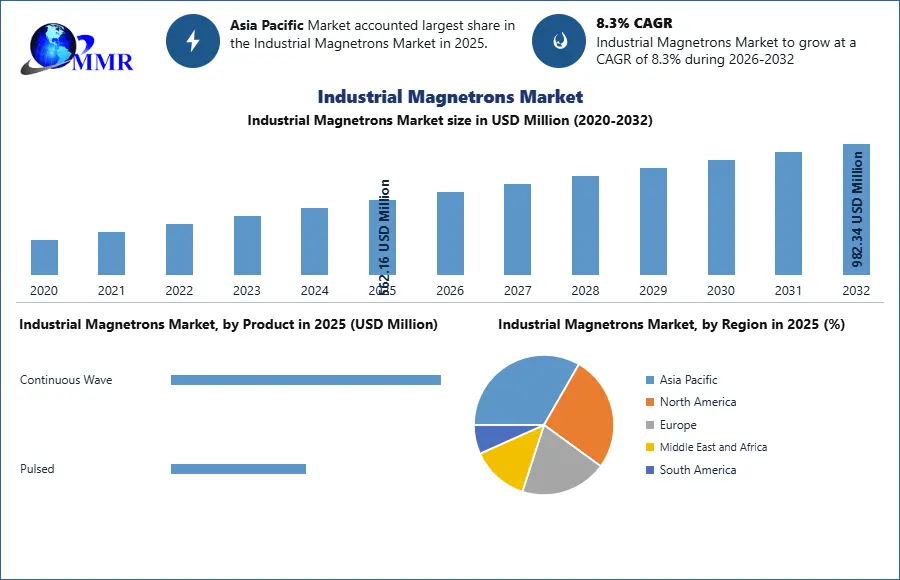 To know about the Research Methodology :- Request Free Sample Report
Industrial Magnetrons Market Dynamics:
Rising Demand from Industrial, Healthcare, and Defence Applications Driving Industrial Magnetrons Market Growth
The global Industrial Magnetrons Market is expanding steadily due to increasing demand across industrial heating, medical treatment, and defence sectors. Industrial magnetrons are widely used in microwave-based heating systems for food processing, drying, ceramic sintering, and material treatment because they provide rapid, uniform, and energy-efficient heating compared to conventional thermal systems. The growing automation trend in manufacturing industries has further accelerated the use of industrial microwave technology, creating strong demand for industrial magnetron equipment. In healthcare, industrial magnetrons are increasingly integrated into advanced medical systems such as radiation therapy and sterilization devices, supporting market expansion. Defence applications are also a key growth driver, as magnetrons are essential components in radar, surveillance, navigation, and communication systems. Increasing investments in aerospace and military modernization programs globally are strengthening product demand. The rising adoption of microwave power technology, industrial processing systems, and energy-efficient heating solutions continues to support the Industrial Magnetrons Market size, Industrial Magnetrons Market share, and long-term Industrial Magnetrons Market growth across developed and emerging economies.
Technological Innovations and Expansion in Emerging Economies to Boost Industrial Magnetrons Market
Continuous innovation in microwave generation technology is creating strong opportunities for the Industrial Magnetrons Market. Manufacturers are focusing on developing advanced industrial magnetrons with higher power output, improved thermal management, longer operational life, and greater energy efficiency. These technological advancements are helping industries reduce operating costs and improve productivity, making magnetrons more attractive for industrial applications. The integration of smart control systems and automated microwave heating equipment is further transforming industrial operations. Emerging economies such as China, India, Brazil, and countries across the Middle East are experiencing rapid industrialization, which is increasing demand for industrial processing systems, food production equipment, and defence infrastructure. Expanding food manufacturing facilities, modernization of industrial plants, and rising healthcare investments are creating new growth opportunities. Additionally, the transition toward eco-friendly industrial systems and energy-saving manufacturing processes supports wider adoption of industrial magnetron technology. These factors are expected to accelerate Industrial Magnetrons Market trends, strengthen Industrial Magnetrons Market demand, and create significant opportunities for manufacturers during the forecast period.
High Replacement Costs and Limited Operational Life Restraining Industrial Magnetrons Market
Despite growth prospects, several challenges are limiting the expansion of the Industrial Magnetrons Market. One of the major restraints is the limited lifespan of industrial magnetrons compared to alternative microwave technologies. Frequent replacement requirements increase maintenance expenses and overall ownership costs for end users. Industrial sectors operating continuous microwave systems often face operational disruptions caused by component wear and equipment downtime. Additionally, magnetrons offer less flexibility in power modulation and precision control than emerging solid-state microwave technologies. This performance limitation makes them less suitable for applications requiring exact temperature management and process control. Rising preference for advanced solid-state RF solutions is creating competitive pressure on conventional industrial magnetrons. Environmental regulations and increasing focus on sustainable industrial equipment are also pushing manufacturers to adopt more efficient technologies. High installation costs, service expenses, and system upgrades remain key barriers for small and medium industries. These limitations may affect future Industrial Magnetrons Market revenue, reduce adoption in certain applications, and restrain overall Industrial Magnetrons Market expansion in price-sensitive industrial sectors.
Industrial Magnetrons Market Segment Analysis:
Based on product type, the Continuous Wave segment dominates the global Industrial Magnetrons Market and is expected to maintain the largest market share during the forecast period. Continuous wave industrial magnetrons are preferred because they provide uninterrupted microwave energy, making them ideal for industrial heating, drying, semiconductor fabrication, and plasma processing applications. Their high efficiency and stable performance make them suitable for food production, chemical processing, and material treatment industries. These systems are widely used where continuous thermal processing is essential for maintaining product consistency and operational efficiency. Growing industrial automation and increasing demand for energy-efficient production technologies continue to support the segment’s dominance. Continuous wave magnetrons are also extensively used in microwave ovens for industrial-scale food processing and advanced manufacturing operations. In comparison, pulsed wave magnetrons are mainly used in specialized applications such as radar and scientific instruments, limiting their market size. Rising adoption of industrial microwave systems across manufacturing sectors is expected to strengthen the Industrial Magnetrons Market share of continuous wave technology throughout the forecast period.

Based On Cooling Type: The Air-Cooled segment dominates the global Industrial Magnetrons Market owing to its simple installation, lower maintenance requirements, and cost-effective operation. Air-cooled industrial magnetrons are widely preferred in industrial heating equipment, drying systems, and commercial microwave processing units because they eliminate the need for complex water circulation systems. Their compact design, easier servicing, and lower operating costs make them suitable for small and medium industrial applications. Air-cooled systems are highly used in food manufacturing, packaging, and chemical industries where continuous heating processes are essential. Meanwhile, water-cooled industrial magnetrons are primarily used in high-power applications requiring better heat dissipation, such as advanced medical equipment, radar systems, and specialized industrial processing plants. However, their higher installation and maintenance costs restrict widespread adoption. The growing focus on cost-efficient industrial processing equipment and increasing deployment of microwave systems in production facilities continue to support the dominance of the air-cooled segment. This trend positively influences overall Industrial Magnetrons Market size, Industrial Magnetrons Market demand, and future technology adoption globally.
Based On Application :The Industrial Heating Equipment segment accounts for the largest share in the global Industrial Magnetrons Market due to extensive use in industrial heating, drying, curing, and sterilization applications. Industries such as food processing, rubber manufacturing, timber treatment, pharmaceuticals, ceramics, and chemical processing rely on microwave heating systems powered by industrial magnetrons for efficient and uniform thermal processing. Industrial microwave heating reduces production time, improves energy efficiency, and supports automation, making it a preferred technology across several sectors. The demand for processed food products, advanced packaging systems, and sustainable manufacturing operations is further strengthening this segment. Medical applications are also witnessing steady growth due to increasing use in sterilization and cancer treatment equipment. Radar systems continue to contribute significantly due to military modernization and surveillance applications. However, industrial heating remains the dominant application due to its broad industrial usage and cost advantages. This segment is expected to drive Industrial Magnetrons Market growth, increase industrial adoption, and support future expansion across global manufacturing industries.
Industrial Magnetrons Market Regional Insights:
Asia Pacific dominates the global Industrial Magnetrons Market, supported by rapid industrialization, strong manufacturing output, and rising demand for microwave-based processing systems. Countries such as China, India, Japan, and South Korea are major contributors due to strong industrial infrastructure, expanding electronics manufacturing, and growing defence investments. China remains a key production hub for industrial magnetrons, supported by large-scale manufacturing operations and exports. India is emerging as a high-growth market due to government initiatives promoting industrial development, food processing modernization, and domestic manufacturing expansion. The region’s growing healthcare sector, rising use of medical microwave systems, and increasing defence expenditure are also fueling market demand. Investments in industrial automation, semiconductor manufacturing, and energy-efficient processing equipment further support regional growth. Strong industrial output, favorable government policies, and increasing adoption of advanced heating systems make Asia Pacific the leading region in terms of Industrial Magnetrons Market revenue, Industrial Magnetrons Market share, and future Industrial Magnetrons Market opportunities.

Competitive Landscape of the Industrial Magnetrons Market
The Industrial Magnetrons Market is characterized by a blend of both global and local leaders and distributors who have distinct approaches to improve their competitive position. Global leaders, like TransDigm's Electron Device Business (previously CPI International) and Teledyne e2v are on a path to growth due to large scale, high levels of technology, and exposure to global markets. TransDigm solidified its global leadership in the Microwave Magnetron Space with the acquisition of CPI in June 2024 and become one of the largest magnetron suppliers to the radar, defense, industrial heating and medical radiotherapy markets. Teledyne integrated its high-voltage and microwave systems capabilities in its magnetron product line with the acquisition of ETM-Electromatic's in 2022. Both companies represent the edge of innovation on the North American and European fronts, with strong R&D pipelines and relationships with defense and health authority organizations.
Asia Pacific region is the leader in the Industrial Magnetrons Market because of scale manufacturing, lower costs, and rapidly growing industrial applications. The development of magnetrons is led by Panasonic Corporation, Toshiba Hokuto Electronics, and Hitachi Power Solutions that leverage the manufacturing expertise of Japan to develop high quality, energy-efficient magnetrons for food processing, heating, and radar. LG Electronics further strengthens the industrial magnetron compete by an excellent OEM environment in South Korea and is bringing new consumer magnetrons to market. These companies have a competitive advantage based on low cost, higher volume production, and geographical dominance, allowing APAC to sell domestically and increasingly into global markets. The end-use market segments are growing in food processing, healthcare, and industrial automation. While APAC is clearly the leader in market share, and growth, the region is also clearly leading the path for the next decade in growth.
In Europe, MUEGGE GmbH is a leader in micro and plasma technologies in the United States and the continent, selling integrated systems instead of standalone magnetrons. As such, it serves cutting-edge applications for advanced semiconductors, advanced specialty materials, and food processing, positioning it as the innovation leader with system-level know-how. The overall trends in Europe are directives to marketplace preference in favor of justification for investment in sustainability and “turnkey” solutions, which is indicative of the region’s proclivity for energy-efficient solutions or designs and advanced material processing.
In the USA, Richardson Electronics, Ltd is a key channel-driven distributor and integrator. Its global distribution agreement with Quantic MWD for 2024 enhanced its RF and microwave supplier relationships, thereby realigning projects or service providers by providing customers access to a more comprehensive portfolio of marketable magnetron and adjacent technologies. The enduring strength of Richardson is its established channel market reach and service integration support to provide true value, acting as a conduit for manufacturers and end-users globally.
In summary, although North America and Europe remain important for the defense and medical radiotherapy markets, the Asia Pacific is easily the most significant market for industrial magnetrons, driven by scale, competitor pricing, and the largest pool of rapidly expanding demand. It can be said that as a group the Asia Pacific region can be considered as the largest current market but will remain the engine of growth for the industry going forward.
Recent Development in Industrial Magnetrons Market
• March 2025, United States – L3 Harris, alongside companies like Toshiba, is advancing magnetron innovation with a focus on higher power outputs and improved thermal management, enhancing efficiency and lifespan of industrial magnetrons.
• September 2024, United States
Richardson Electronics entered into a global distribution agreement with Quantic MWD (Microwave Dynamics) to expand its portfolio of microwave and millimeter-wave products such as oscillators, integrated microwave assemblies, amplifiers, frequency mixers, and frequency multipliers enhancing accessibility for applications across space, defense, and industrial sectors.
• 2023, Japan, Panasonic launched eco-friendly industrial magnetrons offering 18% higher power efficiency with sustainable material sourcing and recyclable components, resulting in a 29% reduction in cooling requirements and a 17% decrease in maintenance overhead, while enabling easier integration into automated production systems.
• 2024, Japan, Toshiba Hokuto Electronics introduced a flexible magnetron platform enabling rapid customization of output settings, enhancing cross-application compatibility by approximately 33%, and delivering a 28% reduction in setup times—culminating in a 25% boost in compatibility across heating and drying systems within food processing, electronics, and biomedical industries, thereby improving overall process efficiency by 19%.
• January 2024, Germany, MUEGGE GmbH was granted a patent (No. 11864298) for a novel device for treating a product with microwaves, featuring a coaxial conductor design that enables precise emission of microwaves through specialized openings—an innovation that enhances industrial microwave irradiation performance and offers refined control over product treatment processes.
Key trends emerging in the Industrial Magnetrons Market:
• Transition to Energy-Efficient and Eco-Friendly Magnetrons
Similar to Panasonic, many manufacturers are beginning to develop greener magnetrons with a stronger efficiency rate, sustainable materials, and reduced cooling and maintenance energy consumption. The trend toward greener technologies and energy-saving solutions is expected to continue as regulatory consequences develop and consumers increasingly demand sustainable industrial processes.
• Customized and Application-Driven Innovations
Toshiba Hokuto Electronics and MUEGGE GmbH are focusing on flexible magnetron platforms and patented microwave treatment devices; this signifies a major method of application-driven innovation. The market is expanding to more customized magnetrons that more accurately and efficiently serve various industries, including, but not limited to, food processing, electronics, and biomedical.
• Broaden Distribution Networks Through Partnerships
The developments with Richardson Electronics and Quantic MWD, and L3 Harris's partnerships with compatible global players such as Toshiba, speak to a trend of increasing strategic partnerships and alliances. Companies are expanding their coverage and reach by expanding distribution networks and complementary technologies, allowing them to tap into different markets in defence, space, and industrial.
Industrial Magnetrons Market Scope: Inquire before buying
| Industrial Magnetrons Market | |||
|---|---|---|---|
| Report Coverage | Details | ||
| Base Year: | 2025 | Forecast Period: | 2026-2032 |
| Historical Data: | 2020 to 2025 | Market Size in 2025: | 562.16 USD Million |
| Forecast Period 2026-2032 CAGR: | 8.3% | Market Size in 2032: | 982.34 USD Million |
| Segments Covered: | by Product | Continuous Wave Pulsed |
|
| by Operating Frequency | L Band S Band C Band X Band Ku & Ka Band |
||
| by Cooling Type | Air Cooled Water Cooled |
||
| by Application | Industrial Heating Equipment Radar Systems Medical Applications Others |
||
Industrial Magnetrons Market, by Region
North America (United States, Canada and Mexico)
Europe (UK, France, Germany, Italy, Spain, Sweden, Austria, Turkey, Russia and Rest of Europe)
Asia Pacific (China, India, Japan, South Korea, Australia, ASEAN and Rest of APAC)
Middle East and Africa (South Africa, GCC, Egypt, Nigeria and Rest of ME&A)
South America (Brazil, Argentina, Columbia and Rest of South America)
Industrial Magnetrons Market, Key Players are
Industrial Magnetron Manufacturers & Solution Providers
The following companies are key participants in the global industrial magnetron market, providing microwave generators, RF power devices, vacuum electronic components, and advanced microwave solutions.
1. Panasonic Corporation – Japan
2. Toshiba Corporation – Japan
3. Hitachi, Ltd. – Japan
4. L3Harris Technologies – United States
5. Communications & Power Industries (CPI) – United States
6. MUEGGE GmbH – Germany
7. Teledyne e2v – United Kingdom
8. Richardson Electronics, Ltd. – United States
9. STT International Limited – United Kingdom
10. MDP Components – United Kingdom
11. Mitsubishi Electric Corporation – Japan
12. Thales Group – France
13. TMD Technologies Limited – United Kingdom
14. Samsung Electronics Co., Ltd. – South Korea
15. LG Electronics Inc. – South Korea
16. Sharp Corporation – Japan
17. BSH Hausgeräte GmbH – Germany
18. Ampleon Netherlands B.V. – Netherlands
19. Qorvo, Inc. – United States
20. NXP Semiconductors N.V. – Netherlands
21. New Japan Radio Co., Ltd. – Japan
22. Guoguang Electric Co., Ltd. – China
23. Kunshan Guoli Electronic Technology Co., Ltd. – China
24. Advanced Energy Industries, Inc. – United States
25. Plasma Process Group – United States
26. Electro-Metrics Corporation – United States
27. MACOM Technology Solutions Holdings, Inc. – United States
28. Infineon Technologies AG – Germany
29. Fricke und Mallah Microwave Technology GmbH – Germany
30. Western Electric Company – United States
Key Active Players by Application Segment
Industrial Microwave Heating & Plasma Processing
1 CPI
Radar, Defense & High-Power Microwave Systems
1 L3Harris Technologies
2 Thales Group
3 Teledyne e2v
4 TMD Technologies
5 Mitsubishi Electric Corporation
RF, Semiconductor & Electronic Components
1 Ampleon
2 Richardson Electronics