
Industrial Inkjet Printers Market Size by Type, End Use Industry, Region – Segment-Level Market Assessment, Growth Opportunity Analysis, Competitive Mapping & Forecast to 2032
Overview
The Industrial Inkjet Printers Market size was valued at USD 10.18 Billion in 2025 and the total Industrial Inkjet Printers revenue is expected to grow at a CAGR of 4.2% from 2026 to 2032, reaching nearly USD 13.57 Billion.
Industrial Inkjet Printers Market Overview
Industrial inkjet printers are specialized printing machines designed for use in industrial environments. Unlike traditional inkjet printers used in offices or homes, industrial inkjet printers are built to handle larger volumes, harsher conditions, and a wider variety of materials. They are used for printing on various substrates such as metal, plastic, glass, wood, ceramics, textiles, and more. These printers typically utilize high-resolution printheads that produce high-quality prints with precision and speed. They employ different types of ink, including solvent-based, UV-curable, aqueous, and specialty inks, depending on the requirements of the application. Industrial inkjet printers find applications in various industries such as packaging, textiles, automotive, electronics, aerospace, and signage.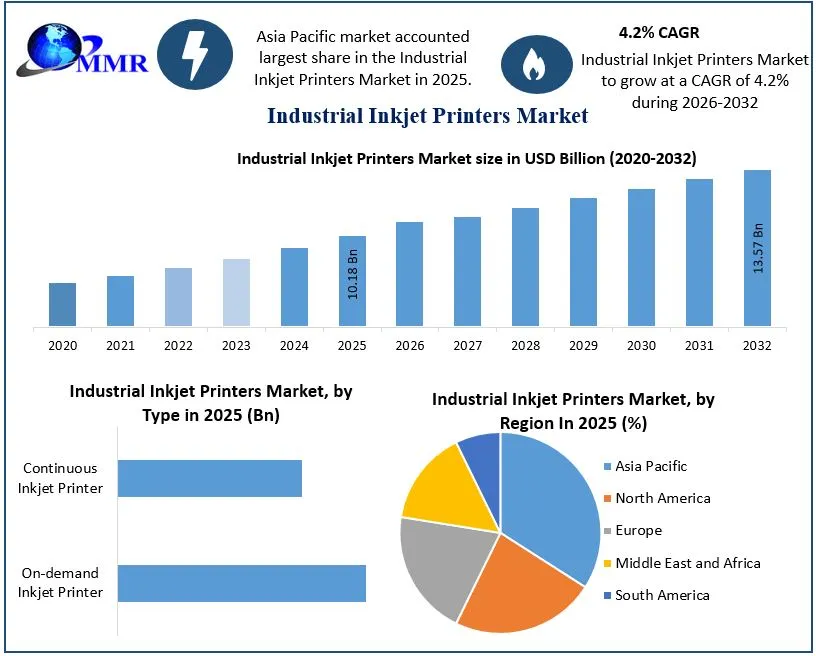 To know about the Research Methodology :- Request Free Sample Report
The industrial inkjet printers market has been experiencing significant growth and transformation in recent years, driven by technological advancements, increasing demand for customization, and the need for efficient printing solutions across various industrial sectors. Industrial inkjet printers are specialized printing machines designed to meet the demanding requirements of industrial environments, offering capabilities such as printing on a wide range of substrates, handling variable data printing, and integrating seamlessly into production lines. The market is highly competitive, with several key players vying for Industrial Inkjet Printers market share. Industrial Inkjet printers companies are investing in research and development to introduce innovative products and stay ahead of the competition. Consolidation through mergers and acquisitions is also prevalent as companies seek to expand their product portfolios and strengthen their market positions.
Industrial Inkjet Printers Market Dynamics
Demand for Customization and Personalization to boost the Industrial Inkjet Printers Market growth
There is increasing consumer preference for customized products and packaging. Industrial inkjet printers enable manufacturers to meet this demand by offering flexibility in printing variable data such as product labels, barcodes, serial numbers, and graphics. This capability allows for mass customization, where each product is tailored to meet specific customer requirements. As businesses strive to differentiate themselves and create unique brand experiences, the demand for industrial inkjet printers continues to rise, which significantly boosts the Industrial Inkjet Printers Market growth. Continuous innovation in inkjet printing technology has been a significant driver of market growth. Advancements in printhead design, ink formulations, and printing processes have led to improved print quality, higher speed, and enhanced reliability. Printheads with increased resolution enable finer details and more precise printing, catering to the demands of various industries for high-quality prints. Advancements in ink chemistry have expanded the range of substrates that are printed on, further broadening the application scope of industrial inkjet printers.
Digital printing technologies in inkjet printing, have gained traction across various industries due to their numerous advantages over traditional printing methods. Digital printing offers faster turnaround times, reduced setup costs, and the ability to produce short print runs economically. Industrial inkjet printers, with their versatility and ability to handle variable data printing, are well-suited to meet the demands of industries such as packaging, textiles, and labels. As businesses seek efficient and flexible printing solutions, the adoption of industrial inkjet printers is expected to increase further, which is expected to boost the Industrial Inkjet Printers Market growth. The adoption of additive manufacturing processes, particularly 3D printing, has opened up new opportunities for industrial inkjet printers. Inkjet-based 3D printing technologies, such as binder jetting, use inkjet printheads to selectively deposit binding agents onto powder beds, enabling the production of complex parts with high precision. As additive manufacturing continues to gain traction across industries, the demand for industrial inkjet printers for 3D printing applications is expected to increase.
High Initial Investment Costs to restraint Industrial Inkjet Printers Market Growth
The adoption of industrial inkjet printers is the high initial investment costs associated with purchasing and installing the equipment, which significantly restraints the Industrial Inkjet Printers Market Growth. Industrial-grade inkjet printers, especially those equipped with advanced features and capabilities, are expensive, making it challenging for small and medium-sized enterprises (SMEs) to afford them. The cost of maintenance, consumables such as inks and printheads, and ongoing operational expenses are further strain budgets, limiting the adoption of industrial inkjet printers. While industrial inkjet printers offer versatility in printing on various substrates, including paper, plastic, metal, and ceramics, there are limitations regarding compatibility with certain materials. Some substrates require specialized inks or pre-treatment processes to ensure proper adhesion and print quality, which add complexity and cost to printing operations. Challenging substrates such as highly porous or uneven surfaces pose technical challenges for industrial inkjet printers, limiting their applicability in certain industries and applications.
Despite advancements in printhead technology and printing processes, industrial inkjet printers still face limitations in terms of print speed and throughput, especially when compared to traditional printing methods such as offset or flexography. High-speed production environments require faster printing capabilities to meet production demands, and industrial inkjet printers struggle to match the throughput of traditional printing presses. This is a significant restraint for industries with high-volume printing requirements, where production efficiency is critical, which is expected to restrain Industrial Inkjet Printers Market Growth. Integrating industrial inkjet printers into existing production lines or workflow processes is complex and time-consuming, particularly for industries with specialized manufacturing requirements. Achieving seamless integration with other equipment, such as packaging machinery or automated systems, requires careful planning, customization, and coordination. Software compatibility issues and the need for specialized training for operators further complicate the integration process, delaying deployment and increasing implementation costs.
Industrial Inkjet Printers Market Segment Analysis
Based on Type, the market is segment into On-demand Inkjet Printer and Continuous Inkjet Printer. Continuous Inkjet Printer segment dominated the market in 2025 and is expected to hold the largest Industrial Inkjet Printers Market share over the forecast period. Continuous inkjet printers work by generating a continuous stream of ink droplets from a printhead. These droplets are electrically charged and passed through a deflection field, where they are selectively charged or deflected based on the desired print pattern. Continuous inkjet printers are designed to seamlessly integrate into existing production lines or manufacturing processes. They are mounted on conveyors, packaging machines, or other equipment to enable inline printing. The continuous inkjet printer segment is witnessing technological advancements aimed at enhancing print quality, speed, efficiency, and connectivity. Industrial Inkjet Printers Market players are focusing on developing innovative features such as remote monitoring and diagnostics, advanced ink formulations, user-friendly interfaces, and integration with Industry 4.0 technologies to meet the evolving needs of manufacturers.
Based on End-Use Industry, the market is segmented into Food & Beverage, Chemical, Pharmaceutical, Packaging, Personal Care & Cosmetics, and Others. The pharmaceutical segment dominated the market in 2025 and is expected to hold the largest Industrial Inkjet Printers Market share over the forecast period. The pharmaceutical industry operates under stringent regulations governing product labeling, serialization, and traceability to ensure patient safety, product integrity, and regulatory compliance. Industrial inkjet printers play a critical role in meeting these regulatory requirements by enabling the printing of important information such as batch numbers, expiration dates, serial numbers, barcodes, QR codes, and product identification codes directly onto pharmaceutical packaging materials. The pharmaceutical segment of the industrial inkjet printers market benefits from advancements in printing technologies such as high-resolution printheads, precision ink deposition, micro-droplet control, and vision inspection systems. These technologies enable pharmaceutical manufacturers to achieve high-quality prints with accurate coding, legible text, and crisp barcodes on various packaging materials, including labels, foils, films, and cartons.

Industrial Inkjet Printers Market Recent Developments
| Date | Company | Development | Impact |
|---|---|---|---|
| 04 March 2025 | HP Inc. | HP unveiled its next-generation HP ThermaCore thermal inkjet (TIJ) platform at SinoPack 2025, delivering three times the throw distance and twice the printing speed of previous generations. | The launch drastically improves operational efficiency on fast-moving consumer goods lines by allowing reliable industrial coding on non-flat or uneven packaging substrates at speeds up to 120 meters per minute. |
| 17 July 2025 | FUJIFILM North America Corporation | Fujifilm launched the Frontier DX400W compact inkjet printer, featuring a pouch-style ink supply system with 250ML capacity and proprietary Image Intelligence processing. | The integration of high-capacity ink pouches instead of cartridges reduces environmental waste and minimizes manufacturing line intervention to maximize operational uptime. |
| 12 November 2025 | Markem-Imaje | Markem-Imaje introduced an enhanced M printhead configuration for its 9712 Bi-Jet continuous inkjet printer model, incorporating a specialized 48µm nozzle structure. | This technology reduces consumable use and lowers VOC emissions via the Intelli'Inks system while delivering highly legible 2D barcodes on small industrial packaging formats. |
| 11 March 2026 | Domino Printing Sciences | Domino launched the Cx150i direct-to-box inkjet printer utilizing non-toxic, non-hazardous vegetable oil-based inks for secondary industrial packaging lines. | By executing branding and tracking codes directly onto containers, the solution eliminates the need for adhesive label backings to heavily bolster industrial packaging sustainability and recyclability. |
Industrial Inkjet Printers Market Regional Insights
Rapid Industrialization with manufacturing boom to boost the Asia Pacific Industrial Inkjet Printers Market growth
Many countries in the Asia-Pacific region are undergoing rapid industrialization, leading to increased demand for advanced manufacturing technologies, including industrial inkjet printers. As industries modernize and adopt digital manufacturing processes, there is a growing need for efficient and flexible printing solutions to meet evolving production requirements. Industrial inkjet printers offer the versatility and customization capabilities necessary to support this transition. The Asia-Pacific region is home to some of the world's largest manufacturing economies, including China, Japan, South Korea, and India. The region's robust manufacturing sector, fueled by factors such as low labor costs, favorable government policies, and access to raw materials, has been a major driver of demand for industrial inkjet printers, which is expected to boost the Asia Pacific Industrial Inkjet Printers Market growth. These printers are essential for printing on a wide range of manufactured goods, including packaging, textiles, electronics, automotive parts, and more.
The Asia-Pacific region is experiencing significant growth in the packaging industry, driven by factors such as urbanization, changing consumer lifestyles, and e-commerce growth. Industrial inkjet printers play a crucial role in the packaging sector by enabling high-quality printing on various packaging materials, including paper, plastic, and flexible packaging. The demand for customized and visually appealing packaging designs further fuels the adoption of industrial inkjet printers in the region, which is expected to boost the Industrial Inkjet Printers Market growth. The region is a hub for technological innovation and R&D activities, driving advancements in inkjet printing technology. Industrial Inkjet Printers local manufacturers and international companies operating in the region are investing in research and development to enhance the performance, speed, and capabilities of industrial inkjet printers. These technological advancements enable industrial inkjet Printers manufacturers to improve print quality, increase production efficiency, and expand the application scope of industrial inkjet printers.
Scope of the Global Industrial Inkjet Printers Market: Inquire before buying
| Global Industrial Inkjet Printers Market | |||
|---|---|---|---|
| Report Coverage | Details | ||
| Base Year: | 2025 | Forecast Period: | 2026-2032 |
| Historical Data: | 2020 to 2025 | Market Size in 2025: | USD 10.18 Bn. |
| Forecast Period 2026 to 2032 CAGR: | 4.2% | Market Size in 2032: | USD 13.57 Bn. |
| Segments Covered: | by Type | On-demand Inkjet Printer Continuous Inkjet Printer |
|
| by End Use Industry | Food & Beverage Chemical Pharmaceutical Packaging Personal Care & Cosmetics Others |
||
Industrial Inkjet Printers Market, by Region
North America (United States, Canada and Mexico)
Europe (UK, France, Germany, Italy, Spain, Sweden, Austria and Rest of Europe)
Asia Pacific (China, South Korea, Japan, India, Australia, Indonesia, Malaysia, Vietnam, Taiwan, and Rest of APAC)
Middle East and Africa (South Africa, GCC, Egypt, Nigeria and Rest of ME&A)
South America (Brazil, Argentina Rest of South America)
Industrial Inkjet Printers Manufacturers include:
North America:
1. Markem-Imaje : Bourg-lès-Valence, France
2. Videojet Technologies Inc.: Wood Dale, Illinois, USA
3. Domino Printing Sciences plc: Cambridge, United Kingdom
4. Squid Ink: Brooklyn Park, Minnesota, USA
5. Eastman Kodak Company: Rochester, New York, USA
Europe:
6. Linx Printing Technologies: Saint Ives, Cambridgeshire, United Kingdom
7. Xaar plc: Cambridge, United Kingdom
8. Koenig & Bauer Coding GmbH: Veitshöchheim, Germany
9. Durst Group: Brixen, Italy
10. Leibinger Group: Tuttlingen, Germany
Asia-Pacific:
11. Beijing Founder Electronics Co., Ltd: Beijing, China
12. Konica Minolta, Inc.: Tokyo, Japan
13. Hitachi Industrial Equipment Systems Co., Ltd.: Tokyo, Japan
14. Keyence Corporation: Osaka, Japan
Frequently asked Questions:
1. What are industrial inkjet printers?
Ans: Industrial inkjet printers are specialized printing machines designed for use in industrial environments. Unlike traditional inkjet printers used in offices or homes, industrial inkjet printers are built to handle larger volumes, harsher conditions, and a wider variety of materials.
2. What types of ink do industrial inkjet printers use?
Ans: Industrial inkjet printers utilize different types of ink, including solvent-based, UV-curable, aqueous, and specialty inks, depending on the requirements of the application.
3. What are the main drivers of growth in the industrial inkjet printers market?
Ans: The main drivers of growth in the industrial inkjet printers market include technological advancements, increasing demand for customization, and the need for efficient printing solutions across various industrial sectors.
4. Which segment dominates the industrial inkjet printers market based on type?
Ans: The continuous inkjet printer segment dominates the industrial inkjet printers market, offering high-speed, continuous printing capabilities suitable for various industrial applications.
5. What was the Global Industrial Inkjet Printers Market size in 2025?
Ans: The Global Industrial Inkjet Printers Market size was USD 10.18 Billion in 2025.