
Industrial Hemp Market by Type, Application, Source and Region – Global Market Size Estimation, Industry-Wide Analysis, Competitive Landscape Assessment & Long-Term Forecast to 2032
Overview
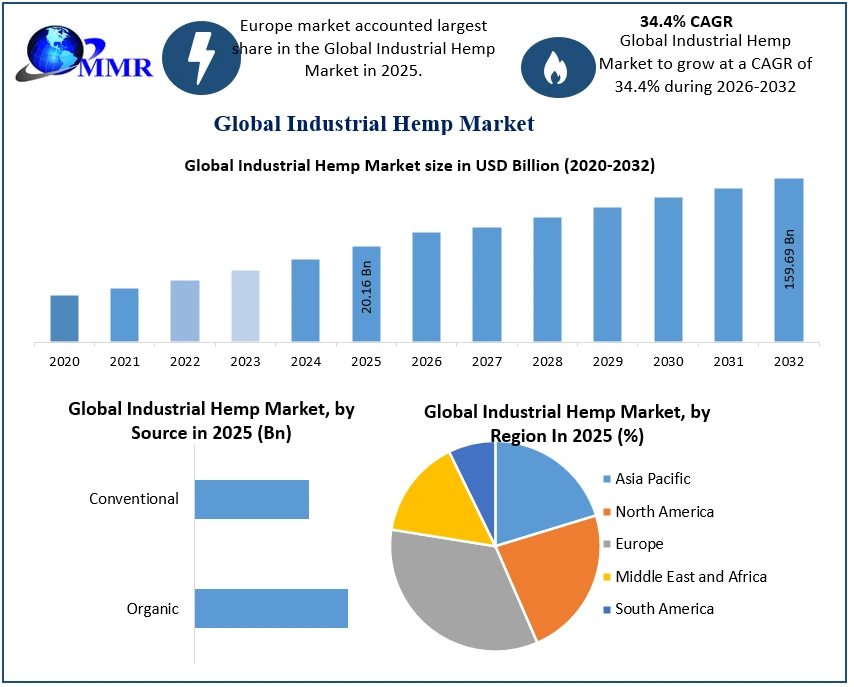
The Industrial Hemp Market size was valued at USD 20.16 Billion in 2025 and the total Industrial Hemp revenue is expected to grow at a CAGR of 34.4% from 2026 to 2032, reaching nearly USD 159.69 Billion by 2032.
The Industrial Hemp Market is segmented by type, application, and source. Based on type, the market is segmented into hemp seed, hemp seed oil, CBD hemp oil, and hemp fiber. Based on application, the market is segmented into food, beverages, personal care products, textiles, pharmaceuticals and others. Based on source, the market is segmented into organic and conventional. Based on region, the market is segmented into North America, Asia Pacific, Europe, Middle East & Africa, and South America.
To know about the Research Methodology:-Request Free Sample Report
Global demand for industrial hemp from application industries, including the food and beverage, personal care, and animal care sectors is driving the growth of the market. Moreover, due to a number of factors, including an increase in the prevalence of chronic diseases like diabetes, increased use of hempseed oil and hemp seeds in various food applications, increased use of non-psychoactive cannabinoid cannabidiol (CBD)-CBD hemp oil in the food and pharmaceutical industries, and increased legalisation of industrial hemp cultivation, the market is witnessing substantial growth. As a result of the COVID-19 pandemic's economic recession, which has reduced industrial activity, the global market is only seeing modest growth. The market has thus suffered a terrible blow. However, the market is expected to rise more quickly because to the rapid recovery of the world's economy.
In order to promote the market recovery, the U.S. government announced a COVID-19 relief package of USD 1.9 trillion in January. Furthermore, over the forecast period, the market in the United States is expected to be driven by the continuous expansion of small-scale market participants producing industrial and consumer goods based on hemp. The market will increase as consumers become more aware of the dietary benefits of hempseed and hempseed oil, as well as as demand from the cosmetics and personal care sectors rises. The expansion of the market is expected to be positively impacted by increased manufacturing of hemp-based products such as soaps, shampoos, bath gels, hand and body lotions, UV skin defenders, massage oils, and a variety of other goods.
Industrial Hemp Market Dynamics
Increasing legalization in the cultivation of industrial hemp: Around the world, hemp has been grown for its fibre and as an oilseed for a variety of commercial and consumer goods. Cannabis sativa L., a distinct cultivar of the same species as marijuana but not marijuana itself, is the source of industrial hemp. The US made various actions to legalise the cultivation of hemp as an agricultural commodity and to remove it from the list of restricted narcotics in the 2018 farm bill (a federal government instrument for agricultural and food policy). Hemp cannot be cultivated as freely as other crops, though. Due to the legalisation of industrial hemp cultivation in the US, the production of oilseeds and cannabidiol (CBD), a non-intoxicating cannabinoid that may be employed in the food and medicinal industries, has taken centre stage in North America.
Excellent sources of vitamins and minerals include hemp seed and hemp seed oil. Hemp seed oil is an excellent source of fatty acids, has a balanced protein composition, and is simple to digest. In addition to being a common nutritional supplement, CBD is also a crucial component of many medicinal and beauty goods. As a result, the usage of CBD hemp oil in dietary supplements and the pharmaceutical sector is progressively becoming more widespread, and this is what is expected to propel the industrial hemp market's expansion in the upcoming years.
New product developments from industrial hemp: The businesses and research institutes are being compelled to create new goods from industrial hemp as hemp farming becomes more permitted. One such use that is expected to have tremendous development potential over the next years is biofuel. Biofuels have been gaining popularity as the cost of oil (diesel and gasoline) has increased and as worries over global warming have grown. Hemp biodiesel, which can be used in any diesel-powered vehicle, is made from hemp seed extracts. In addition, ethanol, which is now produced from food crops like wheat and corn, may be made from hemp. As a consequence, food production would be more effective.
In a paper released in 2010, researchers from the University of Connecticut claimed that hemp biodiesel had a high conversion efficiency of about 97 percent. Thus, using it as a biofuel would speed up the process of making biodiesel. Another product that offers room for industrial hemp expansion is bioplastic. The leftovers from the production of hemp seeds and CBD oil are used to make hemp bioplastics. The development of hemp-based biofuel and bioplastics is expected to be aided by rising customer demand for environmentally friendly products, corporate and governmental initiatives, and financial backing.
Lack of processing facilities and planting & harvesting equipment: As one of the biggest users of hemp-derived goods, the US has seen fast growth in the industrial hemp business since the government legalised the crop. But there hasn't been enough reliable planting and harvesting machinery. Due to their fragility, air seeders used to plant the crop must be used with minimal air volume while sowing hemp. In 2019, hemp processing is one of the biggest obstacles, making up 47.7% of all challenges, according to the hemp fact book released by Marijuana Business Daily (US). In contrast, the acquisition of harvesting equipment makes up roughly 26.3 % of all challenges. Additionally, according to sector analysts, one of the main challenges to the US industrial hemp market's expansion is the absence of facilities for processing industrial hemp on a commercial scale.
Complex regulatory structure for the usage of industrial hemp: Companies selling hemp and goods produced from hemp must adhere to local regulations in each country. While different types of hemp are legalised to varying degrees in various nations around the world, manufacturers and stakeholders may find it difficult to comply with the stringent regulatory standards that apply to the production and sale of industrial hemp in various states within the same nation. The laws governing hemp that contains both tetrahydrocannabinol (THC) and cannabidiol (CBD) are also still very different from state to state, which makes it more difficult to trade the product.
For instance, different legal regulations, such as those governing the licencing of farmers, the regulation and certification of seeds, state-level commissions, and the legal protection of growers in the US, should be taken into account. This business is one of the most heavily regulated because of the complex and varied laws governing the production, distribution, and prescription of industrial hemp in different states and nations.
Industrial Hemp Market Segment Analysis
Based on type, the market is segmented into hemp seed, hemp seed oil, CBD hemp oil, and hemp fiber. The hemp fiber segment is expected to dominate the market during the forecast period. Hemp has two types of fibers: bast (outer long fibers) and hurds (inner short fibers). Primary bast fibres, which can be up to 50 mm long and contain between 50 and 70 percent cellulose, and secondary bast fibres, which are only about 2 mm long, are the other two categories into which the bast fibres are further subdivided. Bast fibres are mostly employed in the textile industry since they can be spun and knitted. Hurds, the brief fibres, which make up between 70 and 80 percent of the hemp stalk, are roughly 0.5 mm long. These are used in the building, furniture, bedding for animals, agricultural, and car sectors. Global demand for hemp fibres is expected to increase as people become more aware of their potential as a renewable resource for biofuels and bioplastics.
Based on application, the market is segmented into food, beverages, textiles, personal care products, pharmaceuticals, and others. According to forecasts, the industrial hemp market will be dominated by the food segment. This is due to the use of hemp in food items, which are high in linoleic and linolenic acid, vitamin E, and minerals including protein, calcium, zinc, iron, salt, potassium, and magnesium. Raw or roasted hemp seed is the most common way of consumption for hemp. Salads, smoothies, yoghurt, and cereals all contain it. The demand for processed food made from hemp, such as bars, flour, snacks, and cheese, is estimated to rise in response to the rising consumption of plant-based protein as veganism gains popularity around the world.
Based on source, the market is segmented into organic and conventional. Since conventional hemp goods are less expensive than organic hemp products, they predominated the industrial market. Furthermore, commercially farmed hemp is high in vitamins and other vital fatty acids despite not being certified.
Industrial Hemp Market Regional Insights
The industrial hemp market is expected to grow at the fastest rate in Europe. This is explained by the substantial market for food, drinks, dietary supplements, and personal care items. Additionally, hemp fibre is being used more and more in a variety of industries, including the construction and automotive industries. The market is expected to expand due to rising hemp seed consumption in foods and other food items including cereals, bars, yoghurt, and smoothies. These items have a very high level of demand in nations like Germany and the Netherlands, which is what is causing the regional market to expand.
In Asia Pacific held the top spot in the market and contributed more than 32% of global revenue. Industrial hemp and its products, including fibre, seed, hurds, and oil, are produced and consumed actively in a number of economies, including China, India, Japan, Korea, Australia, New Zealand, and Thailand. The region's hemp production is evolving as a result of rising global product demand, developing technology, and innovation that make harvesting simpler for growers. Over the course of the forecast period, the regional market is expected to be driven by rising elderly population levels in emerging nations with rising hemp-based food and supplement consumption.
Due to the existence of several application industries, North America ranks among the top consumers on the international market. The need for hemp oil in the region's personal care market is also expected to increase due to high consumer disposable income, an ageing population, and increased worries about skin illnesses and UV protection. The product is primarily used in the production of building materials, textiles, and fabrics in Europe. Over the forecast period, the market for hemp seeds is expected to be driven by the rising demand for hemp oil in the food and supplement, cosmetics, and personal care segments.
The objective of the report is to present a comprehensive analysis of the global Industrial Hemp Market to the stakeholders in the industry. The past and current status of the industry with the forecasted market size and trends are presented in the report with the analysis of complicated data in simple language. The report covers all the aspects of the industry with a dedicated study of key players that include market leaders, followers, and new entrants.
PORTER, PESTEL analysis with the potential impact of micro-economic factors of the market have been presented in the report. External as well as internal factors that are supposed to affect the business positively or negatively have been analyzed, which will give a clear futuristic view of the industry to the decision-makers.
The reports also help in understanding the Industrial Hemp Market dynamic, structure by analyzing the market segments and projecting the Industrial Hemp Market size. Clear representation of competitive analysis of key players by Vehicle type, price, financial position, product portfolio, growth strategies, and regional presence in the Industrial Hemp Market make the report investor’s guide.
Industrial Hemp Market Scope: Inquire before buying
| Industrial Hemp Market | |||
|---|---|---|---|
| Report Coverage | Details | ||
| Base Year: | 2025 | Forecast Period: | 2026-2032 |
| Historical Data: | 2020 to 2025 | Market Size in 2025: | USD 20.16 Bn. |
| Forecast Period 2026 to 2032 CAGR: | 34.4% | Market Size in 2032: | USD 159.69 Bn. |
| Segments Covered: | by Type | Hemp Seed Hemp Seed Oil CBD Hemp Oil Hemp Fiber |
|
| by Application | Food, Beverages Personal Care Products Textiles Pharmaceuticals Others |
||
| by Source | Organic Conventional |
||
Industrial Hemp Market, by Region
North America (United States, Canada and Mexico)
Europe (UK, France, Germany, Italy, Spain, Sweden, Austria and Rest of Europe)
Asia Pacific (China, South Korea, Japan, India, Australia, Indonesia, Malaysia, Vietnam, Taiwan, Bangladesh, Pakistan and Rest of APAC)
Middle East and Africa (South Africa, GCC, Egypt, Nigeria and Rest of ME&A)
South America (Brazil, Argentina Rest of South America)
Industrial Hemp Market, Key Players are:
1. Valley Bio Ltd.
2. Hemp, Inc.
3. Terra Tech Corp.
4. American Hemp
5. Ecofiber Industries Operations
6. Botanical Genetics, LLC
7. Marijuana Company of America, Inc.
8. HempMedsBrasil
9. CBD Biotechnology Co.
10.Plains Industrial Hemp Processing Ltd.
11.HempFlax B.V.
12.Industrial Hemp Manufacturing, LLC
13.Boring Hemp Company
14.American Cannabis Company, Inc.
15.Parkland Industrial Hemp Growers Cooperative Ltd.
Frequently Asked Questions:
1] What segments are covered in the Global Industrial Hemp Market report?
Ans. The segments covered in the Industrial Hemp Market report are based on Type, Application and Source.
2] Which region is expected to hold the highest share in the Global Industrial Hemp Market?
Ans. The Europe region is expected to hold the highest share in the Industrial Hemp Market.
3] What is the market size of the Global Industrial Hemp Market by 2032?
Ans. The market size of the Industrial Hemp Market by 2032 is expected to reach USD 159.69 Bn.
4] What is the forecast period for the Global Industrial Hemp Market?
Ans. The forecast period for the Industrial Hemp Market is 2026-2032.
5] What was the Global Industrial Hemp Market size in 2025?
Ans: The Global Industrial Hemp Market size was USD 20.16 Billion in 2025.