
Industrial Filtration Market Size by Filter Media, Type, End User, Region – Revenue Pool Analysis, Margin Structure Assessment, Capital Flow Trends, Competitive Benchmarking & Forecast to 2032
Overview
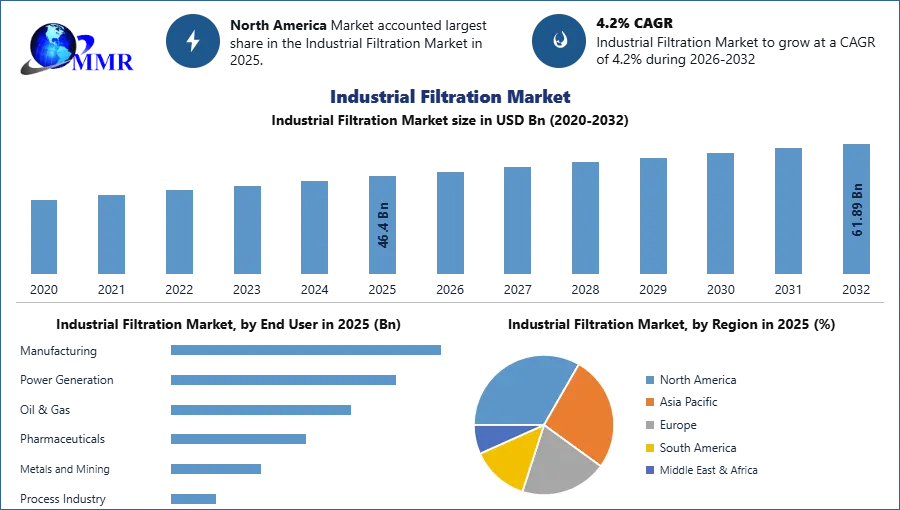
The Industrial Filtration Market size was valued at USD 46.40 Billion in 2025 and the total Industrial Filtration revenue is expected to grow at a CAGR of 4.2% from 2026 to 2032, reaching nearly USD 61.88 Billion by 2032.
Industrial Filtration Industry Snapshot:
The industrial filtration market is a multifaceted sector focused on eliminating impurities and contaminants from liquids and gases in industrial processes. Utilizing a diverse range of technologies including reverse osmosis and microfiltration, it serves various industries such as oil and gas, pharmaceuticals, and manufacturing. Market growth is boosted by factors such as, including escalating industrialization, stringent environmental mandates, and advancements in filtration systems enhancing efficiency. Significant trends such as the integration of IoT and the emphasis on sustainable solutions are shaping the market's landscape.
The industrial filtration sector grapples with challenges such as substantial initial investments and operational complexities. These hurdles underscore the necessity for continuous innovation and adaptation to meet the evolving demands of industries. Also, the market's resilience is tested by the presence of alternative purification methods and technologies, necessitating ongoing advancements and differentiation strategies among market players. The industrial filtration market occupies a crucial position in ensuring operational efficacy, environmental compliance, and product quality across various industrial domains. Its evolution is driven by a confluence of factors, from regulatory pressures to technological innovations. Overcoming challenges and capitalizing on emerging opportunities are imperative for sustaining growth and meeting the ever-changing needs of industries across the World.
To know about the Research Methodology :- Request Free Sample Report
Industrial Filtration Market Key Dynamics
Driver
Growing Industrialization boost the Industrial Filtration Market growth
Growing industrialization plays a significant role in boosting the growth of the industrial filtration market due to several interconnected factors. As industrialization advances, there is a corresponding increase in manufacturing activities across diverse sectors such as automotive, chemicals, electronics, and textiles. These industries generate various airborne pollutants, particulates, and contaminants during their production processes. As a result, there is a heightened need for effective filtration systems to maintain clean air quality within manufacturing facilities, ensuring the health and safety of workers and compliance with environmental regulations.
The expansion of industrial activities, there is a parallel increase in the generation of wastewater containing pollutants and harmful substances. Industrial effluents must undergo rigorous filtration and treatment processes before discharge into water bodies to prevent environmental contamination and comply with regulatory standards. This drives the demand for water filtration technologies in industries such as mining, food processing, and pharmaceuticals.
The growing industrialization often leads to urbanization and the development of industrial clusters or zones, where multiple manufacturing plants and facilities are concentrated in close proximity, which boosts the Industrial Filtration Market growth. This clustering effect intensifies the impact of industrial pollution on local air and water quality, necessitating strong filtration solutions to mitigate environmental risks and protect public health. The growth of industrialization creates a fertile market landscape for industrial filtration products and services by amplifying the need for air and water filtration solutions across diverse industrial sectors. The demand for filtration technologies is driven by the imperative to ensure regulatory compliance, safeguard human health and the environment, and optimize industrial processes for sustainable growth.
Restrain
High Initial Investment Costs limits the Industrial Filtration Market growth
High initial investment costs act as a significant barrier to the growth of the industrial filtration market by deterring potential adopters, particularly small and medium-sized enterprises (SMEs), from investing in advanced filtration technologies. The upfront capital required for purchasing filtration equipment, installation, and ongoing maintenance strain the financial resources of businesses, especially those operating on tight budgets. Also, the perceived risk associated with the substantial initial investment outweigh the anticipated benefits, leading to hesitation or reluctance to commit to implementing advanced filtration solutions.
High initial investment costs contribute to longer payback periods and lower return on investment (ROI), further dampening the appeal of adopting advanced filtration technologies. This financial hurdle impedes market penetration and limits the accessibility of modern filtration solutions to a broader range of industrial sectors, constraining overall market growth. Addressing this challenge require innovative financing models, cost-effective technology solutions, and incentives to incentivize investment in industrial filtration systems, thereby reducing barriers to adoption and accelerating Industrial Filtration Market Growth.
Opportunity
Technological Advancements creates lucrative growth opportunities for the Market Growth
Technological advancements drive the growth of the industrial filtration market by continuously improving the performance, efficiency, and capabilities of filtration systems. These advancements enable filtration solutions to address a wider range of contaminants, operating conditions, and application requirements across various industries. For example, innovations in materials science result in the development of advanced filter media with tailored properties such as increased durability, chemical resistance, and filtration efficiency. This allows filtration systems to effectively remove contaminants ranging from particulate matter and volatile organic compounds (VOCs) to microorganisms and heavy metals, meeting stringent regulatory standards and industry-specific requirements.
The technological breakthroughs drive innovation in product design and functionality, leading to the creation of compact, modular, and customizable filtration systems. Manufacturers leverage advancements in automation, robotics, and digitalization to integrate smart features such as remote monitoring, predictive maintenance, and real-time data analytics into filtration equipment. This enables proactive management of filtration processes, optimization of system performance, and reduction of downtime, enhancing overall operational efficiency and cost-effectiveness, which boosts the Industrial Filtration Market growth.
The integration of digitalization and Internet of Things (IoT) technologies enables connectivity and communication between filtration devices, sensors, and control systems. IoT-enabled filtration systems provide actionable insights into filter condition, operating parameters, and process variables, empowering operators to make informed decisions, anticipate maintenance needs, and optimize filtration performance in real time.
Industrial Filtration Market Segment Overview
Based on Type, the liquid segment dominated the type segment of the Industrial Filtration Market in the year 2025. The dominance of the liquid segment in the Industrial filtration industry stems from its versatility and vital role across various industries, including pharmaceuticals, chemicals, food and beverage, water treatment, and oil and gas. Stringent regulations mandating product quality and environmental standards drive demand for liquid filtration systems to ensure compliance.
Technological advancements continuously enhance the efficiency and effectiveness of liquid filtration, making it an appealing option for industries seeking cost-effective and sustainable solutions. The increasing global demand for clean water, alongside industrial growth, further amplifies the necessity for liquid filtration products. With its broad applicability, regulatory compliance benefits, and technological advancements, the liquid segment stands out as the dominant force in the Industrial Filtration Market, meeting the diverse needs of industries while addressing environmental concerns.

Industrial Filtration Market Regional Insights
North America dominated the Industrial Filtration Market in the year 2025. North America's dominance in the industrial filtration industry is attributed to several key factors. The region boasts a highly developed industrial sector across various industries such as automotive, chemical, pharmaceutical, and food and beverage, all of which rely heavily on advanced filtration technologies to ensure product quality and regulatory compliance. Also, North America's stringent environmental regulations and focus on sustainability drive the demand for innovative filtration solutions to mitigate pollution and meet compliance standards. The presence of major filtration equipment manufacturers and suppliers in North America contributes to its dominance in the market. These companies leverage advanced research and development capabilities to continuously improve filtration technologies, offering cutting-edge solutions tailored to the diverse needs of industries.
The region's strong infrastructure, including well-established distribution networks and logistics capabilities, facilitates the seamless supply of filtration products and services to industries across North America and beyond. The region's stable economic growth and high disposable income levels enable industries to invest in premium filtration solutions to enhance operational efficiency and product quality. North America's dominance in the industrial filtration market is driven by its advanced industrial landscape, stringent regulatory environment, technological innovation, robust infrastructure, and economic stability, positioning it as a key hub for filtration solutions catering to diverse industrial needs.
Industrial Filtration Market Recent Industry Developments (2025–2026)
| Date | Company | Development | Impact |
|---|---|---|---|
| 27 January 2026 | Donaldson Company, Inc. | The company implemented AI-powered predictive maintenance across its industrial filtration systems to monitor real-time filter health. | This technology is projected to reduce operational downtime by 20% and lower energy consumption for large-scale manufacturing plants. |
| 26 August 2025 | 3M Company | 3M expanded its production of advanced carbon capture filtration materials specifically for refinery and petrochemical applications. | The expansion directly supports heavy industries in meeting Net Zero 2050 targets by scaling point-source capture technologies. |
| 31 March 2025 | Camfil AB | The company launched a new line of high-efficiency molecular filters designed to remove volatile organic compounds (VOCs) in commercial and industrial settings. | The launch enhances indoor air quality (IAQ) compliance for facility managers facing stricter health and safety regulations. |
| 24 March 2025 | Merck KGaA | Merck introduced a series of virus-retentive depth filters optimized for sterile bioprocessing and high-integrity clarification. | This development strengthens the pharmaceutical filtration segment by providing higher safety margins for biologics manufacturing. |
| 30 January 2025 | Parker Hannifin Corporation | Parker Hannifin secured a strategic partnership to supply hydrogen fuel cell air filtration technology for heavy-duty zero-emission trucking projects. | The collaboration positions the company as a leader in the clean energy filtration market for the transport sector. |
Global Industrial Filtration Market Scope: Inquire before buying
| Industrial Filtration Market | |||
|---|---|---|---|
| Report Coverage | Details | ||
| Base Year: | 2025 | Forecast Period: | 2026-2032 |
| Historical Data: | 2020 to 2025 | Market Size in 2025: | 46.4 USD Bn |
| Forecast Period 2026-2032 CAGR: | 4.2% | Market Size in 2032: | 61.89 USD Bn |
| Segments Covered: | by Filter Media | Metal Activated Carbon/ Charcoal Fiber Glass Filter Paper Nonwoven Fabric |
|
| by Type | Air Liquid Others |
||
| by Technology | Depth Filtration Surface Filtration Membrane Filtration Electrostatic Filtration Centrifugal Filtration |
||
| by Filtration Mechanism | Mechanical Filtration Adsorption Filtration Biological Filtration Chemical Filtration |
||
| by Product Type | Filter Bags Cartridge Filters Filter Press Filters Drum Filters Vacuum Filters HEPA Filters |
||
| by Application | Water & Wastewater Treatment Air Pollution Control Industrial Processing Product Purification Cooling Systems |
||
| by End User | Manufacturing Power Generation Oil & Gas Pharmaceuticals Metals and Mining Process Industry |
||
Industrial Filtration Market, by Region
North America (United States, Canada and Mexico)
Europe (UK, France, Germany, Italy, Spain, Sweden, Austria and Rest of Europe)
Asia Pacific (China, South Korea, Japan, India, Australia, Indonesia, Malaysia, Vietnam, Taiwan, Bangladesh, Pakistan and Rest of APAC)
South America (Brazil, Argentina Rest of South America)
Middle East & Africa (South Africa, GCC, Egypt, Nigeria and Rest of ME&A)
Leading Companies in the Industrial Filtration Industry
The Industrial Filtration market is marked by strong competition among a diverse range of top Industrial Filtration Companies including established manufacturers and emerging companies. The leading Industrial Filtration companies leverage various strategies to boost growth such as strategic mergers and acquisitions, significant investments in research and development, and enhancements in manufacturing processes. These top Industrial Filtration companies often pursue partnerships and joint ventures to share expertise and resources, driving innovation in filtration technologies. Additionally, they focus on expanding their product offerings to meet the evolving needs of various sectors including oil and gas, pharmaceuticals, food and beverage, and wastewater treatment. By continuously improving filtration efficiency and developing advanced materials, Industrial Filtration companies aim to strengthen their competitive edge and capture new market opportunities.
- Donaldson Company, Inc.
- Parker Hannifin Corporation
- MANN+HUMMEL Group
- Pall Corporation (Port Washington, New York, United States)
- Eaton Corporation plc
- Ahlstrom-Munksjö Oyj
- Filtration Group Corporation
- Freudenberg Filtration Technologies
- Alfa Laval AB
- Camfil AB
- Daikin Industries, Ltd.
- Cummins Inc.
- Lenntech B.V.
- 3M Company (Maplewood, Minnesota, United States)
- Pentair plc
- Hengst SE
- Sartorius AG
- Merck KGaA
- Nederman Holding AB
- Porvair plc
- W. L. Gore & Associates, Inc.
- SPX FLOW, Inc.
- A.L. Group
- Rensa Filtration
- Babcock & Wilcox Enterprises, Inc.
Frequently Asked Questions
1] What segments are covered in the Global Industrial Filtration Market report?
Ans. The segments covered in the Industrial Filtration Market report are based on, Filter Media, Type, End User, and Regions.
2] Which region is expected to hold the highest share of the Global Industrial Filtration Market?
Ans. The North America region is expected to hold the highest share of the Industrial Filtration Market.
3] What is the market size of the Global Industrial Filtration Market by 2032?
Ans. The market size of the Industrial Filtration Market by 2032 is expected to reach USD 61.88 Bn.
4] What was the Global Industrial Filtration Market size in 2025?
Ans: The Global Industrial Filtration Market size was USD 46.40 Billion in 2025.
5] Key players in the Industrial Filtration Market.
Ans. Parker Hannifin Corporation (Cleveland, Ohio, United States), Pall Corporation (Port Washington, New York, United States), Donaldson Company, Inc. (Bloomington, Minnesota, United States), 3M Company (Maplewood, Minnesota, United States), Filtration Group Corporation (Joliet, Illinois, United States).