
Industrial Analytics Market Size by Component, Analytics Type, Organization Size, Deployment Model, Vertical, Region – Revenue Pool Analysis, Margin Structure Assessment, Capital Flow Trends, Competitive Benchmarking & Forecast to 2030
Overview
Industrial Analytics Market size was valued at US$ 22.35 Bn. in 2023 and the total revenue is expected to grow at a CAGR of 18.04% through 2024 to 2030, reaching nearly US$ 71.38 Bn.
Industrial Analytics Market Overview:
Industrial analytics has led to an era of industrial revolution, due to significant advancements in analytics techniques and algorithms, as well as machine learning (ML) and artificial intelligence (AI), which have been used to analyse massive amounts of data gathered from industrial systems. Descriptive, Predictive, Diagnostic, and Prescriptive are the analytics types of the industrial analytics. Energy and utilities, Retail and consumer goods, Transportation and logistics, Telecommunications and IT, and Manufacturing are some of the verticals of the industrial analytics. Industrial Analytics will be critical for business performance in 2022, according to 69% of decision makers, with 15% believing it is critical now. The ability to compare data acquired with other systems and information in order to develop fresh insights is the major benefit of Industrial Analytics. This facilitates access to more up-to-date and effective data on which to organise manufacturing activities.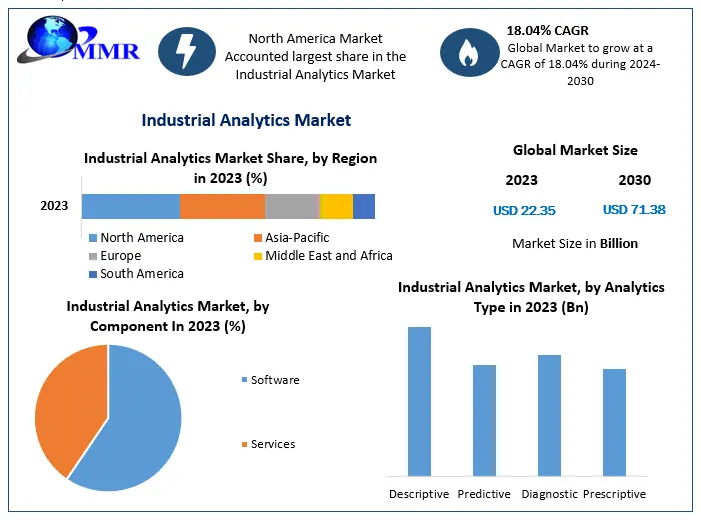 To know about the Research Methodology:- Request Free Sample Report
Industrial Analytics Market Dynamics:
Analytics data can be utilised to improve operational efficiency for components that are necessary for anticipating peak demand, preventative maintenance, and decision-making. The emergence of Industry 4.0 and the widespread use of business intelligence and big data analytics tools, such as Hadoop, in a variety of industry verticals, such as telecommunications, retail, and manufacturing, is a major factor driving industrial analytics market growth. The growing adoption of IIoT, particularly in emerging markets, is boosting market growth.
The industrial analytics market is fuelled by the extraction of substantial data from machines. The industrial analytics market is expected to develop due to an increase in the number of connected spaces (IoT) in manufacturing. In manufacturing, the Internet of Things (IoT) is all about integrating and communicating with customers, accelerating innovation, and creating smarter products.
Industry 4.0, the start of the fourth industrial revolution, is expected to fuel the industrial analytics industry. Gathering industrial data from numerous sources into a unified data system, then discovering the required machine learning, analytics, or artificial intelligence for equipment failure prediction, is what Industry 4.0 is all about. Besides, the introduction of Big Data into the production process is expected to increase global demand for industrial analytics. Security problems in the industrial internet of things (IIoT) data, on the other hand, may restrains the industrial analytics market's growth during the forecast period 2024-2030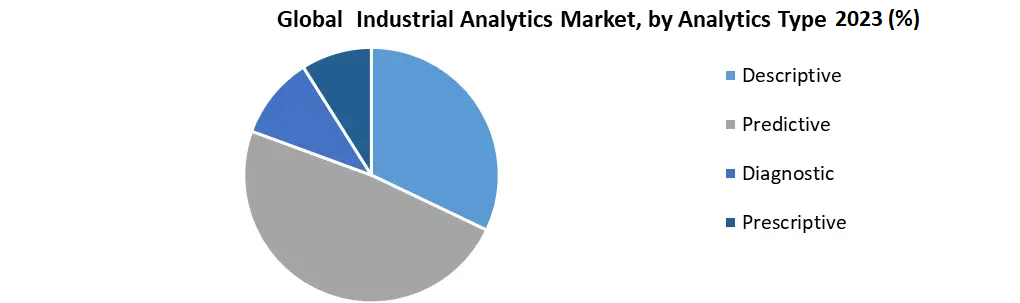
Industrial Analytics Market Segment Analysis:
Based on the Component, the market is segmented into Software, and Services. Services segment is expected to grow rapidly at a CAGR of xx% during the forecast period 2024-2030. Because of the growing need for industrial analytics software solutions across enterprises, the professional services segment is expected to grow at the fastest rate of all services.
Software segment is expected to grow rapidly at a CAGR of xx% during the forecast period 2024-2030. Risk analytics, financial analytics, operational analytics, customer analytics, marketing analytics, and workforce analytics are all part of the software segment. The requirement to monitor customer expectations and ad-campaign efficacy, among other things, are expected to boost the growth of the software segment in the global industrial analytics market during the forecast period 2024-2030.
Based on the Analytics Type, the market is segmented into Descriptive, Predictive, Diagnostic, and Prescriptive. Descriptive segment is expected to grow rapidly at a CAGR of xx% during the forecast period 2024-2030. Descriptive analytics is a term that is used to describe a set of historical data that may be used to make comparisons and present financial metrics including year-over-year pricing variations, the number of users, and total revenue per subscriber, among other things. It's a term used to explain what happened in a company over a period of time.
Based on the Deployment Model, the market is segmented into Hosted/on-Cloud, and On-Premises. On-Premises deployment model segment is expected to grow rapidly at a CAGR of xx% during the forecast period 2024-2030. On-premises industrial analytics technologies can be used to collect, display, and organise critical business data utilising the company's own IT infrastructure. This ensures that data remains safe and secure within the companies.
Hosted/on-Cloud segment is expected to grow rapidly at a CAGR of xx% during the forecast period 2024-2030. Cloud computing's on-demand deployment offers benefits such as scalability, cost-effectiveness, and ease of deployment, among others, allowing businesses to maximise earnings and streamline operations. Cloud computing services are slowly overcoming their negative reputation, and their market is growing. Cloud networks are frequently used in predictive maintenance for better efficiency and cooperation.
Based on the Vertical, the market is segmented into Energy and utilities, Retail and consumer goods, Transportation and logistics, Telecommunications and IT, Manufacturing, and Others. Manufacturing segment is expected hold the largest market share of xx% by 2030. Industry 4.0 is revolutionising the manufacturing industry by leaps and bounds, allowing for a global move toward a future manufacturing sector. With the introduction of Industry 4.0 in the manufacturing industry, numerous facilities are implementing digital technologies such as IIoT, AI, ML, Robotics, and others to improve, automate, and modernise the entire process. Integration of several technologies is becoming increasingly popular due to its numerous advantages. In order to acquire a competitive advantage and become more profitable and scalable, companies must incorporate the above-mentioned technologies into a new method of conducting business. Industrial IoT technologies are expected to connect millions of devices, allowing for automation across the whole value chain. By gathering the massive amount of data created by these technologies in real-time, analytics in the manufacturing industry is expected to boost personalization and automation.
Industrial Analytics Market Regional Insights:
North America dominates the Industrial Analytics market during the forecast period 2024-2030. North America held the largest market share of 33% in 2023 and is expected to continue its dominance by 2030. The region's industrial automation operations are being driven by a rise in the implementation of Industry 4.0 policies. Companies in the region are focusing on cost reduction through automation, which is driving up demand for predictive and diagnostic analytics, among other things.
Europe is expected to grow rapidly at a CAGR of 17.5% during the forecast period 2024-2030. The demand for industrial analytics has given the region a major boost in manufacturing technology. Industry 4.0 is also have a substantial impact and push the industry in Europe. The rising confluence of operational technology (OT) and information technology (IT) are expected to drive demand for smart manufacturing in Europe even higher.
The objective of the report is to present a comprehensive analysis of the Global Industrial Analytics Market to the stakeholders in the industry. The past and current status of the industry with the forecast market size and trends are presented in the report with the analysis of complicated data in simple language. The report covers all the aspects of the industry with a dedicated study of key players that include market leaders, followers, and new entrants.
PORTER, PESTEL analysis with the potential impact of micro-economic factors of the market have been presented in the report. External as well as internal factors that are supposed to affect the business positively or negatively have been analyzed, which will give a clear futuristic view of the industry to the decision-makers.
The reports also help in understanding the Global Industrial Analytics Market dynamic, structure by analyzing the market segments and project the Global Industrial Analytics Market size. Clear representation of competitive analysis of key players by product, price, financial position, product portfolio, growth strategies, and regional presence in the Global Industrial Analytics Market make the report investor’s guide.
Industrial Analytics Market Scope: Inquire before buying
| Global Industrial Analytics Market | |||
|---|---|---|---|
| Report Coverage | Details | ||
| Base Year: | 2023 | Forecast Period: | 2024-2030 |
| Historical Data: | 2018 to 2023 | Market Size in 2023: | US $ 22.35 Bn. |
| Forecast Period 2024 to 2030 CAGR: | 18.04 % | Market Size in 2030: | US $ 71.38 Bn. |
| Segments Covered: | by Component | Software Services |
|
| by Analytics Type | Descriptive Predictive Diagnostic Prescriptive |
||
| by Organization Size | Large Enterprises Small & Medium Enterprises |
||
| by Deployment Model | Hosted/on-Cloud On-Premises |
||
| by Vertical | Energy and utilities Retail and consumer goods Transportation and logistics Telecommunications and IT Manufacturing Others |
||
Industrial Analytics Market, by Region
North America (United States, Canada and Mexico)
Europe (UK, France, Germany, Italy, Spain, Sweden, Austria, Turkey, Russia and Rest of Europe)
Asia Pacific (China, India, Japan, South Korea, Australia, ASEAN and Rest of APAC)
Middle East and Africa (South Africa, GCC, Egypt, Nigeria and Rest of ME&A)
South America (Brazil, Argentina, Columbia and Rest of South America)
Industrial Analytics Market, Key Players are:
1. Hewlett Packard Enterprise Company
2. General Electric Company
3. Microsoft Corporation
4. International Business Machines Corporation
5. SAP SE
6. Cisco Systems, Inc.
7. Oracle Corp
8. Intel Corp.
9. Hitachi Ltd.
10. TIBCO Software, Inc.
11. AGT International
12. Bridgei2i Analytics Solutions
13. Alteryx, Inc.
14. PTC, Inc.
15. SAS Institute
16. Amazon.com
Frequently Asked Questions:
1] What segments are covered in Global Industrial Analytics Market report?
Ans. The segments covered in Global Industrial Analytics Market report are based on Component, Analytics Type, Organization Size, Deployment Model, and Vertical.
2] Which region is expected to hold the highest share in the Global Industrial Analytics Market?
Ans. North America is expected to hold the highest share in the Global Industrial Analytics Market.
3] Who are the top key players in the Global Industrial Analytics Market?
Ans. Hewlett Packard Enterprise Company, General Electric Company, Microsoft Corporation, International Business Machines Corporation, and SAP SE are the top key players in the Global Industrial Analytics Market.
4] Which segment holds the largest market share in the Global Industrial Analytics market by 2030?
Ans. Manufacturing segment holds the largest market share in the Global Industrial Analytics market by 2030.
5] What is the market size of the Global Industrial Analytics market by 2030?
Ans. The market size of the Global Industrial Analytics market is US $ 71.38 Bn. by 2030.
6] What was the market size of the Global Industrial Analytics market in 2023?
Ans. The market size of the Global Industrial Analytics market was worth US $ 22.35 Bn. in 2023.