
In-Flight Entertainment Market – Global Market Size, Strategic Growth Drivers, Risk Assessment Framework, Regulatory Landscape Review, Competitive Intensity Mapping & Long-Term Industry Outlook to 2030
Overview
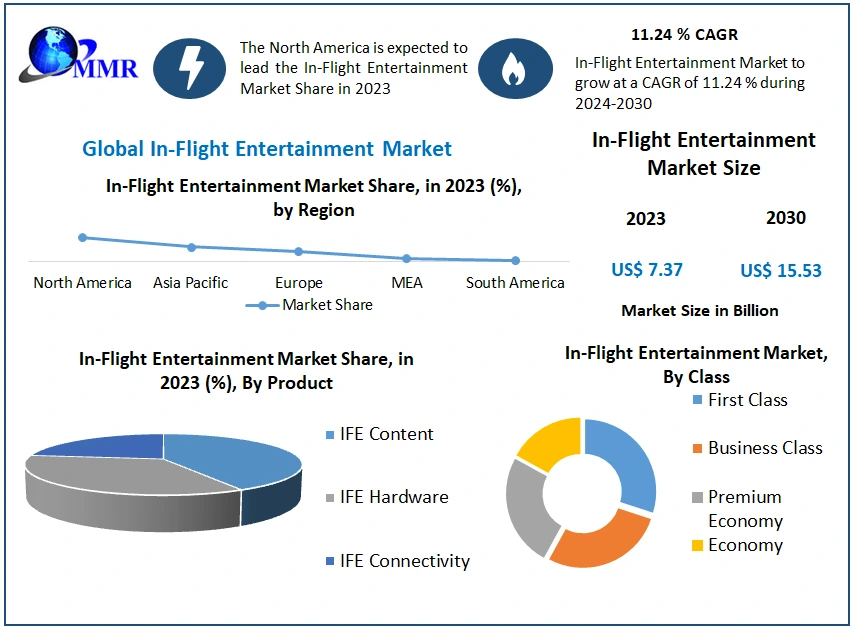
Global In-Flight Entertainment Market size was valued at USD 7.37 billion in 2023 and the total In-Flight Entertainment Market revenue is expected to grow at a CAGR of 11.24 % from 2024 to 2030, reaching nearly USD 15.53 billion.
In-flight entertainment (IFE) refers to the array of entertainment options available to passengers during air travel. It encompasses various multimedia content and services provided onboard aircraft to enhance the passenger experience. Common IFE offerings include movies, TV shows, music, games, and internet connectivity. These entertainment systems are integrated into seat-back screens, personal devices, or accessible through wireless streaming platforms. IFE aims to keep passengers engaged, relaxed, and entertained during flights, contributing to overall satisfaction and comfort.
 To know about the Research Methodology :- Request Free Sample Report
The In-Flight Entertainment Market has witnessed significant growth in recent years, driven by technological advancements, increasing air travel demand, and passenger expectations for enhanced onboard experiences. North America dominates the In-Flight Entertainment Market due to the presence of major airlines and technological advancements. However, regions like Asia Pacific are expected to witness the highest growth rates, driven by expanding aviation infrastructure and rising disposable incomes.
The growing demand for personalized entertainment options and seamless connectivity. With the increasing adoption of digital technology, airlines are investing in advanced IFE systems to cater to passenger preferences and differentiate their services. The proliferation of smartphones and tablets has led to a shift towards wireless streaming solutions, allowing passengers to access content on their personal devices. Moreover, the COVID-19 pandemic has accelerated the adoption of touchless and contactless technologies, prompting airlines to implement innovative solutions for safer and more convenient onboard experiences
The integration of destination-specific content to promote tourism, partnerships between airlines and content providers to offer diverse entertainment options, and the development of accessible modes and features to enhance inclusivity. Opportunities for In-Flight Entertainment Market growth lie in the adoption of state-of-the-art entertainment systems, customizable and personalized content offerings, and the increasing demand for in-flight internet connectivity. Recent developments by In-Flight Entertainment Market key players include strategic partnerships, such as Emirates' investment in Thales Avant Up systems for Airbus A350 aircraft, and the introduction of innovative solutions like Delta Air Lines' "full, fast, free" WiFi for SkyMiles members, aimed at enhancing passenger satisfaction and loyalty.
Market Dynamics:
Long-Term Partnerships Stimulate Market Growth in In-Flight Entertainment:
Rising demand for in-flight Wi-Fi and entertainment services has been a significant driver of In-Flight Entertainment Market growth. Delta Air Lines' introduction of "full, fast, free" WiFi for SkyMiles members, available on most domestic flights from February 2023, reflects this trend. The initiative aims to enhance passenger satisfaction and loyalty. With regional flights set to receive this facility by the end of 2024, Delta is meeting the growing expectation for seamless connectivity, driving In-Flight Entertainment Market growth. Collaborations between airlines and content providers contribute to market growth by offering diverse and high-quality entertainment options. China Airlines' partnership with "SoundOn" to launch a new high-quality podcast program for its in-flight entertainment system demonstrates this trend. By leveraging the expertise of leading brands in Taiwan's audio industry, China Airlines enhances its entertainment offerings, catering to passenger preferences and driving In-Flight Entertainment Market demand. Long-term partnerships between airlines and entertainment service providers stimulate market growth by ensuring continuous innovation and content refreshment. Singapore Airlines' extended partnership with Anub for in-flight entertainment and content services, based on a long-term deal covering film, television, and audio, exemplifies this driver. By securing a stable and comprehensive content supply, airlines enhance passenger satisfaction and loyalty, contributing to In-Flight Entertainment Market growth.
Airlines' investments in state-of-the-art in-flight entertainment systems contribute to market growth by providing passengers with immersive and personalized experiences. Emirates' plan to spend over USD 350 million on Thales Avant Up systems for Airbus A350 aircraft delivery in 2024 exemplifies this trend. By integrating cutting-edge technology to create unforgettable cinematic experiences, airlines meet evolving passenger expectations, driving In-Flight Entertainment Market demand. Airlines' adoption of digital passenger experience solutions fuels market growth by enhancing onboard entertainment delivery and passenger engagement. Bluebox Aviation Systems and Jetstar Group's agreement to bring Bluebox's digital passenger experience, Blueview, to Jetstar's Airbus fleet highlights this driver. By implementing Jetstar Entertainment on all Airbus aircraft, Jetstar enhances its in-flight entertainment offerings, improving the overall passenger experience and driving In-Flight Entertainment Market growth.
Personalized Entertainment Options Drive Demand in In-Flight Entertainment Market:
The introduction of dedicated accessible modes and features in in-flight entertainment systems presents a significant growth opportunity. Safran's announcement of RAVE OS Accessible Mode for passengers with disabilities demonstrates this trend. By catering to a wider range of passengers, including those with vision, auditory, and motor function difficulties, airlines can enhance their offerings and attract more diverse customer segments, driving In-Flight Entertainment Market growth and fostering inclusivity in air travel. Continued innovation in in-flight entertainment technology, such as high-definition screens and immersive audio systems, presents opportunities for market growth. United Airlines' partnership with Panasonic Avionics to install the transformative Astrova system, featuring 4K OLED screens and high-fidelity audio, exemplifies this trend. By investing in advanced entertainment systems, airlines can provide passengers with unparalleled in-flight experiences, driving demand and differentiation in the market. Collaborations between airlines and content providers offer opportunities for expanding entertainment offerings and enhancing the passenger experience. Malaysia Airlines' partnership with Viasat to install wireless In-Flight Entertainment systems on its Boeing 737-8 fleet illustrates this opportunity. By offering curated entertainment options and personalized experiences, airlines can attract more passengers and increase onboard satisfaction, driving In-Flight Entertainment Market growth and competitiveness.
The integration of destination-specific content in in-flight entertainment systems can enhance passenger engagement and promote tourism. Aer Lingus' partnership with InflightFlix to provide destination content for Irish tourism experiences demonstrates this opportunity. By showcasing attractions and experiences, airlines can enrich the travel experience, attract passengers, and contribute to the growth of the tourism industry, driving In-Flight Entertainment Market growth and revenue generation. Customizable and personalized entertainment options offer opportunities for market growth by catering to individual passenger preferences. United Airlines' adoption of the Astrova system, featuring programmable LED lighting and customizable features, exemplifies this trend. By offering tailored experiences, airlines can enhance passenger satisfaction and loyalty, driving demand and differentiation in the market. The increasing demand for in-flight internet connectivity presents opportunities for In-Flight Entertainment Market growth. Delta Air Lines' introduction of "full, fast, free" WiFi for SkyMiles members reflects this trend. By offering reliable and high-speed internet access, airlines can meet passenger expectations for connectivity and productivity, driving In-Flight Entertainment Market growth and revenue generation through premium connectivity services and partnerships.
High Costs Impede Adoption of Advanced Entertainment Systems:
Strict regulatory standards and certification processes pose restraints on the development and implementation of new In-Flight
Entertainment Market. For example, the Federal Aviation Administration (FAA) imposes stringent guidelines on the safety and reliability of electronic devices used onboard aircraft, hindering the introduction of innovative technologies. The high upfront costs associated with installing and maintaining advanced in-flight entertainment systems are a significant barrier for airlines. For instance, Emirates' plan to invest over USD 350 million in Thales Avant Up systems highlights the substantial financial commitment required. These costs strain airline budgets and limit investment in entertainment upgrades. Inadequate satellite bandwidth and connectivity constraints restrict the delivery of high-quality streaming content to passengers. For example, airlines operating in remote or congested airspace struggle to provide reliable internet access, impacting the performance of in-flight entertainment services and frustrating passengers.
Ensuring compatibility with diverse aircraft fleets and existing infrastructure poses challenges for in-flight entertainment system providers. For instance, integrating new systems with older aircraft models or legacy equipment is complex and time-consuming, delaying implementation and increasing costs for airlines. The risk of cybersecurity threats and data breaches presents a significant restraint on the adoption of in-flight entertainment technologies. Airlines must prioritize the protection of passenger data and onboard systems from potential cyberattacks, leading to increased investment in security measures and protocols, which delay the rollout of new entertainment features in In-Flight Entertainment Market.
Based on Product, IFE Content holds dominance in 2023, due to its crucial role in enhancing the passenger experience. Airlines focus on providing diverse and high-quality entertainment options for passengers, including movies, TV shows, music, and games. However, IFE connectivity is rapidly gaining ground, driven by the increasing demand for in-flight Wi-Fi and internet services. This segment's dominance is expected to grow as airlines prioritize seamless connectivity to meet passenger expectations for staying connected during flights.
Meanwhile, IFE Hardware, although foundational, currently plays a supporting role but is vital for delivering content and connectivity services. Its significance lies in providing the infrastructure for delivering entertainment and connectivity solutions, such as screens, servers, and onboard routers. While IFE Content leads in dominance, the future trajectory indicates a shift towards greater prominence of IFE Connectivity, fueled by advancements in technology and passenger preferences for connected experiences. As airlines continue to invest in enhancing connectivity and delivering personalized content, IFE Connectivity is poised to dominate the In-Flight Entertainment Market in the forecast period, revolutionizing the in-flight entertainment experience and shaping the industry's future direction.
In-Flight Entertainment Market Regional Insights:
North America dominates the in-flight entertainment market, driven by the presence of major airlines, technological advancements, and high passenger demand for entertainment services during flights. For instance, the United States, being a hub for aviation innovation, witnessed significant investments in upgrading in-flight entertainment systems. However, despite its dominance, the region is expected to experience moderate growth due to market saturation and maturity. Nevertheless, initiatives like Delta Air Lines' introduction of "full, fast, free" WiFi for SkyMiles members reflect efforts to maintain market leadership and meet evolving passenger preferences.
Europe represents another significant market for in-flight entertainment, with major airlines focusing on enhancing the passenger experience through advanced entertainment systems. Airlines such as British Airways and Lufthansa invest in offering a wide range of content and connectivity options to passengers traveling within and outside the region. The European In-Flight Entertainment Market is expected to witness steady growth, supported by increasing air travel demand and technological advancements in entertainment systems. However, stringent regulations and compliance standards pose challenges to market growth.
The Asia Pacific region emerges as a lucrative market for in-flight entertainment, fueled by the growing aviation industry, rising disposable incomes, and expanding air passenger traffic. Countries like China and India witness significant investments in aviation infrastructure, including modernizing in-flight entertainment offerings. Moreover, partnerships between airlines and technology providers contribute to the adoption of innovative entertainment solutions. With a projected compound annual growth rate (CAGR) of 15.9%, Asia Pacific is expected to witness the highest growth rate in the coming years, becoming a key battleground for In-Flight Entertainment Market players.
Competitive Landscape
The collaboration between Malaysia Airlines and Viasat Inc. to install advanced in-flight entertainment (IFE) systems on their Boeing 737-8 fleet signifies a growing trend toward enhancing passenger experiences through cutting-edge technology. Similarly, InflightFlix International Ltd.'s partnership with Aer Lingus and Air Canada's introduction of exclusive Apple TV+ content demonstrates airlines' efforts to differentiate themselves by offering diverse and engaging entertainment options. Furthermore, Panasonic Avionics' agreement with United Airlines to deploy the innovative Astrova IFE system reflects market demand for high-quality entertainment solutions, driving competition among airlines to provide the most immersive in-flight experiences, ultimately benefiting passengers worldwide
On August 17, 2023, Malaysia Airlines announced its collaboration with Viasat Inc. to enhance the in-flight experience aboard its new Boeing 737-8 fleet. Viasat's leading wireless In-Flight Entertainment (IFE) system will be installed on the aircraft, along with high-quality internet connectivity. This partnership aims to provide passengers with an enriched in-flight experience, featuring MHstudio, offering over 500 on-demand entertainment options and personalized shopping experiences.
On January 12, 2023, InflightFlix International Ltd. partnered with Aer Lingus to provide destination content for their in-flight entertainment. Passengers will enjoy 500 Irish tourism experiences, guides for two UK cities, and 11 transatlantic destinations. This collaboration builds on their 2018 partnership and aims to boost Irish tourism by showcasing attractions across 32 counties. Additionally, it offers opportunities for small businesses to reach a wider audience through affordable access to airline entertainment systems
Aug 01, 2023, Air Canada announces the introduction of exclusive Apple TV+ original programming, making it the first Canadian and second global airline to offer such content onboard. This partnership with Apple enhances Air Canada's award-winning in-flight entertainment, providing passengers with access to acclaimed shows like Ted Lasso and Severance. With over 2,500 hours of entertainment, including movies, TV shows, and live sports, Air Canada continues to prioritize customer satisfaction and plans further content growth.
Jun 06, 2023, Panasonic Avionics and United Airlines ink a deal to deploy the innovative Astrova in-flight entertainment (IFE) system on upcoming long-haul international aircraft. United Airlines becomes the inaugural U.S. carrier to feature Panasonic's Astrova, offering passengers exclusive perks such as 4K OLED screens and customizable LED lighting, commencing in 2025. This investment underscores United's commitment to enhancing passenger experience, marking a significant advancement in aviation entertainment technology.
In-Flight Entertainment Market Scope: Inquire before buying
| Global In-Flight Entertainment Market | |||
|---|---|---|---|
| Report Coverage | Details | ||
| Base Year: | 2023 | Forecast Period: | 2024-2030 |
| Historical Data: | 2018 to 2023 | Market Size in 2023: | US $ 7.37 Bn. |
| Forecast Period 2024 to 2030 CAGR: | 11.24% | Market Size in 2030: | US $ 15.53 Bn. |
| Segments Covered: | by Product | IFE Hardware IFE Connectivity IFE Content |
|
| by Class | First Class Business Class Premium Economy Economy |
||
| by Aircraft Type | Narrow Body Aircraft Wide Body Aircraft Business Jets |
||
In-flight Entertainment Market, by Region
Asia Pacific (China, South Korea, Japan, India, Australia, Indonesia, Malaysia, Vietnam, Taiwan, Bangladesh, Pakistan and Rest of APAC)
Europe (UK, France, Germany, Italy, Spain, Sweden, Austria and Rest of Europe)
North America (United States, Canada and Mexico)
Middle East and Africa (South Africa, GCC, Egypt, Nigeria and Rest of ME&A)
South America (Brazil, Argentina Rest of South America)
In-Flight Entertainment Market Key Players:
Key Players in North America:
1. Global Eagle Entertainment Inc. (U.S.)
2. Gogo LLC (U.S.)
3. Honeywell International Inc. (U.S.)
4. Panasonic Avionics Corporation (U.S.)
5. SmartSky Networks, LLC (U.S.)
6. Astronics Corporation (U.S.)
7. Burrana Pty Ltd (Australia)
8. FDS Avionics Corp. (U.S.)
9. EchoStar Corporation (U.S.)
10. Kymeta Corporation (U.S.)
11. Collins Aerospace (U.S.)
Key Players in Europe:
12. Thales Group (France)
13. Safran (France)
14. Lufthansa Systems GmbH & Co. KG (Germany)
15. Zodiac Aerospace (now part of Safran, France)
16. SITA (OnAir) (Switzerland)
FAQs:
1. What are the growth drivers for the In-Flight Entertainment Market?
Ans. Long-Term Partnerships Stimulate Market Growth in In-Flight Entertainment and is expected to be the major driver for the In-Flight Entertainment Market.
2. What is the major Opportunity for the In-Flight Entertainment Market growth?
Ans. Personalized Entertainment Options Drive Demand is expected to be the major Opportunity in the In-Flight Entertainment Market.
3. Which country is expected to lead the global In-Flight Entertainment Market during the forecast period?
Ans. North America is expected to lead the In-Flight Entertainment Market during the forecast period.
4. What is the projected market size and growth rate of the In-Flight Entertainment Market?
Ans. The In-Flight Entertainment Market size was valued at USD 7.37 billion in 2023 and the total In-Flight Entertainment Market revenue is expected to grow at a CAGR of 11.24 % from 2024 to 2030, reaching nearly USD 15.53 billion.
5. What segments are covered in the In-Flight Entertainment Market report?
Ans. The segments covered in the In-Flight Entertainment Market report are by Product, Class, Aircraft Type, and Region.