
Human Resource Management Software Market - Industry Structure Evaluation, Demand Drivers Analysis, Growth Analysis and Identification, Competitive Positioning Review & Market Size Forecast to 2032
Overview
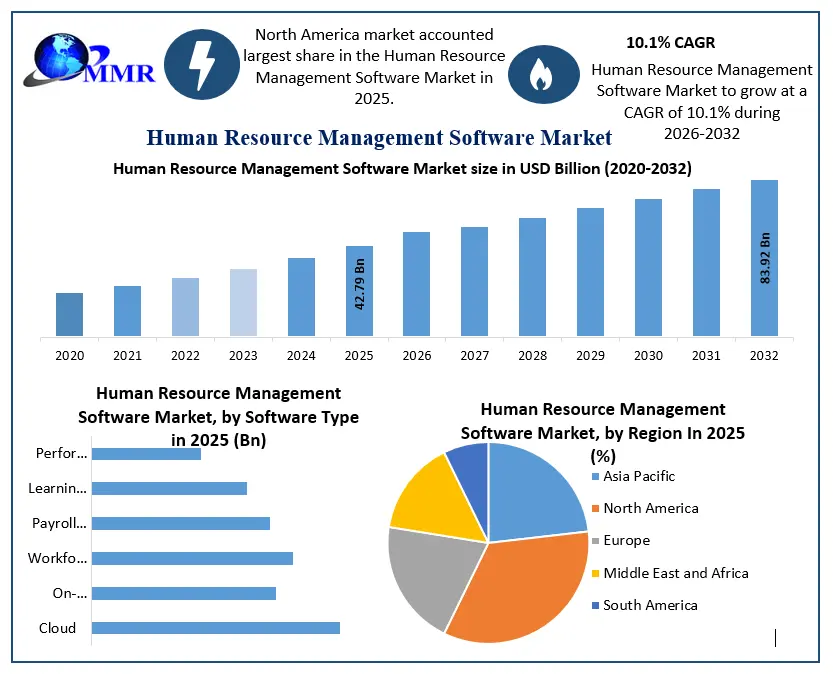
Human Resource Management Software Market was valued at USD 42.79 Bn. in 2025 and the total Global Human Resource Management Software Market revenue is expected to grow at a CAGR of 10.1% from 2026 to 2032 reaching nearly USD 83.92 Bn. by 2032.
Human Resource Management Software Market Overview:
 To know about the Research Methodology :- Request Free Sample Report
Human Resource Management Software Market Dynamics:
Growing Adoption of Cloud-Based HR Platforms and Workforce Digitization is Driving Market Growth
The rapid digitization of workforce management is driving organizations to replace fragmented, paper-based, and legacy HR systems with integrated cloud-based Human Resource Management (HRM) software. Cloud platforms enable organizations to centralize employee data, automate payroll and benefits administration, streamline recruitment and onboarding, and provide real-time workforce insights across locations. The growing adoption of hybrid and remote work models is further increasing demand for mobile-accessible HR platforms that allow employees and managers to access HR services from anywhere. The 48% of surveyed HR leaders planned to increase their HR technology budgets in 2024, highlighting continued investment in digital HR infrastructure. The increasing need for scalable, flexible, and integrated workforce management solutions is therefore expected to remain a major growth driver for the HRM Software Market.
Rapid Integration of Artificial Intelligence and Automation is Creating New Market Opportunities
The integration of artificial intelligence (AI), generative AI, predictive analytics, and intelligent automation is transforming HRM software from administrative systems into strategic workforce management platforms. AI is increasingly being used for resume screening, candidate matching, job-description generation, employee queries, skills assessment, workforce planning, predictive retention analysis, and personalized learning. The growing availability of AI-powered HR assistants, skills intelligence, and predictive workforce analytics is creating significant opportunities for software providers to deliver more personalized and data-driven solutions. As organizations increasingly focus on skills-based hiring and strategic talent management, AI-enabled HRM platforms are expected to become an important source of market expansion.
Data Privacy, Cybersecurity Risks, and Regulatory Compliance are Restraining Market Adoption
HRM software platforms manage highly sensitive employee information, including personal identification, compensation, payroll, performance, health benefits, and employment records, making data security and privacy major concerns for organizations. Increasing cybersecurity threats and stringent regulations governing employee data are raising the compliance requirements associated with HR technology adoption. Organizations operating across multiple countries must also navigate different privacy and employment regulations, increasing the complexity of managing HR data through centralized platforms. In addition, concerns surrounding the use of AI in recruitment and employee evaluation—including algorithmic bias, transparency, explainability, and discrimination—can slow the adoption of advanced AI-enabled HR solutions. These challenges are particularly significant for organizations in highly regulated industries and regions with strict data protection requirements.
Integration Complexity and High Implementation Costs Remain Key Market Challenges
The implementation of HRM software can be challenging for organizations with complex legacy infrastructure, fragmented employee databases, or multiple payroll and enterprise systems. Integrating HRM platforms with ERP, finance, payroll, CRM, identity management, and workforce management systems may require substantial technical resources, customization, data migration, and employee training. Small and medium-sized enterprises may also face budget constraints and limited internal IT capabilities, which can delay technology adoption. Furthermore, employee resistance to changes in established HR processes can affect implementation outcomes. As a result, vendors are increasingly focusing on low-code and no-code configuration, API-based integration, modular SaaS solutions, and simplified implementation models to reduce deployment complexity and improve adoption.
Growing Demand for Employee Experience and Skills-Based Workforce Management is Expanding Market Opportunities
Organizations are increasingly shifting their focus from transactional HR administration toward improving employee experience, workforce engagement, and long-term talent development. This is increasing demand for HRM software that integrates employee self-service, learning and development, performance management, internal mobility, employee engagement, skills intelligence, and personalized career development. Persistent talent shortages are also encouraging organizations to identify existing employee capabilities and close skills gaps rather than relying solely on external recruitment. The growing adoption of skills-based workforce strategies is creating opportunities for HRM platforms to provide intelligent skills mapping, internal talent marketplaces, personalized learning recommendations, and workforce planning. This trend is expected to accelerate the evolution of HRM software into comprehensive AI-enabled employee experience and workforce intelligence ecosystems.
AI Adoption In HR Functions

Human Resource Management Software Market Trends:
- Generative AI and AI-Powered HR Assistants are Transforming HR Operations - HRM platforms are increasingly integrating generative AI, conversational assistants, and intelligent automation to streamline recruitment, employee queries, job-description creation, performance reviews, and personalized learning. .
- Shift Toward Skills-Based Workforce Management is Reshaping HR Technology - Organizations are increasingly adopting skills-based hiring and workforce planning to address changing talent requirements. HR software is incorporating AI-powered skills intelligence to identify capabilities, detect skills gaps, recommend training, and facilitate internal mobility, enabling companies to better utilize existing talent.
- Cloud-Based Unified HR Ecosystems are Replacing Fragmented Systems - Businesses are moving toward cloud-native SaaS platforms that integrate recruitment, payroll, performance management, learning, employee engagement, and workforce analytics. API-based connectivity with ERP, finance, collaboration, and productivity systems is also becoming increasingly important for creating unified workforce ecosystems.
- Predictive Analytics and Personalized Employee Experience are Gaining Momentum - HRM software is increasingly leveraging predictive analytics and people intelligence to forecast workforce needs, identify retention risks, analyze engagement, and support data-driven decisions. At the same time, mobile self-service, personalized dashboards, digital onboarding, and tailored learning recommendations are becoming key features for improving employee experience.
Human Resource Management Software Market Segment Analysis:
The Human Resource Management Software Market, by type, is divided into Cloud and On-premise.
The Cloud segment dominated the Human Resource Management Software Market in 2025 and is expected to maintain its leading position throughout the forecast period. The segment is benefitting from increasing enterprise digitization, flexible deployment, lower infrastructure requirements, and the ability to provide real-time access to HR systems across geographically distributed and hybrid workforces. Cloud-based platforms also enable seamless integration of AI, generative AI, workforce analytics, employee self-service, and automation. The preference for SaaS-based HR solutions is growing thus encouraging an organizations to replace legacy systems with scalable platforms that integrate recruitment, payroll, talent management, performance, and employee engagement. These advantages are expected to sustain the dominance of the Cloud segment throughout the forecast period.
The On-premise segment is expected to maintain a significant presence but is likely to grow at a slower pace than cloud-based solutions. The segment remains relevant among large enterprises and highly regulated organizations that prioritize greater control over employee data, customization, security, and internal IT infrastructure. However, higher maintenance costs, complex implementation, longer deployment cycles, and the need for dedicated IT resources are encouraging businesses to transition toward cloud-based platforms. Nevertheless, organizations with complex legacy infrastructure and stringent data governance or data residency requirements are expected to continue supporting demand for on-premise HRM software.
The Human Resource Management Software Market, by software type, is divided into Core HR, Talent Management, Workforce Management, Payroll & Compensation Management, Learning Management, Performance Management, and Others.
The Core HR segment dominated the Human Resource Management Software Market in 2025 and is expected to maintain its leading position throughout the forecast period. Core HR serves as the foundation of HR technology ecosystems by managing employee records, organizational structures, workforce information, and essential HR workflows. Its ability to integrate with payroll, talent management, workforce management, performance, and employee engagement functions makes it a critical component of enterprise HR platforms. Increasing demand for centralized employee databases and unified HR ecosystems is expected to sustain the segment's dominance. The Talent Management segment is expected to witness strong growth, supported by increasing organizational focus on recruitment, employee retention, succession planning, career development, and internal mobility. The adoption of AI-powered talent intelligence and skills-based workforce management is further strengthening demand. The Workforce Management segment is benefiting from the growing need to optimize distributed and complex workforces through scheduling, time and attendance management, absence tracking, and labor optimization.
The Payroll & Compensation Management segment remains an essential HR software category, supported by demand for accurate payroll processing, automated compensation management, benefits administration, and compliance with changing employment and taxation requirements. The Learning Management segment is expected to expand as organizations increasingly prioritize employee reskilling and continuous development. AI-powered personalized learning and skills-gap identification are creating additional opportunities for the segment. The Performance Management segment is gaining traction as organizations shift from traditional annual appraisals toward continuous feedback, real-time goal tracking, employee development, and performance monitoring.
The Others segment, including employee engagement, HR analytics, recruitment, benefits administration, and HR service delivery, is also expanding as organizations seek integrated employee experience solutions. Although individually smaller, these applications are increasingly being incorporated into comprehensive HRM platforms.
Human Resource Management Software Regional Analysis:
North America dominated the Human Resource Management Software Market in 2025, supported by high enterprise technology spending, widespread cloud adoption, advanced digital infrastructure, and the presence of leading HR technology providers. The region has generated US$20.05 billion in 2025, representing 45.9% of the global HR technology market. The United States remains the primary demand center, driven by the widespread adoption of cloud-based HCM, payroll automation, talent management, workforce analytics, and AI-enabled HR solutions. The region benefits from the presence of established players including Workday, Inc., Oracle Corporation, Automatic Data Processing (ADP), Inc., UKG, Ceridian HCM Holding Inc., and Cornerstone OnDemand, Inc. The increasing focus on employee experience, hybrid workforce management, and AI-powered recruitment and workforce analytics is expected to reinforce North America's leadership throughout the forecast period.
Europe represents a mature and technologically advanced HR software market, supported by increasing enterprise digitization, cloud adoption, and growing demand for compliant workforce management solutions. The region's HR software market generated around US$4.88 billion in 2025. Strict data protection requirements and evolving employment regulations are encouraging organizations to adopt HR platforms with advanced data governance, compliance, security, and responsible AI capabilities. Demand for workforce analytics, employee engagement, talent management, and AI-enabled HR solutions is expected to support further market development, although regulatory requirements may result in more measured AI deployment compared with North America.
Asia Pacific is emerging as one of the most attractive growth regions for HRM software, driven by rapid enterprise digitalization, expanding corporate workforces, increasing cloud adoption, and rising demand for automated recruitment, payroll, workforce management, and talent solutions. Countries such as China, Japan, India, South Korea, Singapore, and Australia are increasingly investing in AI, cloud computing, and workforce automation. The combination of a large labor pool, expanding SMEs, growing technology investments, and demand for mobile-first HR solutions is expected to make Asia Pacific a key growth engine for the market. Latin America is witnessing gradual expansion in HRM software adoption, supported by increasing cloud penetration, workforce digitization, and the growing need to automate payroll, recruitment, attendance, and compliance processes. Organizations are increasingly seeking flexible SaaS-based solutions that can address complex labor regulations and support geographically distributed employees. The region also presents significant opportunities among small and medium-sized enterprises, which are transitioning from spreadsheets and fragmented HR processes toward integrated digital platforms. International providers such as SAP, Oracle, Workday, ADP, and UKG, alongside regional payroll and HR technology specialists, are strengthening the competitive landscape. Growing demand for localized payroll, employee self-service, and workforce analytics is expected to support steady market expansion.
The Middle East & Africa region represents an emerging opportunity for HRM software as governments and enterprises accelerate digital transformation and workforce modernization initiatives. Demand is increasing for cloud-based HR platforms that can support employee records, payroll, recruitment, talent management, localization requirements, and workforce analytics. The expansion of large-scale infrastructure, technology, healthcare, financial services, and tourism projects in the Middle East is generating demand for sophisticated workforce management capabilities. Established global providers such as SAP, Oracle, Workday, and ADP, together with regional HR and payroll technology companies, are contributing to market development. Increasing investment in digital infrastructure and the need to manage diverse, multinational workforces are expected to support the region's adoption of integrated HRM solutions.
Human Resource Management Software Market Recent Developments:
| Month & Year | Recent Development |
| January 2025 | Workday expanded its AI capabilities across its HCM platform, strengthening the use of generative AI and intelligent agents to support HR workflows, employee experiences, talent management, and workforce decision-making. |
| February 2025 | SAP continued advancing Joule, its generative AI copilot, across SAP SuccessFactors to provide AI-powered assistance for HR professionals and employees, supporting tasks such as talent management, employee development, and HR decision-making. |
| March 2025 | Oracle expanded AI capabilities within Oracle Fusion Cloud HCM, increasing the use of AI-powered agents and automation to streamline HR processes and improve employee and manager experiences. |
| April 2025 | ADP strengthened its AI-driven workforce management capabilities, focusing on the application of AI and data analytics to payroll, talent, compliance, and workforce decision-making for organizations of different sizes. |
| May 2025 | UKG continued expanding its AI-powered HCM ecosystem, focusing on intelligent workforce management, employee experience, scheduling, and workforce insights to help organizations manage increasingly complex labor environments. |
| June 2025 | Dayforce advanced its AI strategy across its unified HCM platform, emphasizing AI-enabled workforce intelligence, talent management, payroll, and employee experience capabilities to support more automated HR operations. |
| 2025 | HR technology providers increasingly integrated generative AI and AI-powered assistants into HCM platforms, enabling automated employee support, recruitment assistance, job-description creation, workforce analytics, personalized learning, and HR workflow automation. |
| 2025–2026 | The HRM software industry increasingly shifted toward skills-based workforce management, with vendors expanding skills intelligence, internal talent marketplaces, personalized learning, and AI-powered talent matching to help organizations address changing workforce requirements and skills gaps. |
| 2025–2026 | Cloud-based unified HCM ecosystems continued gaining momentum, as organizations increasingly sought integrated platforms combining Core HR, payroll, talent management, workforce management, performance, learning, analytics, and employee experience capabilities. |
| 2025–2026 | HR software providers increasingly focused on responsible AI and data governance, introducing stronger emphasis on AI transparency, bias mitigation, privacy, security, explainability, and compliance as organizations expanded the use of AI in recruitment and employee management. |
Human Resource Management Software Market Scope: Inquiry Before Buying
| Global Human Resource Management Software Market | |||
|---|---|---|---|
| Report Coverage | Details | ||
| Base Year: | 2025 | Forecast Period: | 2026-2032 |
| Historical Data: | 2020 to 2025 | Market Size in 2025: | USD 42.79 Bn. |
| Forecast Period 2026 to 2032 CAGR: | 10.1% | Market Size in 2032: | USD 83.92 Bn. |
| Segments Covered: | By Component | Software Talent Management Workforce Management Recruitment Payroll Management Performance Management Support & Maintenance Integration & Deployment Training & Consulting |
|
| By Type | Cloud On-premise |
||
| By Software Type | Core HR Talent Management Workforce Management Payroll & Compensation Management Learning Management Performance Management Others |
||
| By End-Use | IT & Telecom BFSI (Banking, Financial Services, Insurance) Manufacturing Healthcare Retail & E-commerce Government Education Others |
||
Human Resource Management Software Market, by Region
North America (United States, Canada and Mexico)
Europe (UK, France, Germany, Italy, Spain, Sweden, Austria, Turkey, Russia and Rest of Europe)
Asia Pacific (China, India, Japan, South Korea, Australia, ASEAN and Rest of APAC)
Middle East and Africa (South Africa, GCC, Egypt, Nigeria and Rest of ME&A)
South America (Brazil, Argentina, Columbia and Rest of South America)
Human Resource Management Software Market, Key Players:
North America
- ADP, Inc.
- Workday, Inc.
- Oracle Corporation
- UKG Inc.
- Dayforce, Inc.
- Paychex, Inc.
- Paylocity Holding Corporation
- Paycor HCM, Inc.
- BambooHR
- Rippling
- Cornerstone OnDemand, Inc.
- IBM Corporation
- Microsoft Corporation
- Mercer LLC
- Accenture
Europe
- SAP SE
- Sage Group plc
- Personio SE & Co. KG
- Cegid
- Cezanne HR Ltd.
- HiBob
- SD Worx
- Zellis
- Visma
- Factorial
- Talentsoft
Asia Pacific
- Darwinbox
- Zoho Corporation (Zoho People)
- PeopleStrong
- greytHR
- Keka Technologies
- Ramco Systems
- Employment Hero
- HROne
- factoHR
Latin America
- TOTVS
- Buk
- Runa
- Meta4
Middle East & Africa
- Bayzat
- GulfHR
- ZenHR
- Jisr
- Menaitech
Others
Frequently Asked Questions:
1. Which region has the largest share in Global Market?
Ans: North American region held the highest share in 2025.
2. What is the growth rate of Global Human Resource Management Software Market?
Ans: The Global Human Resource Management Software Market is expected to grow at a CAGR of 10.1% during forecast period 2026-2032.
3. What is scope of the Global Human Resource Management Software market report?
Ans: Global Human Resource Management Software Market report helps with the PESTEL, PORTER,Recommendations for Investors & Leaders, and market estimation of the forecast period.
4. Who are the key players in Global market?
Ans: The important key players in the Global Market are Accenture ADP, Inc. Cezanne HR Ltd. Oracle PwC Ceridian HCM Holding, Inc. International Business Machines Corp. (IBM) Kronos Incorporated (now Ultimate Kronos Group) Mercer LLC NetSuite, Inc.