Human Machine Interface Market by Offering, Configure, End User and Region - Global Market Size Estimation, Industry-Wide Analysis, Competitive Landscape Assessment & Long-Term Forecast to 2032

9.76%
CAGR (2026-2032)
7.97(2025) USD Bn.
Market Size
324
Report Pages
136
Market Tables

Overview

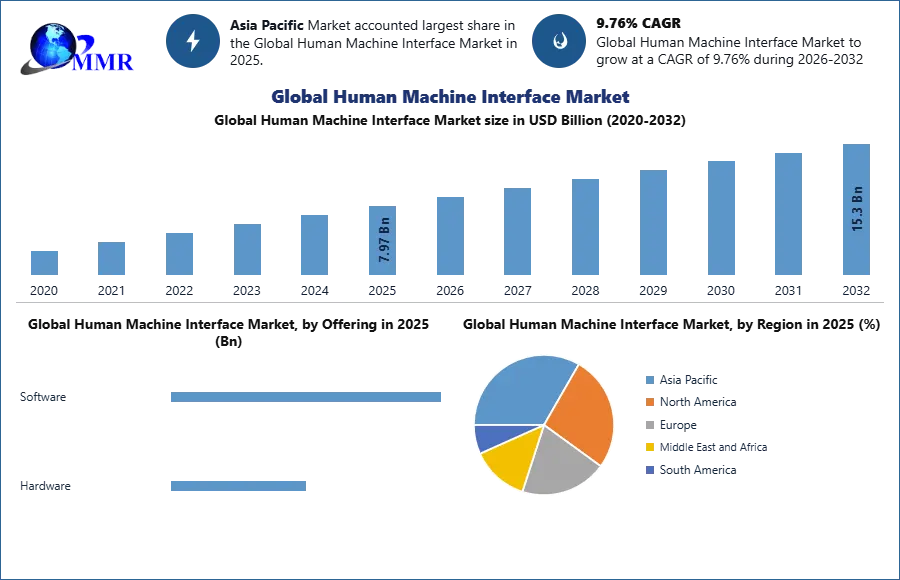
Global Human Machine Interface Market size was valued at USD 7.97 Bn in 2025 and Human Machine Interface market revenue is expected to reach USD 15.3 Bn by 2032, at a CAGR of 9.76 % over the forecast period.

Human Machine Interface Market Overview

In industrial and commercial settings, the transformation is equally significant. HMI systems have become central to the operation of complex machinery, manufacturing processes, and automation systems. Touchscreen interfaces, integrated with intuitive software, have streamlined tasks, reduced errors, and improved overall productivity. In these environments, HMI systems are utilized to monitor and control a wide range of equipment, from assembly lines and robotics to HVAC systems and power plants. Ensuring the security of HMI systems is critical, especially when they are used in sensitive or critical applications. Robust security measures are implemented to protect against unauthorized access or tampering.

HMIs are integral to everyday gadgets such as smartphones, tablets, and smart appliances. They enhance user experiences through features like touchscreens, voice recognition, and gesture controls. In manufacturing and industrial settings, Human Machine Interface systems are used to control machinery, monitor processes, and manage complex systems. They contribute to increased efficiency and reduced downtime. Medical equipment, such as MRI machines and patient monitors, relies on HMIs for operation. In healthcare settings, intuitive interfaces are vital for healthcare professionals to monitor patients and administer treatment. Modern agriculture employs Human Machine Interface technology to control and monitor automated farming machinery, improving productivity and crop management.
To know about the Research Methodology :- Request Free Sample Report

Human Machine Interface Market Dynamics

Consumer Expectations for Connected and Smart Vehicles to Boost the Human Machine Interface Market growth

Consumers are increasingly looking for connected and smart vehicles equipped with features like infotainment systems, in-car connectivity, and integrated navigation. These features require advanced HMIs that provide a seamless user experience. As a result, the automotive HMI market is expanding to cater to these evolving consumer expectations. Safety remains a paramount concern in the automotive industry. Advanced HMIs play a crucial role in reducing driver distraction by providing interfaces that are easy to navigate and allow drivers to access essential information without taking their eyes off the road. The automotive Human Machine Interface market is driven by the need to design systems that prioritize safety. Safety standards and regulations in industries like healthcare, aviation, and manufacturing are becoming more stringent. HMI systems are integral in ensuring safety and compliance by providing accurate information and facilitating control in critical applications. The integration of emerging technologies such as augmented reality (AR) and virtual reality (VR) is expanding the capabilities of HMIs. AR and VR interfaces are increasingly used in training, maintenance, and complex industrial tasks, improving efficiency and reducing errors. Users in consumer electronics and automotive sectors expect customization and personalization options. HMIs are being designed to allow users to personalize their interfaces, settings, and preferences, enhancing the overall user experience, which is expected to boost the Human Machine Interface Market growth. There is a growing focus on making HMI systems accessible to individuals with disabilities. These systems incorporate features such as voice commands, screen readers, and tactile feedback to ensure inclusivity and usability for a wider range of users. In the aerospace and defense sectors, HMI systems are critical for piloting aircraft, controlling unmanned aerial vehicles (UAVs), and managing complex defense systems. The growing demand for these applications is driving the HMI market in the aerospace and defense sector.

Complex Integration to limit the Human Machine Interface Market growth

The integration of HMI systems into existing infrastructure and industrial processes can be complex and time-consuming. Compatibility issues, legacy systems, and the need for specialized expertise can complicate the integration process. This complexity deter organizations from adopting HMI solutions, especially when they fear disruptions to ongoing operations. Effective utilization of HMI systems requires a workforce with the necessary training and skills. Employees are proficient in using HMI interfaces to maximize their benefits. While the demand for user-friendly interfaces is growing, the design and usability of HMI systems is challenge. Creating interfaces that are intuitive and easily customizable for diverse users can be complex. Poorly designed interfaces lead to confusion and errors, impacting productivity and safety. Users often seek customized HMI solutions to meet their specific requirements and preferences. However, the degree of customization that HMI systems offer is limited.

Organizations find it challenging to tailor HMI interfaces precisely to their unique needs, leading to compromises in functionality and usability. In certain industries, such as manufacturing and heavy machinery, HMI systems are exposed to harsh environmental conditions, including extreme temperatures, dust, moisture, and vibrations, which significantly restraints the Human Machine Interface Market growth. Ensuring the durability and reliability of HMI systems in such environments is a restraint that requires specialized engineering and materials. Many organizations have legacy systems and equipment that may not be compatible with modern HMI solutions. Adapting these legacy systems to work seamlessly with new HMI technology can be complex and costly. Some organizations may hesitate to invest in HMI upgrades due to these compatibility issues.

Human Machine Interface Market Segment Analysis

Based on Offering, the market is segmented into Hardware and Software. The software segment is expected to dominate the Human Machine Interface Market over the forecast period. HMI software provides the logic and control capabilities necessary to manage and control various aspects of connected systems. This involve regulating processes, executing commands, and responding to user inputs. It enables users to set parameters, configure devices, and initiate actions, which is crucial in industrial settings where precision and control are essential. It facilitates connectivity with a wide range of hardware, sensors, controllers, and other devices. It often supports various communication protocols to ensure compatibility with different systems. Many HMI software solutions offer remote access capabilities, enabling users to monitor and control systems from a distance. This is especially valuable for industries with distributed assets or remote facilities. Remote access often includes the use of mobile applications, cloud-based platforms, and web interfaces. HMI software often includes features for system diagnostics and maintenance. It helps users identify issues, troubleshoot problems, and perform updates and software patches, which is expected to boost the Human Machine Interface Market growth.

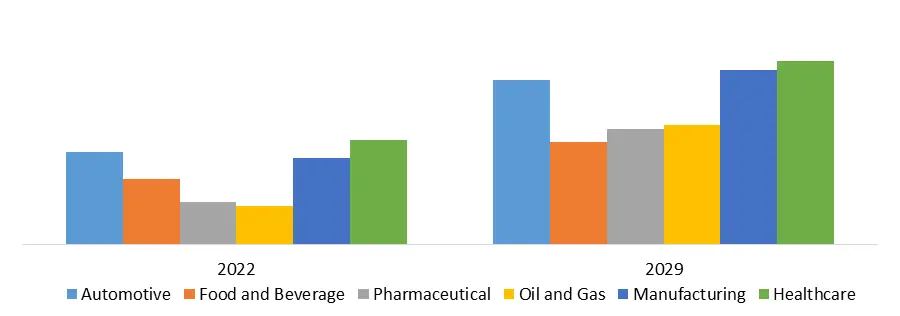
Based on End-User, the market is segmented into Automotive, Food and Beverage, Pharmaceutical, Oil and Gas, Manufacturing, and Healthcare. The automotive segment dominated the market in 2022 and is expected to hold the largest Human Machine Interface Market share over the forecast period. The "Automotive" segment in the Human Machine Interface (HMI) market represents a pivotal and dynamic sector characterized by the integration of advanced technologies to enhance the in-vehicle experience, improve safety, and cater to the evolving demands of modern drivers and passengers. Automotive HMIs are essential interfaces that enable seamless interactions between occupants and the vehicle's numerous systems and functionalities. Safety is a paramount concern in the automotive sector, and HMIs play a pivotal role in ensuring it. HMIs provide drivers with vital information, control over vehicle functions, and assistance in real-time. Whether it's conveying critical data, facilitating hands-free communication, or enabling swift access to safety features, HMIs are indispensable for minimizing distractions and enhancing safety on the road. Automotive HMIs are designed with a strong focus on user experience. They are crafted to be user-centric, with ergonomics and accessibility at the forefront. An intuitive and user-friendly interface is essential, allowing drivers and passengers to engage with in-vehicle systems with minimal effort and distraction. HMIs provide intuitive controls and interfaces that enhance the overall driving experience. Automotive HMIs facilitate personalization, allowing drivers to tailor their in-vehicle experience to their preferences. Users can adjust seat positions, climate control settings, infotainment options, and more. This level of customization and personalization elevates the driving experience, creating a sense of ownership and comfort for drivers and passengers.

Human Machine Interface Market share, by End-User
Human Machine Interface Market

Human Machine Interface Market Regional Insight

Increasing Healthcare and Medical Sector Advancements in Asia Pacific to boost the Human Machine Interface Market growth

The Asia Pacific region is witnessing advancements in the healthcare and medical sectors. HMI solutions are employed in various medical devices and equipment, such as diagnostic machines, patient monitoring systems, and surgical robots. The increasing demand for high-quality healthcare services and medical equipment is driving the growth of the HMI market within this sector. Countries such as China, Japan, India, and South Korea in the Asia Pacific region are heavily investing in infrastructure development. This includes smart cities, transportation systems, and public utilities. Human Machine Interface technology plays a pivotal role in managing and controlling the complex systems that support these initiatives, ranging from intelligent traffic management to energy-efficient buildings. Notably, APAC has evolved into a substantial manufacturing center as numerous enterprises have chosen to relocate their production facilities to the region. This strategic move leverages the presence of a skilled workforce and cost-effective labor resources. Furthermore, the gradual adoption of automated technologies in both process and discrete manufacturing industries across the APAC region has played a pivotal role in driving the expansion of the HMI market.

The automotive industry in North America heavily relies on advanced HMI solutions for enhancing in-vehicle experiences, enabling autonomous driving features, and providing seamless connectivity. As the automotive sector continues to innovate and integrate new technologies, the demand for automotive HMIs remains consistently high. The energy and utilities sector is increasingly adopting HMI solutions for efficient monitoring and control of power generation, distribution, and smart grid systems. The need for real-time data analysis and improved grid management is pushing the growth of HMI technologies. The development of smart cities and the modernization of urban infrastructure are significant drivers for HMI solutions. North American cities are adopting smart technologies that rely on HMI interfaces for efficient control and management of various systems, from transportation to public services.

Recent Development: Human Machine Interface Market

Exact Date Company Development Impact
28 October 2025 NTX Embedded NTX Embedded introduced the Octolux Industrial HMI Platform, a comprehensive solution featuring customizable touchscreens ranging from 5 to 21 inches for harsh environments. The platform accelerates development cycles for OEMs by providing pre-designed hardware and software modules capable of operating in wet, dirty, or sunlight-lit locations.
05 November 2025 Schneider Electric Schneider Electric signed a Memorandum of Understanding with SRMIST to establish a Centre of Excellence in Human Machine Interface (HMI) and a state-of-the-art laboratory. This collaboration strengthens the industrial automation ecosystem by providing hands-on training and research opportunities in AI-based HMI systems and cybersecurity.
18 November 2025 Mitsubishi Electric Mitsubishi Electric announced the global launch of its next-generation GOT3000 HMI, designed to integrate production facilities seamlessly with IT-level data structures. The system enhances digital transformation by supporting OPC UA and CC-Link IE TSN networks, enabling high-performance communication across networked production environments.
05 December 2025 Pro-face (Schneider Electric) Pro-face officially released the GP6000 Advanced Model, a high-performance addition to its flagship HMI series. This launch expands the company's HMI-centric architecture, offering improved connectivity and processing power for complex industrial automation workflows.
17 February 2026 Pro-face (Schneider Electric) Pro-face announced the immediate availability of the GPH6000 Series, specifically engineered for enhanced reliability in demanding applications. The series enables efficient Lexium Cobot operations, streamlining the interface between collaborative robots and human operators in smart manufacturing setups.
09 March 2026 ABB ABB announced a $75 million investment in India for 2026 to expand manufacturing footprint and R&D capabilities for automation segments. The investment supports a "local-for-local" strategy, scaling up the production of HMI and electrification solutions to meet growing regional demand in data centers and railways.

Human Machine Interface Market Competitive Landscape

Prominent companies with a significant market share, extensive industry experience, and a wide range of HMI products and solutions. These market leaders often set industry standards and are known for their expertise in delivering high-quality HMI solutions. Innovative companies that consistently push the envelope in HMI technology and design. These innovators focus on research and development, driving advancements in HMI solutions to enhance performance and user experience. Niche players that cater to specific industry segments or unique HMI applications. They excel in tailoring HMI solutions to meet specialized needs and are often sought after for their domain expertise. Young companies that are introducing novel HMI technologies and approaches. They disrupt the market by offering fresh perspectives and innovative solutions, and their agility allows them to quickly adapt to changing industry trends. Beyond Human Machine Interface hardware and software, some players offer value-added services like consulting, training, maintenance, and technical support. These services enhance the overall customer experience. In response to the rising cybersecurity and data privacy concerns, there is a growing niche of companies specializing in HMI cybersecurity. They offer solutions to protect HMI systems from cyber threats.

Global Human Machine Interface Market Report Scope: Inquire before buying

Global Human Machine Interface Market
Report Coverage Details
Base Year: 2025 Forecast Period: 2026-2032
Historical Data: 2020 to 2025 Market Size in 2025: 7.97 USD Billion
Forecast Period 2026-2032 CAGR: 9.76% Market Size in 2032: 15.3 USD Billion
Segments Covered: by Technology Touchscreen HMI
Motion HMI
Voice-based HMI
Others
by Offering Software
Hardware
by Configure Embedded HMI
Stand-Alone HMI
by End User Automotive
Food and Beverage
Pharmaceutical
Oil and Gas
Others

Human Machine Interface Market, by Region

North America (United States, Canada and Mexico)
Europe (UK, France, Germany, Italy, Spain, Sweden, Austria and Rest of Europe)
Asia Pacific (China, South Korea, Japan, India, Australia, Indonesia, Malaysia, Vietnam, Taiwan, Bangladesh, Pakistan and Rest of APAC)
Middle East and Africa (South Africa, GCC, Egypt, Nigeria and Rest of ME&A)
South America (Brazil, Argentina Rest of South America)

Human Machine Interface Key Players

  • Siemens AG
  • Rockwell Automation
  • Schneider Electric
  • ABB Ltd.
  • Honeywell International Inc.
  • General Electric
  • Mitsubishi Electric Corporation
  • Omron Corporation
  • Yokogawa Electric Corporation
  • Emerson Electric Co.
  • Advantech Co., Ltd.
  • Beijer Electronics
  • Beckhoff Automation
  • Kontron AG
  • Bosch GmbH
  • Continental AG
  • Denso Corporation
  • Panasonic Corporation
  • Harman International
  • Visteon Corporation
  • Synaptics Incorporated
  • Valeo S.A.
  • Luxoft Holding Inc.
  • Desay SV Automotive
  • Alpine Electronics
  • Clarion Co., Ltd.
  • Rightware
  • ifm electronic gmbh
  • Eaton Corporation
  • Red Lion Controls

Frequently asked Questions

1. What is the significance of HMIs in modern vehicles?
Ans: HMIs in vehicles provide a seamless interaction between drivers and the vehicle's systems. They enhance safety, reduce distractions, and offer a user-centric experience.

2. How do HMI systems contribute to safety in the automotive sector?
Ans: Automotive HMIs play a critical role in reducing driver distraction. They offer easy-to-navigate interfaces that provide drivers with essential information without taking their focus away from the road.

3. How does the automotive industry in North America impact the demand for HMI solutions?
Ans: The automotive industry in North America heavily relies on advanced HMI solutions for enhancing in-vehicle experiences, enabling autonomous driving features, and providing seamless connectivity. As the automotive sector continues to innovate and integrate new technologies, the demand for automotive HMIs remains consistently high.

4. How do HMI systems facilitate personalization in vehicles?
Ans: HMI systems allow users to personalize their in-vehicle experience by adjusting settings such as seat positions, climate control, and infotainment options, enhancing the overall driving experience.

5. What is the role of HMI technology in the Asia Pacific region's healthcare sector?
Ans: The Asia Pacific region is witnessing advancements in the healthcare sector, and HMI solutions are integral to medical devices and equipment. They help in improving the quality of healthcare services and medical equipment.

Table of Contents

1. Global Human Machine Interface Market Introduction
1.1. Study Assumption and Market Definition
1.2. Scope of the Study
1.3. Executive Summary
2. Global Global Human Machine Interface Market: Competitive Landscape
2.1. MMR Competition Matrix
2.2. Competitive Landscape
2.3. Key Players Benchmarking
2.3.1. Company Name
2.3.2. Business Segment
2.3.3. End-user Segment
2.3.4. Revenue (2025)
2.3.5. Company Locations
2.4. Leading Global Human Machine Interface Market Companies, by market capitalization
2.5. Market Structure
2.5.1. Market Leaders
2.5.2. Market Followers
2.5.3. Emerging Players
2.6. Mergers and Acquisitions Details
3. Global Human Machine Interface Market: Dynamics
3.1. Global Human Machine Interface Market Trends by Region
3.1.1. North America Global Human Machine Interface Market Trends
3.1.2. Europe Global Human Machine Interface Market Trends
3.1.3. Asia Pacific Global Human Machine Interface Market Trends
3.1.4. Middle East and Africa Global Human Machine Interface Market Trends
3.1.5. South America Global Human Machine Interface Market Trends
3.2. Global Human Machine Interface Market Dynamics by Region
3.2.1. North America
3.2.1.1. North America Global Human Machine Interface Market Drivers
3.2.1.2. North America Global Human Machine Interface Market Restraints
3.2.1.3. North America Global Human Machine Interface Market Opportunities
3.2.1.4. North America Global Human Machine Interface Market Challenges
3.2.2. Europe
3.2.2.1. Europe Global Human Machine Interface Market Drivers
3.2.2.2. Europe Global Human Machine Interface Market Restraints
3.2.2.3. Europe Global Human Machine Interface Market Opportunities
3.2.2.4. Europe Global Human Machine Interface Market Challenges
3.2.3. Asia Pacific
3.2.3.1. Asia Pacific Global Human Machine Interface Market Drivers
3.2.3.2. Asia Pacific Global Human Machine Interface Market Restraints
3.2.3.3. Asia Pacific Global Human Machine Interface Market Opportunities
3.2.3.4. Asia Pacific Global Human Machine Interface Market Challenges
3.2.4. Middle East and Africa
3.2.4.1. Middle East and Africa Global Human Machine Interface Market Drivers
3.2.4.2. Middle East and Africa Global Human Machine Interface Market Restraints
3.2.4.3. Middle East and Africa Global Human Machine Interface Market Opportunities
3.2.4.4. Middle East and Africa Global Human Machine Interface Market Challenges
3.2.5. South America
3.2.5.1. South America Global Human Machine Interface Market Drivers
3.2.5.2. South America Global Human Machine Interface Market Restraints
3.2.5.3. South America Global Human Machine Interface Market Opportunities
3.2.5.4. South America Global Human Machine Interface Market Challenges
3.3. PORTER's Five Forces Analysis
3.4. PESTLE Analysis
3.5. Technology Roadmap
3.6. Regulatory Landscape by Region
3.6.1. North America
3.6.2. Europe
3.6.3. Asia Pacific
3.6.4. Middle East and Africa
3.6.5. South America
3.7. Key Opinion Leader Analysis For Global Human Machine Interface Industry
3.8. Analysis of Government Schemes and Initiatives For Global Human Machine Interface Industry
3.9. Global Human Machine Interface Market Trade Analysis
3.10. The Global Pandemic Impact on Global Human Machine Interface Market
4. Global Human Machine Interface Market: Global Market Size and Forecast by Segmentation (in USD Billion) 2025-2032
4.1. Global Human Machine Interface Market Size and Forecast, by Technology (2025-2032)
4.1.1. Touchscreen HMI
4.1.2. Motion HMI
4.1.3. Voice-based HMI
4.1.4. Others
4.2. Global Human Machine Interface Market Size and Forecast, by Offering (2025-2032)
4.2.1. Software
4.2.2. Hardware
4.3. Global Human Machine Interface Market Size and Forecast, by Configure (2025-2032)
4.3.1. Embedded HMI
4.3.2. Stand-Alone HMI
4.4. Global Human Machine Interface Market Size and Forecast, by End User (2025-2032)
4.4.1. Automotive
4.4.2. Food and Beverage
4.4.3. Pharmaceutical
4.4.4. Oil and Gas
4.4.5. Others
4.5. Global Human Machine Interface Market Size and Forecast, by Region (2025-2032)
4.5.1. North America
4.5.2. Europe
4.5.3. Asia Pacific
4.5.4. Middle East and Africa
4.5.5. South America
5. North America Global Human Machine Interface Market Size and Forecast by Segmentation (in USD Billion) 2025-2032
5.1. North America Global Human Machine Interface Market Size and Forecast, by Technology (2025-2032)
5.1.1. Touchscreen HMI
5.1.2. Motion HMI
5.1.3. Voice-based HMI
5.1.4. Others
5.2. North America Global Human Machine Interface Market Size and Forecast, by Offering (2025-2032)
5.2.1. Software
5.2.2. Hardware
5.3. North America Global Human Machine Interface Market Size and Forecast, by Configure (2025-2032)
5.3.1. Embedded HMI
5.3.2. Stand-Alone HMI
5.4. North America Global Human Machine Interface Market Size and Forecast, by End User (2025-2032)
5.4.1. Automotive
5.4.2. Food and Beverage
5.4.3. Pharmaceutical
5.4.4. Oil and Gas
5.4.5. Others
5.5. North America Global Human Machine Interface Market Size and Forecast, by Country (2025-2032)
5.5.1. United States
5.5.1.1. United States Global Human Machine Interface Market Size and Forecast, by Technology (2025-2032)
5.5.1.1.1. Touchscreen HMI
5.5.1.1.2. Motion HMI
5.5.1.1.3. Voice-based HMI
5.5.1.1.4. Others
5.5.1.2. United States Global Human Machine Interface Market Size and Forecast, by Offering (2025-2032)
5.5.1.2.1. Software
5.5.1.2.2. Hardware
5.5.1.3. United States Global Human Machine Interface Market Size and Forecast, by Configure (2025-2032)
5.5.1.3.1. Embedded HMI
5.5.1.3.2. Stand-Alone HMI
5.5.1.4. United States Global Human Machine Interface Market Size and Forecast, by End User (2025-2032)
5.5.1.4.1. Automotive
5.5.1.4.2. Food and Beverage
5.5.1.4.3. Pharmaceutical
5.5.1.4.4. Oil and Gas
5.5.1.4.5. Others
5.5.2. Canada
5.5.2.1. Canada Global Human Machine Interface Market Size and Forecast, by Technology (2025-2032)
5.5.2.1.1. Touchscreen HMI
5.5.2.1.2. Motion HMI
5.5.2.1.3. Voice-based HMI
5.5.2.1.4. Others
5.5.2.2. Canada Global Human Machine Interface Market Size and Forecast, by Offering (2025-2032)
5.5.2.2.1. Software
5.5.2.2.2. Hardware
5.5.2.3. Canada Global Human Machine Interface Market Size and Forecast, by Configure (2025-2032)
5.5.2.3.1. Embedded HMI
5.5.2.3.2. Stand-Alone HMI
5.5.2.4. Canada Global Human Machine Interface Market Size and Forecast, by End User (2025-2032)
5.5.2.4.1. Automotive
5.5.2.4.2. Food and Beverage
5.5.2.4.3. Pharmaceutical
5.5.2.4.4. Oil and Gas
5.5.2.4.5. Others
5.5.3. Mexico
5.5.3.1. Mexico Global Human Machine Interface Market Size and Forecast, by Technology (2025-2032)
5.5.3.1.1. Touchscreen HMI
5.5.3.1.2. Motion HMI
5.5.3.1.3. Voice-based HMI
5.5.3.1.4. Others
5.5.3.2. Mexico Global Human Machine Interface Market Size and Forecast, by Offering (2025-2032)
5.5.3.2.1. Software
5.5.3.2.2. Hardware
5.5.3.3. Mexico Global Human Machine Interface Market Size and Forecast, by Configure (2025-2032)
5.5.3.3.1. Embedded HMI
5.5.3.3.2. Stand-Alone HMI
5.5.3.4. Mexico Global Human Machine Interface Market Size and Forecast, by End User (2025-2032)
5.5.3.4.1. Automotive
5.5.3.4.2. Food and Beverage
5.5.3.4.3. Pharmaceutical
5.5.3.4.4. Oil and Gas
5.5.3.4.5. Others
6. Europe Global Human Machine Interface Market Size and Forecast by Segmentation (in USD Billion) 2025-2032
6.1. Europe Global Human Machine Interface Market Size and Forecast, by Technology (2025-2032)
6.2. Europe Global Human Machine Interface Market Size and Forecast, by Offering (2025-2032)
6.3. Europe Global Human Machine Interface Market Size and Forecast, by Configure (2025-2032)
6.4. Europe Global Human Machine Interface Market Size and Forecast, by End User (2025-2032)
6.5. Europe Global Human Machine Interface Market Size and Forecast, by Country (2025-2032)
6.5.1. United Kingdom
6.5.1.1. United Kingdom Global Human Machine Interface Market Size and Forecast, by Technology (2025-2032)
6.5.1.2. United Kingdom Global Human Machine Interface Market Size and Forecast, by Offering (2025-2032)
6.5.1.3. United Kingdom Global Human Machine Interface Market Size and Forecast, by Configure (2025-2032)
6.5.1.4. United Kingdom Global Human Machine Interface Market Size and Forecast, by End User (2025-2032)
6.5.2. France
6.5.2.1. France Global Human Machine Interface Market Size and Forecast, by Technology (2025-2032)
6.5.2.2. France Global Human Machine Interface Market Size and Forecast, by Offering (2025-2032)
6.5.2.3. France Global Human Machine Interface Market Size and Forecast, by Configure (2025-2032)
6.5.2.4. France Global Human Machine Interface Market Size and Forecast, by End User (2025-2032)
6.5.3. Germany
6.5.3.1. Germany Global Human Machine Interface Market Size and Forecast, by Technology (2025-2032)
6.5.3.2. Germany Global Human Machine Interface Market Size and Forecast, by Offering (2025-2032)
6.5.3.3. Germany Global Human Machine Interface Market Size and Forecast, by Configure (2025-2032)
6.5.3.4. Germany Global Human Machine Interface Market Size and Forecast, by End User (2025-2032)
6.5.4. Italy
6.5.4.1. Italy Global Human Machine Interface Market Size and Forecast, by Technology (2025-2032)
6.5.4.2. Italy Global Human Machine Interface Market Size and Forecast, by Offering (2025-2032)
6.5.4.3. Italy Global Human Machine Interface Market Size and Forecast, by Configure (2025-2032)
6.5.4.4. Italy Global Human Machine Interface Market Size and Forecast, by End User (2025-2032)
6.5.5. Spain
6.5.5.1. Spain Global Human Machine Interface Market Size and Forecast, by Technology (2025-2032)
6.5.5.2. Spain Global Human Machine Interface Market Size and Forecast, by Offering (2025-2032)
6.5.5.3. Spain Global Human Machine Interface Market Size and Forecast, by Configure (2025-2032)
6.5.5.4. Spain Global Human Machine Interface Market Size and Forecast, by End User (2025-2032)
6.5.6. Sweden
6.5.6.1. Sweden Global Human Machine Interface Market Size and Forecast, by Technology (2025-2032)
6.5.6.2. Sweden Global Human Machine Interface Market Size and Forecast, by Offering (2025-2032)
6.5.6.3. Sweden Global Human Machine Interface Market Size and Forecast, by Configure (2025-2032)
6.5.6.4. Sweden Global Human Machine Interface Market Size and Forecast, by End User (2025-2032)
6.5.7. Austria
6.5.7.1. Austria Global Human Machine Interface Market Size and Forecast, by Technology (2025-2032)
6.5.7.2. Austria Global Human Machine Interface Market Size and Forecast, by Offering (2025-2032)
6.5.7.3. Austria Global Human Machine Interface Market Size and Forecast, by Configure (2025-2032)
6.5.7.4. Austria Global Human Machine Interface Market Size and Forecast, by End User (2025-2032)
6.5.8. Rest of Europe
6.5.8.1. Rest of Europe Global Human Machine Interface Market Size and Forecast, by Technology (2025-2032)
6.5.8.2. Rest of Europe Global Human Machine Interface Market Size and Forecast, by Offering (2025-2032)
6.5.8.3. Rest of Europe Global Human Machine Interface Market Size and Forecast, by Configure (2025-2032)
6.5.8.4. Rest of Europe Global Human Machine Interface Market Size and Forecast, by End User (2025-2032)
7. Asia Pacific Global Human Machine Interface Market Size and Forecast by Segmentation (in USD Billion) 2025-2032
7.1. Asia Pacific Global Human Machine Interface Market Size and Forecast, by Technology (2025-2032)
7.2. Asia Pacific Global Human Machine Interface Market Size and Forecast, by Offering (2025-2032)
7.3. Asia Pacific Global Human Machine Interface Market Size and Forecast, by Configure (2025-2032)
7.4. Asia Pacific Global Human Machine Interface Market Size and Forecast, by End User (2025-2032)
7.5. Asia Pacific Global Human Machine Interface Market Size and Forecast, by Country (2025-2032)
7.5.1. China
7.5.1.1. China Global Human Machine Interface Market Size and Forecast, by Technology (2025-2032)
7.5.1.2. China Global Human Machine Interface Market Size and Forecast, by Offering (2025-2032)
7.5.1.3. China Global Human Machine Interface Market Size and Forecast, by Configure (2025-2032)
7.5.1.4. China Global Human Machine Interface Market Size and Forecast, by End User (2025-2032)
7.5.2. S Korea
7.5.2.1. S Korea Global Human Machine Interface Market Size and Forecast, by Technology (2025-2032)
7.5.2.2. S Korea Global Human Machine Interface Market Size and Forecast, by Offering (2025-2032)
7.5.2.3. S Korea Global Human Machine Interface Market Size and Forecast, by Configure (2025-2032)
7.5.2.4. S Korea Global Human Machine Interface Market Size and Forecast, by End User (2025-2032)
7.5.3. Japan
7.5.3.1. Japan Global Human Machine Interface Market Size and Forecast, by Technology (2025-2032)
7.5.3.2. Japan Global Human Machine Interface Market Size and Forecast, by Offering (2025-2032)
7.5.3.3. Japan Global Human Machine Interface Market Size and Forecast, by Configure (2025-2032)
7.5.3.4. Japan Global Human Machine Interface Market Size and Forecast, by End User (2025-2032)
7.5.4. India
7.5.4.1. India Global Human Machine Interface Market Size and Forecast, by Technology (2025-2032)
7.5.4.2. India Global Human Machine Interface Market Size and Forecast, by Offering (2025-2032)
7.5.4.3. India Global Human Machine Interface Market Size and Forecast, by Configure (2025-2032)
7.5.4.4. India Global Human Machine Interface Market Size and Forecast, by End User (2025-2032)
7.5.5. Australia
7.5.5.1. Australia Global Human Machine Interface Market Size and Forecast, by Technology (2025-2032)
7.5.5.2. Australia Global Human Machine Interface Market Size and Forecast, by Offering (2025-2032)
7.5.5.3. Australia Global Human Machine Interface Market Size and Forecast, by Configure (2025-2032)
7.5.5.4. Australia Global Human Machine Interface Market Size and Forecast, by End User (2025-2032)
7.5.6. Indonesia
7.5.6.1. Indonesia Global Human Machine Interface Market Size and Forecast, by Technology (2025-2032)
7.5.6.2. Indonesia Global Human Machine Interface Market Size and Forecast, by Offering (2025-2032)
7.5.6.3. Indonesia Global Human Machine Interface Market Size and Forecast, by Configure (2025-2032)
7.5.6.4. Indonesia Global Human Machine Interface Market Size and Forecast, by End User (2025-2032)
7.5.7. Malaysia
7.5.7.1. Malaysia Global Human Machine Interface Market Size and Forecast, by Technology (2025-2032)
7.5.7.2. Malaysia Global Human Machine Interface Market Size and Forecast, by Offering (2025-2032)
7.5.7.3. Malaysia Global Human Machine Interface Market Size and Forecast, by Configure (2025-2032)
7.5.7.4. Malaysia Global Human Machine Interface Market Size and Forecast, by End User (2025-2032)
7.5.8. Vietnam
7.5.8.1. Vietnam Global Human Machine Interface Market Size and Forecast, by Technology (2025-2032)
7.5.8.2. Vietnam Global Human Machine Interface Market Size and Forecast, by Offering (2025-2032)
7.5.8.3. Vietnam Global Human Machine Interface Market Size and Forecast, by Configure (2025-2032)
7.5.8.4. Vietnam Global Human Machine Interface Market Size and Forecast, by End User (2025-2032)
7.5.9. Taiwan
7.5.9.1. Taiwan Global Human Machine Interface Market Size and Forecast, by Technology (2025-2032)
7.5.9.2. Taiwan Global Human Machine Interface Market Size and Forecast, by Offering (2025-2032)
7.5.9.3. Taiwan Global Human Machine Interface Market Size and Forecast, by Configure (2025-2032)
7.5.9.4. Taiwan Global Human Machine Interface Market Size and Forecast, by End User (2025-2032)
7.5.10. Rest of Asia Pacific
7.5.10.1. Rest of Asia Pacific Global Human Machine Interface Market Size and Forecast, by Technology (2025-2032)
7.5.10.2. Rest of Asia Pacific Global Human Machine Interface Market Size and Forecast, by Offering (2025-2032)
7.5.10.3. Rest of Asia Pacific Global Human Machine Interface Market Size and Forecast, by Configure (2025-2032)
7.5.10.4. Rest of Asia Pacific Global Human Machine Interface Market Size and Forecast, by End User (2025-2032)
8. Middle East and Africa Global Human Machine Interface Market Size and Forecast by Segmentation (in USD Billion) 2025-2032
8.1. Middle East and Africa Global Human Machine Interface Market Size and Forecast, by Technology (2025-2032)
8.2. Middle East and Africa Global Human Machine Interface Market Size and Forecast, by Offering (2025-2032)
8.3. Middle East and Africa Global Human Machine Interface Market Size and Forecast, by Configure (2025-2032)
8.4. Middle East and Africa Global Human Machine Interface Market Size and Forecast, by End User (2025-2032)
8.5. Middle East and Africa Global Human Machine Interface Market Size and Forecast, by Country (2025-2032)
8.5.1. South Africa
8.5.1.1. South Africa Global Human Machine Interface Market Size and Forecast, by Technology (2025-2032)
8.5.1.2. South Africa Global Human Machine Interface Market Size and Forecast, by Offering (2025-2032)
8.5.1.3. South Africa Global Human Machine Interface Market Size and Forecast, by Configure (2025-2032)
8.5.1.4. South Africa Global Human Machine Interface Market Size and Forecast, by End User (2025-2032)
8.5.2. GCC
8.5.2.1. GCC Global Human Machine Interface Market Size and Forecast, by Technology (2025-2032)
8.5.2.2. GCC Global Human Machine Interface Market Size and Forecast, by Offering (2025-2032)
8.5.2.3. GCC Global Human Machine Interface Market Size and Forecast, by Configure (2025-2032)
8.5.2.4. GCC Global Human Machine Interface Market Size and Forecast, by End User (2025-2032)
8.5.3. Nigeria
8.5.3.1. Nigeria Global Human Machine Interface Market Size and Forecast, by Technology (2025-2032)
8.5.3.2. Nigeria Global Human Machine Interface Market Size and Forecast, by Offering (2025-2032)
8.5.3.3. Nigeria Global Human Machine Interface Market Size and Forecast, by Configure (2025-2032)
8.5.3.4. Nigeria Global Human Machine Interface Market Size and Forecast, by End User (2025-2032)
8.5.4. Rest of ME&A
8.5.4.1. Rest of ME&A Global Human Machine Interface Market Size and Forecast, by Technology (2025-2032)
8.5.4.2. Rest of ME&A Global Human Machine Interface Market Size and Forecast, by Offering (2025-2032)
8.5.4.3. Rest of ME&A Global Human Machine Interface Market Size and Forecast, by Configure (2025-2032)
8.5.4.4. Rest of ME&A Global Human Machine Interface Market Size and Forecast, by End User (2025-2032)
9. South America Global Human Machine Interface Market Size and Forecast by Segmentation (in USD Billion) 2025-2032
9.1. South America Global Human Machine Interface Market Size and Forecast, by Technology (2025-2032)
9.2. South America Global Human Machine Interface Market Size and Forecast, by Offering (2025-2032)
9.3. South America Global Human Machine Interface Market Size and Forecast, by Configure (2025-2032)
9.4. South America Global Human Machine Interface Market Size and Forecast, by End User (2025-2032)
9.5. South America Global Human Machine Interface Market Size and Forecast, by Country (2025-2032)
9.5.1. Brazil
9.5.1.1. Brazil Global Human Machine Interface Market Size and Forecast, by Technology (2025-2032)
9.5.1.2. Brazil Global Human Machine Interface Market Size and Forecast, by Offering (2025-2032)
9.5.1.3. Brazil Global Human Machine Interface Market Size and Forecast, by Configure (2025-2032)
9.5.1.4. Brazil Global Human Machine Interface Market Size and Forecast, by End User (2025-2032)
9.5.2. Argentina
9.5.2.1. Argentina Global Human Machine Interface Market Size and Forecast, by Technology (2025-2032)
9.5.2.2. Argentina Global Human Machine Interface Market Size and Forecast, by Offering (2025-2032)
9.5.2.3. Argentina Global Human Machine Interface Market Size and Forecast, by Configure (2025-2032)
9.5.2.4. Argentina Global Human Machine Interface Market Size and Forecast, by End User (2025-2032)
9.5.3. Rest Of South America
9.5.3.1. Rest Of South America Global Human Machine Interface Market Size and Forecast, by Technology (2025-2032)
9.5.3.2. Rest Of South America Global Human Machine Interface Market Size and Forecast, by Offering (2025-2032)
9.5.3.3. Rest Of South America Global Human Machine Interface Market Size and Forecast, by Configure (2025-2032)
9.5.3.4. Rest Of South America Global Human Machine Interface Market Size and Forecast, by End User (2025-2032)
10. Company Profile: Key Players
10.1. Siemens AG
10.1.1. Company Overview
10.1.2. Business Portfolio
10.1.3. Financial Overview
10.1.4. SWOT Analysis
10.1.5. Strategic Analysis
10.1.6. Scale of Operation (small, medium, and large)
10.1.7. Details on Partnership
10.1.8. Regulatory Accreditations and Certifications Received by Them
10.1.9. Awards Received by the Firm
10.1.10. Recent Developments
10.2. Rockwell Automation
10.3. Schneider Electric
10.4. ABB Ltd.
10.5. Mitsubishi Electric Corporation
10.6. Honeywell International Inc.
10.7. Emerson Electric Co.
10.8. General Electric
10.9. Yokogawa Electric Corporation
10.10. Omron Corporation
10.11. Advantech Co. Ltd.
10.12. Delta Electronics Inc.
10.13. Beijer Electronics
10.14. Beckhoff Automation
10.15. Eaton Corporation
10.16. Kontron AG
10.17. Red Lion Controls
10.18. Pro-face
10.19. Weintek Labs Inc.
10.20. Kinco Automation
10.21. Inductive Automation
10.22. Bartec Group
10.23. Maple Systems
10.24. Exor International
10.25. American Industrial Systems
10.26. Texas Instruments
10.27. Microchip Technology Inc.
10.28. Celestica Inc.
10.29. Rittal GmbH & Co. KG
10.30. HMS Networks
11. Key Findings
12. Industry Recommendations
13. Global Human Machine Interface Market: Research Methodology
14. Terms and Glossary

Custom Market Research Services

We Will Customise The Research For You, In Case The Report Listed Above Does Not Meet With Your Requirements