
Home Entertainment Devices Market Size by Device Audio Video Gaming Consoles, Connectivity Wired Wireless, Distribution Channel Online Offline, Regional Insights 2034
Overview
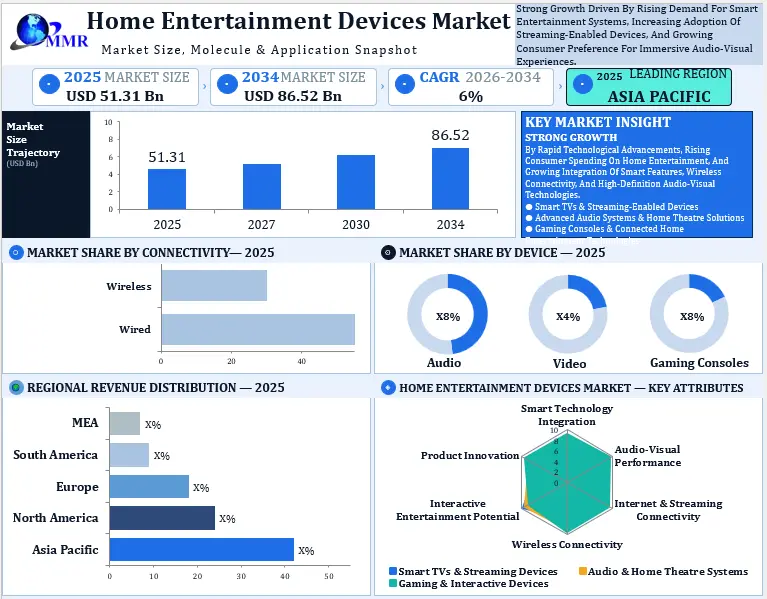
Home Entertainment Devices Market is expected to grow at a CAGR of 6% during the forecast period and Market is expected to reach USD 86.52 Bn. by 2034.
The report covers the detailed analysis of the Global Home Entertainment Devices industry with the classifications of the market on the basis of Device Type, Connectivity, Distribution Channel, and region. Analysis of past market dynamics from 2020 to 2025 is given in the report, which will help readers to benchmark the past trends with current market scenarios with the key player's contribution in it.
Home Entertainment Devices Market Definition
A specific product category of consumer goods, which includes Televisions, Sound Systems, DVD players, and game consoles, among many others, is the home entertainment segment.The home entertainment systems were designed for experiencing the movie theater experience by sitting at home, using the high-resolution audio and video equipment. These devices are becoming one of the important parts of every household, with the rising standard of lifestyle and increased disposable income by people, worldwide.
Home entertainment devices are increasingly integrated with smart home ecosystems, allowing users to connect televisions, speakers, gaming systems, and streaming platforms through a unified digital environment. Features such as voice control, wireless connectivity, and compatibility with online content services are influencing product development and consumer preferences. Manufacturers are focusing on improving device interoperability, user-friendly interfaces, and personalized entertainment experiences.
The market is also shaped by rapid advancements in display technology, audio engineering, and gaming hardware. Developments such as 4K and 8K resolution, OLED and QLED displays, immersive surround sound, and cloud gaming are encouraging product upgrades and expanding consumer choices. In addition, e-commerce platforms and direct-to-consumer sales channels are improving product accessibility, while competition among brands is driving innovation, affordability, and greater product variety.
Home Entertainment Devices Market Size, Growth & Share Analysis
To know about the Research Methodology :- Request Free Sample Report
Home Entertainment Devices Market Dynamics
Modernization and Rising Preferences for New Technologies
As per the United Nation Organization, today almost 55% of the world population resides in urban areas and is expected that this share would increase to about 68% by the year 2050. With such a tremendous, shift towards urbanization, the preferences of people and the developing economies play a huge part in working for the development of the urban areas. The increased urbanization in turn paves the way for modernization and rise in disposable income. These factors altogether are responsible for the rising demand for luxury products. Moreover, the young generation is comparatively more attracted to such devices, due to the enhanced features that the devices come with. The major attractive features could include the wireless device functions, smart technologies build into the devices, and so on.
Shift of Consumers towards Smart Technology and Alternative Platforms
With the rising trend of smartphones, consumers are more in the favor of the devices, because they are handy and can be used anytime and anywhere. Also, the smartphone is capable of doing all the things through a single device, unlike the different home entertainment devices. Hence, it is been observed that the high use of smartphones in a way is reducing the usage of televisions and other home entertainment devices, and this, in turn, could restrain the market for the same, over the forecast period.
Home Entertainment Devices Market Segment Analysis
The market is divided into 3 major segments and further into sub-segments to forecast the market size by value.
Based on Device, The video devices segment held the largest market share of about 85%, in the year 2025, and it is expected that it would continue being dominant in the market, during the forecast period. This substantial growth of the segment could be attributed to the customer preferences for televisions as the prime choice for home entertainment. Furthermore, the development of smart devices, which enable wireless connections and allow access to the internet are other major factors that are contributing significantly to the growth of the segment.
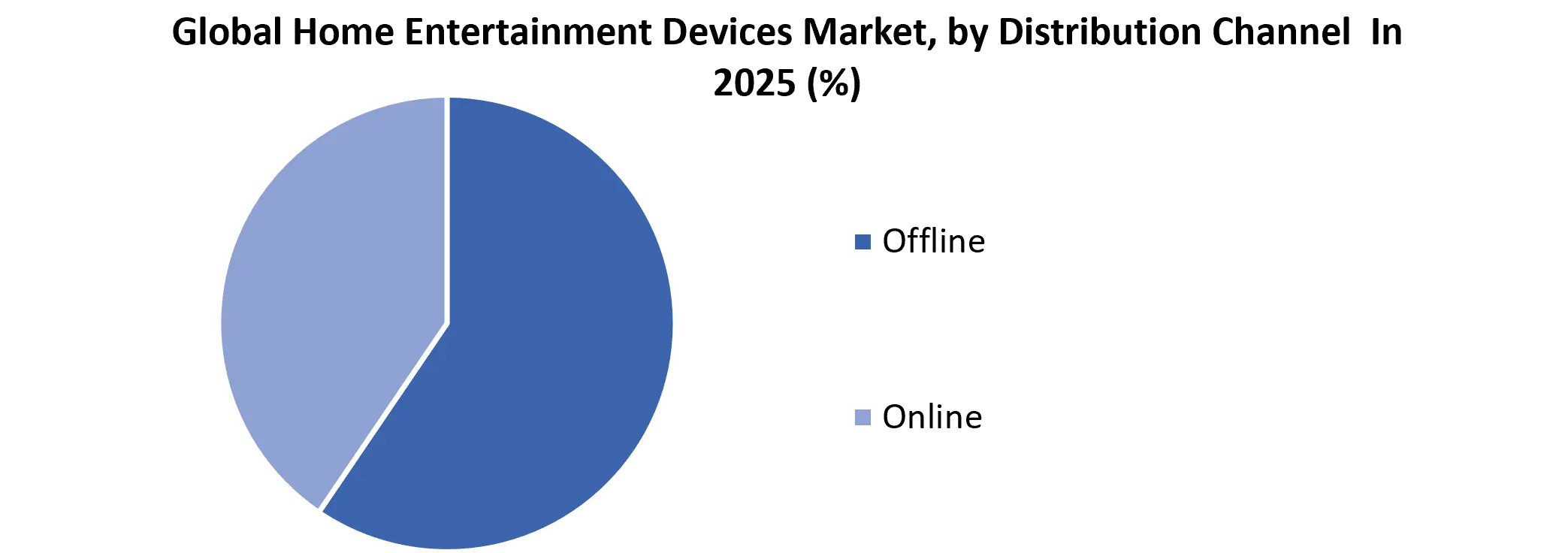
On the basis of distribution Channel, The Offline Segment is expected to Account for the Largest Market Share during the Forecast Period.In 2025, the offline segment attributed for a market share of almost 72% for the Home Entertainment Devices, and it is expected to continue over the forecast period; thanks to the consumer’s preferences of purchasing such luxury goods from retail stores than through online sites.
Home Entertainment Devices Market Regional Insights
Asia Pacific is expected to account for the Largest Market Share during the Forecast Period.
It is expected that Asia Pacific region would account for the highest market share for the Home Entertainment Devices, during the forecast period. The highest market share of the region could be attributed to the rising penetration of internet and urbanization rate of the region, which in turn increases the disposable income of people there. Moreover, it is observed that the people are spending a much higher part of their in the luxurious goods, with their rising expenditures.
North America represents a significant market, supported by high consumer spending on advanced electronics, widespread streaming adoption, and established gaming markets. The United States is a major contributor to regional demand for smart televisions, premium audio systems, gaming consoles, and connected entertainment devices. Frequent technology upgrades and consumer interest in immersive home entertainment experiences further support market development.
Europe maintains a strong presence in the Home Entertainment Devices Market due to established consumer electronics distribution networks and demand for premium entertainment technologies. Germany, the United Kingdom, France, and Italy are important markets for smart televisions, wireless speakers, home theatre systems, and gaming devices. Consumer interest in energy-efficient products, high-quality audio and video, and integrated smart home technologies contributes to regional demand.
South America offers growth opportunities as internet access, e-commerce, and digital entertainment adoption expand. Brazil and Argentina are key markets, with consumers showing demand for smart televisions, streaming devices, gaming consoles, and affordable audio systems. However, import costs, currency fluctuations, and differences in purchasing power can influence product pricing and market penetration.
The Middle East and Africa market is supported by increasing digital connectivity, urbanization, and demand for modern consumer electronics. The United Arab Emirates, Saudi Arabia, and South Africa are important markets for televisions, home audio systems, and connected entertainment devices. Growth in online retail, expanding distribution networks, and investment in residential infrastructure may create further opportunities, although affordability and uneven access to technology remain challenges.
The objective of the report is to present a comprehensive analysis of the Global Home Entertainment Devices Market to the stakeholders in the industry. The past and current status of the industry with forecasted market size and trends are presented in the report with the analysis of complicated data in simple language.
The report covers all the aspects of the industry with a dedicated study of key players that includes market leaders, followers, and new entrants. PORTER, SVOR, PESTEL analysis with the potential impact of micro-economic factors of the market has been presented in the report. External as well as internal factors that are supposed to affect the business positively or negatively have been analyzed, which will give a clear futuristic view of the industry to the decision-makers.
The report also helps in understanding Global Home Entertainment Devices Market dynamics, structure by analyzing the market segments and projects the Global Home Entertainment Devices Market size. Clear representation of competitive analysis of key players by product, price, financial position, product portfolio, growth strategies, and regional presence in the Global Home Entertainment Devices Market make the report investor’s guide.
Home Entertainment Devices Market Competitive Insights
The report has profiled around eighteen key players in the market from different regions. However, the report has considered all market leaders, followers, and new entrants with investors while analyzing the market and estimating the size of the same. The manufacturing environment in each region is different and focus is given on the regional impact on the cost of manufacturing, supply chain, availability of raw materials, labor cost, availability of advanced technology, trusted vendors are analyzed and the report has come up with recommendations for a future hot spot in the Asia Pacific region.
The top leaders in the Home Entertainment Devices market include Sony Corporation, Xiaomi Corporation, Panasonic Corporation, Microsoft Corporation, Apple Inc., Bose Corporation, Haier Inc., Samsung Electronics Co. Ltd, among many others.
As per the study, Xiaomi stands to be the most popular brand in the Asia Pacific region, and Samsung follows it as the next most accepted brand by the people, for home entertainment devices, across the region. Considering the share worldwide, the South Korean company Samsung Electronics was a market leader, until previous year, owning almost 18% share in the market. LG Electronics, another multinational electronics company reported its global revenue of around US $13 billion in the year 2029 (Home Entertainment Segment), out of which, company’s 80% revenue was attributed from the most populous areas of Asia, Europe, North America, and South Korea.
Global Home Entertainment Devices Market Recent Developments:
| Date | Company | Development | Impact |
| 03 January 2026 | LG Electronics | LG Electronics announced its expanded 2026 xboom speaker lineup, featuring four new models (Stage 501, Blast, Mini, and Rock) equipped with AI-driven voice suppression and audio personalization. | The launch enhances LG's market presence in smart home audio and portable party sound systems with military-grade durability and AI integration. |
| 06 January 2026 | Samsung Electronics | Samsung Electronics unveiled the world’s first 130-inch Micro RGB TV (R95H model) at CES 2026, featuring the NQ8 AI Gen4 processor and new HDR10+ ADVANCED support. | The flagship release sets a new benchmark in ultra-large luxury home display and home theater entertainment tech. |
| 20 January 2026 | Sony Group Corporation | Sony Group Corporation announced a joint venture agreement with TCL Technology concerning its flagship Bravia TV display business. | The strategic partnership optimizes global manufacturing scale and supply chain efficiency for premium home entertainment hardware. |
| 31 March 2026 | Xiaomi Corporation | Xiaomi Corporation launched its 2nd Generation Xiaomi TV Stick HD, integrated with a faster processor and high-dynamic-range HDR10+ playback support. | The product release expands Xiaomi's footprint in low-cost high-definition home streaming media adapters globally. |
| 30 September 2026 | Amazon.com, Inc. | Amazon officially launched the updated Fire TV Stick 4K (2026 model) along with an upgraded, AI-integrated Fire TV Voice Remote. | The deployment accelerates processing speeds and voice navigation across Amazon's smart home streaming ecosystem. |
Home Entertainment Devices Market Scope: Inquire before Buying
| Global Home Entertainment Devices Market | ||||
|---|---|---|---|---|
| Base Year | 2025 | Forecast Period | 2026-2034 | |
| Historical Data | CAGR | Market Size in 2025 | Market Size in 2034 | |
| 2020 to 2025 | 6% | US$ 51.31 Bn | US$ 86.52 Bn | |
| Segments Covered | ||||
| by Device Audio Video Gaming Consoles |
by Connectivity Wired Wireless |
by Distribution Channel Online Offline |
||
| Regions Covered | ||||
| North America United States Canada Mexico |
Europe UK France Germany Italy Spain Sweden Austria Rest of Europe |
Asia Pacific China S Korea Japan India Australia Indonesia Malaysia Vietnam Taiwan Bangladesh Pakistan Rest of APAC |
Middle East and Africa South Africa GCC Egypt Nigeria Rest of ME&A |
South America Brazil Argentina Rest of South America |
Home Entertainment Devices Market Key Players Covered –
1. Samsung Electronics Co., Ltd.
2. Sony Corporation
3. LG Electronics Inc.
4. Panasonic Corporation
5. Microsoft Corporation
6. Apple Inc.
7. Bose Corporation
8. Koninklijke Philips N.V.
9. Mitsubishi Electric Corporation
10. Sennheiser Electronic GmbH & Co. KG
11. Haier Group Corporation
12. TCL Technology Group Corporation
13. Hisense Group
14. Xiaomi Corporation
15. Roku, Inc.
16. Harman International Industries, Inc.
17. Yamaha Corporation
18. Sharp Corporation
19. Toshiba Corporation
20. Sonos, Inc.
21. Google LLC
22. Amazon.com, Inc.
23. Nintendo Co., Ltd.
24. VIZIO, Inc.
25. BenQ Corporation
26. Hitachi, Ltd.
27. Skyworth Group Limited
28. Sound United, LLC
29. Savant Systems, Inc.
30. Bang & Olufsen A/S
31. Logitech International S.A.
32. Dolby Laboratories, Inc.
33. Pioneer Corporation
34. Denon
35. Marantz
36. Onkyo Corporation
37. JVC Kenwood Corporation
38. Bowers & Wilkins
39. XTZ Group AB
40. INSIGNIA SYSTEMS
Frequently Asked questions
1. What is the market size of the Market in 2025?
Ans. The market size Market in 2025 was USD 51.31 Billion.
2. What are the different segments of the Market?
Ans. The Global Market is divided into Device, Connectivity and Distribution Channel.
3. What is the study period of this market?
Ans. The Market will be studied from 2020 to 2034.
4. Which region is expected to hold the highest Market share?
Ans. The Asia Pacific dominates the market share in the market.
5. What is the Forecast Period of Market?
Ans. The Forecast Period of the market is 2026-2034 in the market.