
Holographic Display Market Size by Product, Component, Technology, Application, Region – Segment-Level Market Assessment, Growth Opportunity Analysis, Competitive Mapping & Forecast to 2032
Overview
Global Holographic Display Market size was valued at USD 14.07 Bn in 2025 and is expected to reach USD 95.14 Bn by 2032, at a CAGR of 31.4 %.
Holographic Display Market Overview
Holographic Display are a kind of technology that aim to create immersive and realistic three-dimensional (3D) visual experiences. Holography is a method that records and duplicates the interference patterns of light waves and underlying holographic Display. These interference patterns involve information about the direction and intensity of light, allowing the recreation of 3D images that have been viewed from different angles. This technique includes reflecting an image or video onto a transparent surface. Holographic Display have a wide range of applications. For Instance, in entertainment, they have been revolutionizing gaming experiences, allowing players to interact with virtual objects in 3D space.
Holographic Display have been enhancing the visualization of complex anatomical structures, in medical imaging. To create more realistic prototypes, they have also been utilized in design and visualization applications. The market report focuses on the drivers, challenges and major restraints of the Holographic Display industry. The report contains a comprehensive analysis of the global Holographic Display market's trends, forecasts, and monetary values. The bottom-up approach was used in the report for the estimation of the Holographic Display market size. The qualitative and quantitative methods are included in the report for the analysis of the data of the market.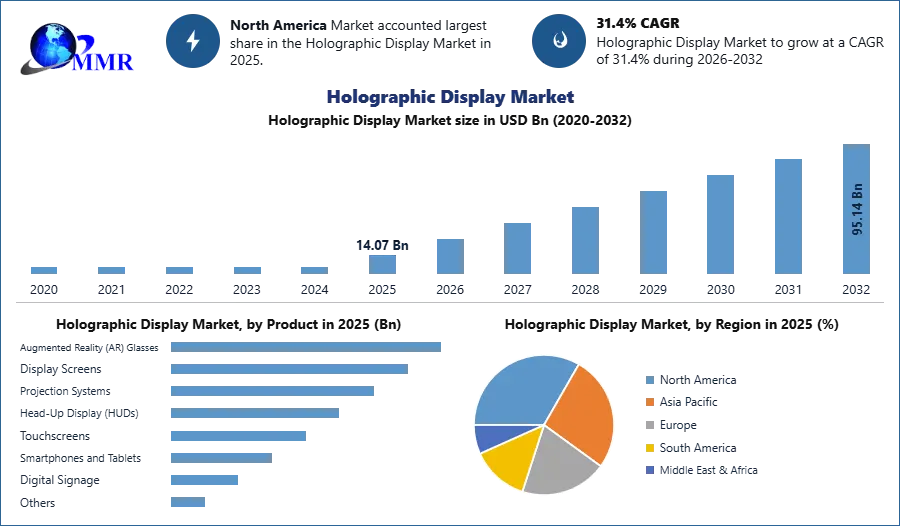 To know about the Research Methodology :- Request Free Sample Report
Holographic Display Market Dynamics
Drivers
Increasing Demand for Enhanced Visualization to Boost Market Growth
Holographic Displays offer a more realistic and immersive visual experience as compared to traditional 2D Display. They establish the illusion of depth, allowing viewers to realize images or videos as if they are floating in space. This heightened sense of immersion and realism enhances the overall visual experience, making holographic Displays highly desirable in various industries. The captivating nature of holographic Display attracts and holds the viewer’s attention. The dynamic and interactive nature of 3D holographic content has a higher potential to employ and captivate audiences. This assurance is especially valuable in advertising, where marketers aim to create impactful experiences. Advertisers have been effectively capturing the attention of consumers and delivering their messages in a more constraining manner by leveraging holographic Display.
Holographic Display have the potential to enhance comprehension and communication of complex information which drive the Holographic Display Market growth. In fields including medical imaging, design, and engineering, visualizing 3D objects and structures in a more realistic and interactive way has been significantly improving understanding. Surgeons, for instance, have benefited from holographic Display to visualize detailed 3D representations of patient scans, resulting in better surgical planning and training.
Holographic Display provide new possibilities for user interfaces and interactions. With advancements in gesture recognition and tracking technologies, users have been interacting with holographic content using gestures and movements, creating a more intuitive user experience. This creates lucrative opportunities for innovative applications in gaming, augmented reality, virtual reality and other fields where immersive interfaces are valued and boosts the Holographic Display Market growth.
Advancements in Holographic Technology to fuel Market Growth
Holographic Display provide a more immersive as well as realistic visual experience Compared to traditional 2D Display. The increasing advancements in holographic technology resulted in increased resolution, improved image quality and enhanced depth perception, ensuring more lifelike and compelling visual presentations. This has created an increasing demand for holographic Displays in several industries including entertainment, advertising and gaming.
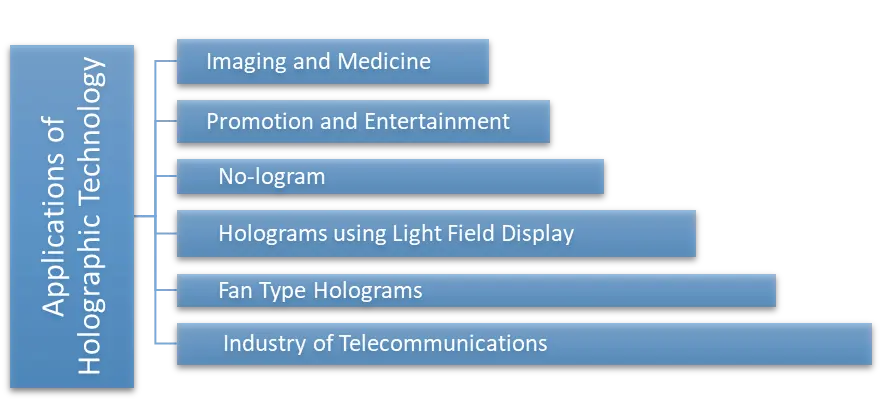
The range of applications for holographic displays has significantly expanded, with advancements in holographic technology. Holographic Displays are being used in teleconferencing, medical imaging, product visualization, virtual reality and automotive display areas. These emerging applications have created new market opportunities and increased the overall holographic display demand, which fuels the Holographic Display Market growth.
The continuous development of holographic technology has resulted in significant innovations in display hardware and software. This involves advancements in holographic projection techniques, holographic materials and image rendering algorithms. Holographic Displays are becoming more cost-effective for commercial uses due to these advancements' lighter, smaller and more energy-efficient designs. As the technology improves, the cost of production reduces and this makes holographic Displays more utilizable to consumers and industries.
The rising interest in holographic technology has admirable significant investments from the public as well as private sectors. Companies with holographic Display specializing are partnering with technology content developers, giants and display manufacturers to stimulate research and development efforts. These collaborations encourage technological advancements and boost the commercialization of holographic Display leading to driving the Holographic Display Market growth.
Holographic Display Market Trends
Growing Adoption in Retail and Advertising
Holographic Displays provide a unique and eye-catching visual experience that attracts customers. The three-dimensional and interactive nature of holographic Displays creates a sense of intrigue and novelty, making them highly effective in appealing to potential buyers. In the retail and advertising sectors, where standing out and creating enormous experiences is essential, holographic Displays offer a competitive advantage. Holographic Display enables retailers and advertisers to provide more engaging and interactive experiences to their customers and leading to growing the Holographic Display Market growth in recent years.
These Displays showcase products in a lifelike manner, allowing customers to view them from several angles and interact with virtual models. This interactivity raises customer engagement and creates a higher connection with the brand or product, ultimately resulting in brand loyalty and increased sales. Holographic Displays provide a powerful tool for visualizing products in a realistic and immersive manner. Retailers have been using holographic Display to showcase products that are critical to display physically, including large or complex items. Holographic Display allow customers to see detailed 3D representations of products and explore customization options, offering a superior understanding of the product and its advantages.
Holographic Display have been aiding virtual try-on experiences, especially in the fashion and beauty industries. Customers have been virtually trying on accessories, clothing, or makeup by overlaying virtual representations onto their own images captured by cameras. This implements customers to see how products look on them without physically trying them on, improving personalization and convenience and helping to grow the Holographic Display industry.
Holographic Display Market Restraints
High Costs to Restrain the Holographic Display Market Growth
Holographic display technology is less accessible due to its expensive cost, especially for small and medium-sized organizations with limited budgets. Holographic display production, development, and implementation required a substantial upfront expenditure, including costs for research and development, process of manufacturing, and distribution networks. Higher costs make it challenging for businesses to justify the investment and have led to slower adoption rates. The higher upfront costs of holographic Displays has been resulting in longer payback periods and lower returns on investment.
Businesses require to consider the potential benefits and revenue generation that holographic Displays have provided including improved brand recognition, increased customer engagement and higher sales. However, the uncertainty surrounding the market demand and the ability to invent holographic display investments has been making businesses averse to investing in this technology. As a result, High Costs are the major factor that restrains the Holographic Display Market growth.
Holographic Display Market Segment Analysis
Based on Product, the market is categorized into Augmented Reality (AR) Glasses, Display Screens, Touchscreens, and Projection Systems, Head-Up Display (HUDs), Smartphones and Tablets, Digital Signage and Others. Augmented Reality (AR) Glasses held the largest Holographic Display Market share in 2022. AR glasses with holographic Display overlay digital information seamlessly onto the real world by projecting 3D holograms directly into the user's field of view, accomplishing a more interactive user experience. AR applications have been used to transform several industries such as gaming, education, healthcare, manufacturing and others. AR glasses with holographic Displays provide a compelling platform for delivering these AR experiences, resulting in increased demand for such devices. Holographic display technologies have advancements, enabling the development of compact and lightweight AR glasses.
These glasses have been offered high-resolution holographic imagery with a wide field of view, making them suitable and preferable for everyday use and extended wear. The increasing advancements in display panels, optics and tracking systems have led to the development of more sophisticated AR glasses with holographic Displays. Major technology companies, such as Magic Leap, Microsoft with its HoloLens and other players, have highly invested in the development of AR glasses with holographic Display. These companies have enthusiastic research and development teams working on advancing the technology and bearing more capable as well as affordable AR glasses to the market. The industry's focus on AR glasses with holographic Display led to drive the Holographic Display Market growth.
Based on Technology, the market is segmented into the Electro-Holography, Photopolymer Holography, Hybrid Technique, Transmission Technique, Pepper's Ghost Technique and Reflection Technique. Electro-Holography is expected to have the highest CAGR for the Holographic Display Market during the forecast period. Electro-Holography enables real-time interactivity, allowing users to interact with holographic objects or data. This technology has been updated with holographic images at a high frame rate, making it preferable for applications including virtual prototyping and interactive presentations. This technology supports full-color holographic Display, providing a vibrant and realistic visual experience.
It has been accurately reproducing the colors of the virtual objects and scenes, to enhance the immersion and quality of the holographic display. Electro-Holography have been achieve high-resolution holographic Display, providing fine details as well as clarity in holographic imagery. This is crucial for applications needing precise visualization including engineering design, medical imaging and architectural visualization. Electro-Holography is scalable, allowing for the creation of holographic Display in several sizes and formats. It has been implemented in small devices such as smartphones or scaled up to larger Display for entertainment, advertising and public installations and boosts the Holographic Display Market growth.
Holographic Display Market Regional Insights
North America dominated the largest Holographic Display Market share in 2022 and is expected to continue its dominance over the forecast period. The region has a robust ecosystem of technology companies, research institutions, and start-ups that boosts advancements in holographic display technology. These advancements involve improved image quality, higher resolution, enhanced brightness and more seamless integration with other technologies. Technological progress continues to push the boundaries of holographic Display, making them more preferable and practical for several applications.
The region has an advanced entertainment and media industry such as film, television, gaming and live events. Holographic Display provide immersive and engaging experiences that align well with the innovative content delivery demand. Holographic Display are used for various applications including virtual reality experiences, live concerts, gaming events and theatrical performances. The increasing interest in augmented reality (AR) and virtual reality (VR) technologies in the entertainment industry resulted to increase adoption of Holographic Display which drive the Holographic Display Market growth.
North America has a vibrant retail and advertising sector that envelops innovative display technologies. Holographic Display are increasingly utilized in retail environments for product demonstrations, and engaging customer experiences. Advertisers leverage holographic Display to create captivating advertising campaigns. The ability of holographic Display to attract attention and enhance brand engagement makes them a preferable tool in the advertising landscape and competitive retail. The US is the major contributor to the regional Holographic Display Market growth. The healthcare industry is a significant driver of holographic display adoption.
Holographic Display are utilized in medical imaging, surgical planning and educational applications. Surgeons and medical professionals have been visualizing complex anatomical structures and medical data in a more immersive manner, improving the care of patients and surgical outcomes. The demand for advanced visualization technologies in healthcare contributes to the growth of holographic Display. According to Maximize Market Research, The increase in the use of Holographic Display in medical imaging contributes to the Holographic Display Market growth. Since, as the increase in the Medical Imaging market drives the Holographic Display industry in the U.S.
Holographic Display Market Competitive Landscape
The Competitive Landscape of the Holographic Display market covers the number of key companies, company size, their strengths, weaknesses, barriers and threats. It also focuses on potential, new market entrants, customers, suppliers and substitute services that boost the profitability of Holographic Display companies. The global Holographic Display markets include several market players at the country, regional and global levels. Some of the key players are Av Concepts, Inc (US) , EON Reality. (US), Holoxica Ltd (UK) , Konica Minolta,Inc. (Japan), Qualcomm Technologies, Inc. (US), Provision Holding, Inc. (US), RealView Imaging Ltd. (Israel), ViewSonic Corporation. (US), Looking Glass Factory (US), Light Field Lab (US), Holoxica Ltd. (UK) and HoloTech Switzerland AG (Switzerland) and Others.
Many companies conducted research and development activities regarding Holographic Display. Holoxica Ltd (UK): The company develops the HoloViewer App which is real-time holographic visualisation. For Instance, Medical Specialists: People, medical students and patients alike, understand information much more enhanced and quicker when presented in visual 3D than verbally or in 2D. 3D medical visualization resulted in a faster understanding of medical issues by 40 to 75%. Holographic imagery technology provides medical professionals with a complete vocabulary of a disease or procedure.
Holographic Display Market Recent Industry Developments (2025–2026)
| Exact Date | Company | Development | Impact |
|---|---|---|---|
| 18 February 2026 | Looking Glass Factory | Introduced the Hololuminescent Display (HLD) platform, manufactured by faytech, featuring a light-field optical stack in a form factor less than 1 inch thick. | The product enables glasses-free 3D digital signage in retail environments, allowing multiple viewers to interact with holographic AI characters simultaneously. |
| 05 January 2025 | Hyundai Mobis | Unveiled its Holographic Windshield Display technology at CES 2025, projecting driving instructions and personalized data directly onto the glass. | This development accelerates the transition to screenless automotive interiors by replacing physical instrument clusters with immersive holographic interfaces. |
| 25 March 2025 | VividQ | Collaborated with Activision Blizzard to launch a world-first 3D holographic gaming experience featuring the Call of Duty franchise. | The partnership demonstrates the commercial viability of computer-generated holography in high-performance consumer gaming applications. |
| 01 August 2025 | HYPERVSN | Launched the World's Largest Retail Hologram installation in Times Square, utilizing its proprietary SmartV Wall technology. | This large-scale deployment sets a new benchmark for holographic advertising and digital out-of-home (DOOH) media engagement. |
| 03 December 2025 | Avatar Medical & Barco | Launched Eonis Vision, a joint solution designed to evolve exam room imaging through medical holographic displays. | The launch enhances surgical planning and patient consultation by providing doctors with high-fidelity, interactive 3D anatomical models. |
| 17 January 2025 | VividQ | Filed a key patent for a new holographic display system (Publication ID: GB-202500661-D0) focused on compact light manipulation. | This R&D milestone secures critical intellectual property for next-generation AR/VR devices requiring high-resolution diffraction-based imaging. |
Holographic Display Market Scope : Inquire Before Buying
| Holographic Display Market | |||
|---|---|---|---|
| Report Coverage | Details | ||
| Base Year: | 2025 | Forecast Period: | 2026-2032 |
| Historical Data: | 2020 to 2025 | Market Size in 2025: | 14.07 USD Bn |
| Forecast Period 2026-2032 CAGR: | 31.4% | Market Size in 2032: | 95.14 USD Bn |
| Segments Covered: | by Product | Augmented Reality (AR) Glasses Display Screens Projection Systems Head-Up Display (HUDs) Touchscreens Smartphones and Tablets Digital Signage Others |
|
| by Component | Light Source Spatial Light Modulator (SLM) Optics Holographic Film or Plate Others |
||
| by Technology | Electro-Holography Photopolymer Holography Hybrid Technique Transmission Technique Pepper's Ghost Technique Reflection Technique |
||
| by Application | Medical Imaging Consumer Electronics Automotive Retail and Advertising Aerospace and Defense Entertainment and Events Others |
||
Holographic Display Market, by Region
North America (United States, Canada and Mexico)
Europe (UK, France, Germany, Italy, Spain, Sweden, Austria and Rest of Europe)
Asia Pacific (China, South Korea, Japan, India, Australia, Indonesia, Malaysia, Vietnam, Taiwan, Bangladesh, Pakistan and Rest of APAC)
Middle East and Africa (South Africa, GCC, Egypt, Nigeria and Rest of ME&A)
South America (Brazil, Argentina Rest of South America)
Holographic Display Market, Key Players are
1. Av Concepts, Inc (US)
2. EON Reality. (US)
3. Holoxica Ltd (UK)
4. Konica Minolta,Inc. (Japan)
5. Qualcomm Technologies, Inc. (US)
6. Provision Holding, Inc. (US)
7. RealView Imaging Ltd. (Israel)
8. ViewSonic Corporation. (US)
9. Looking Glass Factory (US)
10. Light Field Lab (US)
11. Holoxica Ltd. (UK)
12. HoloTech Switzerland AG (Switzerland)
13. RealView Imaging Ltd. (Israel)
14. Eon Reality (US)
15. Voxon Photonics (Australia)
16. Displair (Russia)
17. Leia Inc. (US)
18. HoloCap Technologies (US)
19. The Coretec Group Inc. (US)
20. Zebra Imaging (US)