
Higher Education Market Size – Industry Structure Evaluation, Demand Drivers Analysis, Regional Growth Analysis and Identification, Competitive Positioning Review & Global Market Size Forecast to 2032
Overview
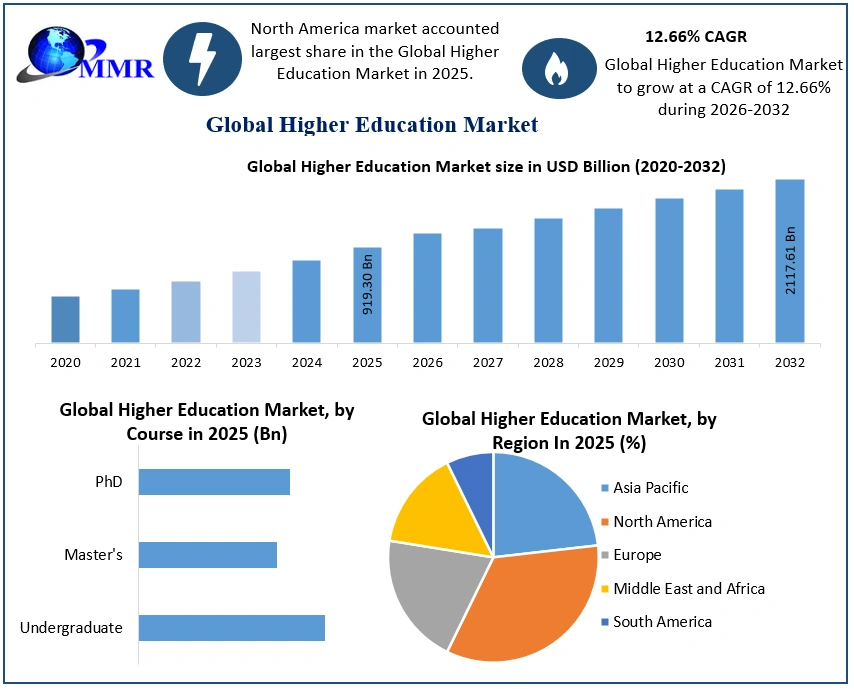
The Higher Education Market size was valued at USD 919.30 Billion in 2025 and the total Higher Education revenue is expected to grow at a CAGR of 12.66% from 2025 to 2032, reaching nearly USD 2117.61 Billion by 2032.
Definition:
Higher education refers to the formal education that comes after secondary school. It consists of all post-secondary education, training, and research guidance at education. Higher education is provided in a variety of educational institutions, including universities, academies, colleges, seminaries, and institutes of technology, and at certain college-level institutions like vocational schools, trade schools, and other degree-granting institutions.
Global Higher Education Market Overview:
The global higher education market growth is driven by rising global populations and increasing awareness of the value of higher education, mainly in developing countries like China and India. The world is becoming increasingly interconnected, fostering international student mobility. Universities are actively attracting students to create a more diverse and competitive higher education market. The integration of technology like AI, big data, and online learning platforms is transforming the higher education sector. It has a central role in the economic, social and environmental development. The higher education sector has the responsibility of co-creating knowledge and innovations that allow progress in the sustainable development goals. The sector has the mission of educating citizens as social agents who can become leaders for sustainable development. Elements of higher education quality includes facilitating learning throughout life, and permitting and promoting diverse learning paths. Higher education is research and learning that supports climate action, decent work, gender equality, responsible citizenship, peace, and justice.
The availability of high-speed internet, growing usage of personal computing devices, and governments’ initiative towards digital learning are the key factors responsible for driving the growth of the higher education market. The competitive landscape of the global higher education market is undergoing a shift from a traditional, institution-centric model towards a more dynamic education sector. Many established institutions are forming partnerships with EdTech companies to enhance their online offerings and reach to stay competitive. It creates a more integrated learning ecosystem. Education technology companies are emerging as significant players and offering innovative online learning platforms, adaptive learning tools, and micro-credentials. The higher education report has covered the size and forecast growth rate by region in detailed with country market data like North America (US, Canada and Mexico), Europe (UK, Italy, Germany, France, Spain, Austria, Russia, and rest of Europe), Asia Pacific (China, India, Japan, South Korea, Australia and rest of APAC), Middle East & Africa (South Africa, GCC and rest of middle east and Africa) and South America (Brazil, Argentina and rest of South America).
To know about the Research Methodology :- Request Free Sample Report
Global Higher Education Market Dynamics:
Higher education systems experience a growing demand for enrollment that drive the market growth.
A strong surge in demand for enrollment in higher education systems worldwide is one of the key drivers in the global higher education market growth. A higher education degree is increasingly seen as essential for securing good jobs and career advancement in a globalized and knowledge-based economy. Higher education is valued for job skills and critical thinking, communication, and problem-solving abilities that benefit individuals throughout their lives.
The demand of employers for skilled and professional workers, increased importance in modern economies for research and development are some of the prominent factors, which are expected to drive the demand for higher education. In 2023, more than 40% of persons aged 25-34 years had completed higher education in Europe. In the same year, 84 % of persons aged 20-24 years had completed upper secondary level of education in Europe. The demographics are leading to a surge in the number of young adults seeking higher education mainly in UK, China, India and USA. A growing number of international students, particularly from India is one of the key drivers in the global higher education market.
The globalization of the internet has been a game-changer for access to higher education.
Top universities are offering online courses, programs, and full degrees through platforms like Coursera, EdX, and FutureLearn. It eliminates geographical barriers and makes top-tier education accessible to a wider audience. Online courses and programs make quality education more affordable for many learners, mainly who are able to afford the full cost of attending an admired university abroad. The internet offers a vast array of courses from universities worldwide. The internet offers a vast number of educational resources, from scholarly articles and online textbooks to educational videos and tutorials. It allows students to learn independently and supplement their studies. Online platforms enable remote learning, allowing students to participate in classes and programs offered by universities in other countries. The internet fosters collaboration between universities and researchers across the globe, which is expected to lead to richer learning experiences and innovative research projects. Growing demand for higher education is expected to put high pressure on limited fiscal resources and on existing systems.
Government initiatives play a vital role in propelling the growth of the higher education market.
Higher education is rapidly evolving and expected to become increasingly important for the development of low- and middle-income countries. Investing in higher education is expected to contribute to competitiveness in the market. Higher education is expected to make an important contribution to building a stronger society, ending extreme poverty, and boosting shared prosperity. The US Department of Education provides financial aid through grants and loans to students pursuing higher education. Federal work-study programs help students earn money to offset educational expenses. The Canadian government offers financial aid through loans and grants to make education more affordable. Each province has its own funding structures and programs for higher education. The UK government provides tuition fee loans that students repay after graduation when their income reaches a certain threshold. Government funding supports research activities within universities. National Education Policy ambitious plan aims to increase access and improve the quality of higher education in India. It emphasizes multidisciplinary learning, skill development, and research in India. The government is increasing funding for public universities to improve infrastructure and faculty development. The Indian government initiatives like SWAYAM and Unnat Bharat Abhiyan programs promote online learning platforms and connect universities with local communities to address local challenges. The government is allocating more resources to public universities to improve infrastructure, faculty development, and research facilities.
Technological Advancements in the higher education is expected to drive the market growth.
Technological advancements are considered a major key engine for growth in the higher education market. Educational technology (EdTech) encompasses various tools and platforms that enhance learning. It includes online learning platforms, virtual reality (VR) simulations for practical learning, and adaptive learning software that personalizes the learning experience. Technology allows universities to offer courses online or in a hybrid format, making education more accessible to students. The Interactive technologies like VR and gamification can make learning more engaging and immersive that is expected to lead to better knowledge retention and skill development. The technological advancements are transforming the higher education market by making it more accessible, engaging, and effective. Globalization of the internet has unlocked up new opportunities for individuals to increase their skillset from top-notch universities that are range across the globe. Individuals are opting for these courses as they are in line with the technological advancements that are happening all across the globe. It is expected to be one of the top factors that drive the adoption of higher education software adoption across institutions.
Global Higher Education Market Segment Overview:
By Course, the global higher education market is segmented into undergraduate, Master's and PhD. Undergraduate programs held the dominant position in 2025 and is projected to continue its dominance during the forecast period. Undergraduate programs have large pool of potential students. Undergraduate programs encompass a vast array of disciplines, including general studies options, catering to a broader range of interests and career paths. Undergraduate programs generally have lower tuition fees over postgraduate programs. It makes them a more affordable option for many students, especially those coming from families with limited financial resources. A growing trend of enrollment in postgraduate programs, particularly in fields like business, engineering, and computer science is one of the key drivers in the global higher education market.
By End User, the global higher education market is segmented into public universities, private universities and community colleges. Public universities are funded primarily by the government. They typically offer lower tuition fees compared to private institutions with a wider range of academic programs. Private universities are independent institutions funded primarily through tuition fees, donations, and endowments. They often have more flexibility in curriculum design and program offerings. Community colleges are two-year institutions that offer associate degrees and certificates in various vocational and technical fields, and general education programs. The public universities held the dominant position in the global higher education market and is projected to continue its dominance during the forecast period. Public universities offer a more affordable option for many students, particularly in countries where the government heavily subsidizes higher education. Public universities have a long history and established reputation, attracting a larger student body. They typically offer a broader range of academic programs catering to various interests and career paths. Private universities are experiencing growth, particularly in developing countries were public funding for higher education.
by Learning Mode, the global higher education market is segmented into Online Mode and Offline Mode. Online learning takes place through a virtual platform where students access course materials, participate in discussions, and complete assignments remotely using the internet. Online programs offer greater flexibility in terms of scheduling and location, allowing students to learn at their own pace and convenience. Online programs are expected affordable than traditional programs because of lower overhead costs for universities. Online segment is expected to grow at a more than 13% rate of CAGR during the forecast period. Improvements in online learning platforms, video conferencing tools, and interactive learning resources are making online education more engaging and effective. The COVID-19 pandemic has normalized online learning and increased the greater comfort level with online mode of education. Universities are expected to offer online platforms to reach a larger student body without significant infrastructure investment. Some online programs offer features that cater to individual learning styles and pace.
The Offline segment held the dominant position in 2025 with a share of more than 70% in the global higher education market. Offline mode allows for practical activities, labs, and in-person discussions that can be difficult to replicate entirely online. Physical classrooms foster social interaction, collaboration, and networking opportunities are expected to boost the market growth. The physical setting provides a more structured learning environment for some students who thrive on routine and scheduled in-person classes. High preference for traditional learning methods is a major factor driving the market growth of this segment. Less distraction, full attentiveness, and teachers can offer individual attention to students. The factors are contributing the global higher education market growth.

Global Higher Education Market Regional Insights:
North American region held the dominant share in the global higher education market with a 30 % share in 2025. North America is an education hub with the maximum number of institutions and universities globally. Increasing investments in educational technologies are driving the market growth. Governmental efforts to broaden the education landscape at the international level and bring your own devices concept among students as well as faculty on increase and driving the demand for higher education in the region. The presence of world-renowned universities like Harvard, MIT, and Stanford attracts a large number of international students, contributing to the North America higher education market's strength. North American universities are at the forefront of adopting new technologies like online learning platforms and Bring Your Own Device (BYOD) initiatives to enhance student engagement and cater to a wider audience. Significant public and private funding are directed towards research in North American universities, fostering a strong culture of innovation that benefits students and contributes to technological advancements across various fields.
Asia Pacific Higher Education Market Overview:
The Asia Pacific (APAC) region is projected to be leading region in the global higher education market. An increase in disposable incomes, presence of young population, and government investments are some of the prominent factors behind the higher education market growth. A growing recognition of the value of a university degree for career prospects and social mobility are expected to increase importance of higher education. Changes in economic and learning conditions also influence the desire and ability of young people to enrol in higher education. China and India countries have massive student populations and are experiencing significant growth in higher education enrollment. The governments are actively investing in expanding access and improving quality. Countries like Australia, Japan, and Singapore have established higher education systems that attract international students, which is contributing to the Asia Pacific higher education market growth.
India Higher Education Market Overview:
The Indian higher education market is experiencing significant growth, driven by a young population and increasing aspirations for higher qualifications. India has a young population, with over 550 million people under 25, which seen a large pool of potential students seeking higher education. There are around 43.3 million students enrolled in higher education, with female enrollment rising. The network of higher education institutions is vast, with over 50,734 colleges and 1,265 universities in 2024. The Indian government recognizes the importance of a robust higher education system and has launched several initiatives to improve access, quality, and employability of graduates.
The government encourages collaboration between public and private entities for setting up and managing higher education institutions. It allows for leveraging private sector expertise and resources to expand access and improve quality. India has the largest higher education system with over 58,000 higher education institutions. The total number of foreign students in Indian institutions are 40431 in 2023. India is attracting a growing number of international students, with an enrolling in undergraduate programs. Nepal sends the largest contingent (28%), followed by Afghanistan (7%), the United States (6%), Bangladesh (6%), the UAE (5%), and Bhutan (3%). In India, recently in June 2024, Maharashtra government has announced free higher education policy for higher education policy for girls. The initiative is taken with aim at promoting women’s education.

Global Higher Education Market Industry Recommendation:
Technology is playing an increasingly important role in higher education. Online learning platforms and other educational technologies are making it easier and more affordable for people to access higher education.
Industry Recommendation for Key Players Operating in the Global Higher Education Market.
Focus on online Learning: The demand for flexible learning options is growing across the globe. The higher education institutions have expected to focus on high-quality online learning to establish their well position in the higher education market.
Invest in educational technology: Educational technology is expected to assist to improve the quality of teaching and learning, and make higher education more accessible and affordable.
Develop partnerships with businesses and industries: Collaboration between higher education institutions and businesses are expected to assist to ensure that educational programs are aligned with the needs of the workforce.
Provide support services for students: Higher education institutions are expected to provide a range of support services to help students succeed, such as academic advising, career counselling, and mental health services.
MMR Global Higher Education Market Report Offers:
Higher Education Market Scope: Inquire before buying
| Global Higher Education Market | |||
|---|---|---|---|
| Report Coverage | Details | ||
| Base Year: | 2025 | Forecast Period: | 2026-2032 |
| Historical Data: | 2020 to 2025 | Market Size in 2025: | USD 919.30 Bn. |
| Forecast Period 2026 to 2032 CAGR: | 12.66% | Market Size in 2032: | USD 2117.61 Bn. |
| Segments Covered: | by Course | Undergraduate Master's PhD |
|
| by End User | Public Universities Private Universities Community Colleges |
||
| by Learning Mode | Online Mode Offline Mode |
||
Higher Education Market, by Region
North America (United States, Canada and Mexico)
Europe (UK, France, Germany, Italy, Spain, Sweden, Austria, Turkey, Russia and Rest of Europe)
Asia Pacific (China, India, Japan, South Korea, Australia, ASEAN and Rest of APAC)
Middle East and Africa (South Africa, GCC, Egypt, Nigeria and Rest of ME&A)
South America (Brazil, Argentina, Columbia and Rest of South America)
Leading Global Higher Education Market, Key Players:
1. California Institute of Technology
2. Columbia University
3. Imperial College London
4. Massachusetts Institute of Technology
5. Peking University
6. Stanford University
7. Tsinghua University
8. The President and Fellows of Harvard College
9. The Trustees of Princeton University
10. The University of Tokyo
11. University of Cape Town
12. University College London, UCL
13. University of Oxford
14. University of the Andes
15. University of Pennsylvania
16. Yale University
17. Adtalem Global Education
18. Apollo Education Group
19. Arizona State University
20. Bridgepoint Education
21. Capella University
22. City University of New York
23. DeVry University
24. Grand Canyon University
25. Laureate Education
26. Purdue University Global
FAQs:
1. What are the growth drivers for the Global Higher Education market?
Ans. Rising Student Enrollments, E-learning and Online Programs, Tech Integration are some of the major factors driving the Global Higher Education market.
2. What are the factors restraining the global Higher Education market growth during the forecast period?
Ans. Limited access and affordability, Concerns about the value proposition, Data privacy concerns are expected to be the major factors restraining the global Higher Education market growth during the forecast period.
3. Which region is expected to lead the global Higher Education market during the forecast period?
Ans. Asia Pacific is expected to lead the global Higher Education market during the forecast period.
4. What is the projected market size and growth rate of the Global Higher Education Market?
Ans. The Higher Education Market size was valued at USD 919.30 Billion in 2025 and the total Higher Education revenue is expected to grow at a CAGR of 12.66% from 2025 to 2032, reaching nearly USD 2117.61 Billion by 2032.
5. What segments are covered in the Global Higher Education Market report?
Ans. The segments covered in the Global Higher Education market report are Course, Distribution Channel, End User and Region.