
Global Healthcare Artificial Intelligence Market by Component, by Application, by End-user, by Region and Forecast 2034
Overview
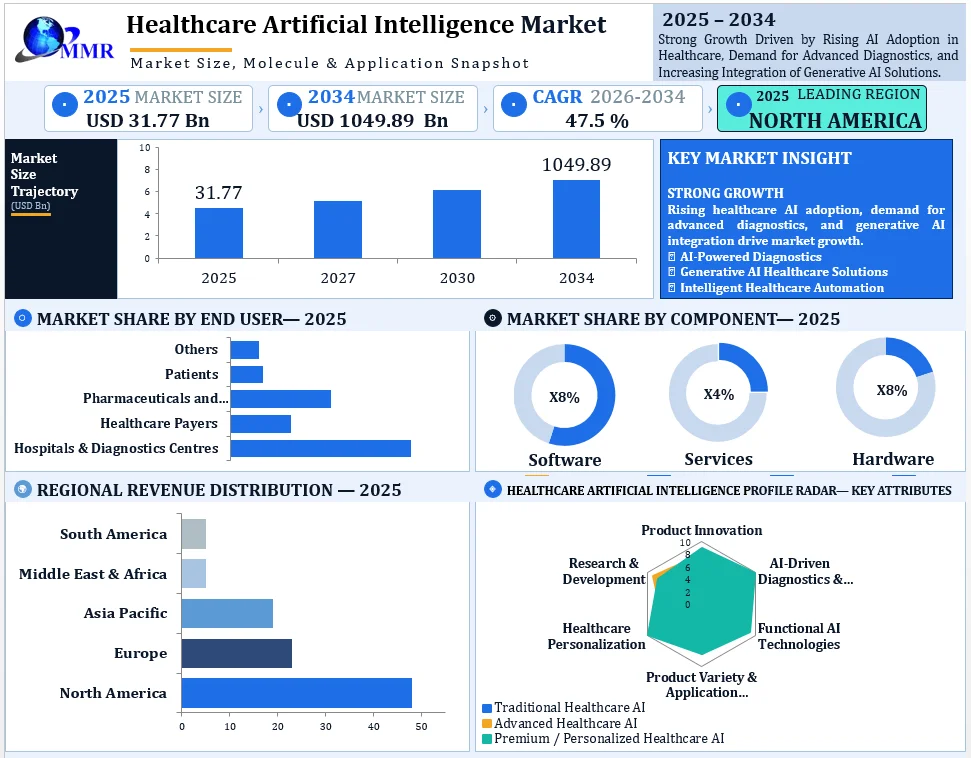
The Global Healthcare Artificial Intelligence Market size was valued at USD 31.77 Billion in 2025 and the total Healthcare Artificial Intelligence revenue is expected to grow at a CAGR of 47.5 % from 2026 to 2034, reaching USD 1049.89 Billion by 2034.
Global Healthcare Artificial Intelligence Market Overview
The Global Healthcare Artificial Intelligence (AI) Market comprises the development, commercialization, adoption, and integration of artificial intelligence technologies across healthcare services, medical devices, pharmaceutical research, diagnostics, and hospital management. The market includes AI-powered software, machine learning algorithms, deep learning systems, natural language processing (NLP), generative AI, predictive analytics, computer vision, and intelligent automation solutions that analyze complex healthcare data to support clinical decision-making and improve operational efficiency. According to the U.S. Food and Drug Administration (FDA), AI systems generate predictions, recommendations, or decisions based on defined objectives, while healthcare applications extend across medical imaging, disease detection, clinical decision support, patient monitoring, and AI-enabled medical products.
The Global Healthcare Artificial Intelligence Market evolves through the increasing adoption of digital health technologies, growing healthcare data volumes, rising demand for precision medicine, and the need to improve clinical and administrative workflows. AI-powered healthcare platforms enable faster medical image analysis, early disease detection, predictive healthcare analytics, treatment planning, and patient risk stratification.
Healthcare Artificial Intelligence is application of artificial intelligence technologies in the field of healthcare to enhance and optimize various aspects of patient care, diagnostics, treatment plans, and overall healthcare management. AI in healthcare involves using algorithms, machine learning, and computer-based systems to perform tasks that traditionally require human intelligence. AI is employed in interpreting medical images such as X-rays, MRIs, and CT scans. It helps in the early detection and diagnosis of diseases, providing insights to healthcare professionals for more accurate and timely treatment decisions. AI accelerates the drug discovery process by analyzing biological data, identifying potential drug candidates, and predicting their efficacy. This contributes to more efficient and cost-effective drug development.
Global Healthcare Artificial Intelligence Market Growth Outlook
To know about the Research Methodology:-Request Free Sample Report
The healthcare artificial intelligence market has witnessed significant growth in recent years, driven by the increasing adoption of Artificial Intelligence technologies across various healthcare applications. AI is revolutionizing healthcare by enhancing diagnostic accuracy, improving treatment outcomes, and optimizing operational efficiency. The global healthcare AI market has experienced substantial growth and is expected to grow continuously. Factors such as the rising demand for advanced healthcare solutions, the increasing prevalence of chronic diseases, and the need for efficient healthcare delivery contribute to market growth. The healthcare Artificial Intelligence market dynamic growth in regions such as North America, Europe, Asia-Pacific, and Latin America helps to grow the market. North America, particularly the United States, has been a significant contributor to market revenue, followed by Europe and Asia-Pacific. The healthcare Artificial Intelligence market is expected to witness continuous growth with ongoing technological advancements, increased research and development activities, and collaborations between healthcare and technology companies. The integration of AI into various healthcare applications is likely to redefine patient care and healthcare delivery models globally.
Healthcare Artificial Intelligence Market Dynamics
Global Healthcare Artificial Intelligence Market Drivers
• Increasing Demand for AI-Powered Diagnostics and Early Disease Detection: The growing need for faster and more accurate disease diagnosis drives the adoption of artificial intelligence in healthcare. AI-powered medical imaging, machine learning algorithms, predictive analytics, and clinical decision support systems help healthcare professionals identify diseases, analyze medical images, assess patient risks, and support treatment planning. The expansion of AI-enabled medical devices and precision medicine strengthens demand across hospitals, diagnostic laboratories, and specialty healthcare centers.
• Growing Adoption of Healthcare Automation and Digital Health Technologies: Healthcare providers increasingly implement generative AI, ambient clinical documentation, electronic health record analytics, and intelligent workflow automation to reduce administrative workloads and improve operational efficiency. For example, on September 15, 2026, GE HealthCare announced CareIntellect for Operations, an AI-powered platform designed to forecast hospital capacity constraints up to 72 hours in advance and help optimize staffing, patient discharge, transfers, and resource utilization. This development highlights the growing demand for AI-driven hospital management solutions.
Global Healthcare Artificial Intelligence Market Restraints
• High Implementation Costs and Healthcare IT Infrastructure Requirements: The deployment of healthcare artificial intelligence solutions requires substantial investment in computing infrastructure, cloud platforms, data integration, software licensing, cybersecurity, system maintenance, and staff training. Smaller hospitals, diagnostic centers, and healthcare facilities in developing economies may face budget constraints that limit the adoption of advanced AI healthcare software and medical technologies.
• Data Privacy, Security and Regulatory Compliance Concerns: Healthcare AI systems process sensitive patient information, including electronic health records, diagnostic images, clinical histories, and treatment data. Compliance with data protection laws, cybersecurity requirements, and medical device regulations increases implementation complexity. Unclear regulatory expectations and varying requirements across countries can delay commercialization and limit the scalability of AI-powered healthcare applications.
Global Healthcare Artificial Intelligence Market Opportunities
• Expansion of Generative AI and Personalized Healthcare Solutions: The increasing use of generative AI, large language models, predictive healthcare analytics, and AI-powered clinical decision support creates opportunities for healthcare technology companies. These solutions support personalized treatment recommendations, automated medical documentation, clinical research, patient engagement, and precision medicine. Pharmaceutical and biotechnology companies also use AI-enabled drug discovery, molecular analysis, and clinical trial optimization to improve research productivity.
• Growing Healthcare AI Adoption in Emerging Economies: Developing markets, including India and other Asia Pacific countries, present opportunities for AI-powered diagnostics, telemedicine, remote patient monitoring, and affordable digital healthcare platforms. Increasing investments in healthcare digitization, expanding access to cloud computing, and demand for scalable diagnostic services support the adoption of AI solutions. For example, on August 28, 2026, Healthcare IT News reported that Sir H. N. Reliance Foundation Hospital in Mumbai had expanded ambient AI across clinical workflows, including progress notes and shift handovers. This demonstrates opportunities for healthcare AI deployment in Indian hospitals.
Global Healthcare Artificial Intelligence Market Challenges
• Lack of High-Quality Healthcare Data and System Interoperability: Healthcare AI model performance depends on the quality, completeness, representativeness, and consistency of training data. Fragmented electronic health records, incompatible hospital information systems, incomplete medical histories, and limited access to diverse patient datasets create challenges for AI model development and deployment. Healthcare organizations also need reliable interoperability between AI software, laboratory systems, medical imaging platforms, and clinical information systems.
• Algorithmic Bias, Clinical Reliability and Healthcare Professional Trust: AI-generated recommendations may produce inaccurate results when models encounter unfamiliar patient populations, incomplete data, or conditions that differ from their training datasets. Healthcare providers must validate model performance, address algorithmic bias, maintain clinical oversight, and monitor AI systems after deployment. On August 18, 2026, the U.S. Food and Drug Administration issued a discussion paper seeking public feedback on the regulation of generative AI-enabled medical devices, including risk assessment, premarket evaluation, and post market monitoring. This highlights the importance of clinical validation and patient safety in healthcare AI commercialization.
Global Healthcare Artificial Intelligence Market Trends
• Rapid Adoption of Generative AI and Ambient Clinical Intelligence: Healthcare organizations increasingly integrate generative AI, AI medical scribes, natural language processing, and conversational AI into clinical workflows. These technologies assist with medical documentation, clinical note generation, patient communication, and healthcare information retrieval.
• Increasing Focus on Responsible AI, Regulatory Governance and Predictive Hospital Management: Healthcare AI trends increasingly emphasize transparent algorithms, risk-based regulation, continuous performance monitoring, responsible AI governance, and predictive operational analytics. On June 1, 2026, The Joint Commission International announced a voluntary Responsible Use of AI in Healthcare certification focused on governance, data management, bias reduction, performance monitoring, and transparency. These developments support the shift toward trustworthy, scalable, and operationally integrated healthcare artificial intelligence solutions.
Global Healthcare Artificial Intelligence Market Segment Analysis
Based on Offering, the market is segmented into Hardware, Software, and Services. Services dominated the market in 2025 and is expected to hold the largest Healthcare Artificial Intelligence Market share over the forecast period. The Services segment provides various offerings and support mechanisms provided by companies or service providers to assist healthcare organizations in the implementation, integration, and utilization of AI technologies. This segment encompasses a range of services aimed at optimizing the application of AI in healthcare settings, addressing specific needs, and ensuring the successful deployment of Healthcare Artificial Intelligence solutions. Service providers offer support in implementing AI solutions within existing healthcare infrastructure. This includes integrating AI technologies seamlessly with electronic health record (EHR) systems, diagnostic tools, and other healthcare software. Consulting services involve providing strategic advice to healthcare organizations on how to leverage AI effectively. This include assessing the organization's readiness for AI adoption, defining AI strategy, and identifying areas where AI enhance operations and patient care. Many healthcare AI solutions operate on cloud platforms. Service providers offer cloud-based services, including hosting, data storage, and security, to enable healthcare organizations to leverage the benefits of cloud computing without significant infrastructure investments.
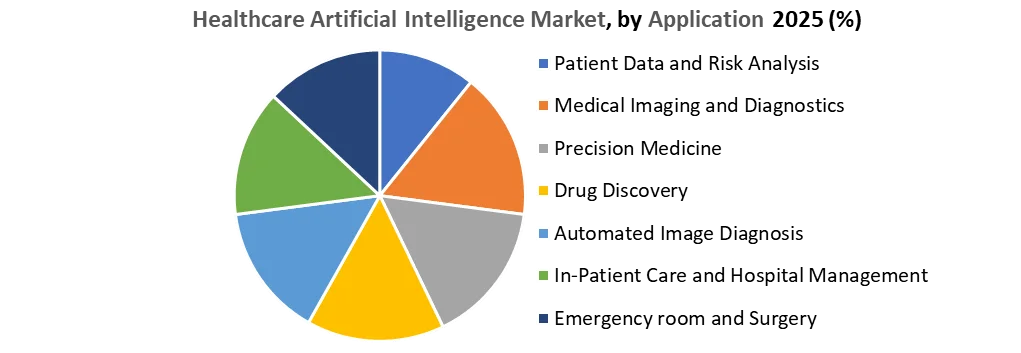
Based on Application, the market is segmented into Patient Data and risk Analysis, Medical Imaging and diagnostics, Precision Medicine, Drug Discovery, Automated Image Diagnosis, In-Patient Care and hospital Management, Emergency room and surgery, and Others. The Medical Imaging and diagnostics segment dominated the market in 2025 and is expected to hold the largest Healthcare Artificial Intelligence Market share over the forecast period. The Medical Imaging and diagnostics segment in the Healthcare Artificial Intelligence (AI) market involves the application of AI technologies to various medical imaging modalities and diagnostic processes. This segment focuses on enhancing the accuracy, efficiency, and speed of medical imaging interpretation, aiding healthcare professionals in diagnosing and treating a wide range of medical conditions. AI is applied to traditional diagnostic imaging modalities such as X-rays, computed tomography (CT), magnetic resonance imaging (MRI), ultrasound, and positron emission tomography (PET). AI algorithms analyze images to identify patterns, anomalies, and potential signs of diseases or abnormalities. Within the Medical Imaging and diagnostics segment, Radiology AI is a prominent area. AI algorithms assist radiologists in interpreting medical images, detecting abnormalities (such as tumors or fractures), and providing quantitative measurements. This improves the efficiency of the radiology workflow and aids in early disease detection. AI is used for automated image segmentation, where it identifies and delineates specific structures or regions of interest within medical images, which significantly boosts the Healthcare Artificial Intelligence Market growth. This assists in precise measurements, volumetric analysis, and localization of abnormalities.
Based on End User, the market is segmented into Hospitals & Diagnostics Centres, Healthcare Payers, Pharmaceuticals and Biotechnology Companies, Patients, and Others. The Hospital & Diagnostic Centers segmented held the largest Healthcare Artificial Intelligence Market share in 2025 and is expected to dominate the market over the forecast period. The Hospital & Diagnostic Centers segment in the Healthcare Artificial Intelligence (AI) market refers to the integration and utilization of AI technologies within hospitals and diagnostic facilities to enhance various aspects of healthcare delivery. This segment focuses on leveraging AI applications to improve operational efficiency, diagnostic accuracy, patient care, and overall healthcare outcomes. AI is employed in hospitals and diagnostic centers to streamline administrative processes, optimize resource allocation, and enhance overall operational efficiency. Automated workflows, intelligent scheduling systems, and AI-driven decision support contribute to more efficient hospital management. Hospitals use AI-driven predictive analytics to anticipate patient needs and optimize resource allocation. Predictive models analyze historical data to forecast patient admission rates, resource utilization, and potential disease outbreaks, allowing hospitals to proactively manage patient care. Hospitals use AI to enhance cybersecurity measures and protecting patient data. AI-powered solutions detect and respond to potential security threats, ensuring the confidentiality and integrity of healthcare information.
Global Healthcare Artificial Intelligence Market Regional Insight
North America holds a leading position in the Global Healthcare Artificial Intelligence Market, driven by advanced healthcare infrastructure, high healthcare technology expenditure, strong AI research capabilities, and widespread adoption of digital health solutions. The United States represents a major regional market due to the presence of leading healthcare AI companies, technology providers, pharmaceutical manufacturers, biotechnology firms, and medical device developers. Increasing demand for AI-powered medical imaging, clinical decision support systems, predictive healthcare analytics, generative AI, electronic health record automation, and precision medicine supports market expansion. Companies such as Microsoft, NVIDIA, Google, Amazon Web Services, IBM, GE HealthCare, Tempus AI, and IQVIA strengthen the regional competitive landscape.
Europe experiences growing adoption of healthcare artificial intelligence, supported by established healthcare systems, medical technology innovation, pharmaceutical research, and increasing investment in digital healthcare transformation. Germany, the United Kingdom, France, Sweden, and the Netherlands contribute to regional demand through AI-enabled medical imaging, digital pathology, clinical decision support, precision medicine, and automated healthcare workflows. Leading companies such as Siemens Healthineers, Philips, Owkin, Isomorphic Labs, BenevolentAI, Brainomix, and Ada Health support the development of AI-powered diagnostics and pharmaceutical research solutions. European healthcare AI adoption also emphasizes data privacy, clinical validation, transparency, interoperability, and compliance with applicable regulations, including the European Union AI Act and the General Data Protection Regulation (GDPR).
Asia Pacific represents a rapidly expanding region in the Global Healthcare Artificial Intelligence Market, driven by healthcare digitalization, increasing healthcare expenditure, rising demand for early disease diagnosis, expanding hospital infrastructure, and growing investments in artificial intelligence technologies. China, Japan, India, South Korea, and Australia contribute to regional market development through AI-powered medical imaging, intelligent diagnostics, digital pathology, telemedicine, remote patient monitoring, and healthcare data analytics. Companies such as Qure.ai, Lunit, VUNO, Fujifilm, Canon Medical Systems, United Imaging Healthcare, and Infervision strengthen the regional healthcare AI ecosystem.
South America experiences increasing adoption of healthcare artificial intelligence, supported by digital healthcare transformation, expanding diagnostic laboratory networks, growing demand for efficient medical services, and investments in healthcare information technology. Brazil represents a major regional market, while Argentina, Chile, and Colombia contribute to the adoption of AI-enabled healthcare solutions. Regional demand focuses on AI-powered medical imaging, automated laboratory diagnostics, clinical data analytics, electronic health record optimization, telemedicine, and predictive patient management. Healthcare organizations and diagnostic service providers, including Dasa and Fleury Group in Brazil, participate in the development of digital diagnostic services and technology-enabled healthcare delivery. Increasing use of AI-assisted radiology, intelligent clinical workflows, remote patient monitoring, and healthcare analytics creates opportunities to improve diagnostic efficiency and operational productivity.
The Middle East & Africa Healthcare Artificial Intelligence Market develops through increasing investments in healthcare infrastructure, digital transformation initiatives, smart hospital projects, and AI-enabled diagnostic technologies. Saudi Arabia, the United Arab Emirates, Israel, and South Africa contribute to regional adoption through healthcare modernization, medical imaging innovation, telehealth platforms, and intelligent hospital management systems. Demand for AI-powered medical diagnostics, clinical decision support software, predictive patient monitoring, electronic health record analytics, and automated healthcare administration supports market development. Companies such as Aidoc and NANO-X Imaging, alongside international healthcare AI providers and regional digital health companies, contribute to the competitive landscape.
Global Healthcare Artificial Intelligence Market Competitive Landscape
The Global Healthcare Artificial Intelligence Market features a diverse competitive landscape comprising multinational technology companies, medical imaging manufacturers, healthcare software providers, pharmaceutical research companies, and specialized AI healthcare startups. Key market participants compete through AI-powered medical diagnostics, clinical decision support systems, generative AI, medical imaging analytics, predictive healthcare analytics, drug discovery platforms, and hospital workflow automation. Major players include Microsoft, NVIDIA, Google, Amazon Web Services, IBM, GE HealthCare, Siemens Healthineers, Philips, and IQVIA, while specialized companies such as Aidoc, Qure.ai, Lunit, Tempus AI, and Viz.ai strengthen competition in targeted healthcare applications.
| Leading Companies | Region | Competitive Strength | Market Development Focus |
|---|---|---|---|
| Microsoft, NVIDIA, Google, AWS, GE HealthCare, Tempus AI, Aidoc |
North America | Advanced AI infrastructure, healthcare data ecosystems, research investment and commercialization |
Generative AI, clinical automation, medical imaging, drug discovery |
| Siemens Healthineers, Philips, Isomorphic Labs, Owkin, Brainomix, Ada Health |
Europe | Medical imaging expertise, pharmaceutical research, digital health and clinical software |
Precision medicine, AI-assisted diagnostics, regulatory compliance |
| Qure.ai, Lunit, VUNO, United Imaging, Canon Medical, Fujifilm, Infervision |
Asia Pacific | Medical imaging manufacturing, diagnostic innovation and expanding digital health adoption |
Affordable diagnostics, AI cancer screening, hospital digitization |
| Aidoc, NANO-X Imaging and regional healthcare technology integrators |
Middle East & Africa |
Hospital modernization, medical imaging deployment and growing digital health investment |
AI-enabled diagnostics, telehealth, clinical workflow automation |
| Dasa, Fleury Group and international healthcare AI vendors |
South America | Diagnostic laboratory networks, private healthcare services and digital transformation |
AI-assisted diagnostics, laboratory automation and predictive analytics |
Global Healthcare Artificial Intelligence Market Recent Development
| Exact Date |
Company / Organization |
Recent Development |
Impact on the Healthcare AI Market |
|---|---|---|---|
| January 7, 2026 |
OpenAI | Introduces ChatGPT Health, a dedicated experience for health-related information and connected health data. |
Strengthens consumer healthcare AI, personalized health insights, and digital health engagement. |
| January 8, 2026 |
OpenAI | Launches ChatGPT for Healthcare for clinicians, researchers, and healthcare administrators. |
Expands enterprise generative AI adoption in clinical and administrative workflows. |
| January 11, 2026 |
Anthropic | Introduces Claude for Healthcare and expands Claude for Life Sciences capabilities. |
Supports healthcare administration, clinical research, and pharmaceutical development workflows. |
| January 22, 2026 |
Amazon | Launches Health AI for One Medical members. | Advances AI-assisted health guidance, appointment access, and patient engagement. |
| March 12, 2026 |
Microsoft | Announces Copilot Health for personalized health insights using connected medical records and wearable data. |
Strengthens consumer-facing healthcare AI and connected health data analytics. |
| May 21, 2026 |
Johnson & Johnson and Department of Health – Abu Dhabi |
Announce a global intelligent operating room network initiative using Polyphonic, with technology partners including AWS and NVIDIA. |
Promotes surgical intelligence, AI-enabled operating rooms, and data-driven surgical innovation. |
Global Healthcare Artificial Intelligence Market Scope: Inquire before buying
| Healthcare Artificial Intelligence Market | |||
|---|---|---|---|
| Report Coverage | Details | ||
| Base Year: | 2025 | Forecast Period: | 2026-2034 |
| Historical Data: | 2020 to 2025 | Market Size in 2025: | USD 31.77 Billion |
| Forecast Period 2026-2034 CAGR: | 47.5% | Market Size in 2034: | USD 1049.89 Billion |
| Segments Covered: | by Component | Services Hardware Software |
|
| by Application | Patient Data and Risk Analysis Medical Imaging and Diagnostics Precision Medicine Drug Discovery Automated Image Diagnosis In-Patient Care and Hospital Management Emergency room and Surgery Others |
||
| by End-user | Hospitals & Diagnostics Centres Healthcare Payers Pharmaceuticals and Biotechnology Companies Patients Others |
||
Global Healthcare Artificial Intelligence Market, by Region
North America (United States, Canada and Mexico)
Europe (UK, France, Germany, Italy, Spain, Sweden, Austria and Rest of Europe)
Asia Pacific (China, South Korea, Japan, India, Australia, Indonesia, Malaysia, Vietnam, Taiwan, Bangladesh, Pakistan and Rest of APAC)
Middle East and Africa (South Africa, GCC, Egypt, Nigeria and Rest of ME&A)
South America (Brazil, Argentina Rest of South America)
Global Healthcare Artificial Intelligence Key Leaders Includes:
1. IBM
2. Google Health
3. Microsoft
4. NVIDIA
5. Intel Corporation
6. Amazon Web Services (AWS)
7. Oracle Health
8. Siemens Healthineers
9. GE HealthCare
10. Philips
11. Medtronic
12. Johnson & Johnson MedTech
13. Roche Diagnostics
14. QIAGEN
15. IQVIA
16. Tempus AI
17. PathAI
18. Aidoc
19. Qure.ai
20. Viz.ai
21. Butterfly Network
22. HeartFlow
23. Insilico Medicine
24. Recursion Pharmaceuticals
25. BenevolentAI
26. Owkin
27. Abridge
28. Nuance Communications
29. Verily
30. Isomorphic Labs
31. OpenEvidence
32. Hippocratic AI
33. Ambience Healthcare
34. RapidAI
35. Proscia
36. SOPHiA GENETICS
37. Caris Life Sciences
38. GeneDx
39. Fabric Genomics
40. Annalise.ai
41. Harrison.ai
42. ScreenPoint Medical
43. DeepHealth
44. Avicenna.AI
45. Brainomix
46. Gleamer
47. AZmed
48. Koios Medical
49. Digital Diagnostics
50. Nanox.AI
51. Hyperfine
52. Clarius Mobile Health
53. Brainlab
54. Intuitive Surgical
55. Stryker
56. Zimmer Biomet
57. Eko Health
58. iRhythm Technologies
59. Dexcom
60. Abbott
Frequently Asked Questions
1. What is the global healthcare artificial intelligence market?
Ans. The global healthcare artificial intelligence market comprises AI-powered software, hardware, and services used for medical imaging, disease diagnosis, clinical decision support, drug discovery, precision medicine, patient monitoring, and healthcare workflow automation.
2. What are the key growth drivers of the global healthcare artificial intelligence market?
Ans. The major healthcare artificial intelligence market growth drivers include increasing demand for early disease detection, rising healthcare expenditure, growing adoption of digital health technologies, expanding clinical data volumes, increasing demand for personalised medicine, pharmaceutical drug discovery innovation, and the need to automate clinical and administrative workflows.
3. What are the major restraints affecting the global healthcare artificial intelligence market?
Ans. The key market restraints include high AI implementation costs, patient data privacy concerns, cybersecurity risks, limited interoperability between healthcare information systems, algorithmic bias, regulatory complexity, and insufficient clinical validation.
4. What are the emerging opportunities in the global healthcare artificial intelligence market?
Ans. Major market opportunities include generative AI for healthcare, agentic AI clinical workflows, AI-powered drug discovery, precision medicine, AI-enabled medical imaging, virtual health assistants, remote patient monitoring, robotic-assisted surgery, and automated clinical trial management.
5.Which region dominates the global healthcare artificial intelligence market?
Ans. North America holds a leading position in many published healthcare AI market estimates, supported by advanced healthcare infrastructure, high technology investment, established AI companies, and strong pharmaceutical and biotechnology industries.