
Global Health Care Predictive Analytics Market - Industry Structure Evaluation, Demand Drivers Analysis, Regional Growth Analysis and Identification & Global Market Size Forecast 2025-2032
Overview
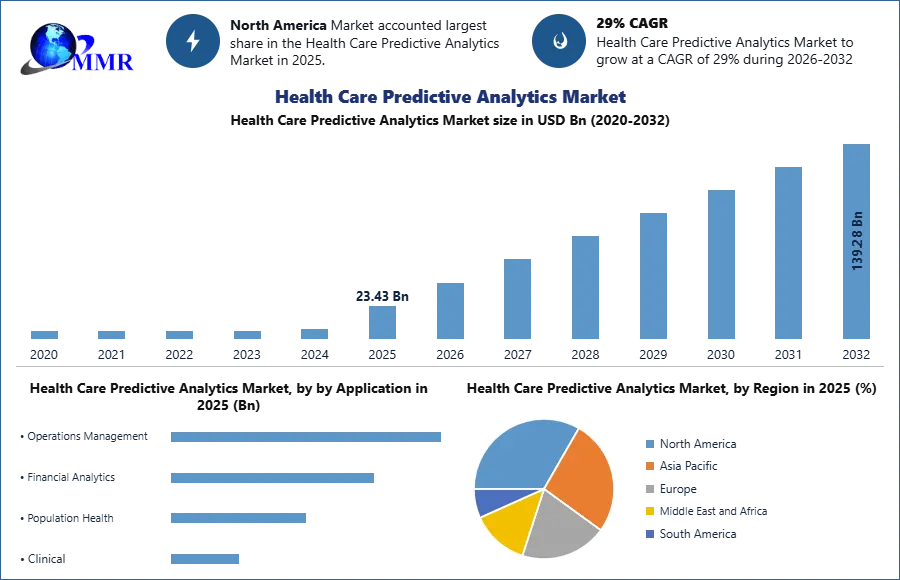
Health Care Predictive Analytics Market was valued at USD 23.43 Bn in 2025 and is expected to reach USD 139.28 Bn by 2032, at a CAGR of 29% during the forecast period.
To know about the Research Methodology :- Request Free Sample Report
Health Care Predictive Analytics Market Dynamics
Healthcare predictive analysis helps to detect the early sign of patient deterioration in the ICU and general ward. Predictive analytics helps to find out patients risks to prevent hospital readmissions, and prevent avoidable downtime of medical equipment. As a result, the global health care predictive analytics have wide spread opportunities in the forecast period.
Predictive analytics promises healthy budget savings
The healthcare industry has moved from volume-based healthcare to value-based healthcare. Customers’ demand are growing for modern, quality, and regulated healthcare services. The pressure on healthcare providers to satisfy the patient services and facilities are creating novel opportunities for global market.
It improves operational management efficiency
The healthcare predictive analytics help in optimal management of patient-to-staff ratio and improves the accuracy of diagnosis, which in turn results in quality care.
Predictive analytics enables diagnosis and treatment to be more precise
Predictive analytics work at an individual level by connecting the personal health history, current medication, family health history, and previous illness and uncovering hidden insights in a couple of seconds. Predictive analytics help professionals in treatment of patients with the medication for a particular illness.
Health Care Predictive Analytics Market Segment Analysis
Predictive analytics technology has wide applications in operation management.
In 2025, the Operations Management segment accounts for the highest demand within the Health Care Predictive Analytics market. Healthcare organizations increasingly rely on predictive tools to optimize patient flow, staffing allocation, scheduling, and resource utilization. These solutions help reduce operational inefficiencies and improve overall productivity, making operations management the primary revenue contributor.
Clinical analytics is also witnessing strong adoption, particularly for early disease detection, personalized treatment planning, and risk stratification. Financial analytics supports revenue cycle management and fraud detection, while population health analytics assists in managing chronic diseases and improving community health outcomes. However, operations management remains the dominant application area due to its direct impact on cost savings and service efficiency.
In 2025, Software and Services represent the most demanded product segment. Predictive analytics platforms, AI-driven tools, and consulting services generate substantial revenue as healthcare organizations seek integrated, scalable solutions. Hardware demand remains comparatively lower, primarily supporting data storage and processing infrastructure.
Regarding delivery mode, Cloud-based Solutions are the fastest-growing segment due to their scalability, remote accessibility, and lower upfront investment. Healthcare institutions increasingly prefer cloud platforms to manage large volumes of patient data securely and efficiently. On-premise systems are still utilized in organizations with strict data control requirements, but their growth rate is slower compared to cloud-based deployment models.
Health Care Predictive Analytics Market Regional Analysis
North America leads the Global Health Care Predictive Analytics Market in 2025. The region benefits from advanced healthcare IT infrastructure, high adoption of AI technologies, and strong government initiatives promoting digital health transformation. Healthcare providers and payers in this region prioritize predictive solutions to enhance efficiency and reduce costs.
Asia Pacific is the fastest-growing region, driven by expanding healthcare infrastructure, rising patient populations, and increasing investments in digital health technologies. Europe demonstrates steady growth supported by regulatory frameworks and modernization of healthcare systems. Meanwhile, Latin America and the Middle East & Africa show moderate adoption, primarily influenced by infrastructure development and investment capacity.
Health Care Predictive Analytics Market Scope: Inquire before buying
| Health Care Predictive Analytics Market | |||
|---|---|---|---|
| Report Coverage | Details | ||
| Base Year: | 2025 | Forecast Period: | 2026-2032 |
| Historical Data: | 2020 to 2025 | Market Size in 2025: | 23.43 USD Bn |
| Forecast Period 2026-2032 CAGR: | 29% | Market Size in 2032: | 139.28 USD Bn |
| Segments Covered: | by Product | • Hardware • Software and Services |
|
| by Mode of Delivery | • On-premise • Cloud-based |
||
| by End User | • Healthcare Payers • Healthcare Providers • Others |
||
| by Application | • Operations Management • Financial Analytics • Population Health • Clinical |
||
Key Players/Competitors Profile, Covered in Health Care Predictive Analytics Market Report, From A Strategic Perspective.
- IBM Corporation
- Optum Inc.
- Cerner Corporation
- SAS Institute Inc.
- Allscripts Health Solutions
- McKesson Corporation
- MedeAnalytics Inc.
- Inovalon
- Oracle Corporation
- Health Catalyst
- SCIO Health Analytics
- Verscend Technologies Inc.
- CitiusTech Inc.
- Wipro Limited
- VitreosHealth
- Microsoft Corporation
- Google LLC
- Amazon Web Services
- Siemens Healthineers
- Koninklijke Philips N.V.
- Verisk Analytics
- IQVIA
- EXL Service
- Accenture
- HCL Technologies
| Exact Date | Company | Development | Impact |
|---|---|---|---|
| 28 January 2026 | Oracle Health | Oracle Health officially launched its next-generation AI-powered EHR platform, which natively embeds predictive clinical intelligence and voice-activated assistant tools. | The integration shifts EHRs from static record-keeping to dynamic systems of intelligence, significantly reducing documentation burdens and improving point-of-care decision accuracy. |
| 16 January 2026 | IBM Corporation | IBM released its 2026 Watson Services Roadmap, prioritizing the expansion of predictive diagnostic tools and personalized medicine algorithms for large-scale hospital networks. | The focus on enterprise AI maturity is projected to drive 15% annual revenue growth by lowering technical barriers for SMEs in the healthcare analytics space. |
| 02 January 2026 | Optum (UnitedHealth Group) | Optum Life Sciences deployed a new predictive algorithm utilizing integrated real-world data (RWD) to identify high-risk osteoporosis patients with unprecedented accuracy. | This development enables proactive screening and earlier interventions, directly reducing long-term treatment costs related to bone fractures and chronic disability. |
| 02 June 2025 | IBM & Roche | IBM and Roche announced a strategic partnership to launch the Accu-Chek SmartGuide Predict app, an AI solution that forecasts hypoglycemic risks. | The use of predictive algorithms for continuous glucose monitoring allows patients to take preventative therapy actions up to two hours before adverse glycemic events occur. |
| 14 May 2025 | Adastra Group | Adastra Group expanded its healthcare AI and data analytics operations by opening a new specialized hub in Austin, Texas, focused on AWS-integrated predictive tools. | The expansion facilitates closer collaboration with cloud providers to scale population health analytics and fraud detection services for the U.S. payer market. |
| 12 March 2025 | Health Catalyst | Health Catalyst commercialized Health Catalyst Ignite, a comprehensive data and analytics ecosystem designed to optimize value-based care models. | By automating revenue cycle predictive insights, the platform helps providers reduce avoidable claim denials and enhance operational margin stability. |