Global Glyoxal Market by Application, by End-Use Industry, by Segment Analysis, Regional Analysis and Forecast 2034

4.4%
CAGR (2026-2034)
355 USD Mn.
Forecast Market Size
324
Report Pages
149
Market Tables

Overview

The Glyoxal Market Size was valued at USD 355 Million in 2025 and is estimated to grow at a CAGR of 4.4% over the forecast period, reaching USD 523.04 Million by 2034.

Global Glyoxal Market Overview

Glyoxal is a reactive organic chemical and dialdehyde mainly supplied in aqueous form. It is used as a chemical intermediate, crosslinking agent, and specialty chemical in textiles, paper and packaging, adhesives and resins, leather treatment, pharmaceuticals, cosmetics, and oilfield chemicals. The Global Glyoxal Market includes the production, supply, and consumption of glyoxal across these industries. The U.S. Environmental Protection Agency recognizes glyoxal production as an industrial chemical activity and identifies applications including polymers, paper coatings, textile finishes, adhesives, leather tanning, cosmetics, and chemical synthesis.

The market is increasing demand for durable textiles, specialty resins, paper chemicals, coatings, and chemical intermediates. Asia Pacific remains an important regional market because of its strong textile, paper, chemical manufacturing, and industrial processing base. Companies such as BASF use glyoxal as a specialty intermediate for applications including pharmaceuticals, crop protection, polymers, coatings, and printing inks. Growing demand for application-specific chemicals and improved product performance is creating additional opportunities for glyoxal manufacturers.

The MMR Glyoxal Market Report provides analysis of market size, CAGR, market trends, drivers, restraints, opportunities, challenges, applications, regional demand, and competitive landscape. The research helps manufacturers, investors, suppliers, and distributors identify opportunities across textile chemicals, paper chemicals, adhesives and sealants, pharmaceuticals, cosmetics, leather, oil and gas, coatings, and specialty chemicals. It also highlights regional growth patterns and emerging opportunities related to sustainable chemical solutions and higher-value glyoxal applications.
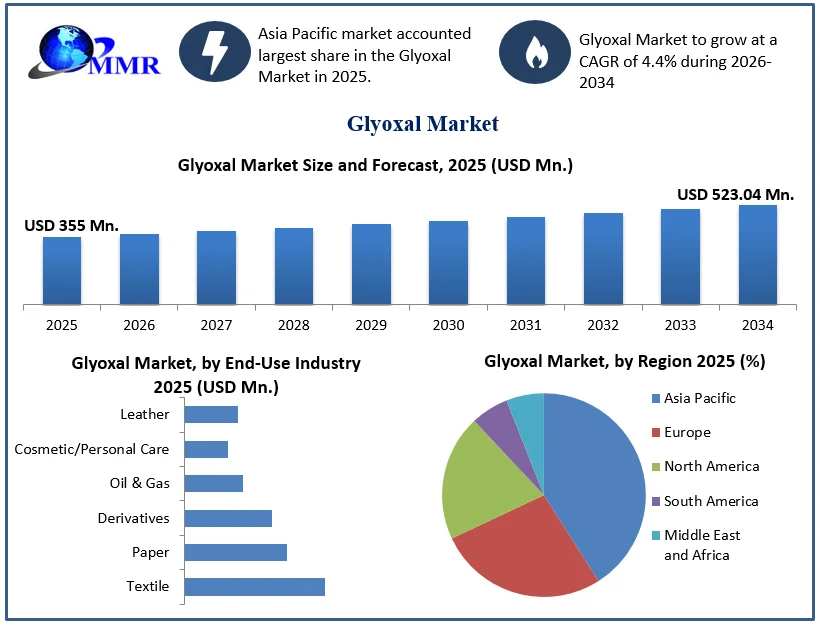
Glyoxal Market Growth

To know about the Research Methodology :- Request Free Sample Report

Glyoxal Market Dynamics:

Glyoxal Market Drivers

Growing demand for durable textile finishing

Glyoxal-based chemistry supports wrinkle resistance, dimensional stability, and durable finishing of fabrics. Textile applications remain a major consumption area, particularly across Asia Pacific, where large textile manufacturing and processing bases create consistent demand.

Rising use in paper and packaging chemicals

Paper manufacturers are using glyoxal-based formulations for wet-strength, surface treatment, moisture resistance, and improved paper durability. Growing demand for functional paper and packaging materials is creating additional consumption opportunities.

Glyoxal Market Restraints

High reactivity creates handling requirements

Glyoxal requires controlled storage, transportation, and handling because its reactive nature can create stability and safety concerns. These requirements can increase operational complexity, particularly for smaller chemical manufacturers and distributors.

Availability of alternative chemical systems

Manufacturers in textiles, adhesives, resins and specialty formulations can select alternative crosslinking and finishing chemistries depending on performance, cost, regulatory requirements, and processing conditions. This limits glyoxal adoption in applications where substitution is technically practical.

Glyoxal Market Opportunities

Development of higher-purity glyoxal grades

Pharmaceuticals and specialty chemical synthesis provide an opportunity for suppliers to develop high-purity glyoxal, consistent impurity profiles, and application-specific grades. Chemical intermediates are projected to record stronger growth than some traditional applications, creating opportunities for value-added suppliers.

Lower-emission and sustainable chemical formulations

Demand for lower-emission chemistry is encouraging manufacturers to evaluate glyoxal-based systems for textiles, adhesives, paper, and packaging. This creates opportunities for formulations designed around regulatory compliance, reduced emissions, and improved environmental performance.

Glyoxal Market Challenges

Raw material and production-cost volatility

Changes in feedstock costs, energy prices, manufacturing efficiency, and transportation expenses can affect glyoxal production economics. Producers need efficient processes and reliable supply arrangements to maintain competitive pricing.

Need for application-specific product development

Customers increasingly require consistent performance for specific textile, paper, pharmaceutical, resin, and specialty chemical processes. Glyoxal suppliers face the challenge of providing reliable quality across different formulations rather than competing only on bulk chemical price

Global Glyoxal Market Key Trends

Key Trend Description
Greater focus on formaldehyde-reduced formulations Textile, coating, and resin manufacturers are paying more attention to formulations that can reduce formaldehyde-related concerns. Glyoxal-based crosslinking systems are gaining interest where flexible films and lower formaldehyde emissions are required.
Paper performance is becoming more application-specific Demand is moving toward glyoxal-based paper treatments that provide targeted wet-strength, dry-strength, coating, and surface-performance benefits. This is particularly relevant for higher-performance paper and packaging products.
Supply security is becoming a purchasing priority Recent supply-chain conditions are encouraging buyers to evaluate regional sourcing, inventory availability, and supplier reliability alongside price. Production and sourcing activity in Asia is strengthening regional supply options.
Pharmaceutical and specialty applications gaining attention Pharmaceutical intermediates and specialty chemical synthesis are becoming attractive areas because customers in these applications generally place greater emphasis on chemical consistency and purity than on bulk-volume pricing alone.
Regional manufacturing is becoming more important Asia Pacific continues to be the leading demand center, while producers and buyers are increasingly considering local or regional supply arrangements to reduce freight exposure and improve delivery reliability.

Glyoxal Market Segment Analysis:

Global Glyoxal Market, by Application

By application, Crosslinking is the leading position in the Glyoxal Market, which established use in textile finishing, paper treatment, resins, adhesives, and other formulations where improved strength, durability, and dimensional stability are required. Glyoxal's reactivity allows manufacturers to improve material performance without relying solely on conventional formaldehyde-based systems. However, Intermediate is the more promising and increasingly trending application, as glyoxal is being used as a reactive building block in pharmaceutical, specialty chemical, and synthesis processes. Demand for higher-purity material and more application-specific chemical inputs is creating additional opportunities for intermediate use. Current industry estimates also show chemical-intermediate applications growing faster than the established crosslinking segment, making Intermediate the key growth-oriented application, while Crosslinking remains the volume-leading segment.
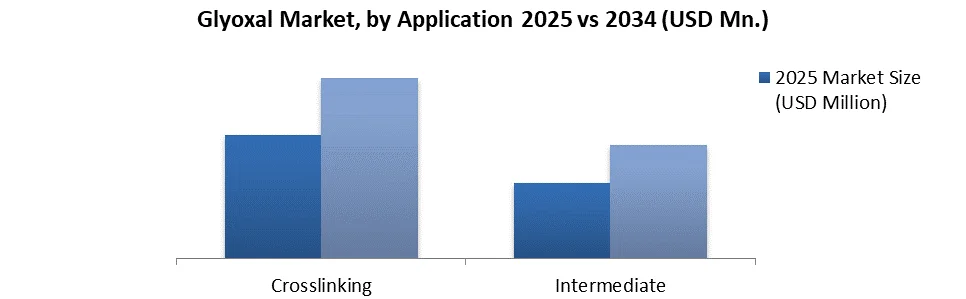
Glyoxal Market by application


Global Glyoxal Market, by End-Use Industry

By end-use industry, Textile remains the leading and most established segment, supported by glyoxal-based finishing treatments that improve wrinkle resistance, dimensional stability, durability, and fabric performance. Paper is another important application, particularly where stronger and more moisture-resistant paper materials are required. Derivatives are gaining attention as glyoxal is increasingly used as a chemical building block for downstream specialty chemicals and pharmaceutical-related synthesis, making this one of the more promising areas for future demand. Oil & Gas represents a smaller but technically important segment, where glyoxal can be incorporated into chemical systems used in drilling and production operations. Cosmetic/Personal Care and Leather remain specialized markets, with demand linked to formulation performance, tanning, finishing, and material treatment. Based on current industry developments, Derivatives is the most promising trending segment, while Textile continues to hold the strongest established demand base.

Glyoxal Market Regional Insights:

Asia Pacific is the leading region in the Glyoxal Market, supported by its large textile, paper, chemical manufacturing, and downstream processing base. China and India are particularly important because of their strong textile production and growing specialty chemical manufacturing. The region also benefits from established chemical supply chains and cost-efficient manufacturing, making it the strongest demand center for glyoxal.

Europe represents a mature market, with demand concentrated in specialty chemicals, textiles, paper, coatings, and pharmaceutical-related applications. Purchasing decisions are increasingly influenced by chemical safety, product quality, environmental compliance, and lower-emission formulations. Germany, France, Italy, the United Kingdom, and Spain remain important markets, while opportunities are emerging for higher-purity and application-specific glyoxal grades.

North America is an important high-value market supported by established chemical distribution, paper and packaging, specialty chemicals, oilfield applications, and pharmaceutical manufacturing. The region is showing particular interest in performance-focused and compliant chemical formulations, while domestic supply security and specialty chemical production are becoming more relevant to buyers. The United States remains the principal demand center in the region.

South America is a smaller but developing regional market, with demand linked mainly to textiles, leather processing, paper and packaging, chemical manufacturing, and industrial applications. Brazil represents the most significant opportunity because of its diversified manufacturing base, while improving regional industrial activity can support additional consumption of glyoxal-based chemical formulations.

Middle East and Africa currently represent a smaller share of demand, but the region has opportunities in oil and gas chemicals, petrochemical processing, leather, paper, water-treatment-related applications, and industrial chemicals. The Middle East is particularly relevant for oilfield and petrochemical uses, while African markets offer longer-term potential as chemical processing, packaging, leather production, and industrial infrastructure develop.

Global Glyoxal Market Competitive Landscape

The Glyoxal Market is a moderately concentrated competitive environment, with established chemical manufacturers competing through production capacity, product purity, application expertise, supply reliability, and regional distribution networks. BASF SE maintains a strong competitive position through large-scale glyoxal production and established relationships across textile, paper, leather, cosmetics, and chemical intermediate applications, while WeylChem International GmbH competes through specialized chemical manufacturing and European supply capabilities. Other notable participants include Eastman Chemical Company, Dow, INEOS, SINOPEC, Reliance Industries, Kemira Oyj, Haihang Group, Amzole India Pvt. Ltd., Hubei Hongyuan Pharmaceutical Technology Co., Ltd., Zhonglan Industry Co., Ltd., Merck KGaA, and Thermo Fisher Scientific. Current competition is increasingly centered on high-purity glyoxal, application-specific formulations, pharmaceutical chemical intermediates, sustainable production, supply-chain reliability, and regional manufacturing, rather than price competition alone. Recent supplier data also indicates active participation from both large multinational producers and specialized regional manufacturers, creating a competitive structure that varies across Asia Pacific, Europe, and North America.

Global Glyoxal Market Recent Development

Month Company Recent Development
March 2026 BASF SE BASF inaugurated its large integrated production site in Zhanjiang, China, strengthening its manufacturing presence and regional chemical supply capabilities in Asia Pacific.
March 2026 Hubei Hongyuan Pharmaceutical Technology Hubei Hongyuan continued its position in organic chemical raw materials and pharmaceutical intermediates, with glyoxal included in its ethylene glycol reaction chain product portfolio.
April 2026 BASF SE BASF reported first quarter 2026 results, with volume growth particularly supported by China, while competitive pressure affected prices across several chemical businesses.
April 2026 Hubei Hongyuan Pharmaceutical Technology The company reported its first quarter 2026 financial results, reflecting continued activity across organic chemical raw materials and pharmaceutical intermediates.
July 2026 BASF SE BASF reported stronger second quarter performance, with higher prices and increased volumes contributing to improved results in its Chemicals and other industrial businesses.
August 2026 Hubei Hongyuan Pharmaceutical Technology Hubei Hongyuan reported substantially higher first half 2026 sales and returned to positive net income, supporting its continuing position in organic chemical raw materials and pharmaceutical intermediates.
September 2026 BASF SE BASF announced the modernization and commissioning of a production facility for acid chlorides and chloroformates in Ludwigshafen, strengthening production capacity and supply reliability within its Intermediates division.

Glyoxal Market Scope: Inquire before buying

Glyoxal Market
Report Coverage Details
Base Year: 2025 Forecast Period: 2026-2034
Historical Data: 2020 to 2025 Market Size in 2025: USD 355 Mn.
Forecast Period 2026 to 2034 CAGR: 4.4% Market Size in 2034: USD 523.04 Mn.
Segments Covered: by Application Crosslinking
Intermediate
by End-Use Industry Textile
Paper
Derivatives
Oil & Gas
Cosmetic/Personal Care
Leather

Glyoxal Market, by Region

North America (United States, Canada and Mexico)
Europe (UK, France, Germany, Italy, Spain, Sweden, Austria and Rest of Europe)
Asia Pacific (China, South Korea, Japan, India, Australia, Indonesia, Malaysia, Vietnam, Taiwan, Bangladesh, Pakistan and Rest of APAC)
Middle East and Africa (South Africa, GCC, Egypt, Nigeria and Rest of ME&A)
South America (Brazil, Argentina Rest of South America)

Glyoxal Market, Key Players are

1. BASF SE
2. Eastman Chemical Company
3. Silver Fern Chemical Inc.
4. Clariant AG
5. Huntsman International LLC
6. Formosa Plastics Group
7. INEOS Group Holdings SA
8. Shell Chemicals
9. SINOPEC
10. ME Global B.V.
11. Alberta & Orient Glycol
12. Merck KGaA
13. Thermo Fisher Scientific Inc.
14. WeylChem International GmbH
15. Haihang Group
16. Dow Inc.
17. Reliance Industries Limited
18. Amzole India Pvt. Ltd.
19. Kemira Oyj
20. FUJIFILM Wako Pure Chemical Corporation
21. HiMedia Laboratories Pvt. Ltd.
22. Hubei Hongyuan Pharmaceutical Technology Co., Ltd.
23. Hubei Xingfa Chemicals Group Co., Ltd.
24. Jining Lucky Chemical Co., Ltd.
25. Meru Chem Pvt. Ltd.
26. Mitsubishi Gas Chemical Company, Inc.
27. Mubychem Group
28. Nouryon Chemicals B.V.
29. Otto Chemie Pvt. Ltd.
30. Perstorp Holding AB
31. Shandong Rainbow Chemical Co., Ltd.
32. Shandong Zhishang Chemical Co., Ltd.
33. Wanhua Chemical Group Co., Ltd.
34. Gujarat Alkalies and Chemicals Limited
35. Yunnan Yuntianhua Co., Ltd.
36. Nippon Shokubai Co., Ltd.
37. Jinan Huashihang Chemical Co., Ltd.
38. Zhonglan Industry Co., Ltd.
39. Hubei Hongyuan Chemical Co., Ltd.
40. Tata Chemicals Limited
41. Johnson Matthey Plc
42. Evonik Industries AG
43. Lonza Group AG
44. Lanxess AG
45. Jubilant Ingrevia Limited

Frequently Asked Questions:

1. Which region has the largest share in Glyoxal Market?
Answer: Asia Pacific region held the highest share in 2025.

2. What is the growth rate of Glyoxal Market?
Answer: The Glyoxal Market is growing at a CAGR of 4.4% during the forecasting period 2026-2034.

3. What is the scope of the Glyoxal Market report?
Answer: The Glyoxal Market report covers, investor recommendations, and market estimation for the forecast period.

4. Who are the key players in Glyoxal Market?
Answer: The important key players in the Glyoxal Market are BASF SE, Haihang Group, Eastman Chemical Company, Hubei Hongyuan Pharmaceutical Technology Co. Ltd., Amzole India Pvt. Ltd., and Zhonglan Industry Co. Ltd.

5. What is the study period of this Market?
Answer: The Glyoxal Market is studied from 2020 to 2034.

Table of Contents

1. Glyoxal Market Introduction 1.1. Study Assumption and Market Definition 1.2. Scope of the Study 1.3. Executive Summary 2. Global Glyoxal Market: Competitive Landscape 2.1. MMR Competition Matrix 2.2. Competitive Landscape 2.3. Key Players Benchmarking 2.3.1. Company Name 2.3.2. Business Segment 2.3.3. End-user Segment 2.3.4. Revenue (2025) 2.3.5. Company Locations 2.4. Leading Glyoxal Market Companies, by market capitalization 2.5. Market Structure 2.5.1. Market Leaders 2.5.2. Market Followers 2.5.3. Emerging Players 2.6. Mergers and Acquisitions Details 3. Glyoxal Market: Dynamics 3.1. Glyoxal Market Trends by Region 3.1.1. North America Glyoxal Market Trends 3.1.2. Europe Glyoxal Market Trends 3.1.3. Asia Pacific Glyoxal Market Trends 3.1.4. Middle East and Africa Glyoxal Market Trends 3.1.5. South America Glyoxal Market Trends 3.2. Glyoxal Market Dynamics by Region 3.2.1. North America 3.2.1.1. North America Glyoxal Market Drivers 3.2.1.2. North America Glyoxal Market Restraints 3.2.1.3. North America Glyoxal Market Opportunities 3.2.1.4. North America Glyoxal Market Challenges 3.2.2. Europe 3.2.2.1. Europe Glyoxal Market Drivers 3.2.2.2. Europe Glyoxal Market Restraints 3.2.2.3. Europe Glyoxal Market Opportunities 3.2.2.4. Europe Glyoxal Market Challenges 3.2.3. Asia Pacific 3.2.3.1. Asia Pacific Glyoxal Market Drivers 3.2.3.2. Asia Pacific Glyoxal Market Restraints 3.2.3.3. Asia Pacific Glyoxal Market Opportunities 3.2.3.4. Asia Pacific Glyoxal Market Challenges 3.2.4. Middle East and Africa 3.2.4.1. Middle East and Africa Glyoxal Market Drivers 3.2.4.2. Middle East and Africa Glyoxal Market Restraints 3.2.4.3. Middle East and Africa Glyoxal Market Opportunities 3.2.4.4. Middle East and Africa Glyoxal Market Challenges 3.2.5. South America 3.2.5.1. South America Glyoxal Market Drivers 3.2.5.2. South America Glyoxal Market Restraints 3.2.5.3. South America Glyoxal Market Opportunities 3.2.5.4. South America Glyoxal Market Challenges 3.3. PORTER's Five Forces Analysis 3.4. PESTLE Analysis 3.5. Technology Roadmap 3.6. Regulatory Landscape by Region 3.6.1. North America 3.6.2. Europe 3.6.3. Asia Pacific 3.6.4. Middle East and Africa 3.6.5. South America 3.7. Key Opinion Leader Analysis in the Glyoxal Market 3.8. Analysis of Government Schemes and Initiatives For Global Industry 3.9. Glyoxal Market Trade Analysis 3.10. The Global Pandemic Impact on Glyoxal Market 4. Glyoxal Market: Global Market Size and Forecast by Segmentation (in Mn.) 2025-2034 4.1. Glyoxal Market Size and Forecast, by Application (2025-2034) 4.1.1. Crosslinking 4.1.2. Intermediate 4.2. Glyoxal Market Size and Forecast, by End-Use Industry (2025-2034) 4.2.1. Textile 4.2.2. Paper 4.2.3. Derivatives 4.2.4. Oil & Gas 4.2.5. Cosmetic/Personal Care 4.2.6. Leather 4.3. Glyoxal Market Size and Forecast, by Region (2025-2034) 4.3.1. North America 4.3.2. Europe 4.3.3. Asia Pacific 4.3.4. Middle East and Africa 4.3.5. South America 5. North America Glyoxal Market Size and Forecast by Segmentation (in Mn.) 2025-2034 5.1. North America Glyoxal Market Size and Forecast, by Application (2025-2034) 5.1.1. Crosslinking 5.1.2. Intermediate 5.2. North America Glyoxal Market Size and Forecast, by End-Use Industry (2025-2034) 5.2.1. Textile 5.2.2. Paper 5.2.3. Derivatives 5.2.4. Oil & Gas 5.2.5. Cosmetic/Personal Care 5.2.6. Leather 5.3. North America Glyoxal Market Size and Forecast, by Country (2025-2034) 5.3.1. United States 5.3.1.1. United States Glyoxal Market Size and Forecast, by Application (2025-2034) 5.3.1.1.1. Crosslinking 5.3.1.1.2. Intermediate 5.3.1.2. United States Glyoxal Market Size and Forecast, by End-Use Industry (2025-2034) 5.3.1.2.1. Textile 5.3.1.2.2. Paper 5.3.1.2.3. Derivatives 5.3.1.2.4. Oil & Gas 5.3.1.2.5. Cosmetic/Personal Care 5.3.1.2.6. Leather 5.3.2. Canada 5.3.2.1. Canada Glyoxal Market Size and Forecast, by Application (2025-2034) 5.3.2.1.1. Crosslinking 5.3.2.1.2. Intermediate 5.3.2.2. Canada Glyoxal Market Size and Forecast, by End-Use Industry (2025-2034) 5.3.2.2.1. Textile 5.3.2.2.2. Paper 5.3.2.2.3. Derivatives 5.3.2.2.4. Oil & Gas 5.3.2.2.5. Cosmetic/Personal Care 5.3.2.2.6. Leather 5.3.3. Mexico 5.3.3.1. Mexico Glyoxal Market Size and Forecast, by Application (2025-2034) 5.3.3.1.1. Crosslinking 5.3.3.1.2. Intermediate 5.3.3.2. Mexico Glyoxal Market Size and Forecast, by End-Use Industry (2025-2034) 5.3.3.2.1. Textile 5.3.3.2.2. Paper 5.3.3.2.3. Derivatives 5.3.3.2.4. Oil & Gas 5.3.3.2.5. Cosmetic/Personal Care 5.3.3.2.6. Leather 6. Europe Glyoxal Market Size and Forecast by Segmentation (in Mn.) 2025-2034 6.1. Europe Glyoxal Market Size and Forecast, by Application (2025-2034) 6.1.1. Crosslinking 6.1.2. Intermediate 6.2. Europe Glyoxal Market Size and Forecast, by End-Use Industry (2025-2034) 6.2.1. Textile 6.2.2. Paper 6.2.3. Derivatives 6.2.4. Oil & Gas 6.2.5. Cosmetic/Personal Care 6.2.6. Leather 6.3. Europe Glyoxal Market Size and Forecast, by Country (2025-2034) 6.3.1. United Kingdom 6.3.1.1. United Kingdom Glyoxal Market Size and Forecast, by Application (2025-2034) 6.3.1.1.1. Crosslinking 6.3.1.1.2. Intermediate 6.3.1.2. United Kingdom Glyoxal Market Size and Forecast, by End-Use Industry (2025-2034) 6.3.1.2.1. Textile 6.3.1.2.2. Paper 6.3.1.2.3. Derivatives 6.3.1.2.4. Oil & Gas 6.3.1.2.5. Cosmetic/Personal Care 6.3.1.2.6. Leather 6.3.2. France 6.3.2.1. France Glyoxal Market Size and Forecast, by Application (2025-2034) 6.3.2.1.1. Crosslinking 6.3.2.1.2. Intermediate 6.3.2.2. France Glyoxal Market Size and Forecast, by End-Use Industry (2025-2034) 6.3.2.2.1. Textile 6.3.2.2.2. Paper 6.3.2.2.3. Derivatives 6.3.2.2.4. Oil & Gas 6.3.2.2.5. Cosmetic/Personal Care 6.3.2.2.6. Leather 6.3.3. Germany 6.3.3.1. Germany Glyoxal Market Size and Forecast, by Application (2025-2034) 6.3.3.1.1. Crosslinking 6.3.3.1.2. Intermediate 6.3.3.2. Germany Glyoxal Market Size and Forecast, by End-Use Industry (2025-2034) 6.3.3.2.1. Textile 6.3.3.2.2. Paper 6.3.3.2.3. Derivatives 6.3.3.2.4. Oil & Gas 6.3.3.2.5. Cosmetic/Personal Care 6.3.3.2.6. Leather 6.3.4. Italy 6.3.4.1. Italy Glyoxal Market Size and Forecast, by Application (2025-2034) 6.3.4.1.1. Crosslinking 6.3.4.1.2. Intermediate 6.3.4.2. Italy Glyoxal Market Size and Forecast, by End-Use Industry (2025-2034) 6.3.4.2.1. Textile 6.3.4.2.2. Paper 6.3.4.2.3. Derivatives 6.3.4.2.4. Oil & Gas 6.3.4.2.5. Cosmetic/Personal Care 6.3.4.2.6. Leather 6.3.5. Spain 6.3.5.1. Spain Glyoxal Market Size and Forecast, by Application (2025-2034) 6.3.5.1.1. Crosslinking 6.3.5.1.2. Intermediate 6.3.5.2. Spain Glyoxal Market Size and Forecast, by End-Use Industry (2025-2034) 6.3.5.2.1. Textile 6.3.5.2.2. Paper 6.3.5.2.3. Derivatives 6.3.5.2.4. Oil & Gas 6.3.5.2.5. Cosmetic/Personal Care 6.3.5.2.6. Leather 6.3.6. Sweden 6.3.6.1. Sweden Glyoxal Market Size and Forecast, by Application (2025-2034) 6.3.6.1.1. Crosslinking 6.3.6.1.2. Intermediate 6.3.6.2. Sweden Glyoxal Market Size and Forecast, by End-Use Industry (2025-2034) 6.3.6.2.1. Textile 6.3.6.2.2. Paper 6.3.6.2.3. Derivatives 6.3.6.2.4. Oil & Gas 6.3.6.2.5. Cosmetic/Personal Care 6.3.6.2.6. Leather 6.3.7. Austria 6.3.7.1. Austria Glyoxal Market Size and Forecast, by Application (2025-2034) 6.3.7.1.1. Crosslinking 6.3.7.1.2. Intermediate 6.3.7.2. Austria Glyoxal Market Size and Forecast, by End-Use Industry (2025-2034) 6.3.7.2.1. Textile 6.3.7.2.2. Paper 6.3.7.2.3. Derivatives 6.3.7.2.4. Oil & Gas 6.3.7.2.5. Cosmetic/Personal Care 6.3.7.2.6. Leather 6.3.8. Rest of Europe 6.3.8.1. Rest of Europe Glyoxal Market Size and Forecast, by Application (2025-2034) 6.3.8.1.1. Crosslinking 6.3.8.1.2. Intermediate 6.3.8.2. Rest of Europe Glyoxal Market Size and Forecast, by End-Use Industry (2025-2034) 6.3.8.2.1. Textile 6.3.8.2.2. Paper 6.3.8.2.3. Derivatives 6.3.8.2.4. Oil & Gas 6.3.8.2.5. Cosmetic/Personal Care 6.3.8.2.6. Leather 7. Asia Pacific Glyoxal Market Size and Forecast by Segmentation (in Mn.) 2025-2034 7.1. Asia Pacific Glyoxal Market Size and Forecast, by Application (2025-2034) 7.1.1. Crosslinking 7.1.2. Intermediate 7.2. Asia Pacific Glyoxal Market Size and Forecast, by End-Use Industry (2025-2034) 7.2.1. Textile 7.2.2. Paper 7.2.3. Derivatives 7.2.4. Oil & Gas 7.2.5. Cosmetic/Personal Care 7.2.6. Leather 7.3. Asia Pacific Glyoxal Market Size and Forecast, by Country (2025-2034) 7.3.1. China 7.3.1.1. China Glyoxal Market Size and Forecast, by Application (2025-2034) 7.3.1.1.1. Crosslinking 7.3.1.1.2. Intermediate 7.3.1.2. China Glyoxal Market Size and Forecast, by End-Use Industry (2025-2034) 7.3.1.2.1. Textile 7.3.1.2.2. Paper 7.3.1.2.3. Derivatives 7.3.1.2.4. Oil & Gas 7.3.1.2.5. Cosmetic/Personal Care 7.3.1.2.6. Leather 7.3.2. S Korea 7.3.2.1. S Korea Glyoxal Market Size and Forecast, by Application (2025-2034) 7.3.2.1.1. Crosslinking 7.3.2.1.2. Intermediate 7.3.2.2. S Korea Glyoxal Market Size and Forecast, by End-Use Industry (2025-2034) 7.3.2.2.1. Textile 7.3.2.2.2. Paper 7.3.2.2.3. Derivatives 7.3.2.2.4. Oil & Gas 7.3.2.2.5. Cosmetic/Personal Care 7.3.2.2.6. Leather 7.3.3. Japan 7.3.3.1. Japan Glyoxal Market Size and Forecast, by Application (2025-2034) 7.3.3.1.1. Crosslinking 7.3.3.1.2. Intermediate 7.3.3.2. Japan Glyoxal Market Size and Forecast, by End-Use Industry (2025-2034) 7.3.3.2.1. Textile 7.3.3.2.2. Paper 7.3.3.2.3. Derivatives 7.3.3.2.4. Oil & Gas 7.3.3.2.5. Cosmetic/Personal Care 7.3.3.2.6. Leather 7.3.4. India 7.3.4.1. India Glyoxal Market Size and Forecast, by Application (2025-2034) 7.3.4.1.1. Crosslinking 7.3.4.1.2. Intermediate 7.3.4.2. India Glyoxal Market Size and Forecast, by End-Use Industry (2025-2034) 7.3.4.2.1. Textile 7.3.4.2.2. Paper 7.3.4.2.3. Derivatives 7.3.4.2.4. Oil & Gas 7.3.4.2.5. Cosmetic/Personal Care 7.3.4.2.6. Leather 7.3.5. Australia 7.3.5.1. Australia Glyoxal Market Size and Forecast, by Application (2025-2034) 7.3.5.1.1. Crosslinking 7.3.5.1.2. Intermediate 7.3.5.2. Australia Glyoxal Market Size and Forecast, by End-Use Industry (2025-2034) 7.3.5.2.1. Textile 7.3.5.2.2. Paper 7.3.5.2.3. Derivatives 7.3.5.2.4. Oil & Gas 7.3.5.2.5. Cosmetic/Personal Care 7.3.5.2.6. Leather 7.3.6. Indonesia 7.3.6.1. Indonesia Glyoxal Market Size and Forecast, by Application (2025-2034) 7.3.6.1.1. Crosslinking 7.3.6.1.2. Intermediate 7.3.6.2. Indonesia Glyoxal Market Size and Forecast, by End-Use Industry (2025-2034) 7.3.6.2.1. Textile 7.3.6.2.2. Paper 7.3.6.2.3. Derivatives 7.3.6.2.4. Oil & Gas 7.3.6.2.5. Cosmetic/Personal Care 7.3.6.2.6. Leather 7.3.7. Malaysia 7.3.7.1. Malaysia Glyoxal Market Size and Forecast, by Application (2025-2034) 7.3.7.1.1. Crosslinking 7.3.7.1.2. Intermediate 7.3.7.2. Malaysia Glyoxal Market Size and Forecast, by End-Use Industry (2025-2034) 7.3.7.2.1. Textile 7.3.7.2.2. Paper 7.3.7.2.3. Derivatives 7.3.7.2.4. Oil & Gas 7.3.7.2.5. Cosmetic/Personal Care 7.3.7.2.6. Leather 7.3.8. Vietnam 7.3.8.1. Vietnam Glyoxal Market Size and Forecast, by Application (2025-2034) 7.3.8.1.1. Crosslinking 7.3.8.1.2. Intermediate 7.3.8.2. Vietnam Glyoxal Market Size and Forecast, by End-Use Industry (2025-2034) 7.3.8.2.1. Textile 7.3.8.2.2. Paper 7.3.8.2.3. Derivatives 7.3.8.2.4. Oil & Gas 7.3.8.2.5. Cosmetic/Personal Care 7.3.8.2.6. Leather 7.3.9. Taiwan 7.3.9.1. Taiwan Glyoxal Market Size and Forecast, by Application (2025-2034) 7.3.9.1.1. Crosslinking 7.3.9.1.2. Intermediate 7.3.9.2. Taiwan Glyoxal Market Size and Forecast, by End-Use Industry (2025-2034) 7.3.9.2.1. Textile 7.3.9.2.2. Paper 7.3.9.2.3. Derivatives 7.3.9.2.4. Oil & Gas 7.3.9.2.5. Cosmetic/Personal Care 7.3.9.2.6. Leather 7.3.10. Rest of Asia Pacific 7.3.10.1. Rest of Asia Pacific Glyoxal Market Size and Forecast, by Application (2025-2034) 7.3.10.1.1. Crosslinking 7.3.10.1.2. Intermediate 7.3.10.2. Rest of Asia Pacific Glyoxal Market Size and Forecast, by End-Use Industry (2025-2034) 7.3.10.2.1. Textile 7.3.10.2.2. Paper 7.3.10.2.3. Derivatives 7.3.10.2.4. Oil & Gas 7.3.10.2.5. Cosmetic/Personal Care 7.3.10.2.6. Leather 8. Middle East and Africa Glyoxal Market Size and Forecast by Segmentation (in Mn.) 2025-2034 8.1. Middle East and Africa Glyoxal Market Size and Forecast, by Application (2025-2034) 8.1.1. Crosslinking 8.1.2. Intermediate 8.2. Middle East and Africa Glyoxal Market Size and Forecast, by End-Use Industry (2025-2034) 8.2.1. Textile 8.2.2. Paper 8.2.3. Derivatives 8.2.4. Oil & Gas 8.2.5. Cosmetic/Personal Care 8.2.6. Leather 8.3. Middle East and Africa Glyoxal Market Size and Forecast, by Country (2025-2034) 8.3.1. South Africa 8.3.1.1. South Africa Glyoxal Market Size and Forecast, by Application (2025-2034) 8.3.1.1.1. Crosslinking 8.3.1.1.2. Intermediate 8.3.1.2. South Africa Glyoxal Market Size and Forecast, by End-Use Industry (2025-2034) 8.3.1.2.1. Textile 8.3.1.2.2. Paper 8.3.1.2.3. Derivatives 8.3.1.2.4. Oil & Gas 8.3.1.2.5. Cosmetic/Personal Care 8.3.1.2.6. Leather 8.3.2. GCC 8.3.2.1. GCC Glyoxal Market Size and Forecast, by Application (2025-2034) 8.3.2.1.1. Crosslinking 8.3.2.1.2. Intermediate 8.3.2.2. GCC Glyoxal Market Size and Forecast, by End-Use Industry (2025-2034) 8.3.2.2.1. Textile 8.3.2.2.2. Paper 8.3.2.2.3. Derivatives 8.3.2.2.4. Oil & Gas 8.3.2.2.5. Cosmetic/Personal Care 8.3.2.2.6. Leather 8.3.3. Nigeria 8.3.3.1. Nigeria Glyoxal Market Size and Forecast, by Application (2025-2034) 8.3.3.1.1. Crosslinking 8.3.3.1.2. Intermediate 8.3.3.2. Nigeria Glyoxal Market Size and Forecast, by End-Use Industry (2025-2034) 8.3.3.2.1. Textile 8.3.3.2.2. Paper 8.3.3.2.3. Derivatives 8.3.3.2.4. Oil & Gas 8.3.3.2.5. Cosmetic/Personal Care 8.3.3.2.6. Leather 8.3.4. Rest of ME&A 8.3.4.1. Rest of ME&A Glyoxal Market Size and Forecast, by Application (2025-2034) 8.3.4.1.1. Crosslinking 8.3.4.1.2. Intermediate 8.3.4.2. Rest of ME&A Glyoxal Market Size and Forecast, by End-Use Industry (2025-2034) 8.3.4.2.1. Textile 8.3.4.2.2. Paper 8.3.4.2.3. Derivatives 8.3.4.2.4. Oil & Gas 8.3.4.2.5. Cosmetic/Personal Care 8.3.4.2.6. Leather 9. South America Glyoxal Market Size and Forecast by Segmentation (in Mn.) 2025-2034 9.1. South America Glyoxal Market Size and Forecast, by Application (2025-2034) 9.1.1. Crosslinking 9.1.2. Intermediate 9.2. South America Glyoxal Market Size and Forecast, by End-Use Industry (2025-2034) 9.2.1. Textile 9.2.2. Paper 9.2.3. Derivatives 9.2.4. Oil & Gas 9.2.5. Cosmetic/Personal Care 9.2.6. Leather 9.3. South America Glyoxal Market Size and Forecast, by Country (2025-2034) 9.3.1. Brazil 9.3.1.1. Brazil Glyoxal Market Size and Forecast, by Application (2025-2034) 9.3.1.1.1. Crosslinking 9.3.1.1.2. Intermediate 9.3.1.2. Brazil Glyoxal Market Size and Forecast, by End-Use Industry (2025-2034) 9.3.1.2.1. Textile 9.3.1.2.2. Paper 9.3.1.2.3. Derivatives 9.3.1.2.4. Oil & Gas 9.3.1.2.5. Cosmetic/Personal Care 9.3.1.2.6. Leather 9.3.2. Argentina 9.3.2.1. Argentina Glyoxal Market Size and Forecast, by Application (2025-2034) 9.3.2.1.1. Crosslinking 9.3.2.1.2. Intermediate 9.3.2.2. Argentina Glyoxal Market Size and Forecast, by End-Use Industry (2025-2034) 9.3.2.2.1. Textile 9.3.2.2.2. Paper 9.3.2.2.3. Derivatives 9.3.2.2.4. Oil & Gas 9.3.2.2.5. Cosmetic/Personal Care 9.3.2.2.6. Leather 9.3.3. Rest Of South America 9.3.3.1. Rest Of South America Glyoxal Market Size and Forecast, by Application (2025-2034) 9.3.3.1.1. Crosslinking 9.3.3.1.2. Intermediate 9.3.3.2. Rest Of South America Glyoxal Market Size and Forecast, by End-Use Industry (2025-2034) 9.3.3.2.1. Textile 9.3.3.2.2. Paper 9.3.3.2.3. Derivatives 9.3.3.2.4. Oil & Gas 9.3.3.2.5. Cosmetic/Personal Care 9.3.3.2.6. Leather 10. Company Profile: Key Players 10.1. BASF SE 10.1.1. Company Overview 10.1.2. Business Portfolio 10.1.3. Financial Overview 10.1.4. SWOT Analysis 10.1.5. Strategic Analysis 10.1.6. Scale of Operation (small, medium, and large) 10.1.7. Details on Partnership 10.1.8. Regulatory Accreditations and Certifications Received by Them 10.1.9. Awards Received by the Firm 10.1.10. Recent Developments 10.2. Eastman Chemical Company 10.3. Silver Fern Chemical Inc. 10.4. Clariant AG 10.5. Huntsman International LLC 10.6. Formosa Plastics Group 10.7. INEOS Group Holdings SA 10.8. Shell Chemicals 10.9. SINOPEC 10.10. ME Global B.V. 10.11. Alberta & Orient Glycol 10.12. Merck KGaA 10.13. Thermo Fisher Scientific Inc. 10.14. WeylChem International GmbH 10.15. Haihang Group 10.16. Dow Inc. 10.17. Reliance Industries Limited 10.18. Amzole India Pvt. Ltd. 10.19. Kemira Oyj 10.20. FUJIFILM Wako Pure Chemical Corporation 10.21. HiMedia Laboratories Pvt. Ltd. 10.22. Hubei Hongyuan Pharmaceutical Technology Co., Ltd. 10.23. Hubei Xingfa Chemicals Group Co., Ltd. 10.24. Jining Lucky Chemical Co., Ltd. 10.25. Meru Chem Pvt. Ltd. 10.26. Mitsubishi Gas Chemical Company, Inc. 10.27. Mubychem Group 10.28. Nouryon Chemicals B.V. 10.29. Otto Chemie Pvt. Ltd. 10.30. Perstorp Holding AB 10.31. Shandong Rainbow Chemical Co., Ltd. 10.32. Shandong Zhishang Chemical Co., Ltd. 10.33. Wanhua Chemical Group Co., Ltd. 10.34. Gujarat Alkalies and Chemicals Limited 10.35. Yunnan Yuntianhua Co., Ltd. 10.36. Nippon Shokubai Co., Ltd. 10.37. Jinan Huashihang Chemical Co., Ltd. 10.38. Zhonglan Industry Co., Ltd. 10.39. Hubei Hongyuan Chemical Co., Ltd. 10.40. Tata Chemicals Limited 10.41. Johnson Matthey Plc 10.42. Evonik Industries AG 10.43. Lonza Group AG 10.44. Lanxess AG 10.45. Jubilant Ingrevia Limited 11. Key Findings 12. Industry Recommendations 13. Glyoxal Market: Research Methodology 14. Terms and Glossary

Custom Market Research Services

We Will Customise The Research For You, In Case The Report Listed Above Does Not Meet With Your Requirements