Glucose, Dextrose, and Maltodextrin Market Size by Product, Application, Form, Region, Industry-Wide Analysis, Competitive Landscape Assessment & Long-Term Forecast to 2032

7%
CAGR (2024-2030)
67.31  USD Bn.
Market Size
308
Report Pages
148
Market Tables

Overview

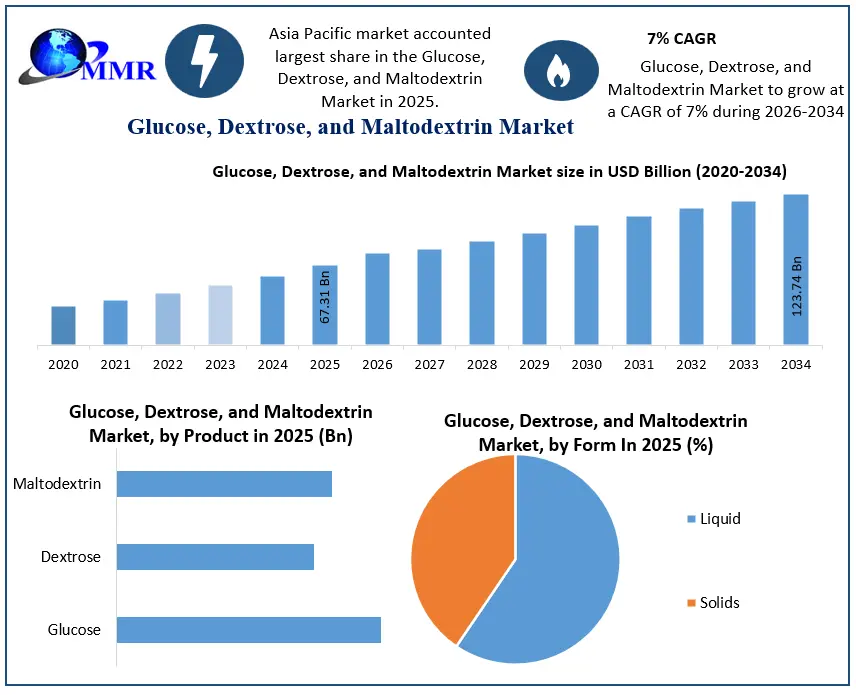
The Glucose, Dextrose, and Maltodextrin Market size was valued at USD 67.31  Billion in 2025 and the total Glucose, Dextrose, and Maltodextrin revenue is expected to grow at a CAGR of 7% from 2025 to 2032, reaching nearly USD 108.08 Billion.

Glucose, Dextrose, and Maltodextrin Market Overview:

The Glucose is the most common form of sugar and the body's primary source of energy. Dextrose is a natural sugar derived from corn, honey, and fruits. Maltodextrin is a carbohydrate used in the food industry. Demand for convenience meals is surging, increasing demand for food and beverages, and large corporations are increasing their investments are the factor which drive the growth of market.Glucose, Dextrose, and Maltodextrin MarketTo know about the Research Methodology :- Request Free Sample Report
Glucose, Dextrose, and Maltodextrin Market Dynamics:

Owing to increasing preference for convenience foods, increasing demand for maltodextrin, and the price effectiveness of glucose syrup, the increased demand for food and beverages are the factors drive the growth of  market.

Moreover increase in personal disposable income, increasing R&D activities, increased consumer awareness, increased demand for low-calorie foods, and an increase in investment by major companies are factors driving the growth of the market.

Increasing demand for chewing gum as a substitute for glucose, dextrose, and maltodextrin is considered to be one of the main factors, and it is estimated that this will reduce the growth of the glucose, dextrose and maltodextrin market. Government regulations are one of the restraints factors for the growth of market.

Glucose, Dextrose, and Maltodextrin Market Segment Analysis:

In 2025, the Liquid segment holds the highest demand in the Glucose, Dextrose, and Maltodextrin Market. Liquid forms are widely used in the food and beverage industry due to their ease of handling, quick solubility, and efficient blending in applications such as beverages, syrups, and processed foods. The Solids segment, including powders and crystals, is also witnessing steady growth, particularly in bakery, confectionery, and pharmaceutical applications where longer shelf life and ease of storage are important.

Based on Grade, Food Grade dominates the market in 2025 owing to its extensive use in food processing, confectionery, bakery, and beverage industries. These ingredients are essential as sweeteners, stabilizers, and texture enhancers. Pharmaceutical Grade is experiencing notable growth due to its increasing application in drug formulations, intravenous solutions, and nutraceuticals, driven by rising healthcare demand and pharmaceutical production.

Based on Process, Enzymatic Hydrolysis is the most preferred and fastest-growing segment in 2025. This process is favored for its efficiency, higher yield, and ability to produce consistent quality products with fewer by-products. Acid Hydrolysis, although traditionally used, is gradually declining due to environmental concerns and less precise control over product characteristics compared to enzymatic methods.

Based on Process, Enzymatic Hydrolysis is the most preferred and fastest-growing segment in 2025. This process is favored for its efficiency, higher yield, and ability to produce consistent quality products with fewer by-products. Acid Hydrolysis, although traditionally used, is gradually declining due to environmental concerns and less precise control over product characteristics compared to enzymatic methods.

Glucose, Dextrose, and Maltodextrin Market
Report Coverage Details
Base Year: 2025 Forecast Period: 2026-2032
Historical Data: 2020 to 2025 Market Size in 2025: 67.31 USD Bn
Forecast Period 2026-2032 CAGR: 7% Market Size in 2032: 108.08 USD Bn
Segments Covered: by Product Glucose
Dextrose
Maltodextrin
by Form Liquid
Solids
by Grade Food Grade
Pharmaceutical Grade
by Process Acid Hydrolysis
Enzymatic Hydrolysis
by Packaging Type Bags
Bulk
Drums
Sachets
by Application Food and Beverages
    Confectionery products
    Bakery products
    Dairy products
    Beverages
    Soups, Sauces
    Others
Pharmaceuticals
Personal Care products
Paper & pulp
Others
by Distribution Channel Direct Sales
Distributors
E-Commerce

Regional Insights:

Based on Region, Asia Pacific leads the Glucose, Dextrose, and Maltodextrin Market in 2025, driven by strong demand from the food and beverage industry, expanding population, and rapid industrialization in countries like China and India. North America follows with significant demand due to advanced food processing industries and high consumption of packaged foods. Europe shows steady growth supported by established food and pharmaceutical sectors. Meanwhile, regions such as Latin America and Middle East & Africa (MEA) exhibit moderate growth, influenced by increasing urbanization and rising demand for processed food products.

Recent development:

• In 2019, Taylor expanded its non-GMO maltodextrin production line, which is a nutritional sweetener made from non-GMO corn. -Genetically modified corn to meet the growing global demand for food grade.

The objective of the report is to present a comprehensive analysis of the global market to the stakeholders in the industry. The past and current status of the industry with the forecasted market size and trends are presented in the report with the analysis of complicated data in simple language. The report covers all the aspects of the industry with a dedicated study of key players that include market leaders, followers, and new entrants.

PORTER, PESTEL analysis with the potential impact of micro-economic factors of the market have been presented in the report. External as well as internal factors that are supposed to affect the business positively or negatively have been analysed, which will give a clear futuristic view of the industry to the decision-makers.

The report also helps in understanding the global market dynamics, structure by analyzing the market segments and projects the global market size. Clear representation of competitive analysis of key players by product, price, financial position, product portfolio, growth strategies, and regional presence in the global market make the report investor’s guide.

Glucose, Dextrose, and Maltodextrin Market Scope: Inquire before buying

Glucose, Dextrose, and Maltodextrin Market, by Region

Asia Pacific (China, South Korea, Japan, India, Australia, Indonesia, Malaysia, Vietnam, Taiwan, Bangladesh, Pakistan and Rest of APAC)
Europe (UK, France, Germany, Italy, Spain, Sweden, Austria and Rest of Europe)
North America (United States, Canada and Mexico)
Middle East and Africa (South Africa, GCC, Egypt, Nigeria and Rest of ME&A)
South America (Brazil, Argentina Rest of South America)

Glucose, Dextrose, and Maltodextrin Market Key Players

  1. Archer Daniel Midland Company (ADM)
  2. AGRANA
  3. AVEBE
  4. Cargill Incorporated
  5. COPAM
  6. Fooding Group Limited
  7. Grain Processing Corporation
  8. Gulshan Polyols Ltd.
  9. Ingredion Incorporated
  10. Luzhou Bio-Chem Technology Ltd.
  11. Matsutani Chemical Industry Co., Ltd.
  12. Roquette Frères
  13. Shandong Xiwang Sugar Industry Co. Ltd.
  14. Xingmao
  15. Südzucker AG
  16. Tate & Lyle PLC
  17. Tereos S.A.
  18. Gujarat Ambuja Exports Limited
  19. Qinhuangdao Lihua Starch Co., Ltd.
  20. Pruthvi Foods Pvt Ltd

Table of Contents

1. Glucose, Dextrose and Maltodextrin Market : Executive Summary 1.1. Study Assumption and Market Definition 1.2. Scope of the Study 1.3. Executive Summary 1.3.1 Market Size (2025) & Forecast (2026-2032), 1.3.2 Market Size (Value USD Mn.) (Volume in Kilotons) and Market Share (%) - By Segments, Regions and Country 2. Glucose, Dextrose and Maltodextrin Market : Competitive Landscapes 2.1. MMR Competition Matrix 2.2. Key Players Benchmarking 2.2.1 Company Name 2.2.2 Headquarters 2.2.3 Product Portfolio 2.2.4 Form Offering 2.2.5 Production Capacity (Kilotons) 2.2.6 Processing Technology Capabilities 2.2.7 Quality Standards & Certifications 2.2.8 Cost Competitiveness 2.2.9 Distribution Reach 2.2.10 Sustainability & ESG Initiatives 2.2.11 Profit Margin (%) 2.2.12 Revenue Growth Rate (%) 2.2.13 Market Share (%) 2.2.14 Revenue (2025) 2.2.15 R&D Investment 2.2.16 Global Presence 2.3 Competitive Positioning Of Top Key Players 2.4. Market Structure 2.4.1 Market Leaders 2.4.2 Market Followers 2.4.3 Emerging Players 2.5. Mergers, Acquisitions, and Strategic Partnerships 2.5.1 Acquisitions Expanding Sweetener and Food Ingredient Portfolios 2.5.2 Strategic Partnerships with Food, Beverage, and Pharma Companies 2.5.3 Capacity Expansion Investments in Asia-Pacific and Latin America 2.5.4 Backward Integration Strategies for Corn and Starch Security 2.5.5 Private Equity Investments in Starch and Carbohydrate Assets 2.6 R&D and Intellectual Property Landscape 2.6.1 Innovation in Clean-Label and Non-GMO Carbohydrate Ingredients 2.6.2 Advances in Enzymatic Hydrolysis Yield Optimization 2.6.3 Development of Specialty Maltodextrins with Controlled DE Values 2.6.4 Shelf-Life Stability and Texture-Enhancing Functional Innovations 2.6.5 Patent Trends Related to Processing and Application Technologies 2.7 Go-to-Market and Commercial Strategy 2.7.1 Direct Sales Versus Distributor-Led Channel Prioritization 2.7.2 Contract Pricing Models with Large Food and Beverage Buyers 2.7.3 Premium Versus Commodity Grade Portfolio Positioning 2.7.4 Regional Pricing Differentiation Based on Feedstock Economics 2.7.5 Customer Retention Strategies and Long-Term Supply Agreements 2.8 Marketing and Branding Strategy 2.8.1 Clean-Label, Natural, and Functional Ingredient Positioning 2.8.2 Application-Focused Value Proposition for Food Manufacturers 2.8.3 Sustainability and Responsible Sourcing Communication 2.8.4 Technical Marketing and Formulation Support Strategies 2.8.5 Regional Branding and Localization Approaches 3. Glucose, Dextrose and Maltodextrin Market: Dynamics 3.1. Glucose, Dextrose and Maltodextrin Market Trends 3.2. Glucose, Dextrose and Maltodextrin Market Dynamics 3.2.1 Drivers 3.2.2 Restraints 3.2.3 Opportunities 3.2.4 Challenges 3.3. PORTER’s Five Forces Analysis 3.4. PESTLE Analysis 4. Production and Processing Landscape 4.1 Global Production Volumes by Product and Processing Method 4.2 Regional Starch Processing Hubs and Manufacturing Clusters 4.3 Raw Material Availability and Agricultural Seasonality Impact 4.4 Acid Hydrolysis Versus Enzymatic Hydrolysis Technology Comparison 4.5 Cost Structure Breakdown Including Feedstock, Energy, and Labor 4.6 Capacity Utilization Across Developed and Emerging Economies 4.7 Technology Advancements in Drying, Concentration, and Blending 5. Consumption Landscape and End-Use Demand 5.1 Global Consumption Trends by Product and Application 5.2 Food and Beverage Industry Demand Across Key Categories 5.3 Pharmaceutical Industry Usage in Formulations and Excipients 5.4 Industrial Demand from Paper, Pulp, and Personal Care Sectors 5.5 Regional Consumption Differences Driven by Dietary Patterns 5.6 Per-Capita Sweetener and Carbohydrate Intake Comparison 6. Trade and Cross-Border Dynamics (2025) 6.1 Global Import and Export Flow Analysis by Product Type 6.2 Major Exporting Countries and Cost Competitiveness Assessment 6.3 Key Importing Markets and Demand-Driven Trade Patterns 6.4 Tariff Structures and Non-Tariff Trade Barriers 6.5 Price Differentials Between Domestic and Imported Products 6.6 Currency Fluctuation Impact on Global Trade Economics 7. Pricing and Market Economics (2020–2025) 7.1 Historical Pricing Trends Across Glucose, Dextrose and Maltodextrin 7.2 Regional Price Variations Influenced by Corn and Energy Costs 7.3 Impact of Agricultural Commodity Volatility on Pricing 7.4 Contract Pricing Versus Spot Market Dynamics 7.5 Competitive Pricing Strategies Among Leading Producers 7.6 Price Forecast Outlook Based on Supply–Demand Fundamentals 8. Supply Chain and Sourcing Analysis 8.1 Corn, Wheat, and Tapioca Sourcing Regions and Risk Exposure 8.2 Contract Farming and Agricultural Procurement Models 8.3 Processing, Storage, and Bulk Handling Workflow Analysis 8.4 Packaging, Warehousing, and Inventory Management Practices 8.5 Logistics Cost Analysis Across Domestic and Export Supply Chains 8.6 Sustainability, Traceability, and Responsible Sourcing Initiatives 9. Regulatory and Compliance Framework 9.1 Global Food Safety Regulations Governing Carbohydrate Ingredients 9.2 Labeling Requirements Including Sugar, Calorie, and Allergen Disclosure 9.3 Pharmaceutical Grade Standards and Pharmacopoeia Compliance 9.4 Import Regulations and Quality Inspection Protocols 9.5 Restrictions on GMOs, Residues, and Processing Aids 9.6 Compliance Challenges Across Multi-Regional Operations 10. Nutritional Trends, Health Claims & Reformulation 10.1 Low sugar mandates and reduced calories demand 10.2 Impact of clean label and natural claims on formulation 10.3 Functional positioning (gut health, energy, metabolic roles) 10.4 DE levels and consumer perception impacts 10.5 Compliance with global nutrition labeling standards 11. Consumer and Industrial Buyer Behavior 11.1 Procurement Criteria of Food and Beverage Manufacturers 11.2 Price Sensitivity and Long-Term Contract Preferences 11.3 Switching Behavior Between Sweeteners and Carbohydrate Sources 11.4 Importance of Consistency, Solubility, and Functional Performance 11.5 Sustainability and Supplier Transparency Influence 11.6 Buyer Expectations on Technical Support and Reliability 12. Product Innovation and R&D Trends 12.1 Development of Low-DE and Specialty Maltodextrins 12.2 Clean-Label and Organic Product Innovation Trends 12.3 Functional Blends for Texture, Mouthfeel, and Stability 12.4 Pharmaceutical-Grade Purity and Performance Enhancements 12.5 Investment Trends in Application-Specific Customization 12.6 R&D Collaboration Between Ingredient Suppliers and Brands 13. Technology and Processing Advancements 13.1 Advances in Enzyme Efficiency and Conversion Yield 13.2 Automation and Digital Process Control Integration 13.3 Energy Optimization and Water Usage Reduction Technologies 13.4 Waste Reduction and By-Product Utilization Techniques 13.5 Smart Manufacturing and Predictive Maintenance Adoption 13.6 Technology Scalability and Capital Investment Requirements 14. Packaging and Distribution Channel Analysis 14.1 Packaging Formats Including Bags, Bulk, Drums, and Sachets 14.2 Impact of Packaging Choice on Shelf Stability and Handling 14.3 Direct Sales Versus Distributor-Led Channel Economics 14.4 Growth of E-Commerce and Digital Procurement Platforms 14.5 Regional Distribution Network Optimization Strategies 14.6 Private Label and Contract Manufacturing Opportunities 15. Substitutes and Competitive Threat Analysis 15.1 Competition from Alternative Sweeteners and Carbohydrates 15.2 Functional Substitution by Fibers, Polyols, and Proteins 15.3 Cost-Performance Trade-Off in Formulation Decisions 15.4 Regulatory Influence on Substitution Trends 15.5 Switching Costs and Reformulation Timelines 15.6 Long-Term Competitive Threat Assessment 16. Sustainability and Environmental Impact 16.1 Carbon Footprint of Starch and Carbohydrate Processing 16.2 Water Consumption and Effluent Treatment Practices 16.3 Renewable Energy Adoption in Processing Facilities 16.4 ESG Reporting and Sustainability Disclosure Requirements 16.5 Customer Demand for Low-Impact Ingredients 16.6 Long-Term Sustainability Risks and Opportunities 17. Global Adoption Trends and Future Outlook 17.1 Regional Adoption Trends Across Mature and Emerging Markets 17.2 Demand Growth Driven by Processed Food Expansion 17.3 Impact of Health Trends on Long-Term Consumption 17.4 Innovation-Driven Shift Toward Functional Carbohydrates 17.5 Role of Policy, Regulation, and Consumer Awareness 17.6 Market Outlook and Strategic Implications Through 2032 18. Value Chain Mapping & End‑to‑End Economics 18.1 Raw material inputs: corn, cassava, wheat 18.2 Production & conversion pathways 18.3 Downstream formulation nodes: syrups, powders, specialty grades 18.4 Distribution and logistics (bulk, cold chain, regional hubs) 18.5 End‑use aggregation and value capture points 19. Raw Material Sourcing & Feedstock Economics 19.1 Corn starch supply dynamics 19.2 Cassava and tropical feedstock trends 19.3 Wheat and alternative starch feedstock streams 19.4 Commodity price correlation with product pricing 19.5 Global feedstock dependency and import vulnerability 20. Liquid vs Powdered Formats: Adoption Economics 20.1 Cost, handling and storage differences 20.2 Conversion economics for processors 20.3 Shelf life and quality integrity factors 20.4 Channel preference analysis 20.5 Product differentiation and pricing impact 21. E‑Commerce & Digital Food Supply Disruption 21.1 Online sales share by product & channel 21.2 Marketplace pricing and SKU proliferation 21.3 Direct‑to‑food manufacturers models 21.4 Subscription & automated reordering impact 21.5 Digital loyalty and data capture strategies 22. Global Glucose, Dextrose and Maltodextrin Market: Market Size and Forecast by Segmentation (by Value in USD Million and Volume in Kilotons) (2025-2032) 22.1. Global Glucose, Dextrose and Maltodextrin Market Size and Forecast, by Product (2025-2032) 22.1.1 Glucose 22.1.2 Dextrose 22.1.3 Maltodextrin 22.2. Global Glucose, Dextrose and Maltodextrin Market Size and Forecast, by Form (2025-2032) 22.2.1 Liquid 22.2.2 Solids 22.3. Global Glucose, Dextrose and Maltodextrin Market Size and Forecast, by Grade (2025-2032) 22.3.1 Food Grade 22.3.2 Pharmaceutical Grade 22.4. Global Glucose, Dextrose and Maltodextrin Market Size and Forecast, by Process (2025-2032) 22.4.1 Acid Hydrolysis 22.4.2 Enzymatic Hydrolysis 22.5. Global Glucose, Dextrose and Maltodextrin Market Size and Forecast, by Packaging Type (2025-2032) 22.5.1 Bags 22.5.2 Bulk 22.5.3 Drums 22.5.4 Sachets 22.6. Global Glucose, Dextrose and Maltodextrin Market Size and Forecast, by Application (2025-2032) 22.6.1 Food and Beverages 22.6.2 Confectionery products 22.6.3 Bakery products 22.6.4 Dairy products 22.6.5 Beverages 22.6.6 Soups, Sauces, and Dressings 22.6.7 Others 22.6.8 Pharmaceuticals 22.6.9 Personal Care products 22.6.10 Paper & pulp 22.6.11 Others 22.7. Global Glucose, Dextrose and Maltodextrin Market Size and Forecast, by Distribution Channel (2025-2032) 22.7.1 Direct Sales 22.7.2 Distributors 22.7.3 E-Commerce 22.8. Global Glucose, Dextrose and Maltodextrin Market Size and Forecast, by Region (2025-2032) 22.8.1 North America 22.8.2 Europe 22.8.3 Asia Pacific 22.8.4 Middle East and Africa 22.8.5 South America 23. North America Glucose, Dextrose and Maltodextrin Market Size and Forecast by Segmentation (by Value in USD Million and Volume in Kilotons) (2025-2032) 23.1. North America Market Size and Forecast, by Product (2025-2032) 23.2. North America Market Size and Forecast, by Form (2025-2032) 23.3. North America Market Size and Forecast, by Grade (2025-2032) 23.4. North America Market Size and Forecast, by Process (2025-2032) 23.5. North America Market Size and Forecast, by Packaging Type (2025-2032) 23.6. North America Market Size and Forecast, by Application (2025-2032) 23.7. North America Market Size and Forecast, by Distribution Channel (2025-2032) 23.8. North America Market Size and Forecast, by Country (2025-2032) 23.8.1 United States 23.8.2 Canada 23.8.3 Mexico 24. Europe Glucose, Dextrose and Maltodextrin Market Size and Forecast by Segmentation (by Value in USD Million and Volume in Kilotons) (2025-2032) 24.1. Europe Market Size and Forecast, by Product (2025-2032) 24.2. Europe Market Size and Forecast, by Form (2025-2032) 24.3. Europe Market Size and Forecast, by Grade (2025-2032) 24.4. Europe Market Size and Forecast, by Process (2025-2032) 24.5. Europe Market Size and Forecast, by Packaging Type (2025-2032) 24.6. Europe Market Size and Forecast, by Application (2025-2032) 24.7. Europe Market Size and Forecast, by Distribution Channel (2025-2032) 24.8. Europe Market Size and Forecast, by Country (2025-2032) 24.8.1 United Kingdom 24.8.2 France 24.8.3 Germany 24.8.4 Italy 24.8.5 Spain 24.8.6 Sweden 24.8.7 Russia 24.8.8 Rest of Europe 25. Asia Pacific Glucose, Dextrose and Maltodextrin Market Size and Forecast by Segmentation (by Value in USD Million and Volume in Kilotons) (2025-2032) 25.1. Asia Pacific Market Size and Forecast, by Product (2025-2032) 25.2. Asia Pacific Market Size and Forecast, by Form (2025-2032) 25.3. Asia Pacific Market Size and Forecast, by Grade (2025-2032) 25.4. Asia Pacific Market Size and Forecast, by Process (2025-2032) 25.5. Asia Pacific Market Size and Forecast, by Packaging Type (2025-2032) 25.6. Asia Pacific Market Size and Forecast, by Application (2025-2032) 25.7. Asia Pacific Market Size and Forecast, by Distribution Channel (2025-2032) 25.8. Asia Pacific Market Size and Forecast, by Country (2025-2032) 25.8.1 China 25.8.2 South Korea 25.8.3 Japan 25.8.4 India 25.8.5 Australia 25.8.6 Indonesia 25.8.7 Philippines 25.8.8 Malaysia 25.8.9 Vietnam 25.8.10 Thailand 25.8.11 Rest of Asia Pacific 26. Middle East and Africa Glucose, Dextrose and Maltodextrin Market Size and Forecast by Segmentation (by Value in USD Million and Volume in Kilotons) (2025-2032) 26.1. Middle East and Africa Market Size and Forecast, by Product (2025-2032) 26.2. Middle East and Africa Market Size and Forecast, by Form (2025-2032) 26.3. Middle East and Africa Market Size and Forecast, by Grade (2025-2032) 26.4. Middle East and Africa Market Size and Forecast, by Process (2025-2032) 26.5. Middle East and Africa Market Size and Forecast, by Packaging Type (2025-2032) 26.6. Middle East and Africa Market Size and Forecast, by Application (2025-2032) 26.7. Middle East and Africa Market Size and Forecast, by Distribution Channel (2025-2032) 26.8. Middle East and Africa Market Size and Forecast, by Country (2025-2032) 26.8.1 South Africa 26.8.2 GCC 26.8.3 Turkey 26.8.4 Egypt 26.8.5 Nigeria 26.8.6 Rest of ME&A 27. South America Glucose, Dextrose and Maltodextrin Market Size and Forecast by Segmentation (by Value in USD Million and Volume in Kilotons) (2025-2032) 27.1. South America Market Size and Forecast, by Product (2025-2032) 27.2. South America Market Size and Forecast, by Form (2025-2032) 27.3. South America Market Size and Forecast, by Grade (2025-2032) 27.4. South America Market Size and Forecast, by Process (2025-2032) 27.5. South America Market Size and Forecast, by Packaging Type (2025-2032) 27.6. South America Market Size and Forecast, by Application (2025-2032) 27.7. South America Market Size and Forecast, by Distribution Channel (2025-2032) 27.8. South America Market Size and Forecast, by Country (2025-2032) 27.8.1 Brazil 27.8.2 Argentina 27.8.3 Colombia 27.8.4 Chile 27.8.5 Rest Of South America 28. Company Profile: Key Players 28.1. Archer Daniel Midland Company (ADM) 28.1.1 Company Overview 28.1.2 Business Portfolio 28.1.3 Financial Overview 28.1.4 SWOT Analysis 28.1.5 Strategic Analysis 28.2. AGRANA 28.3. AVEBE 28.4. Cargill Incorporated 28.5 COPAM 28.6. Fooding Group Limited 28.7. Grain Processing Corporation 28.8. Gulshan Polyols Ltd. 28.9. Ingredion Incorporated 28.10.Luzhou Bio-Chem Technology Ltd. 28.11.Matsutani Chemical Industry Co., Ltd. 28.12.Roquette Frères 28.13.Shandong Xiwang Sugar Industry Co.Ltd 28.14.Xingmao 28.15.Südzucker AG 28.16.Tate & Lyle PLC 28.17.Tereos S.A. 28.18.Gujarat Ambuja Exports Limited 28.19.QINHUANGDAO LIHUA STARCH Co.,Ltd.. 28.20.Pruthvi Foods Pvt Ltd 28.20.1 Others 29. Key Findings 30. Future Outlook and Opportunity Landscape 31. Glucose, Dextrose and Maltodextrin Market: Research Methodology

Custom Market Research Services

We Will Customise The Research For You, In Case The Report Listed Above Does Not Meet With Your Requirements