
Glass Substrate Market Size by Type, End User, Region – Segment-Level Market Assessment, Growth Opportunity Analysis, Competitive Mapping & Forecast to 2032
Overview
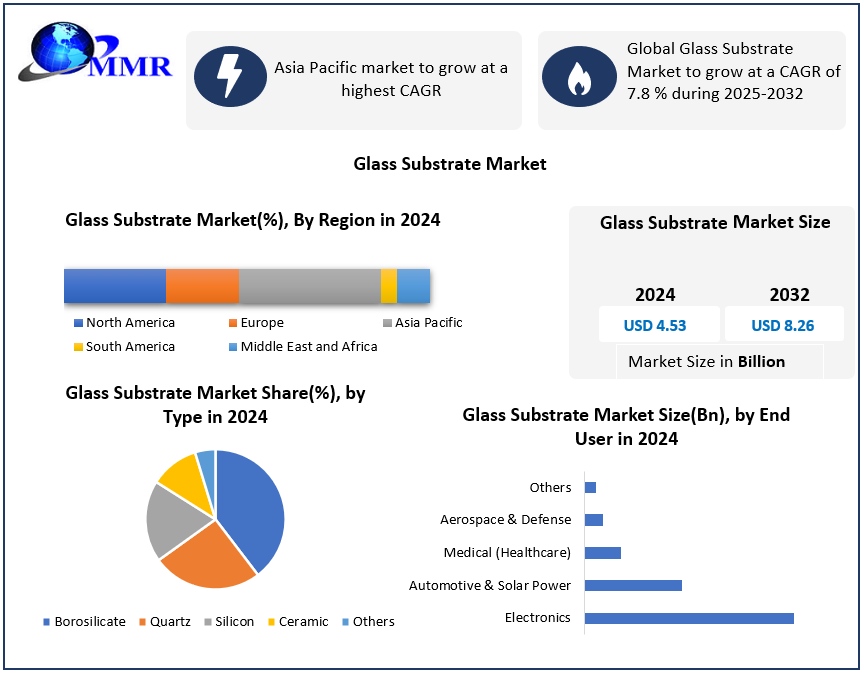
Global Glass Substrate Market size was valued at USD 4.53 Bn. in 2024 and the total Glass Substrate Market revenue is expected to grow by 7.8 % from 2025 to 2032, reaching nearly USD 8.26 Bn.
Glass Substrate Market Overview:
In materials science and engineering, the substrate is the foundation component on which processing takes place. This layer is used to create new films or material coatings, e.g. deposited coverings. It might be the foundation to which paint, glue, or sticky tape adhere. A hard substrate, e.g. metal, cement, or glass, could be used to apply a layer. Malleable substrates are also utilized. The report explores the Glass Substrate market's segments (Type, End-User Industry, and Region). Data has been provided by market participants, and regions (North America, Asia Pacific, Europe, Middle East & Africa, and South America). It provides a thorough analysis of the rapid advances that are currently taking place across all industry sectors. Facts and figures, illustrations, and presentations are used to provide key data analysis for the historical period from 2018-2023. The report investigates the Glass Substrate market's drivers, limitations, prospects, and barriers. This MMR report includes investor recommendations based on a thorough examination of the Glass Substrate market's contemporary competitive scenario.
 To know about the Research Methodology :- Request Free Sample Report
Glass Substrate Market Dynamics:
A major driver of the market is that in the automobile sector, there has been an increase in the usage of fiberglass composites.
Fiberglass offers a greater strength-to-weight ratio, which is significant in the automotive industry. Vehicles made of lightweight, high-strength materials provide higher mileage and better fuel economy. To minimize carbon dioxide emissions, the automobile sector has been subjected to rigorous restrictions. This has prompted the automotive industry to develop fuel-efficient compact cars to cut greenhouse gas emissions. In the automobile industry, fiberglass substrates are frequently utilized as an alternative to aluminum and steel in the production of lightweight cars.
The key opportunity in the market is that solar power-producing facilities have a lot of promise in the glass substrate industry.
The price of power is always rising; as a result, the need for alternative energy sources has increased during the previous decade. Solar energy is one of the substitutes for traditional energy sources. The functionality of photochromic smart glass substrates is affected by sunshine, either actively or passively. The adoption of such smart glass substrates significantly reduces power usage, particularly for heating and cooling systems. Solar power-producing plants are one of the growing possible applications of smart glass substrates. Smart glass panels are used in solar panels to capture as much light as possible to create power. In the future, the solar power generating sector is likely to provide several potentials for smart glass technologies.
A major challenge in the market is that glass production consumes a lot of fuel.
A huge quantity of fuel is used in the glass-making process to liquefy raw ingredients. This also results in the release of hazardous gases e.g. carbon dioxide. There is a desire for novel production procedures that reduce fuel use. Companies e.g. Nippon Sheet Glass (Japan), which are important participants in the insulated glass window industry, are developing innovative methods to cut fuel usage, which would not only lower manufacturing costs but also help them adhere to several carbon credits rules. This would assist these businesses in achieving long-term success.
Glass Substrate Market Segment Analysis:
By End-User Industry, the electronics segment is expected to grow at a CAGR of 4.1% in the forecast period. The glass substrate is widely and diversely used in the electronics sector. They are utilized in the production of semiconductor circuits for a variety of applications. Glass substrate uses in semiconductors include CMOS, MEMS, image, sensors, LEDs, Integrated Circuits, Power Devices, and optoelectronics. With rising demand from emerging nations, the electronics sector is seeing astonishing growth. Electronic systems and networks, variable frequency drives, factory control devices, and other sub-sectors are expected to grow rapidly in the future years.
By Type, the Borosilicate segment has dominated the market in 2024. This dominance is driven by borosilicate glass’s exceptional thermal stability, low thermal expansion, high chemical resistance, and cost-effectiveness, making it the preferred choice for critical applications like LCD panels, touchscreens, optical devices, and precision electronics. Its balanced mechanical properties and processability enable large-scale production at competitive prices, unlike higher-cost materials like quartz or ceramics that are used mainly in niche or high-purity applications. As a result, borosilicate continues to hold the largest market share among glass substrate types.
Glass Substrate Market Regional Insights:
Due to increased consumption in countries e.g. China, India, and Japan, the APAC region is the main market and is anticipated to be the fastest-growing market. China is the world's largest producer of electronic goods. Not only does the country meet domestic consumption for electronics, but it also distributes electronic products to foreign countries. Electronics output is expected to increase further throughout the projection period, owing to rising middle-class spending power and rising demand for electronic items in nations purchasing digital products from China. Furthermore, the country offers one of the world's largest medical fields. The Chinese government stresses welfare and technology in the 13th Five-Year Plan, which is likely to enhance expenditures in the biotechnology and pharmaceutical industry throughout the projection period. This, in turn, is predicted to boost the manufacturing of high-tech medical equipment used to relieve severe and age-related disorders in the nation, increasing demand for the market under consideration.
Glass Substrate Industry Ecosystem
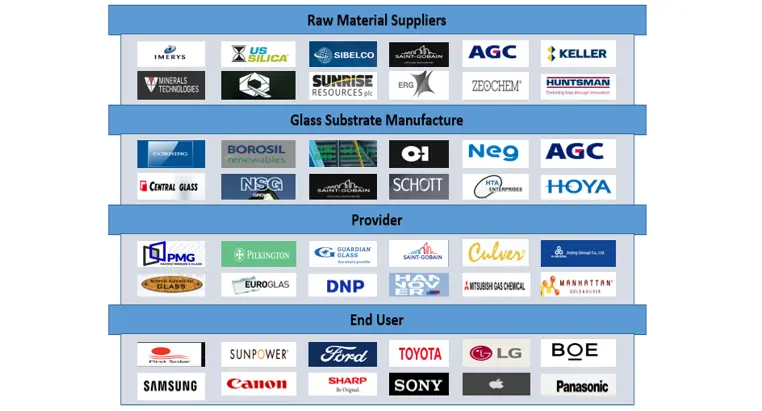
The objective of the report is to present a comprehensive analysis of the Glass Substrate market to the stakeholders in the industry. The past and current status of the industry with the forecasted market size and trends are presented in the report with the analysis of complicated data in simple language. The report covers all the aspects of the industry with a dedicated study of key players that include market leaders, followers, and new entrants.
PORTER, PESTEL analysis with the potential impact of micro-economic factors of the market have been presented in the report. External as well as internal factors that are supposed to affect the business positively or negatively have been analyzed, which will give a clear futuristic view of the industry to the decision-makers.
The report also helps in understanding the Glass Substrate market dynamics, and structure by analyzing the market segments and projecting the Glass Substrate market size. Clear representation of competitive analysis of key players by product, price, financial position, product portfolio, growth strategies, and regional presence in the Glass Substrate market make the report investor’s guide.
Glass Substrate Market Scope: Inquiry Before Buying
| Glass Substrate Market | |||
|---|---|---|---|
| Report Coverage | Details | ||
| Base Year: | 2024 | Forecast Period: | 2025-2032 |
| Historical Data: | 2019 to 2024 | Market Size in 2024: | USD 4.53 Bn. |
| Forecast Period 2025 to 2032 CAGR: | 7.8% | Market Size in 2032: | USD 8.26 Bn. |
| Segments Covered: | by Type | Borosilicate Silicon Ceramic Quartz Others |
|
| by End User | Automotive Aerospace and Defense Healthcare Solar Power Electronics Others |
||
Glass Substrate Market, by Region
North America (United States, Canada and Mexico)
Europe (UK, France, Germany, Italy, Spain, Sweden, Austria and Rest of Europe)
Asia Pacific (China, South Korea, Japan, India, Australia, Indonesia, Malaysia, Vietnam, Taiwan, Bangladesh, Pakistan and Rest of APAC)
Middle East and Africa (South Africa, GCC, Egypt, Nigeria and Rest of ME&A)
South America (Brazil, Argentina Rest of South America)
Glass Substrate Market, Key Players
• AGC
• SCHOTT
• Corning Inc.
• Nippon Sheet Glass
• Plan Optik
• HOYA Corporation
• LG Chem
• OHARA Inc.
• IRICO Group New Energy Company Limited
• The Tunghsu Group
• Viracon
• Guardian Glass
• Asahi Glass Co., Ltd.
• Dongxu Group Co., Ltd.
• Saint-Gobain
• China Glass Holdings Limited
FAQs:
1. Which is the potential market for the Glass Substrate in terms of the region?
Ans. APAC is the potential market for the Glass Substrate in terms of the region.
2. What are the opportunities for new market entrants?
Ans. The key opportunity in the market is that solar power-producing facilities have a lot of promise in the glass substrate industry.
3. What is expected to drive the growth of the Glass Substrate market in the forecast period?
Ans. A major driver of the market is that in the automobile sector, there has been an increase in the usage of fiberglass composites.
4. What is the projected market size & growth rate of the Glass Substrate Market?
Ans. Glass Substrate Market size was valued at USD 4.53 Billion in 2024 and the total Glass Substrate revenue is expected to grow by 7.8% from 2025 to 2032, reaching nearly USD 8.26 Billion.
5. What segments are covered in the Glass Substrate Market report?
Ans. The segments covered are Type, End-User Industry, and Region.