
Germanium Market By Product Type Grade, Form, Production Source, Application, End-Use Industry, Sales Channel and Region 2034
Overview
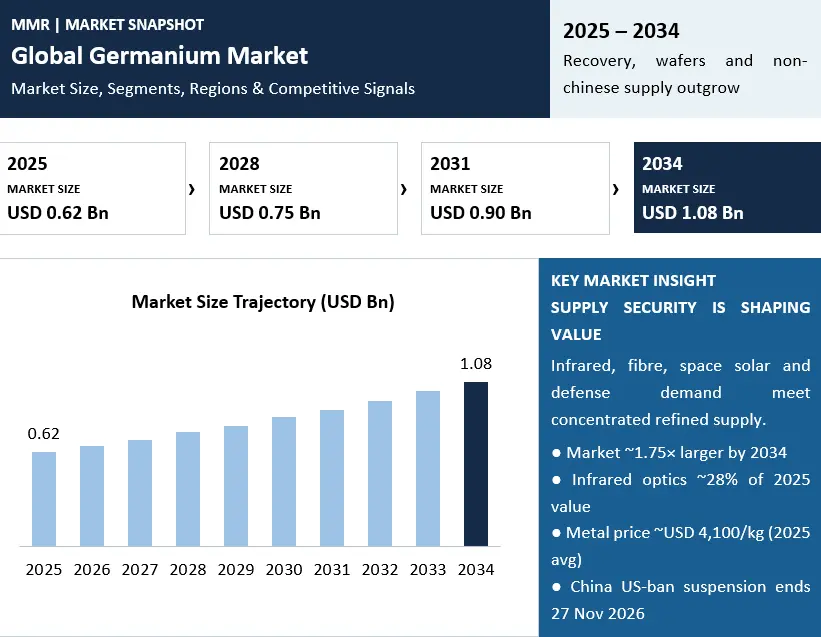
The Global Germanium Market was valued at USD 0.62 billion in 2025 and is projected to reach USD 1.08 billion by 2034, growing at a CAGR of 6.4% during 2026–2034, according to Maximize Market Research (MMR). Germanium is a brittle, silver-grey metalloid (element 32) recovered almost entirely as a by-product of zinc smelting, coal fly ash and recycled scrap. Its transparency to infrared light, high refractive index and semiconductor behaviour make it a strategic input for thermal imaging optics, optical fibre, space-grade solar cells, silicon-germanium (SiGe) chips and radiation detectors.
This germanium market analysis, covering germanium market size, trends and growth, answers both sides of the search: what the germanium industry is worth for producers, refiners and investors, and what buyers and engineers want to know, from how germanium is extracted and refined to germanium metal and germanium dioxide pricing, high-purity germanium grades, germanium semiconductor applications and germanium infrared optics.
Infrared optics and defence lead germanium demand, with fibre optics, semiconductors and space solar close behind, but germanium market growth is shifting toward wafers and substrates, secondary recovery, North America and non-Chinese supply as export controls and record prices reshape the germanium supply and demand balance.
Maximize Market Research provides comprehensive analysis of global germanium market size, share, product type, grade, form, production source, application, end-use industry, sales channel and regional segmentation, the germanium competitive landscape, strategic scenarios and growth opportunities. The report helps miners, zinc smelters, refiners, wafer and optics manufacturers, recyclers, distributors and investors decide which segments, channels and countries to prioritise through 2034.
Global Germanium Market Overview:
The market is measured at product level across germanium metal (ingots, bars, pellets and powders), germanium dioxide (GeO₂), germanium tetrachloride (GeCl₄), other germanium compounds and processed forms such as wafers and substrates, valued at producer-level selling prices and sold worldwide for optical, electronic, photonic, solar, chemical and scientific use. Mining of zinc and coal feedstock, finished infrared systems, optical fibre cable and solar panels are excluded.
Three shifts shape 2026–2034: demand is broadening from infrared optics into space solar, SiGe electronics and high-speed photonics; supply is being rebuilt outside China through refining, recycling and by-product recovery projects; and value is moving toward high-purity grades, wafers and secondary germanium. Producers are answering price volatility and export licensing with long-term supply agreements and qualified non-Chinese sources, and this germanium market analysis tracks those moves through the germanium market forecast to 2034.
To know about the Research Methodology: Request Free Sample Report
Germanium Quick Answers: 20 Most-Searched Questions About Germanium, Answered in One Line
This report is built around what procurement teams, optics and semiconductor engineers, producers and investors actually search for. Use this table for instant answers, then jump to the section named in the last column.
| USD 0.62 Bn in 2025 (MMR); USD 1.08 Bn by 2034 at 6.4% CAGR | How big is the global germanium market? | Market Size |
| Short answer | Question people search | Section |
| Value rises about 1.75× to USD 1.08 Bn; volume grows from about 215 to 283 metric tons | What is the germanium market forecast to 2034? | Forecast |
| 6.4% CAGR on MMR’s base; published estimates range from about 3% to 8.5% | How fast is germanium market growth? | Growth |
| Asia Pacific leads with 46% share; North America is fastest at 7.2% CAGR | Which region has the largest germanium market share? | Regional |
| A brittle metalloid (element 32) recovered as a by-product of zinc smelting, coal fly ash and scrap | What is germanium? | Overview |
| About 44% of 2025 value; zone-refined ingots, bars and wafers; USGS-reported 2025 price about USD 4,100/kg | What is the germanium metal market? | Segmentation |
| About 27% of 2025 value at 6.6% CAGR; fibre, PET catalyst and metal feedstock; price about USD 2,500/kg | What is the germanium dioxide market? | Segmentation |
| Germanium refined to 5N–6N or better; used in detectors, optics and electronics; high-purity grade is about 24% of value | What is high-purity germanium? | Grades |
| SiGe chips, germanium wafers, photodetectors and Ge-on-Si photonics; about 15% of value at 7.6% CAGR | What are the main germanium semiconductor applications? | Applications |
| It transmits roughly 2–14 microns and has a high refractive index; infrared optics is the largest use at about 28% | Why is germanium used in infrared optics? | Applications |
| Germanium tetrachloride dopes the silica core to raise its refractive index; fibre and photonics is about 21% of value | How is germanium used in fibre optics? | Applications |
| Germanium substrates carry multijunction III-V cells for satellites; solar and PV is about 12% of value at 8.4% CAGR | Why does space solar use germanium? | Applications |
| Tight outside China: by-product supply, roughly 60–70% Chinese refining, export licensing since August 2023 | What does germanium supply and demand look like? | Supply & Demand |
| Zinc ore residues about 58%, coal fly ash about 17%, recycling about 16%, other by-products about 9% | Where does germanium come from? | Raw Materials |
| 2025 averages of about USD 4,100/kg (metal) and USD 2,500/kg (dioxide); Western spot above USD 6,000/kg in mid-2026 | What is the current germanium price? | Pricing |
| Licensing since August 2023; US ban suspended until 27 Nov 2026; military end-user ban remains | What are China’s germanium export controls? | Regulation |
| Yunnan Chihong, China Germanium, Umicore, Teck, 5N Plus, Nyrstar, Korea Zinc, Dowa and PPM Pure Metals | Who are the leading germanium producers? | Competitive |
| Defense and military 24%, telecom and optical networking 21%, semiconductor and electronics 17% of 2025 value | Who buys germanium? | End User |
| Direct sales at about 48%; online specialty platforms are the fastest at about 8.0% CAGR | Which sales channel is largest for germanium? | Channels |
| Yes: secondary recovery is about 16% of supply value and the fastest source at 9.4% CAGR | Is germanium recycling growing? | Recycling |
Key Findings: Eight Insights Shaping the Global Germanium Market
MMR’s analysis of published market data, USGS price statistics, company announcements, government funding awards, and trade-policy notices points to eight findings that explain where germanium market growth and value are created through 2034.
| Sr.No. | Findings | Evidence | So what |
| 1 | The market grows about 1.75× by 2034 | USD 0.62 Bn (2025) to USD 1.08 Bn (2034) at 6.4% CAGR | Refining, zone-refining and wafer capacity must expand ahead of demand |
| 2 | Price and mix drive half of value growth | Volume grows about 3.1% a year; value 6.4%; 2025 metal price about USD 4,100/kg | Producers with high-purity grades capture the margin |
| 3 | Asia Pacific is the largest region | 46% share in 2025, led by Chinese production, refining and consumption | Chinese licensing policy sets global availability and pricing |
| 4 | North America is the fastest-growing region | 7.2% CAGR; US DPA awards of USD 18.1 Mn (5N Plus) and USD 11.8 Mn (Umicore) | Reshoring creates qualified local supply for defense and space |
| 5 | Infrared optics is the largest application | About 28% of 2025 value; germanium transmits roughly 2–14 microns | Defense budgets and thermal imaging set demand stability |
| 6 | Fibre optics and GeCl₄ grow faster than the market | GeCl₄ about 20% of value, 7.4% CAGR; fibre and photonics about 21% | Telecom and data-centre build-outs support tetrachloride demand |
| 7 | Secondary recovery is the fastest source | About 16% of 2025 value; 9.4% CAGR from scrap, lenses and solar cells | Recyclers able to requalify material win long-term contracts |
| 8 | Export controls make supply security the key risk | China’s US ban suspension ends 27 Nov 2026; Teck, 5N Plus and Korea Zinc expansions | Buyers should qualify non-Chinese sources and sign long-term agreements |
Global Germanium Market Size, Share and Germanium Market Forecast, 2025–2034
MMR sizes the Global Germanium Market at USD 0.62 billion in 2025, rising to USD 0.66 billion in 2026 and USD 1.08 billion in 2034, a 6.4% CAGR. The germanium market forecast adds about USD 0.46 billion over the period; about 43% of the 2034 market is revenue that does not exist today. Volume is estimated at 215 metric tons of contained germanium in 2025, growing at 3.1% per year to about 283 metric tons by 2034, so roughly half of value growth comes from price and a richer mix of high-purity grades, wafers and compounds. The germanium market share of the largest segments is covered below. Published germanium market size estimates differ widely because of scope and price assumptions: most 2025 values sit between about USD 0.27 billion and USD 0.35 billion with growth of about 3% to 5%, while at least one publisher reports about USD 1.8 billion at 8.5%. MMR’s base values all four product families and processed forms at 2025 prices, when USGS-reported average prices reached about USD 4,100 per kilogram for germanium metal and USD 2,500 per kilogram for germanium dioxide.
Global Germanium Market Dynamics:
Global Germanium Market Growth Drivers: Infrared Optics, Defense Spending, Fibre Optics and Space Solar Cells
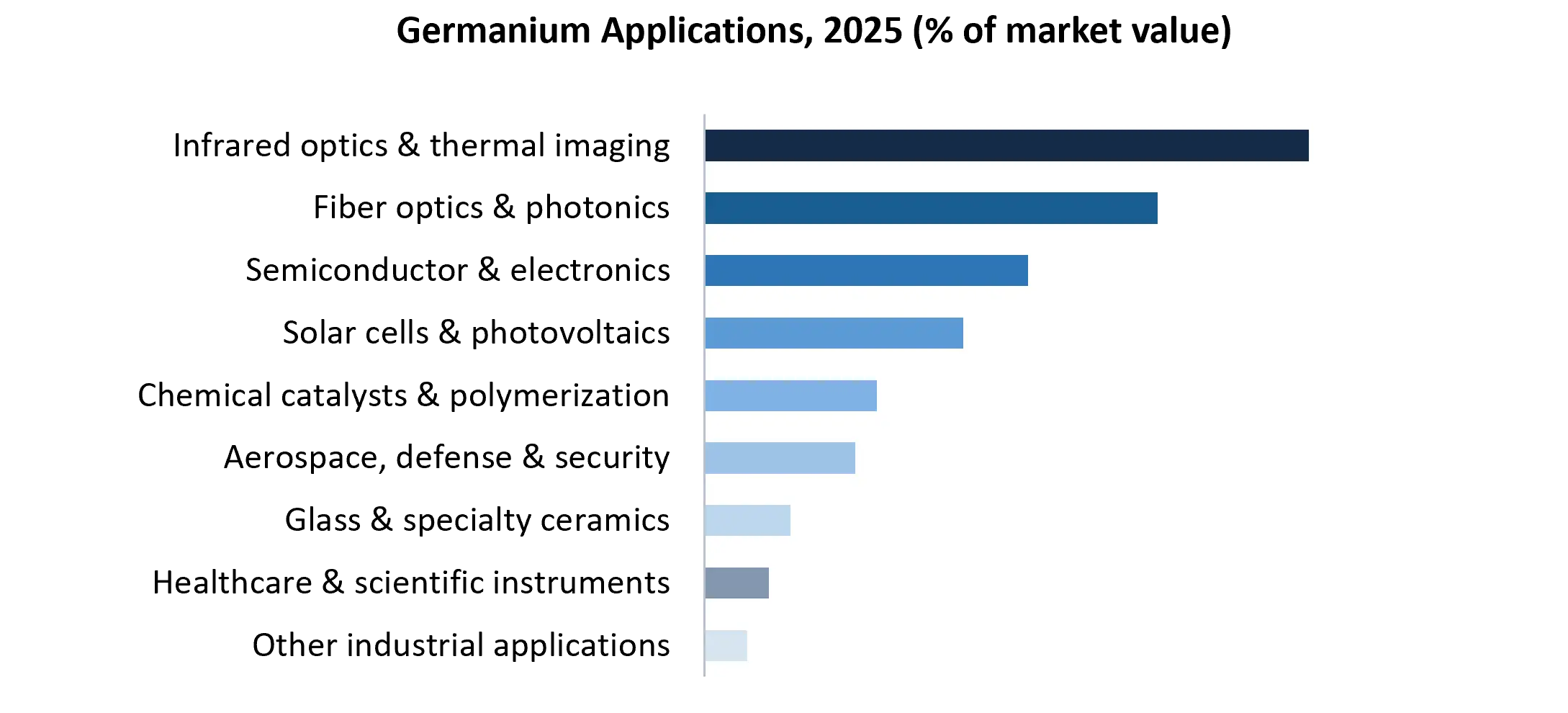
The Global Germanium Market is supported by demand from technologies that few other materials can serve. Germanium transmits infrared radiation in roughly the 2–14 micron band and has a high refractive index, which makes it the benchmark material for germanium infrared optics: lenses, windows and prisms in thermal cameras, night-vision equipment, targeting systems and missile seekers. Rising defence budgets and modernization programmes keep thermal-imaging procurement active, and infrared optics and thermal imaging account for about 28% of 2025 value, the largest application. Germanium tetrachloride is the dopant source that raises the refractive index of the silica core in optical fibre, so broadband, 5G backhaul and data-centre interconnect build-outs sustain demand for GeCl₄, which holds about 20% of 2025 value and is projected to grow at 7.4% CAGR. These factors give the germanium industry a base of demand that is partly defense-funded and partly tied to telecommunications capital spending.
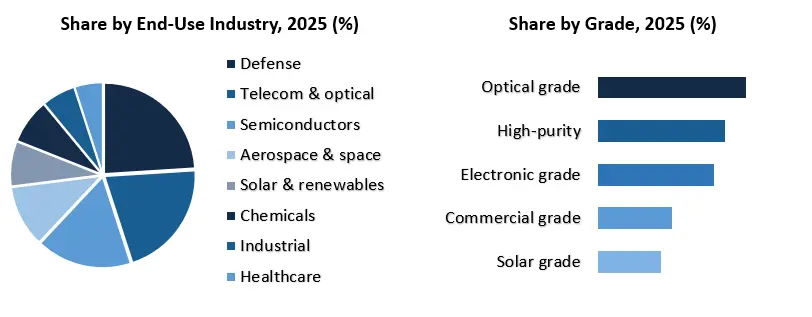
Space power, semiconductors and high-purity materials add newer layers of demand. Germanium wafers and substrates are the base layer for multijunction III-V solar cells that power satellites, and satellite constellations and national space programmes are expanding that market; solar and photovoltaics make up about 12% of 2025 value and are projected to grow at about 8.4% CAGR. Germanium semiconductor applications include silicon-germanium (SiGe) devices for high-frequency and automotive radar chips, germanium photodetectors and germanium-on-silicon photonics for optical interconnects, and these applications account for about 15% of value and grow at about 7.6%. High-purity germanium (HPGe) crystals are also used in gamma-ray spectroscopy, nuclear safeguards, and physics experiments. High-purity, optical and electronic grades together hold about 74% of 2025 value, which shows how quickly purity is becoming the main source of pricing power in the germanium metal market.
Global Germanium Market Restraints: Concentrated Supply, By-Product Dependence, Export Controls and Price Volatility
Germanium supply and demand are structurally tight for buyers outside China. Germanium has no primary mines of its own: it is recovered from zinc concentrates, coal fly ash and recycled scrap, so output depends on zinc smelter throughput and on the germanium content of feedstock rather than on germanium prices. Industry estimates commonly put China at roughly 60% to 70% of refined supply, and USGS notes that global refinery production and recycling data are limited, which makes the market opaque. China introduced licensing for germanium and gallium exports in August 2023 and in December 2024 announced that exports to the United States would not be permitted in principle; that ban was suspended in November 2025 until 27 November 2026, while the licensing regime and the prohibition on military end users remain in place. Western buyers therefore carry rollover risk and have paid large premiums: USGS-reported 2025 average prices of about USD 4,100 per kilogram for metal and USD 2,500 for germanium dioxide were roughly double 2024 levels, and trade sources reported Western spot quotes above USD 6,000 per kilogram in mid-2026.
Substitution, demand cyclicality and capital intensity also limit growth. Chalcogenide glasses and zinc selenide can replace germanium in some infrared systems, titanium and antimony catalysts compete with germanium dioxide in polyethylene terephthalate (PET) production, and some space programmes are developing cells that do not require germanium substrates, so high prices accelerate substitution. Infrared optics depend on government procurement, which can be delayed by budget cycles, while telecom demand follows network investment. New refining and zone-refining capacity is slow to build: the funded Western projects typically take 24 to 48 months or more to reach commercial output, and they need non-Chinese concentrates, intermediates or scrap that are themselves scarce. Quality qualification is another barrier, because defense, space and fibre customers require certified purity and traceability that new suppliers must demonstrate before winning orders.
What Are the Biggest Germanium Market Opportunities Through 2034?
Secondary recovery, wafers and substrates, and non-Chinese refining represent the most significant opportunities because they extend revenue beyond commodity metal. Secondary germanium recovered from semiconductor scrap, infrared lenses, solar cells and fibre manufacturing waste is projected to grow at about 9.4% CAGR from a base of roughly 16% of 2025 value, and recyclers that can requalify material to optical and electronic grades gain pricing power. Wafers and substrates are projected to grow at about 8.6%, supported by satellite solar demand. Government funding is creating supply: in January 2026 the US Department of War announced USD 18.1 million for 5N Plus to raise recovered high-purity germanium output roughly sevenfold to more than 20 tonnes a year, and USD 11.8 million for Umicore Optical Materials at Quapaw, Oklahoma; in July 2026 Teck signed an agreement with the Canada Growth Fund for up to C$400 million within a C$850 million plan to double germanium and antimony capacity at its Trail smelter.
Regional diversification and new compounds offer further routes to growth. North America is projected to be the fastest-growing region at about 7.2% CAGR as defense, space and reshoring programmes fund local refining, while Korea Zinc has outlined a germanium line at Onsan in South Korea and a planned smelter in Tennessee with about 44 tonnes a year of germanium from the end of the decade. Long-term supply agreements between producers and optics, fibre and solar customers, germanium-on-silicon photonics for data-centre optical links, and low-loss germanium-doped fibre for next-generation networks give suppliers ways to lock in demand. Defense-grade qualification, traceable supply chains and recycling partnerships are likely to become differentiators, and producers that combine refining with wafer or optics processing can capture more of the value chain.
Germanium Market Trends: Supply Diversification, High-Purity Demand, Recycling and Space-Grade Solar
Four germanium market trends stand out through 2034, and each shapes germanium market growth and the germanium market forecast. First, supply diversification: governments in the United States, Canada, Europe, South Korea and Japan are funding refining, recovery and stockpiling, and buyers are qualifying non-Chinese sources even at higher cost. Second, purity and processing: demand is moving from commodity metal to high-purity germanium, zone-refined ingots, wafers and optical blanks, where yield and quality control decide margins. Third, circularity: scrap collection, requalification and closed-loop agreements between optics makers and refiners are lifting secondary supply. Fourth, application mix: space-grade solar cells, SiGe and photonic devices are growing faster than the market, while germanium catalysts for PET decline as producers switch to alternatives, shifting germanium industry value toward electronics, photonics and aerospace.
Global Germanium Market Segment Analysis:
Germanium Market by Grade and End-Use Industry: Optical, High-Purity and Electronic Grades Serving Defense, Telecom and Semiconductors
Germanium Metal Market, Germanium Dioxide Market, Form and Sales Channel Analysis
In germanium market share terms, germanium metal is the largest product type at about 44% of 2025 value, covering zone-refined ingots, bars, pellets, powders and the wafers cut from single crystals, while the germanium dioxide market holds about 27%, germanium tetrachloride about 20% and other compounds, including sulfide, organogermanium and specialty precursors, about 9%. Germanium tetrachloride is the fastest-growing product type at 7.4% CAGR, followed by germanium dioxide at 6.6%. By grade, optical grade leads at about 28% of 2025 value, followed by high-purity germanium at 24%, electronic grade at 22%, commercial grade at 14%, and solar grade at 12%. By form, ingots and bars lead at about 33%, followed by wafers and substrates at 24%, which are the fastest at 8.6% CAGR, chemical solutions and precursors at 19%, powders and granules at 14%, and pellets and pieces at 10%. By production source, primary recovery from zinc ores is about 58%, coal and fly ash about 17%, secondary recycling about 16% (fastest at 9.4%), and other metallurgical by-products about 9%. Direct sales remain the largest channel at about 48%, while online specialty platforms are the fastest at about 8.0% CAGR.
| Segmentation | Largest segment (2025 share) | Fastest segment (CAGR) | MMR view |
| Product type | Germanium metal (44%) | Germanium tetrachloride (7.4%) | Defend metal, scale fibre-grade GeCl₄ |
| Grade | Optical grade (28%) | Solar grade (8.2%) | Purity drives pricing power |
| Form | Ingots and bars (33%) | Wafers and substrates (8.6%) | Value moves to processed forms |
| Production source | Zinc ore recovery (58%) | Secondary recycling (9.4%) | Recycling diversifies by-product supply |
| Application | Infrared optics and thermal imaging (28%) | Solar cells and photovoltaics (8.4%) | Defense anchors; space solar adds growth |
| End-use industry | Defense and military (24%) | Aerospace and space technology (8.5%) | Space and defense lead qualification |
| Sales channel | Direct sales (48%) | Online specialty platforms (8.0%) | Direct for contracts, online for small lots |
| Region | Asia Pacific (46%) | North America (7.2%) | Asia anchors volume; North America adds supply |
Germanium Applications: Where Germanium Demand Sits
Global Germanium Market Regional Analysis: North America, Europe, Asia Pacific, Middle East & Africa and South America
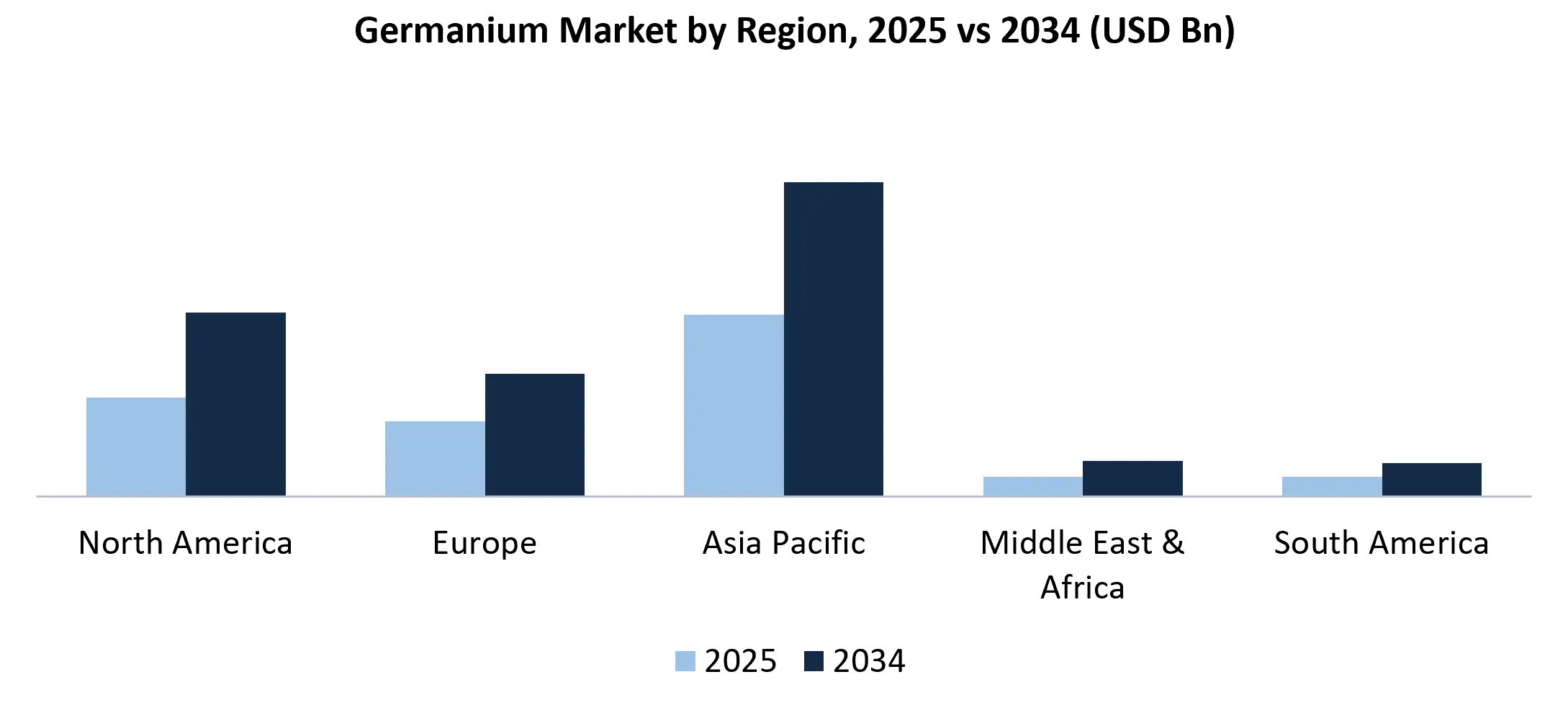
Asia Pacific holds the largest germanium market share by region, accounting for about 46% of global value in 2025. China is the anchor as the largest producer, refiner and consumer, supported by zinc smelters such as Yunnan Chihong Zinc & Germanium, coal-associated germanium resources in Yunnan and Inner Mongolia, and large fibre, electronics and infrared manufacturing bases; Japan, South Korea, Taiwan and India add semiconductor, fibre and optics demand, and Dowa, Mitsubishi Materials, Sumitomo Metal Mining and JX Advanced Metals operate in Japan’s metals and materials chain. Growth is projected at about 6.3% CAGR as export licensing keeps part of Chinese output at home and new capacity is added in Korea and Japan. North America holds about 25% of 2025 value, anchored by US defense optics, space solar substrates and fibre manufacturing, with Teck’s Trail smelter and Red Dog feedstock in Canada and 5N Plus, Umicore Optical Materials and Lattice Materials processing in the United States; the region is the fastest-growing at about 7.2% CAGR because Defense Production Act awards and reshoring support new refining and recycling.
Europe holds about 19% of 2025 value and is projected to grow at about 5.7% CAGR, supported by Umicore’s refining and recycling operations in Belgium, Nyrstar and Aurubis smelting, PPM Pure Metals and Heraeus in high-purity materials, and demand from optics, fibre, space and research sectors in Germany, Belgium, France and the United Kingdom. Middle East & Africa is a smaller market, about 5% of 2025 value, with growth of about 6.8% CAGR, shaped by germanium-bearing tailings and concentrates in the Democratic Republic of the Congo, Gulf defense and optics procurement, and Israel’s infrared and electro-optics industry. South America, also about 5%, is projected to grow at about 6.0% CAGR, led by zinc producers such as Nexa Resources and polymetallic resources in Peru, Chile, and Brazil, though most output is exported as concentrate and refined elsewhere.
| Region | 2025 share | 2025 (USD Bn) | 2034 (USD Bn) | CAGR | Notes |
| North America | 25.0% | 0.155 | 0.289 | 7.2% | US defense optics, space solar and fibre demand; DPA awards and Teck Trail support local supply |
| Europe | XX | XX | XX | 5.7% | Belgium, Germany, France and UK lead; Umicore, Nyrstar and PPM Pure Metals anchor refining and high-purity materials |
| Asia Pacific | XX | XX | XX | 6.3% | China anchors production, refining and consumption; Japan, South Korea and India add electronics and optics demand |
| Middle East & Africa | XX | XX | XX | 6.8% | DRC tailings and concentrates, Gulf defense procurement and Israel’s electro-optics industry |
| South America | XX | XX | XX | 6.0% | Nexa and other zinc producers; Peru, Chile and Brazil resources largely exported as concentrate |
Germanium Companies and Competitive Landscape: Who Are the Top Germanium Producers and Players?
The germanium competitive landscape includes several distinct groups rather than a single set of comparable companies. Chinese integrated zinc and germanium producers such as Yunnan Chihong Zinc & Germanium, Yunnan Lincang Xinyuan Germanium Industry (China Germanium) and Zhuzhou Smelter Group hold the largest share of refined supply. Western smelters and refiners, including Teck Resources, Umicore, Nyrstar, Korea Zinc and 5N Plus, supply high-purity metal, germanium tetrachloride, wafers and optics blanks to defense, fibre and space customers. Japanese processors such as Dowa, Mitsubishi Materials, Sumitomo Metal Mining, JX Advanced Metals and Nippon Rare Metal serve Asian electronics and optics demand, and recyclers and specialty distributors complete the ecosystem. These groups compete on different dimensions and should not be ranked as though they were identical producers.
Competition in the germanium industry and the wider germanium market analysis is increasingly shaped by feedstock access, purity, qualification, and geopolitical position rather than price alone. Teck has a conditional framework of up to C$850 million to double germanium and antimony capacity at Trail; 5N Plus is expanding recovery and zone refining in St. George, Utah to more than 20 tonnes a year over a 48-month programme; Umicore is strengthening processing in Quapaw, Oklahoma, and Korea Zinc plans germanium commercial production at Onsan in the second half of 2027 and later a Tennessee smelter. Chinese producers retain scale and cost advantages, but export licensing means non-Chinese buyers pay a premium for secure supply. Consolidation, offtake agreements, recycling partnerships and government co-investment are likely to continue as customers seek traceable, qualified sources.
Top Germanium Companies: Integrated Producers, Refiners, Optics and Wafer Makers, Recyclers and Distributors
MMR separates participants by role, because a zinc smelter that recovers germanium, a refiner of high-purity metal, and an optics or wafer processor do not compete with each other.
| Group | Examples | Role |
| Integrated zinc and germanium producers | Yunnan Chihong Zinc & Germanium, Zhuzhou Smelter Group, Teck Resources, Nyrstar, Korea Zinc, Nexa Resources | Recover germanium from zinc concentrates and smelter residues |
| Refiners and high-purity metal specialists | Umicore, 5N Plus, PPM Pure Metals, Yunnan Germanium, China Germanium (Yunnan Lincang Xinyuan), Vital Materials | Zone-refined metal, GeO₂, GeCl₄ and high-purity grades |
| Wafer, substrate and semiconductor material suppliers | AXT Inc., Umicore, 5N Plus, Materion, American Elements, Stanford Advanced Materials | Germanium wafers, substrates and electronic-grade materials |
| Infrared optics and photonics suppliers | Umicore Optical Materials, Materion, Heraeus, Merck KGaA, Indium Corporation | Optical blanks, lenses, windows and fibre precursors |
| Japanese and Asian metals processors | Dowa Holdings, Mitsubishi Materials, Sumitomo Metal Mining, JX Advanced Metals, Nippon Rare Metal, China Minmetals | Smelting, processing, trading and regional supply |
| Recyclers, secondary refiners and distributors | Indium Corporation, 5N Plus, Umicore, American Elements, Stanford Advanced Materials | Scrap recovery, requalification and specialty distribution |
Germanium Company Benchmark: Capacity Plans and Strategic Signals, 2025–2026
| Company | Strategic signal |
| Teck Resources | Trail smelter recovers germanium from Red Dog zinc concentrate; July 2026 agreement for up to C$400 Mn from Canada Growth Fund within a C$850 Mn plan to double germanium and antimony capacity |
| 5N Plus | USD 18.1 Mn US award (Jan 2026) to expand recovery and zone refining roughly sevenfold to over 20 t/yr in St. George, Utah |
| Umicore | USD 11.8 Mn US award (Jan 2026) for new processing capability at Quapaw, Oklahoma; germanium output not disclosed |
| Korea Zinc | Germanium line planned at Onsan with commercial production in H2 2027; Tennessee smelter planned at about 44 t/yr of germanium from 2029–30 |
| Yunnan Chihong Zinc & Germanium | Largest Chinese integrated producer; about 56 t of germanium products reported for 2022; later output not disclosed |
| Lattice Materials | USD 18.5 Mn US award (announced Dec 2025) for crystal growth and a new recycling line in Montana |
Global Germanium Market Recent Developments, Capacity Announcements and Policy News | 2025–2026
| Date | Development | Why it matters |
| 9 Nov 2025 | China suspends its ban on germanium, gallium and antimony exports to the US until 27 Nov 2026 | Licensing and the military end-user ban remain in force |
| 29 Dec 2025 | US announces USD 18.5 Mn Defense Production Act award to Lattice Materials | Adds domestic crystal growth and recycling |
| 29 Jan 2026 | 5N Plus awarded USD 18.1 Mn to raise recovered germanium output to over 20 t/yr | Largest funded Western refining expansion |
| 30 Jan 2026 | Umicore Optical Materials awarded USD 11.8 Mn for Quapaw processing | Supports fibre and infrared supply in the US |
| 6 Feb 2026 | USGS Mineral Commodity Summaries 2026 reports 2025 average prices near USD 4,100/kg (metal) | Confirms the roughly doubled price level |
| 7 Jul 2026 | Teck and Canada Growth Fund sign agreement for up to C$400 Mn at Trail | Could double Western germanium capacity |
| 13 Jul 2026 | ReElement receives USD 25 Mn for germanium and gallium refining in Indiana | Adds a recycling and refining route |
| 27 Nov 2026 | Scheduled end of China’s US-specific suspension; no extension notice found in sources reviewed | Key supply-risk date for buyers |
Germanium Market Scope: Inquire before buying
| Global Germanium Market | |||
|---|---|---|---|
| Report Coverage | Details | ||
| Base Year: | 2025 | Forecast Period: | 2026-2034 |
| Historical Data: |
2020 to 2025 | Market Size in 2025: | USD 0.62 Billion |
| Forecast Period 2026 to 2034 CAGR: |
6.4% | Market Size in 2034: | USD 1.08 Billion |
| Segments Covered: |
By Product Type | Germanium Metal (Ingots & Bars, Pellets & Pieces, Powders, Wafers); Germanium Dioxide (GeO₂); Germanium Tetrachloride (GeCl₄); Other Germanium Compounds (Sulfide, Organogermanium, Specialty Precursors) |
|
| By Grade | Commercial-Grade; High-Purity; Electronic-Grade; Optical-Grade; Solar-Grade |
||
| By Form | Ingots & Bars; Wafers & Substrates; Powders & Granules; Pellets & Pieces; Chemical Solutions & Precursors |
||
| By Production Source | Primary Recovery from Zinc Ores; Recovery from Coal & Coal Fly Ash; Recovery from Other Metallurgical Byproducts; Secondary Recovery from Recycled Materials |
||
| By Application | Semiconductor & Electronics; Infrared Optics & Thermal Imaging; Fiber Optics & Photonics; Solar Cells & Photovoltaics; Chemical Catalysts & Polymerization; Glass & Specialty Ceramics; Aerospace, Defense & Security; Healthcare & Scientific Instruments; Other Industrial Applications |
||
| By End-Use Industry | Semiconductor & Electronics Manufacturing; Telecommunications & Optical Networking; Aerospace & Space Technology; Defense & Military Equipment; Renewable Energy & Solar Manufacturing; Chemical & Petrochemical Manufacturing; Healthcare & Scientific Research; Industrial Manufacturing & Engineering |
||
| By Sales Channel | Direct Sales; Authorized Distributors; Specialty Chemical & Material Suppliers; Industrial Metal Traders & Brokers; Online Specialty Material Platforms |
||
Global Germanium Market, By Region
North America (United States, Canada, Mexico)
Europe (Germany, United Kingdom, France, Belgium, Netherlands, Italy, Spain, Switzerland, Sweden, Austria, Poland, Rest of Europe)
Asia Pacific (China, Japan, India, South Korea, Australia, Taiwan, Singapore, Rest of Asia Pacific)
Middle East & Africa (United Arab Emirates, Saudi Arabia, Israel, South Africa, Rest of Middle East & Africa)
South America (Brazil, Argentina, Chile, Peru, Rest of South America)
Global Germanium Market, Key Players
North America
1. Indium Corporation
2. 5N Plus Inc.
3. Umicore USA
4. Teck Resources Limited
5. AXT Inc.
6. Materion Corporation
7. American Elements
8. Stanford Advanced Materials
Europe
9. Umicore
10. PPM Pure Metals GmbH
11. Nyrstar
12. Vital Materials Europe
13. Aurubis AG
14. Heraeus Group
15. Merck KGaA
Asia Pacific
16. Yunnan Germanium Co., Ltd.
17. China Germanium Co., Ltd.
18. Yunnan Chihong Zinc & Germanium Co., Ltd.
19. Yunnan Lincang Xinyuan Germanium Industry Co., Ltd.
20. Zhuzhou Smelter Group Co., Ltd.
21. Teck Resources’ Asian Commercial Network
22. Dowa Holdings Co., Ltd.
23. Mitsubishi Materials Corporation
24. Sumitomo Metal Mining Co., Ltd.
25. China Minmetals Corporation
26. Vital Materials Co., Ltd.
27. JX Advanced Metals Corporation
28. Nippon Rare Metal, Inc.
29. 5N Plus Asia
Middle East & Africa
30. Moxico Resources PLC
31. Metorex (Jinchuan Group)
South America
32. Nexa Resources S.A.
33. Codelco
Global Germanium Market FAQs: Frequently Asked Questions
What is the size and forecast of the global germanium market?
MMR values the global germanium market at USD 0.62 billion in 2025, USD 0.66 billion in 2026, and USD 1.08 billion by 2034, a 6.4% CAGR over 2026–2034. The 2034 value is about 1.75 times the 2025 base, and published germanium market size estimates for 2025 range from about USD 0.27 billion to USD 1.8 billion depending on scope and price assumptions.
Which region and country is the largest germanium market?
Asia Pacific holds the largest germanium market share at 46% in 2025, anchored by China. North America follows at about 25% and Europe at about 19%. North America is the fastest-growing region at about 7.2% CAGR as defense, space and reshoring programmes fund new refining capacity.
Which germanium segments are growing fastest?
Germanium metal is the largest product type at about 44% of 2025 value, while germanium tetrachloride grows fastest at 7.4% CAGR. Secondary recovery grows at 9.4%, wafers and substrates at 8.6%, aerospace and defense applications at 8.3%, and solar and photovoltaic applications at 8.4%, all above the 6.4% market rate.
Who are the leading germanium companies?
Leading names include Yunnan Chihong Zinc & Germanium, China Germanium, Umicore, Teck Resources, 5N Plus, Nyrstar, Korea Zinc, Dowa and PPM Pure Metals, alongside wafer, optics and recycling specialists such as AXT, Materion, Lattice Materials and Indium Corporation. This is the core of the germanium competitive landscape.
What drives germanium supply and demand, and why are prices so high?
Germanium is a by-product, so supply depends on zinc smelting, coal fly ash and recycling rather than on its own mines, while demand from infrared optics, fibre, space solar and semiconductors keeps growing. China’s export licensing since August 2023 and its suspended ban on exports to the United States, due to expire on 27 November 2026, have tightened non-Chinese supply; USGS-reported 2025 average prices were about USD 4,100 per kilogram for metal and USD 2,500 for dioxide.
What are germanium infrared optics and germanium semiconductor applications used for?
Germanium infrared optics are lenses, windows, and prisms that transmit roughly 2–14 microns for thermal cameras, night vision, targeting, and missile seekers. Germanium semiconductor applications include SiGe chips, germanium wafers for multijunction space solar cells, photodetectors and Ge-on-Si photonics, and high-purity germanium detectors used for gamma-ray spectroscopy.
What is the difference between the germanium metal market and the germanium dioxide market?
The germanium metal market covers zone-refined ingots, bars, pellets, powders, and wafers used in optics and electronics, and is about 44% of 2025 value. The germanium dioxide market covers GeO₂ used as a feedstock for metal, as a fibre-optic dopant precursor, and as a PET polymerization catalyst, and is about 27% of value with a 6.6% CAGR.
Global Germanium Market Research Methodology
MMR sized the market bottom-up and top-down from estimated 2025 refined volume of about 215 metric tons of contained germanium and product-level price assumptions, anchored to USGS Mineral Commodity Summaries price data (2025 averages of about USD 4,100 per kilogram for metal and USD 2,500 for dioxide), then triangulated against published market reports (2025 estimates of roughly USD 0.27 to 1.8 billion and CAGRs of about 3% to 8.5%), company announcements, US and Canadian government funding awards and Chinese export-control notices through November 2026. Segment shares and regional splits are MMR estimates anchored to published splits (for example, Asia Pacific at roughly 44% to 47% of the market) and are normalized so every segment sums to the market total. Annual values are constant-CAGR interpolations, and volumes are expressed as contained germanium. Segment CAGRs are the effective rates after normalization.