
Geothermal Heat Pump Market - Industry Structure Evaluation, Demand Drivers Analysis, Regional Growth Analysis and Identification, Competitive Positioning Review & Global Market Size Forecast to 2032
Overview
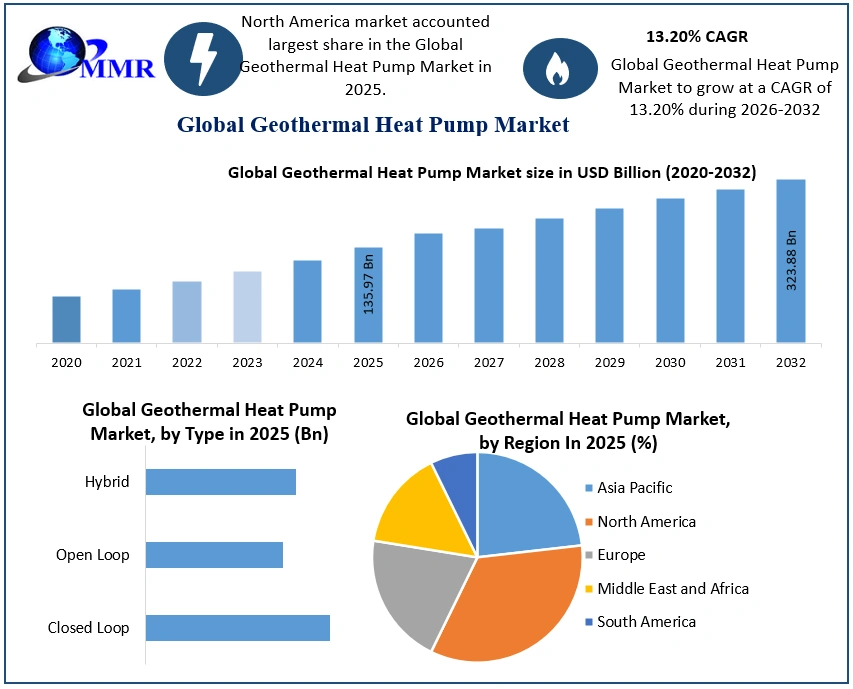
The Geothermal Heat Pump Market size was valued at USD 135.97 Billion in 2025 and the total Geothermal Heat Pump revenue is expected to grow at a CAGR of 13.20% from 2025 to 2032, reaching nearly USD 323.88 Billion by 2032.
Geothermal Heat Pump Industry Snapshot
A geothermal heat pump (GHP) is a sustainable technology designed to regulate the temperature of buildings by harnessing the consistent thermal energy stored in the Earth's subsurface. This system efficiently facilitates both heating and cooling functions, in addition to supplying hot water. The increasing global interest in sustainable energy solutions and a heightened awareness of environmental impact driving the growth of Geothermal Heat Pump Market. GHP technology harnesses the Earth's consistent temperature to deliver efficient heating, cooling, and hot water services across residential, commercial, and industrial sectors.
Widespread adoption of various GHP system types, including Ground Source Heat Pumps (GSHP), Water Source Heat Pumps (WSHP), and Direct Exchange (DX) systems driving the growth of Geothermal Heat Pump Market. Residential adoption is on the rise as homeowners seek eco-friendly alternatives for climate control and water heating. Similarly, commercial and industrial entities are embracing GHP systems to achieve energy savings and align with green building initiatives.
Geographically, North America, Europe, and Asia-Pacific are leading regions witnessing substantial GHP market growth. Ongoing research and development initiatives by governments and industry stakeholders aim to enhance system efficiency, contributing to the market's growth. Against the backdrop of a global push for sustainable energy solutions, the Geothermal Heat Pump market stands as a pivotal player, offering economic and environmental benefits. As the world transitions toward cleaner and more efficient heating and cooling solutions, the GHP market is poised for continued development.
To know about the Research Methodology:-Request Free Sample Report
Geothermal Heat Pump Market Key Dynamics:
Increasing awareness and integration of geothermal heat pumps in residential construction driving the growth of market
Government incentives are playing a major role in driving the global geothermal heat pump market growth. The U.S. Federal Investment Tax Credit (ITC) offers a substantial 26% credit for residential geothermal installations, making these systems more financially appealing to consumers. Stringent environmental regulations further contribute to the rising demand for geothermal heat pumps. Countries like Germany, guided by policies such as the Renewable Energy Act (EEG), are mandating a transition to renewable energy sources, including geothermal. This regulatory environment aligns with global sustainability goals, creating a compelling market driver as industries and consumers seek eco-friendly alternatives.
Ongoing technological advancements, such as improved drilling techniques and heat exchanger designs, boost Geothermal Heat Pump Market growth by enhancing efficiency and reducing installation costs. Innovations in geothermal technology contribute to broader adoption, exemplified by companies such as Ormat Technologies investing in enhanced geothermal systems (EGS) research. Increasing awareness of geothermal benefits fuels residential adoption. The Whisper Valley community in Texas exemplifies this trend, integrating geothermal heat pumps in each home, showcasing the market's growth as sustainable heating and cooling become integral to residential construction.
Tech giants like Google and Apple incorporating geothermal systems into their campuses highlight the market's appeal for large-scale applications. Corporate adoption showcases the efficacy of geothermal heat pumps in meeting the complex heating and cooling needs of commercial and industrial facilities, influencing Geothermal Heat Pump Market growth. Urbanization drives demand for efficient and space-saving HVAC solutions, benefiting geothermal heat pumps. Their compact footprint and versatility cater to high-rise buildings, as seen in Stockholm, reflecting the market's growth in response to global urbanization trends. Continuous investments in R&D by industry players such as Climatemaster lead to technological breakthroughs.
Improved performance and durability resulting from research efforts enhance market competitiveness, contributing to the overall growth of the geothermal heat pump market. Projects like the Lakeview Green development in Birmingham showcase how these systems leverage water sources, indicating the market's adaptability and diversification to different geothermal resources. Educational campaigns, such as those by the Geothermal Exchange Organization, play a pivotal role in increasing public awareness. Informed consumers are more likely to embrace geothermal heat pump technology, contributing to market growth by expanding the consumer base and promoting sustainable heating and cooling solutions.
Permitting and Regulatory Hurdles with High Initial Costs hindering the growth of Geothermal Heat Pump Market
The high upfront costs associated with drilling and ground loop installations poses a barrier to adoption, particularly in regions where cost considerations play a pivotal role which hindering the growth of geothermal heat pump market. For instance, residential geothermal systems often demand a substantial initial investment, dissuading potential customers from embracing this renewable technology.
The lack of awareness about the benefits of geothermal heat pumps hampering the adoption of geothermal heat pump This results in potential customers opting for traditional heating and cooling solutions instead. Cumbersome permitting processes and regulatory challenges hamper the geothermal heat pump market. Delayed approvals and stringent regulations in certain regions contribute to increased project timelines and costs, creating obstacles for the smooth development and adoption of geothermal systems.
Geological factors, such as rocky terrains and limited ground space, present challenges for ground loop installations, particularly in densely populated urban areas like New York City. The competition from alternative energy sources, shortage of skilled technicians, limitations in water source accessibility, performance variability, long payback periods, and risks associated with emerging technologies collectively contribute to the complexities faced by the geothermal heat pump market, impacting its overall growth trajectory.
Global Market Segment Overview
By Type, the closed-loop segment holds the largest market share in the Global Geothermal Heat Pump Market. According to MMR analysis, the segment is further expected to grow at a CAGR of 13.20 % during the forecast period. Closed-loop geothermal systems are transforming the heating and cooling market by offering a highly efficient, sustainable alternative to conventional HVAC methods. These systems circulate a heat-transfer fluid through a sealed loop of underground pipes configured horizontally, vertically, or submerged in water to exchange heat with the earth. By leveraging the ground’s stable temperature, they provide reliable climate control year-round, significantly reducing energy consumption and greenhouse gas emissions.
Horizontal loops are favored for residential use due to their cost-efficiency, while vertical loops dominate in urban or commercial settings with limited space. Pond or lake loops offer a niche but cost-effective option where natural water bodies exist. The market is increasingly gravitating toward closed-loop systems due to their durability, lower maintenance needs, and compatibility with diverse soil and site conditions. While higher upfront installation costs remain a challenge, long-term savings and minimal environmental impact make these systems attractive for both homeowners and businesses. As environmental regulations tighten and demand grows for green building solutions, closed-loop geothermal systems are poised for robust market growth, particularly in regions emphasizing energy independence and carbon reduction. Their ability to deliver consistent performance with minimal ecological disruption is reshaping how the industry approaches sustainable heating and cooling.
Geothermal Heat Pump Market Regional Insights
North America dominated the Geothermal Heat Pump Market in 2025, driven by rapid growth in adoption of Heat Pump the United States and Canada. This ascent attributed to a confluence of factors, including governmental incentives, a conducive geothermal potential, and an escalating emphasis on sustainable energy sources. The adoption of the 2022 Building Energy Efficiency Standards (Energy Code) by the California Energy Commission added momentum to the market. The Code mandated the incorporation of electric heat pumps in new single-family homes and multi-family residences, aligning with the broader trend of residential decarbonization. Vendors, such as Daikin, are actively contributing to this shift by promoting transformative plans to address CO2 emissions, thereby fostering a growing need for heat pumps in the region.
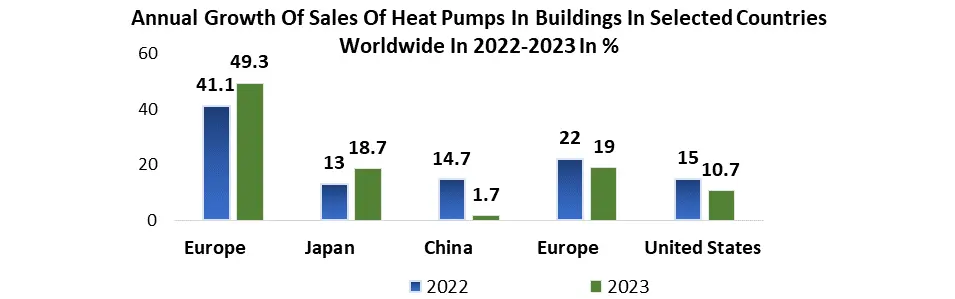
In the Asia-Pacific region, particularly in countries such as China and Japan, a rise in geothermal heat pump installations is underway, driven by the pressing demand for efficient heating and cooling solutions in both residential and commercial sectors. Japan's focus on energy conservation, supported by initiatives from the Agency for Natural Resources and Energy, has boosted the adoption of heat pumps across private and commercial settings. South Korea, Australia, and India also feature noteworthy developments, with government initiatives, environmental certifications, and greenhouse gas reduction targets contributing to the overall growth and diversification of the Geothermal Heat Pump Market across different regions.
 Geothermal Heat Pump Market: Inquire before buying
| Global Geothermal Heat Pump Market | |||
|---|---|---|---|
| Report Coverage | Details | ||
| Base Year: | 2025 | Forecast Period: | 2026-2032 |
| Historical Data: | 2020 to 2025 | Market Size in 2025: | USD 135.97 Bn. |
| Forecast Period 2026 to 2032 CAGR: | 13.13% | Market Size in 2032: | USD 323.88 Bn. |
| Segments Covered: | By Type | Closed Loop Open Loop Hybrid |
|
| By Application | Residential Commercial Industrial |
||
Geothermal Heat Pump Market, by Region
North America (United States, Canada and Mexico)
Europe (UK, France, Germany, Italy, Spain, Sweden, Austria and the Rest of Europe)
Asia Pacific (China, South Korea, Japan, India, Australia, Indonesia, Malaysia, Vietnam, Taiwan, Bangladesh, Pakistan and the Rest of APAC)
South America (Brazil, Argentina Rest of South America)
Middle East & Africa (South Africa, GCC, Egypt, Nigeria and the Rest of ME&A)
Leading Companies in the Geothermal Heat Pump Insights
1. Carrier
2. Trane Technologies
3. Bosch Thermotechnology
4. Mitsubishi Electric
5. Vaillant Group
6. Stiebel Eltron
7. NIBE Industrier AB
8. Ochsner Wärmepumpen
9. Daikin Applied
10. WaterFurnace International
11. ClimateMaster
12. Enertech Global
13. Dandelion Energy
14. GeoStar
15. Hydron Module
16. Tetco
17. De Dietrich Remeha
18. Go Geothermal Ltd
19. Finn Geotherm UK Ltd
20. Droege Energy GmbH
21. Templari S.p.A.
22. Remko Gmbh & Co. Kg
23. Systemair AB
24. Teddington
25. Roth Pump Company
26. Guangdong New Energy Technology Development Co., Ltd.
27. Guangzhou SPRSUN New Energy Technology Development Co., Ltd.
28. Power World Machinery Equipment Co., Ltd.
29. Euroklimat S.P.A.
30. Midea Group
Frequently Asked Questions:
1. What is the growth rate of the Global Geothermal Heat Pump Market?
Ans. The Global market is growing at a significant rate of 13.20 % during the forecast period.
2. Which region is expected to dominate the Global Geothermal Heat Pump Market?
Ans. North America is expected to dominate the market during the forecast period.
3. What is the expected Global Geothermal Heat Pump Market size by 2032?
Ans. The market size is expected to reach USD 323.88 Billion by 2032.