
Gastrointestinal Therapeutics Market Size by Type, Route of Administration, Application, Distribution Channel, Region – Revenue Pool Analysis, Margin Structure Assessment, Capital Flow Trends, Competitive Benchmarking & Forecast to 2030
Overview
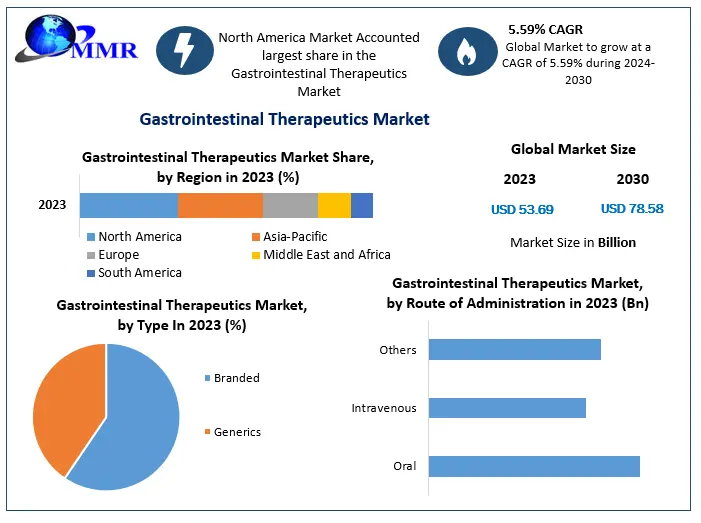
Gastrointestinal Therapeutics Market size is expected to reach US$ 78.58 Bn. by 2030, at a CAGR of 5.59% during the forecast period. The report has covered Country Market trends with competitive landscape.
Global Gastrointestinal Therapeutics Market Overview:
The market for Gastrointestinal Therapeutics is primarily driven by the rising acceptance of biologics in treating gastrointestinal diseases. Biologics like tofacitinib and vedolizumab, and drugs such as Humira, Amjevita, Cimzia, Remicade, and Entyvio approved by the U.S. FDA, have shown superior long-term efficacy. Studies indicate significant reductions in surgeries, hospitalizations, and room stays due to biologic usage.
Technological advancements and increasing R&D investments in biologics and targeted drugs for gastrointestinal diseases are expected to drive market growth. FDA-approved drugs like Amjevita, Cimzia, Entyvio, Inflectra, Remicade, Renflexis, and Tysabri are available, with new drugs like ustekinumab and risankizumab in the pipeline.
The generic segment is expected to grow at a significant rate due to patent expirations, cost-effectiveness, and government initiatives promoting their use. Key pharmaceutical players are focusing on launching generic versions of branded drugs post-patent expiration. However, FDA promotion exclusivity to patent holders may slightly hinder market development. Retail pharmacies dominated distribution in 2023 due to affordability and pharmacist recommendations for drug alternatives, ensuring higher safety.
The North America market held the largest share in 2023 and is expected to maintain its position, driven by lifestyle changes leading to higher disease occurrence. Government initiatives like the Integrated Global Action Plan for Diarrhoea also contribute to market growth in the region.
Recent approvals, such as AbbVie Inc.'s RINVOQ for ulcerative colitis, and BMS's Zeposia for active UC, are expected to boost adoption rates. However, challenges such as high investment requirements for biological drugs and patent expirations, like the case of Zantac, may restrain market growth. Additionally, the introduction of biosimilars for drugs like Humira poses a challenge to market expansion.
The report gives a detailed study of the Global Gastrointestinal Therapeutics Industry, concentrating on stakeholders, industry status and predicting trends. It includes an in-depth analysis of main players like market leaders, followers and new participants. The micro-economic factors in the market are evaluated using Porter's Five Forces model along with SWOT and PESTLE analysis. Factors from within and outside the industry are examined, offering decision-makers a comprehensive understanding.
 To know about the Research Methodology :- Request Free Sample Report
The analysis shows that biologics displays superior long-term efficiency. According to the analysis led by University of Chicago, usage of biologics has caused in a total reduction in the number of surgeries by about 39.65%, extra room stays by 59.87%, & hospitalizations by 49.76%.
The generic segment is anticipated to grow at an exponential rate during the forecast period because steady finishes of patents, cost-effectiveness of generics, & initiatives by government administrations for endorsing usage of generics in developing economies. In addition, key pharmaceutical players are steadily determined to launch generic versions of their branded complements to recover losses affected by patent expiration.
Branded drug producers & generic producing companies are cooperating for manufacturing generic drugs after patent expiry, which is expected to increase the development of generics. In addition, key companies are gradually focusing on emerging generics because of the rise in off-patented drugs in the market. However, promotion exclusivity given by the FDA to patent holders for dissimilar indications is expected to hinder market development to a slight extent.
The others segment accounted for the major share by application in the year 2023. The large share can be attributed to an extensive range of applications for which gastrointestinal drugs have been used steadily over the past few years. Frequent number of drug launches is also responsible for improved scope for development.
Ulcerative colitis accounted for the second-largest share in the market in the year 2023. Progress of this segment can be attributed to easy accessibility of drugs to treat this disorder. The segment is also expected to grow at a substantial rate thanks to high clinical urgency to control rising prevalence of ulcerative colitis. This high occurrence is owing to poor prognosis & consumption of unhealthy food, which may result in high possibility of disease recurrence.
In 2023, retail pharmacy accounted for the leading share in terms of distribution channel due to high affordability & availability to retail stores. As number of treatment medicines being reimbursed is growing, it is inspiring patients to buy medicines from retail pharmacies. Retail pharmacists also suggest drug alternates that prevent adverse drug interactions. These influences are likely to increase customer preference toward retail stores. In case retail pharmacists have any worries concerning prescribed medicines, they suggest substitutes for the same, thus ensuring higher safety. Start of pharmacy chains like CVS Health is a key supplier to the share of the retail segment. Acceptance of digitalized systems in retail pharmacies to decrease risk of mistakes in prescriptions is also expected to fuel development the forecast period.
The North America market accounted for the major share of xx% in 2023 and is anticipated to keep its position during the forecast period. This extensive share is attributed to extraordinary change in lifestyle, causing in greater occurrence of gastrointestinal diseases.
Moreover, occurrence of government initiatives expected at preventing as well as treating gastrointestinal diseases is expected to drive the market towards north. For example, the Integrated Global Action Plan for Diarrhoea by UNICEF & WHO objects at reducing avoidable childhood deaths as a result of diarrhea by providing interventions & services to increase awareness & deliver access to treatment & preventive measures.
Competitive Landscape:
The objective of the report is to present a comprehensive analysis of the Global Gastrointestinal Therapeutics Market including all the stakeholders of the industry. The past and current status of the industry with forecasted Market size and trends are presented in the report with the analysis of complicated data in simple language. The report covers all the aspects of the industry with a dedicated study of key players that includes Market leaders, followers and new entrants. PORTER, SVOR, PESTEL analysis with the potential impact of micro-economic factors of the Market have been presented in the report. External as well as internal factors that are supposed to affect the business positively or negatively have been analyzed, which will give a clear futuristic view of the industry to the decision-makers.
The report also helps in understanding Global Gastrointestinal Therapeutics Market dynamics, structure by analyzing the Market segments and project the Global Gastrointestinal Therapeutics Market size. Clear representation of competitive analysis of key players by Type, price, financial position, Raw material portfolio, growth strategies, and regional presence in the Global Gastrointestinal Therapeutics Market make the report investor’s guide.
Gastrointestinal Therapeutics Market Scope: Inquire before buying
| Global Gastrointestinal Therapeutics Market | |||
|---|---|---|---|
| Report Coverage | Details | ||
| Base Year: | 2023 | Forecast Period: | 2024-2030 |
| Historical Data: | 2018 to 2023 | Market Size in 2023: | US $ 53.69 Bn. |
| Forecast Period 2024 to 2030 CAGR: | 5.59% | Market Size in 2030: | US $ 78.58 Bn. |
| Segments Covered: | by Type | Branded Generics |
|
| by Route of Administration | Oral Intravenous Others |
||
| by Application | Ulcerative Colitis Crohn’s Disease GERD Others |
||
| by Distribution Channel | Hospital Pharmacies Retail Pharmacies Online Pharmacies |
||
Global Gastrointestinal Therapeutics Market, by Region
Asia Pacific (China, South Korea, Japan, India, Australia, Indonesia, Malaysia, Vietnam, Taiwan, Bangladesh, Pakistan and Rest of APAC)
Europe (UK, France, Germany, Italy, Spain, Sweden, Austria and Rest of Europe)
North America (United States, Canada and Mexico)
Middle East and Africa (South Africa, GCC, Egypt, Nigeria and Rest of ME&A)
South America (Brazil, Argentina Rest of South America)
Key Players
1. Abbott Laboratories - Abbott Park, Illinois, United States
2. AstraZeneca - Cambridge, England
3. Bayer AG - Leverkusen, Germany
4. Janssen Pharmaceuticals (a subsidiary of Johnson & Johnson) - Beerse, Belgium
5. Takeda Pharmaceuticals - Tokyo, Japan
6. Pfizer - New York City, New York, United States
7. AbbVie Inc. - North Chicago, Illinois, United States
8. Valeant (Salix Pharmaceuticals) - Bridgewater, New Jersey, United States
9. Takeda Pharmaceutical Company Limited - Tokyo, Japan
10. Eisai Co. Ltd. - Tokyo, Japan
11. Johnson & Johnson Private Limited - Mumbai, India
12. Astellas Pharma Inc. - Tokyo, Japan
13. Sanofi S.A. - Paris, France
14. Bausch Health Companies Inc - Laval, Quebec, Canada
15. Cipla - Mumbai, India
16. Pfizer Inc. - New York City, New York, United States
17. Bayer AG - Leverkusen, Germany
18. Biogen - Cambridge, Massachusetts, United States
19. Azurity Pharmaceuticals, Inc. - Wilmington, Massachusetts, United States
20. Iterative Health - Boston, Massachusetts, United States
Frequently Asked Questions:
1. Which region has the largest share in Global Gastrointestinal Therapeutics Market?
Ans: North America region holds the highest share in 2023.
2. What is the growth rate of Global Gastrointestinal Therapeutics Market?
Ans: The Global Gastrointestinal Therapeutics Market is growing at a CAGR of 5.59% during forecasting period 2024-2030.
3. What is scope of the Global Gastrointestinal Therapeutics market report?
Ans: Global Gastrointestinal Therapeutics Market report helps with the PESTEL, PORTER, COVID-19 Impact analysis, Recommendations for Investors & Leaders, and market estimation of the forecast period.
4. Who are the key players in Global Gastrointestinal Therapeutics market?
Ans: The important key players in the Global Gastrointestinal Therapeutics Market are – Abbott Laboratories, Allergan plc, AstraZeneca, Bayer AG, GlaxoSmithKline plc, Janssen Pharmaceuticals, Takeda Pharmaceuticals, Valeant Pharmaceuticals, Pfizer, AbbVie, Inc., AstraZeneca, Shire, Valeant (Salix Pharmaceuticals), Takeda Pharmaceutical Company Limited, Eisai Co. Ltd., Johnson & Johnson Private Limited, Astellas Pharma Inc., Novo Nordisk A/S, and Sanofi S.A.
5. What is the study period of this market?
Ans: The Global Gastrointestinal Therapeutics Market is studied from 2023 to 2030.