
Game Engine Management Market – Global Market Size, Strategic Growth Drivers, Risk Assessment Framework, Regulatory Landscape Review, Competitive Intensity Mapping & Long-Term Industry Outlook to 2029
Overview
Game Engine Management Market size is expected to reach nearly US $ 5.12 Bn by 2029 with the CAGR of 10.6% during the forecast period.
Game Engine Management Market Overview:
Drivers:
• High Demand for Gaming Applications
The major and the most important driver for the huge market growth of the game management engines is the increased demand by the consumers for various gaming applications. The introduction of the latest gaming applications, with technology being at the fingertips, has seen a huge surge by the youngsters. Moreover, even during the times, when everything was completely shut, the gaming industry still rose with high demand, because of the high penetration of the internet around everyone.
• Development of Advanced Technologies
The games developed nowadays, come with various 3D visual effects, which make them more attractive and challenging. Various latest technologies like augmented and virtual reality help building the games by giving them real–time features and environment. Moreover, these technologies have also made it possible to play games online, as a group with people being very far from each other. All such features are liked by the consumers and hence increase the demand for the gaming applications; which in turn is likely to drive the market for game engine management, during the forecast period.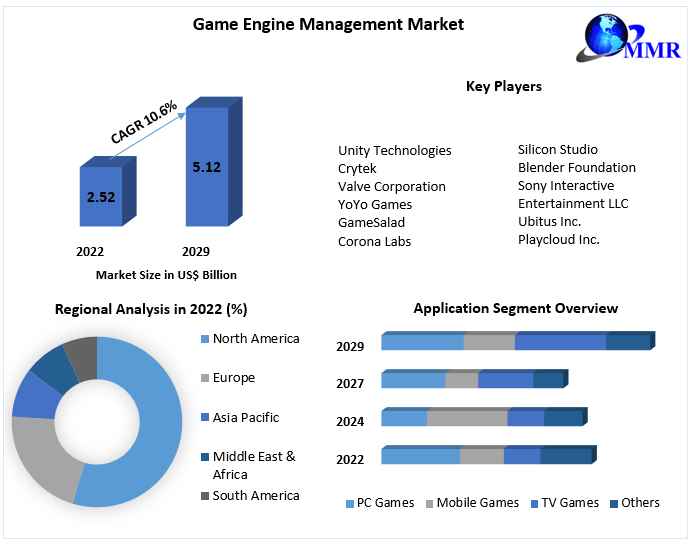 To know about the Research Methodology :- Request Free Sample Report
Restraint:
• High Built – Up Costs
The game engines are nonetheless the software applications, which are not free of cost. These software applications need to have many licenses related to the graphics, deployment, and performance inputs. These licenses cost heavily, and furthermore, the use of rendering; buffering and stencil techniques cost more and hence increase the developing costs for the game engines. Therefore, such factors are likely to hamper the growth of the market for game engine management, during the forecast period.
Game Engine Management Market Segmentation
The report for the global Game Engine Management market is studied across the three major segments:
Based on the type, the 3D game engine type dominated the Game Engine Management market during the year 2022; and it is expected that the same segment would drive the market, during the forecast period. The reason behind the highest market share could be attributed to the high utilization of virtual reality technology in the games. Moreover, the technology specifically helps in building 3D content for the games, mainly giving the stereoscopic vision effect to the design, which helps the designers to make the more attractive.
Game Engine Management Market Objective of the Report:
The objective of the report is to present a comprehensive analysis of the Global Game Engine Management Market to the stakeholders in the industry. The past and current status of the industry with forecasted market size and trends are presented in the report with the analysis of complicated data in simple language. The report covers all the aspects of the industry with a dedicated study of key players that includes market leaders, followers, and new entrants. PORTER, SVOR, PESTEL analysis with the potential impact of micro-economic factors of the market has been presented in the report. External as well as internal factors that are supposed to affect the business positively or negatively have been analyzed, which will give a clear futuristic view of the industry to the decision-makers.
The report also helps in understanding Global Game Engine Management Market dynamics, structure by analyzing the market segments and projects the Global Game Engine Management Market size. Clear representation of competitive analysis of key players by product, price, financial position, product portfolio, growth strategies, and regional presence in the makes the report investor’s guide.
Also called a game frame or game framework, the game engine is a software application, specially developed for building up video games. For any game, a gaming engine is very important, as it is used to make the game characters as the live version in the games. The game engine can be called an integrated development application, which comes with inbuilt visual development tools for designing a game. A typical game engine consists of 6 basic components-
• Networking, through which the game designers get complete support for connecting their developed games on various interfaces, this helps the games to be available online and hence many players can play together.
• Audio, acts as one of the main components in the games, forgiving sound effects, rendering effects, and many such effects to make a game more attractive.
• Artificial Intelligence makes it easy to build up characters and their actions, as compared to before when the designers would need to write a complex code for building the same.
• Physical engine, which is software that helps in the simulation of real-life physical systems, like the movement of the rigid body, fluid dynamics, etc.
• Graphics component of any game denotes the actual game; the 3D graphics are developed using the 3D assets, which are developed using the external rendering programs
• Input, the game engine provides with support of an array of input devices, like the mouse, touch, etc.
Game Engine Management Market Scope: Inquire before buying
The Mobile Games segment by applications is expected to have dominance in the market, during the forecast period. The reason being the rising demand and usage by youngsters across the globe. Moreover, with the high penetration of smart devices in recent times, the youngsters nowadays, prefer playing games on the devices in-hand.
| Game Engine Management Market | |||
|---|---|---|---|
| Report Coverage | Details | ||
| Base Year: | 2022 | Forecast Period: | 2023-2029 |
| Historical Data: | 2017 to 2022 | Market Size in 2022: | US $ 2.52 Bn. |
| Forecast Period 2023 to 2029 CAGR: | 10.6% | Market Size in 2029: | US $ 5.12 Bn. |
| Segments Covered: | by Type | • 2D Game Engines • 3D Game Engines • 5D Game Engines |
|
| by Application | • PC Games • Mobile Games • TV Games • Others |
||
Game Engine Management Market, by Region
• North America (United States, Canada and Mexico)
• Europe (UK, France, Germany, Italy, Spain, Sweden, Austria and Rest of Europe)
• Asia Pacific (China, South Korea, Japan, India, Australia, Indonesia, Malaysia, Vietnam, Taiwan, Bangladesh, Pakistan and Rest of APAC)
• Middle East and Africa (South Africa, GCC, Egypt, Nigeria and Rest of ME&A)
• South America (Brazil, Argentina Rest of South America)
Game Engine Management Market Key Players
o Unity Technologies
o Crytek
o Valve Corporation
o YoYo Games
o GameSalad
o Corona Labs
o Silicon Studio
o Blender Foundation
o Sony Interactive Entertainment LLC
o Ubitus Inc.
o Playcloud Inc.
Frequently Asked Questions:
1. What is the growth rate of Global Game Engine Management Market?
Ans: The Global Game Engine Management Market is growing at a CAGR of 10.6% during forecasting period 2023-2029.
2. What is scope of the Global Game Engine Management Market report?
Ans: Global Game Engine Management Market report helps with the PESTEL, PORTER, COVID-19 Impact analysis, Recommendations for Investors & Leaders, and market estimation of the forecast period.
3. Who are the key players in Global Game Engine Management Market?
Ans: The important key players in the Global Game Engine Management Market are – Unity Technologies, Crytek, Valve Corporation, YoYo Games, GameSalad, Corona Labs, Silicon Studio, Blender Foundation, Sony Interactive Entertainment LLC, Ubitus Inc., Playcloud Inc.
4. What is the study period of this Market?
Ans: The Global Game Engine Management Market is studied from 2022 to 2029.