
Friction Stir Welding Market - Industry Structure Evaluation, Demand Drivers Analysis, Regional Growth Analysis and Identification, Competitive Positioning Review & Global Market Size Forecast to 2030
Overview
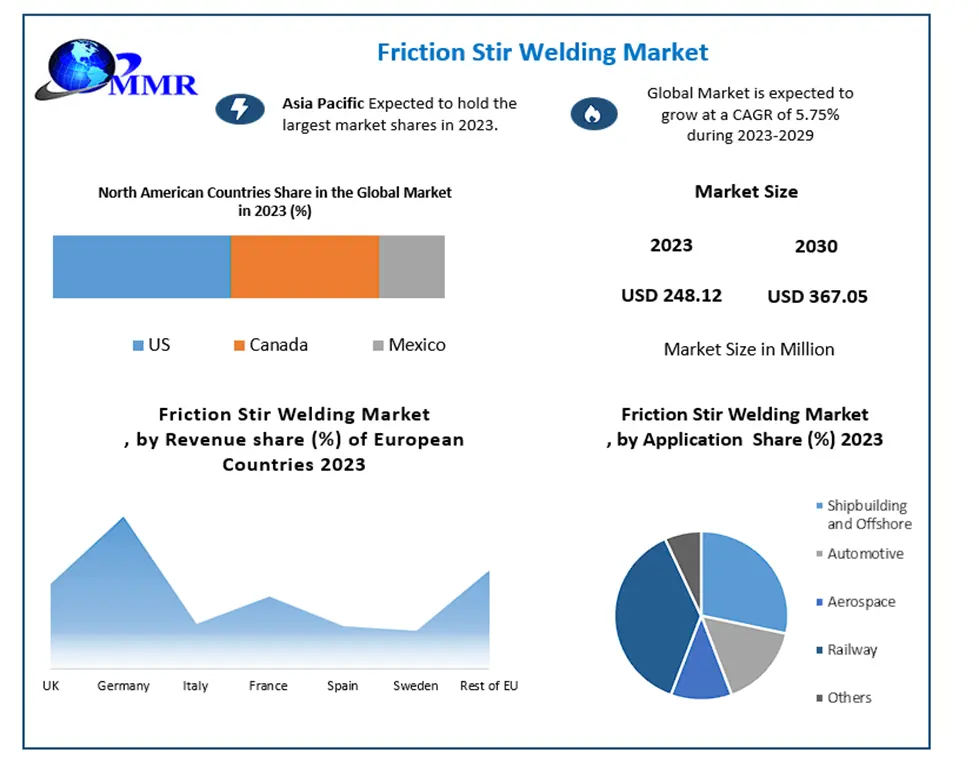
The Friction Stir Welding Market size was valued at USD 248.12 Million in 2023 and the total Friction Stir Welding Market revenue is expected to grow at a CAGR of 5.75% from 2024 to 2030, reaching nearly USD 367.05 Million.
Friction Stir Welding Market Overview:
Friction stir welding (FSW) is a solid-state welding procedure that joins two workpieces without melting the material. It utilizes a non-consumable tool that rotates, plunges into the workpiece's interface, and moves along it, using frictional heat to soften the material. This process produces a joint like those made by traditional welding methods but without using flux, filler metal, or shielding gas, offering unique advantages like cost savings and weight reduction.
In the global friction stir welding market, significant economies include the U.S., Canada, France, Italy, Germany, Russia, China, and South Africa. Growing competition among vendors is expected to drive the industry in the coming years. Rise demand from the electronics sector and the recent launch of new products in the U.S. will drive the friction stir welding market in the region over the next few years. The European region accounted for a considerable share of the global friction stir welding market, thanks to advancements in technology.
Friction Stir Welding Market Report Scope:
The friction stir welding market research report covers product classification, product application, development trend, product technology, competitive landscape, industrial chain structure, industry overview, national policy and planning analysis of the industry, and the most recent dynamic analysis, among other things. The report discusses the global Friction Stir Welding Market’s drivers, opportunities, and limitations. It discusses the influence of various drivers, trends, and restraints on Friction Stir Welding Market demand during the forecast period. The research also outlines market potential on a global scale.
 To know about the Research Methodology :- Request Free Sample Report
The research includes the production time, base distribution, technical characteristics, research and development trends, technology sources, and raw material sources of main Friction Stir Welding Market firms in terms of production bases and technologies. The more precise study also contains the primary market and consumer application sectors, significant regions and consumption, major producers, distributors, raw material suppliers, equipment providers, and their contact information, as well as an industry chain relationship analysis. This report's study also contains product specifications, manufacturing processes, cost structure, and data information organised by equipment type, material, application and region.
Friction Stir Welding Market Dynamics:
The friction stir welding market is experiencing significant growth owing to its broad application in the industrial sector, mainly in the automotive industry. FSW is increasingly adopted in vehicle manufacturing for welding many parts, driven by the increasing global demand for vehicles. This process enhances the mechanical properties of the product, resistance to fatigue, improving strength, and overall durability. The developing use of FSW equipment in industrial applications has significantly boosted friction stir welding market growth, highlighting its importance in modern manufacturing processes.
Technological development and continuous innovation are key factors driving the market. These advancements create unique revenue opportunities that drive market growth. Increased investment in research and development activities and growing awareness of the benefits of FSW contribute to profitable opportunities for the market. The constant development and refinement of FSW practices ensure the market remains dynamic and responsive to the progressing needs of various industries.
Despite its drivers, the market faces challenges due to a lack of skilled and qualified workforce. Insufficient knowledge and improper training of users can hinder the market's growth. Companies may need to invest considerable time and resources in training workers, which can impact profitability. Technical difficulties and the shortage of skilled personnel are significant barriers to the industry's growth, potentially reducing overall revenue and friction stir welding market development.
Likewise, the MMR report covers all the trends and technologies playing a major role in the growth of the market over the forecast period. It highlights the drivers, restraints, and opportunities expected to influence the market growth during 2024-2030.
Friction Stir Welding Market Segmentation Insight:
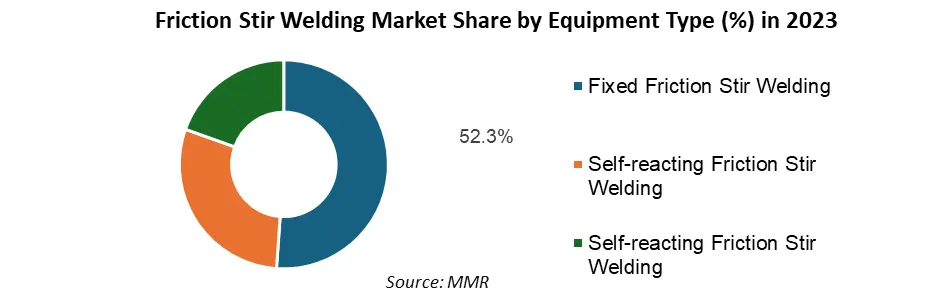
By Equipment Type, the Fixed Friction Stir Welding segment, accounting for the largest revenue share of 52.3% in 2023, represents a pivotal aspect of the friction stir welding market. This growth is attributed to their stability, precision, and suitability for high-volume production. These machines give a stable welding environment, confirming consistent and precise welds, which is crucial for industries such as automotive and aerospace that demand high quality and reliability. The fixed nature of these machines permits for secure positioning of the workpiece during welding, minimizing errors and ensuring uniformity across batches of welded components.
Furthermore, fixed FSW machines are versatile, equipped with multiple widening arms and a horizontal platform that can accommodate many welding tools, making them adaptable to different manufacturing requirements. Technological developments in fixed FSW machines have further boosted their efficiency and ease of use, making them preferred choices for industries seeking robust and dependable welding solutions. Their cost-effectiveness in large-scale production settings, coupled with showed industry standards and widespread adoption, solidify the dominant role of fixed FSW machines in driving the growth and innovation within the market globally.
By Application , in 2023, Railway segment held the largest share in market and is expected to grow at the CAGR of 6.02% over 2024-2030. This growth is driven by huge demand for new line construction and track maintenance, leveraging the cost-effectiveness of friction stir welding compared to alternative processes. The industry's faster growth rate further fuels demand for friction stir equipment. During forecast period, the automotive sector is expected to experience the most rapid development, fuelled by increasing demand for electrified and autonomous vehicles. Factors contributing to this growth include increasing incomes, heightened environmental awareness, and amplified investments in new technologies.
Friction Stir Welding Market Regional Insight:
During 2024-2030, the Asia Pacific region is poised to lead the friction stir welding Market, driven by robust growth in the automotive, railway, aerospace, and defense industries. These sectors are creating many revenue opportunities for the friction stir welding machine industry in the APAC market. In 2023 the Asia Pacific region already commanded a significant market share owing to the widespread adoption of friction stir welding (FSW) equipment. FSW is specifically valued in APAC for its ability to effectively join lightweight materials and cater to critical applications across many sectors.
The technology's capability to manufacture high-quality welds free from defects, coupled with superior mechanical properties, has spurred its popularity in industries such as shipbuilding, aerospace, and automotive manufacturing. Notably, China remains a global leader in vehicle production and sales, with annual domestic production projected to reach 35 million vehicles by 2025, as reported by the Ministry of Industry and Information Technology. In 2021 alone, over 26 million vehicles were sold in China, underscoring the immense demand driving the adoption of advanced welding technologies like FSW.
India has witnessed a substantial rise in defence production, topping USD 12.6 Million in 2023, marking a growth rate exceeding 12% from the previous year. This robust expansion in defense manufacturing further underscores the expanding utilization of FSW equipment for critical applications in the defense sector across the Asia Pacific region. These factors collectively position Asia Pacific at the forefront of the global friction stir welding market, highlighting its pivotal role in driving technological advancements and industry growth in the coming years.
Friction Stir Welding Market: Competitive Insights
The major market players are investing a lot of money in R&D to expand their product lines, which will spur further Friction Stir Welding Market growth. With significant market development like new product releases, contractual agreements, M&A, increased investments, and collaboration with other organizations, Friction Stir Welding Market participants are also undertaking various strategic activities to expand their global presence. To grow and thrive in a market climate that is becoming more competitive and growing, competitors in the Friction Stir Welding industry must offer affordable products.
1. Hitachi introduced their latest generation of friction stir welding machines tailored for the automotive and aerospace industries in August 2023. These new machines boast enhanced productivity and precision, aiming to ensure consistent weld quality and reduce cycle times through advanced monitoring and control systems. Hitachi's commitment to delivering reliable and efficient solutions to the global friction stir welding market is underscored by their ongoing investment in technological innovation.
2. ESAB launched the RebelTM FSW, a state-of-the-art friction stir welding device designed with versatility and usability in mind in September 2023. Equipped with advanced technologies such as adaptive control and automatic parameter optimization, the RebelTM FSW excels in welding a diverse range of materials and thicknesses. This advancement highlights ESAB's dedication to providing innovative solutions that meet the evolving demands of the international market.
Scope of the Global Friction Stir Welding Market:Inquire Before Buying
| Global Friction Stir Welding Market | |||
|---|---|---|---|
| Report Coverage | Details | ||
| Base Year: | 2023 | Forecast Period: | 2024-2030 |
| Historical Data: | 2018 to 2023 | Market Size in 2023: | US $ 248.12 Mn. |
| Forecast Period 2024 to 2030 CAGR: | 5.75% | Market Size in 2030: | US $ 367.05 Mn. |
| Segments Covered: | by Equipment Type | Fixed Friction Stir Welding Adjustable Friction Stir Welding Self-reacting Friction Stir Welding |
|
| by Material | Aluminium alloy Magnesium Titanium Copper Steel alloys Others |
||
| by Application | Shipbuilding and Offshore Automotive Aerospace Railway Others |
||
Friction Stir Welding Market, by Region
North America (United States, Canada and Mexico)
Europe (UK, France, Germany, Italy, Spain, Sweden, Austria, Turkey, Russia and Rest of Europe)
Asia Pacific (China, India, Japan, South Korea, Australia, ASEAN and Rest of APAC)
Middle East and Africa (South Africa, GCC, Egypt, Nigeria and Rest of ME&A)
South America (Brazil, Argentina, Columbia and Rest of South America)
Friction Stir Welding Market, Key Players:
1. Concurrent Technologies Corp. - USA
2. FOOKE GmbH - Germany
3. Gatwick Technologies Ltd. - UK
4. HFW Solutions LLC - USA
5. Hitachi High-Technologies Corp. - Japan
6. Manufacturing Technology, Inc. (MTI) - USA
7. Midea Group (KUKA AG) - China/Germany
8. Norsk Hydro ASA - Norway
9. PaR Systems LLC - USA
10. Yamazaki Mazak Corp. - Japan
11. Beijing FSW Technology Co., Ltd. - China
12. The ESAB Group, Inc. - USA (part of Colfax Corporation)
13. KUKA Systems GmbH - Germany
14. MegaStir - USA
15. Eta Technology Private Limited - India
16. Grenzebach Maschinenbau GmbH - Germany
17. Colfax Corporation (ESAB) - USA
18. Schlumberger Limited - USA
FAQs:
1] What are the application of Market?
Ans. Shipbuilding and Offshore, Automotive, Aerospace, Railway and others.
2] What are the prospects for the Market?
Ans. Market is poised for substantial growth fueled by technological advancements, expanding applications across industries, and increasing global demand for efficient and sustainable welding solutions.
3] Which Equipment Type segment is expected to hold the largest market share in the Market by 2030?
Ans. Fixed Friction Stir Welding segment is expected to hold the largest market share in the Market by 2030.
4] What is the market size of the Market by 2030?
Ans. The market size of the Market is expected to reach US $ 367.05 Mn by 2030.
5] What was the market size of the Market in 2023?
Ans. The market size of the Market was worth US $ 248.12 Mn. in 2023.