
Fraud Detection and Prevention Market: Global Size, Strategic Insights, Competitive Mapping and Long-Term Forecast (2026–2032)
Overview
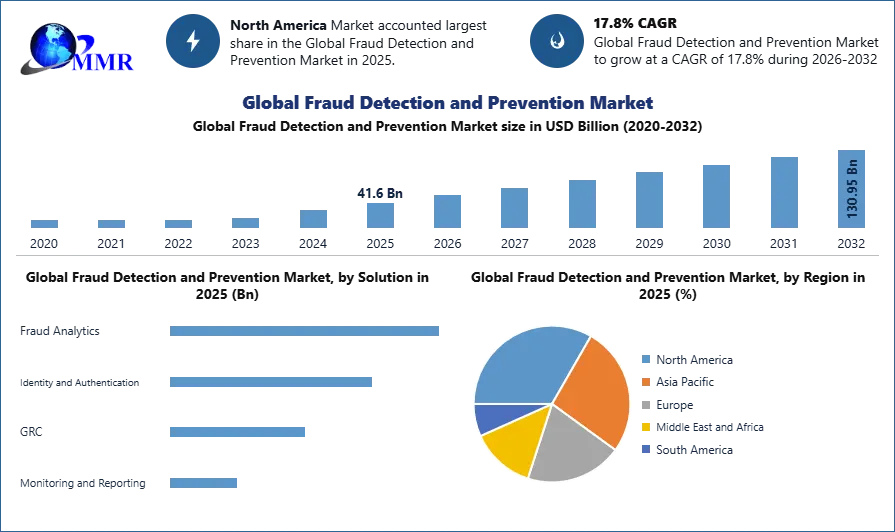
Fraud Detection and Prevention Market size was valued at USD 41.6 Bn. in 2025 and the total revenue is expected to grow at a CAGR of 17.8 % through 2026 to 2032, reaching nearly USD 130.95 Bn.
Fraud Detection and Prevention Market Overview:
Money laundering, cybersecurity concerns, tax evasion, false insurance claims, identity theft, and terrorist financing are all examples of fraudulent actions that occur in the financial institutions, government, healthcare, public sector, and insurance sectors. Organizations are implementing modern fraud detection and prevention technologies and risk management strategies to combat this growing list of opportunities for fraudulent transactions. Fraud Analytics, Identity and Authentication, GRC, and Monitoring and Reporting are the solutions of the Fraud Detection and Prevention.
To know about the Research Methodology :- Request Free Sample Report
Fraud Detection and Prevention Market Dynamics:
The world is undergoing a digital transformation. Users of the internet are no longer limited to online search and social networking, but have extended their activities to include online banking and shopping. People have ceased leaving their homes due to COVID-19 lockout limitations, and a major portion of the population has begun to use internet transactions. According to the Boston Consulting Group (BCG), 70% of urban customers in countries like India are digitally influenced to buy any financial goods, which implies they utilise banking apps or websites to purchase financial items. Due to this factor, there has been an increase in the number of fake websites. Apart from banking, fake websites that resemble businesses and home delivery services are on the rise, luring customers into making online purchases.
The Internet of Things (IoT) continues to play a critical role in both consumer ecosystems and industrial operations, with rapid expansion in connected devices across smart homes, healthcare, manufacturing, and financial services. According to recent industry estimates, global IoT connections surpassed 30 billion by 2025, reflecting sustained growth in device adoption and network integration.
While connected devices enhance convenience and operational efficiency, they also expand the attack surface for cybercriminals. IoT-enabled systems continuously collect, transmit, and store sensitive consumer and enterprise data, increasing exposure to data breaches and privacy risks. Fraud related to connected devices, including ad fraud, ATM fraud, account takeover, and bot-driven transaction manipulation, continues to rise in complexity and scale.
The growing sophistication of cyber threats and the proliferation of IoT endpoints are expected to significantly drive demand for advanced fraud detection and prevention solutions during the forecast period 2026–2032.
Gaming and wireless fraud are one of the fastest-growing categories today. The use of mass login attempts to validate the validity of stolen username/password pairs is known as credential stuffing. This data is used to take control of accounts. Streaming Potluck is a practice in which each member of a group brings their own streaming service account and shares it with the rest of the group. All services are available to all members of the group. Unauthorized account sharing might result in revenue loss depending on the service provider's business strategy.
Fraud Detection and Prevention Market Segment Analysis:
Based on the Deployment Mode, the market is segmented into On-premise, and Cloud. On-premise deployment mode segment is held the largest market share in 2025. The on-premises deployment mode is a classic approach in which customers' in-house servers are used to implement and operate products. Platforms, apps, systems, and data are all under the control of on-premises solutions, which can be handled and maintained by the organization's IT staff. The use of on-premises deployment mode is higher in businesses where user credentials are crucial for business operations since it can control the systems from the enterprise physical or owned location. But it is gradually losing share to cloud deployment due to scalability, lower infrastructure cost, faster implementation, and remote accessibility advantages offered by cloud models.
Based on the Vertical, the market is segmented into BFSI, Retail and ecommerce, and Travel and Transportation. BFSI segment is expected to grow rapidly during the forecast period 2026-2032. This is due to the increased digitalization of banks. Banks in China, India, and Japan are pressuring their customers to adopt more digital payment methods, which is expected to boost the global fraud detection and prevention market for FDP solutions during the forecast period . The BFSI sector is followed by the E-commerce sector. The rise in the number of fake e-commerce sites. The e-commerce market has grown dramatically as a result of the global proliferation of internet services and rising consumer buying power.
Fraud Detection and Prevention Market Regional Insights:
North America is expected hold the largest market share of 38% by 2032. North America region has the biggest number of FDP providers. It is one of the most afflicted regions in the world by money laundering and terrorism financing illegal operations. Banks, governments, and financial institutions in this region are confronted with ever-increasing fraud concerns, necessitating the implementation of innovative technical techniques to fraud management. As the world moves toward interconnectivity and digitalization, protecting enterprise-critical infrastructures and sensitive data has become one of the primary issues. North America, a technologically advanced region, leads the world in cybersecurity vendor presence. These are the factors that are expected to drives the growth of the North America region in the Global Fraud Detection and Prevention market during the forecast period 2026-2032.
Europe is expected to grow rapidly during the forecast period 2026-2032. The major economies of the United Kingdom, Germany, France, Sweden, Italy, and the Netherlands make up Europe. FDP solutions are becoming more popular in these countries. This is due to the surge in network crimes, frauds, and advanced cyber and bot attacks, the demand for FDP solutions is increasing in Europe. Because the key companies are working on growing their position in numerous sectors such as BFSI, telecommunications, retail, government/public sector, and manufacturing, the European FDP market is experiencing substantial growth potential. Insurance fraud is one of Europe's most serious problems.
Key Development in the Market:
| Exact Date | Company | Development | Impact |
|---|---|---|---|
| 23 February 2026 | Mastercard | Expanded its Decision Intelligence Pro generative AI platform to include advanced entity-risk scoring for cross-border transactions. | This development enhances real-time detection accuracy by 20% while significantly reducing false positives during high-volume international digital payments. |
| 12 January 2026 | European Banking Authority (EBA) | Formally implemented the PSD3 and PSR regulatory package, mandating enhanced Strong Customer Authentication (SCA) for all EU financial institutions. | The regulation forces a major technology refresh cycle, driving adoption of behavioral biometrics and risk-based authentication to secure the open banking ecosystem. |
| 03 December 2025 | Government of India (DoT) | Disconnected over 40 lakh mobile connections identified as fraudulent via the AI-integrated ASTR (Artificial Intelligence and Facial Recognition for Telecom Sim Subscriber Verification) system. | This national-scale cleanup directly mitigates phishing and SMS fraud, protecting consumers from estimated cybercrime losses of INR 660 Crore. |
| 14 October 2025 | CyberArk | Launched a specialized Fraud Detection for AI Agents module to secure autonomous identities and prevent insider fraud in hybrid cloud environments. | The solution targets the enterprise-wide fraud management trend by applying least privilege protocols to non-human identities. |
| 18 August 2025 | NICE Actimize | Released its X-Sight AI upgrade, featuring Generative AI-based suspicious activity reporting (SAR) automation. | This milestone addresses the talent shortage in cybersecurity by reducing the time required for fraud investigation and regulatory filing by up to 50%. |
| 05 June 2025 | Launched the Google Safety Charter, deploying on-device AI-based scam detection for financial apps through the Google Play Protect service. | The initiative provides real-time malicious link blocking at the OS level, creating a platform-neutral security framework for the mobile commerce sector. |
The objective of the report is to present a comprehensive analysis of the Global Fraud Detection and Prevention Market to the stakeholders in the industry. The past and current status of the industry with the forecasted market size and trends are presented in the report with the analysis of complicated data in simple language. The report covers all the aspects of the industry with a dedicated study of key players that include market leaders, followers, and new entrants.
PORTER, PESTEL analysis with the potential impact of micro-economic factors of the market have been presented in the report. External as well as internal factors that are supposed to affect the business positively or negatively have been analyzed, which will give a clear futuristic view of the industry to the decision-makers.
The reports also help in understanding the Global Fraud Detection and Prevention Market dynamic, structure by analyzing the market segments and project the Global Fraud Detection and Prevention Market size. Clear representation of competitive analysis of key players by Product Type, price, financial position, product portfolio, growth strategies, and regional presence in the Global Fraud Detection and Prevention Market make the report investor’s guide.
Fraud Detection and Prevention Market Scope: Inquire before buying
| Global Fraud Detection and Prevention Market | |||
|---|---|---|---|
| Report Coverage | Details | ||
| Base Year: | 2025 | Forecast Period: | 2026-2032 |
| Historical Data: | 2020 to 2025 | Market Size in 2025: | 41.6 USD Billion |
| Forecast Period 2026-2032 CAGR: | 17.8% | Market Size in 2032: | 130.95 USD Billion |
| Segments Covered: | by Solution | Fraud Analytics Identity and Authentication GRC Monitoring and Reporting |
|
| by Deployment Mode | On-premise Cloud |
||
| by End User | BFSI Retail and eCommerce Travel and Transportation |
||
Fraud Detection and Prevention Market by Region
North America (United States, Canada and Mexico)
Europe (UK, France, Germany, Italy, Spain, Sweden, Austria and Rest of Europe)
Asia Pacific (China, South Korea, Japan, India, Australia, Indonesia, Malaysia, Vietnam, Taiwan, Bangladesh, Pakistan and Rest of APAC)
Middle East and Africa (South Africa, GCC, Egypt, Nigeria and Rest of ME&A)
South America (razil, Argentina Rest of South America)
Key Players / Competitors Profiles Covered in Brief in Global Fraud Detection and Prevention Market Report in Strategic Perspective:
ACI Worldwide Inc.
Arbutus Software Inc.
Avast Software s.r.o.
DXC Technology Company
ESET spol.s r.o.
Experian plc.
Fiserv, Inc.
First Data Corporation
Fidelity National Information Services, Inc.
FRISS
GreatHorn, Inc.
Guardian Analytics
IBM Corporation
LexisNexis Risk Solutions
SAP SE
SAS Institute Inc.
SpyCloud, Inc.
Fortinet, Inc.
Splunk Inc.
Darktrace Ltd