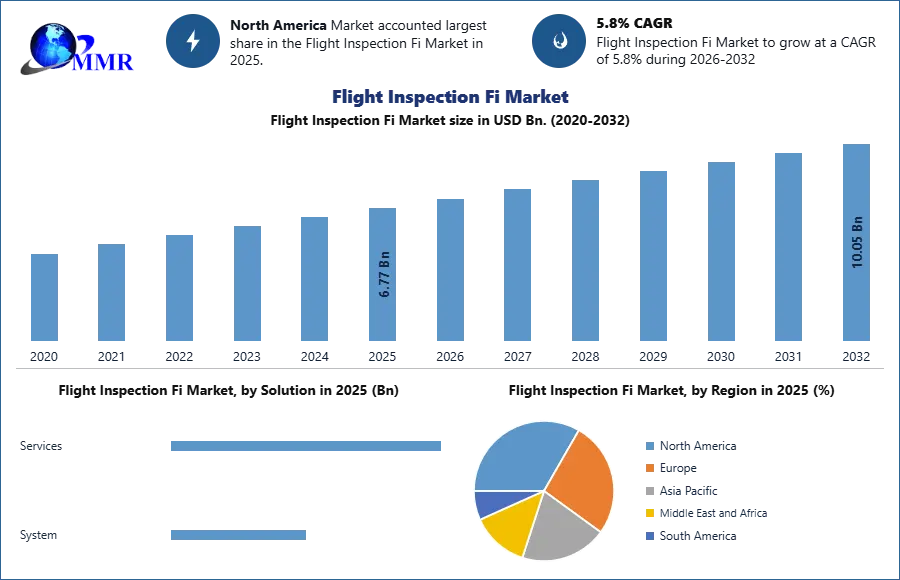
1. Flight Inspection Market : Market Introduction
1.1. Executive Summary
1.2. Market Size (2025) & Forecast (2026-2032)
1.3. Market Size (Value USD Billion) and Market Share (%) - By Segments, Regions, and Country
2. Flight Inspection Market Competitive Landscape
2.1. MMR Competition Matrix
2.2. Competitive Positioning of Top Key Players
2.3. Key Players Benchmarking
2.3.1 Company Name
2.3.2 Headquarter
2.3.3 Product Portfolio
2.3.4 End-User Segment
2.3.5 Revenue Details in 2025
2.3.6 Market Share (%)
2.3.7 Profit Margin (%)
2.3.8 Carbon Footprint Disclosure
2.3.9 Certifications
2.3.10 Technology Adoption
2.3.11 Maintenance & Support Capability
2.3.12 ESG / sustainability policies
2.3.13 Geographical Presence
2.4. Market Structure
2.4.1 Market Leaders
2.4.2 Market Followers
2.4.3 Emerging Players
2.5. Mergers and Acquisitions Details
2.6. Market Share by Player — Revenue & Fleet Deployment
2.6.1 Top 10 Companies by Global Flight Inspection Market Revenue, 2025 (USD Million)
2.6.2 Market Share (%) Comparison – Global Level
2.6.3 Regional Revenue Contribution by Top Players (NA, EU, APAC, MEA, SAM)
2.6.4 Share Evolution Trend (2020–2025)
2.6.5 Installed Base Growth Trend vs Fleet Replacement Cycles
2.7. Global vs Regional Flight Inspection Service Providers Comparative Analysis
2.7.1 Revenue Mix: Government vs Private Operators Exposure
2.7.2 R&D Spend as % of Revenue (Avionics & Calibration Tech Focus)
2.7.3 Global Manufacturing & Maintenance Network vs Regional Service Hubs
2.7.4 Certification & Compliance Strength (ICAO, FAA, EASA Standards)
2.7.5 Service Network Density Across Major Airspace Regions
2.7.6 Dependence on OEM vs Third-Party Equipment & Services
2.8. Advanced & Digital Flight Inspection Technology Providers
2.8.1 Vendors Supporting Next-Gen GNSS, GBAS & Remote Calibration Platforms
2.8.2 AI-based Signal Anomaly Detection & Predictive Calibration Readiness
2.8.3 Integration with Digital Flight Management & Ground Data Platforms
2.8.4 Automation & Reduced Human Intervention Capabilities
2.8.5 Cybersecurity & Data Integrity Frameworks
2.8.6 UAV-based Flight Inspection Adoption & Edge Platforms
2.9. Avionics & System Performance Capabilities
2.9.1 Navigation & Guidance Accuracy Benchmarking (ILS, GNSS, VOR, DME)
2.9.2 Communication & Surveillance System Performance (VHF, SATCOM, ADS-B, Radar)
2.9.3 Flight Management System (FMS) & Autopilot Integration Efficiency
2.9.4 Real-Time Data Acquisition & Processing Accuracy
2.9.5 Lifecycle & Retrofit Upgrade Capabilities
2.9.6 Regulatory Compliance & Certification Readiness
3. Flight Inspection Market Dynamics
3.1. Flight Inspection Market Trends
3.2. Flight Inspection Market Dynamics
3.2.1 Drivers
3.2.2 Restraints
3.2.3 Opportunities
3.2.4 Challenges
3.3. PORTER’s Five Forces Analysis
3.4. PESTLE Analysis
3.5. Key Opinion Leader Analysis For the Global Industry
4. Avionics Systems Analysis in Flight Inspection Market
4.1 Core Avionics Architecture in Flight Inspection Platforms
4.2 Navigation & Guidance Systems Performance Evaluation (ILS, GNSS, VOR, DME Integration)
4.3 Communication & Surveillance Avionics Assessment (VHF, SATCOM, ADS-B, Radar)
4.4 Flight Management Systems (FMS) & Autopilot Integration Efficiency
4.5 Real-Time Data Acquisition, Processing & Calibration Accuracy
4.6 Regulatory Compliance & Certification Requirements (ICAO / FAA / EASA Standards)
4.7 Retrofit vs Next-Generation Digital Avionics Adoption
5. Technology Advancements & Performance Optimization in Flight Inspection Avionics
5.1 AI-Based Signal Anomaly Detection & Predictive Calibration Algorithms
5.2 Software-Defined Avionics & Modular Open Systems Architecture (MOSA)
5.3 Integration with Digital Flight Inspection & Ground Data Platforms
5.4 Cybersecurity & Data Integrity Frameworks in Avionics Systems
5.5 Automation Level Enhancement & Reduced Human Intervention Models
5.6 Lifecycle Cost Optimization & Upgrade Pathway Analysis
6. Operational & Cost Structure Analysis 2025
6.1 Aircraft Acquisition & Modification Cost Analysis
6.2 Fuel, Crew & Operational Cost Benchmarking
6.3 Outsourced vs In-house Inspection Economics
6.4 Cost Sensitivity to Fuel Price & Aircraft Utilization Rates
6.5 Lifecycle Cost Assessment of Fixed-wing vs UAV Platforms
6.6 Maintenance & Downtime Cost Modeling
7. Infrastructure Modernization & Airport Upgrade Impact Analysis
7.1 Impact of Airport Expansion Programs on Inspection Demand
7.2 ILS to GBAS Transition & Inspection Implications
7.3 Digital Tower & Remote Navigation System Calibration Needs
7.4 Military Airbase Modernization Influence
7.5 Emerging Airport Markets & Greenfield Development Impact
7.6 CNS Infrastructure Replacement Cycles
7.7 Smart Airport Integration & Inspection Frequency Evolution
8. Demand Forecasting & Traffic-Linked Growth Analysis
8.1 Air Traffic Growth Correlation with Inspection Frequency
8.2 Regional Airport Density vs Inspection Fleet Demand
8.3 Navigation Aid Deployment Growth Modeling
8.4 UAV Adoption Impact on Future Fleet Requirements
8.5 Emerging Market Aviation Infrastructure Investment
8.6 Sensitivity Modeling Based on Air Traffic Volatility
8.7 Long-term Fleet Planning & Replacement Outlook
9. Training & Human Capital Development in Flight Inspection
9.1 Pilot & Crew Training Programs for Flight Inspection Missions
9.2 Avionics Operator Certification & Skill Benchmarking
9.3 Simulation-based Calibration & System Testing Modules
9.4 Workforce Transition Planning for UAV and Digital Platforms
9.5 Knowledge Transfer from Legacy to Next-Generation Systems
9.6 Training Cost vs Operational Efficiency Impact
9.7 Continuous Professional Development & Recertification Trends
10. Risk, Reliability & Safety Impact Assessment
10.1 Risk of Navigation Signal Degradation & Operational Impact
10.2 Impact of Delayed Calibration on Flight Safety
10.3 Redundancy Requirements in Critical Airspace
10.4 Weather & Terrain Challenges in Inspection Missions
10.5 Operational Disruption Risk Assessment
10.6 Reliability Modeling of Inspection Equipment
10.7 Contingency Planning & Emergency Calibration Framework
11. Platform Optimization & Fleet Analysis
11.1 Fleet Age Profile & Replacement Cycle Assessment
11.2 Aircraft Modification Requirements for Inspection Equipment
11.3 Utilization Rate Benchmarking Across Regions
11.4 Fixed-Wing vs UAV Efficiency Trade-off Analysis
11.5 Fleet Standardization vs Mixed Platform Strategy
11.6 Leasing vs Ownership Model Evaluation
11.7 Long-term Fleet Capacity Planning Framework
12. Data Analytics & Digital Transformation Assessment
12.1 Shift from Manual Calibration to Automated Digital Reporting
12.2 Real-time Signal Performance Monitoring Integration
12.3 Cloud-based Data Storage & CNS Data Archiving Trends
12.4 AI-based Anomaly Detection in Navigation Aids
12.5 Big Data Utilization for Predictive Maintenance
12.6 Integration with Air Traffic Management (ATM) Systems
12.7 Digital Reporting Compliance & Audit Trail Requirements
13. Investment & Budget Allocation Analysis
13.1 Government Aviation Infrastructure Budget Trends
13.2 Public vs Private Funding Models
13.3 ROI Assessment of UAV Adoption in Inspection
13.4 Cost Recovery Models for ANSPs
13.5 Capital Allocation Trends in Developing Economies
13.6 Impact of Defense Budget on Military Inspection Programs
13.7 Long-term Aviation Safety Investment Priorities
14. Outsourcing & Service Model Transformation Analysis
14.1 Growth of Third-party Flight Inspection Providers
14.2 Long-term Service Agreements (LTSA) Trends
14.3 Performance-based Contracting Models
14.4 Cross-border Inspection Service Provision
14.5 Risk-sharing Agreements & SLA Framework
14.6 Hybrid Public–Private Operational Models
14.7 Service Revenue vs Equipment Revenue Contribution
15. Sustainability & Environmental Impact Assessment
15.1 Carbon Emissions from Inspection Aircraft Operations
15.2 Transition to Sustainable Aviation Fuel (SAF)
15.3 Electric & Hybrid Inspection Aircraft Potential
15.4 UAV-based Low-emission Inspection Advantage
15.5 Environmental Compliance & Green Aviation Policies
15.6 Noise Regulation Impact on Inspection Scheduling
15.7 Sustainability-driven Fleet Modernization Strategy
16. Geopolitical & Airspace Policy Impact Analysis
16.1 Cross-border Airspace Inspection Protocols
16.2 Impact of Airspace Restrictions & Geopolitical Tensions
16.3 Sanctions & Export Controls on Inspection Equipment
16.4 Defense-driven Air Navigation Modernization
16.5 Aviation Liberalization & Regional Integration Effects
16.6 Infrastructure Funding Linked to National Aviation Strategy
16.7 Regulatory Delays & Policy Risk Assessment
17. Future Technology Disruption Outlook
17.1 Satellite-based Navigation Reducing Ground Aid Dependency
17.2 Ground-based Augmentation System (GBAS) Adoption Outlook
17.3 Remote & Autonomous Calibration Platforms
17.4 Blockchain-based Compliance Tracking
17.5 Integration with NextGen & SESAR Programs
17.6 Transition Toward Continuous Signal Monitoring Systems
17.7 Long-term Replacement Risk for Traditional Inspection Fleets
18. Supply Chain & Ecosystem Analysis
18.1 Value Chain Mapping & Key Stakeholders
18.2 Critical Component & Avionics Sourcing Dependencies
18.3 Aircraft Platform Integration & Modification Cycle
18.4 Regional Manufacturing & Assembly Footprint
18.5 Lead Time, Procurement & Certification Bottlenecks
18.6 Aftermarket, MRO & Lifecycle Support Network
19. Regulatory & Compliance Framework Analysis By Region
19.1 ICAO Flight Inspection Standards & Annex 10 Compliance
19.2 FAA, EASA & Regional Regulatory Mandates
19.3 Calibration Frequency Requirements by Aid Type
19.4 Certification & Airworthiness Requirements for Inspection Aircraft
19.5 Regulatory Impact on Replacement Cycles
19.6 Harmonization Challenges Across Regions
19.7 Impact of Emerging Performance-Based Navigation (PBN) Standards
20. Flight Inspection Market : Global Flight Inspection Market Size and Forecast by Segmentation (by Value in USD Billion) (2025-2032)
20.1. Global Flight Inspection Market Size and Forecast, by System Type
20.1.1 Communication Aids
20.1.2 Satellite Comm
20.1.3 VHF
20.1.4 Navigation Aids
20.1.5 DME
20.1.6 GNSS
20.1.7 ILS
20.1.8 VOR
20.1.9 Surveillance Aids
20.1.10 ADS-B
20.1.11 Radar
20.1.12 Weather Radar
20.1.13 Doppler
20.1.14 Pulse
20.2. Global Flight Inspection Market Size and Forecast, By Platform Type
20.2.1 Fixed Wing
20.2.2 Business Jet
20.2.3 Narrow Body
20.2.4 Regional Jet
20.2.5 Turboprop
20.2.6 Rotary Wing
20.2.7 Single Rotor
20.2.8 Twin Rotor
20.2.9 Unmanned Aerial System
20.2.10 Fixed Wing Drone
20.2.11 Multirotor Drone
20.3. Global Flight Inspection Market Size and Forecast, by Inspection Type
20.3.1 Commissioning / Site Acceptance
20.3.2 Periodic Routine
20.3.3 Special / Emergency
20.4. Global Flight Inspection Market Size and Forecast, By Application
20.4.1 Civil & Commercial
20.4.2 Military
20.5. Global Flight Inspection Market Size and Forecast, by End User
20.5.1 Air Navigation Service Providers (ANSPs)
20.5.2 Airport Operators
20.5.3 Private / Business Aviation Operators
20.5.4 Others
20.6. Global Flight Inspection Market Size and Forecast, by Region
20.6.1 North America
20.6.2 Europe
20.6.3 Asia Pacific
20.6.4 Middle East and Africa
20.6.5 South America
21. North America Flight Inspection Market Size and Forecast by Segmentation (by Value in USD Billion) (2025-2032)
21.1. North America Market Size and Forecast, by System Type
21.2. North America Market Size and Forecast, By Platform Type
21.3. North America Market Size and Forecast, by Inspection Type
21.4. North America Market Size and Forecast, By Application
21.5. North America Market Size and Forecast, by End User
21.6. North America Market Size and Forecast, by Country
21.6.1 United States
21.6.2 United States Market Size and Forecast, by System Type
21.6.3 United States Market Size and Forecast, By Platform Type
21.6.4 United States Market Size and Forecast, by Inspection Type
21.6.5 United States Market Size and Forecast, By Application
21.6.6 United States Market Size and Forecast, by End User
21.6.7 Canada
21.6.8 Mexico
22. Europe Flight Inspection Market Size and Forecast by Segmentation (by Value in USD Billion) (2025-2032)
22.1. Europe Market Size and Forecast, by System Type
22.2. Europe Market Size and Forecast, By Platform Type
22.3. Europe Market Size and Forecast, by Inspection Type
22.4. Europe Market Size and Forecast, By Application
22.5. Europe Market Size and Forecast, by End User
22.6. Europe Market Size and Forecast, by Country
22.6.1 United Kingdom
22.6.2 France
22.6.3 Germany
22.6.4 Italy
22.6.5 Spain
22.6.6 Sweden
22.6.7 Russia
22.6.8 Rest of Europe
23. Asia Pacific Flight Inspection Market Size and Forecast by Segmentation (by Value in USD Billion) (2025-2032)
23.1. Asia Pacific Market Size and Forecast, by System Type
23.2. Asia Pacific Market Size and Forecast, By Platform Type
23.3. Asia Pacific Market Size and Forecast, by Inspection Type
23.4. Asia Pacific Market Size and Forecast, By Application
23.5. Asia Pacific Market Size and Forecast, by End User
23.6. Asia Pacific Market Size and Forecast, by Country
23.6.1 China
23.6.2 S Korea
23.6.3 Japan
23.6.4 India
23.6.5 Australia
23.6.6 Indonesia
23.6.7 Malaysia
23.6.8 Philippines
23.6.9 Thailand
23.6.10 Vietnam
23.6.11 Rest of Asia Pacific
24. Middle East and Africa Flight Inspection Market Size and Forecast by Segmentation (by Value in USD Billion) (2025-2032)
24.1 Middle East and Africa Market Size and Forecast, by System Type
24.2.Middle East and Africa Market Size and Forecast, By Platform Type
24.3 Middle East and Africa Market Size and Forecast, by Inspection Type
24.4.Middle East and Africa Market Size and Forecast, By Application
24.5.Middle East and Africa Market Size and Forecast, by End User
24.6. Middle East and Africa Market Size and Forecast, by Country
24.6.1 South Africa
24.6.2 GCC
24.6.3 Egypt
24.6.4 Nigeria
24.6.5 Rest of ME&A
25. South America Flight Inspection Market Size and Forecast by Segmentation (by Value in USD Billion) (2025-2032)
25.1. South America Market Size and Forecast, by System Type
25.2. South America Market Size and Forecast, By Platform Type
25.3. South America Market Size and Forecast, by Inspection Type
25.4. South America Market Size and Forecast, By Application
25.5. South America Market Size and Forecast, by End User
25.6. South America Market Size and Forecast, by Country
25.6.1 Brazil
25.6.2 Argentina
25.6.3 Colombia
25.6.4 Chile
25.6.5 Peru
25.6.6 Rest Of South America
26. Company Profile: Key Players
26.01.Textron Aviation Inc.
26.01.1 Company Overview
26.01.2 Business Portfolio
26.01.3 Financial Overview
26.01.4 SWOT Analysis
26.01.5 Strategic Analysis
26.01.6 Recent Developments
26.02.Bombardier Inc.
26.03.Aerodata AG
26.04.Norwegian Special Mission AS
26.05.Saab AB
26.06.Safran S.A.
26.07.Cobham Limited
26.08.Airways International
26.09.Airfield Technology Inc.
26.10.Radiola Limited
26.11.ENAV S.p.A.
26.12.Flight Calibration Services Ltd.
26.13.Flight Precision Ltd.
26.14.Singapore Technologies Engineering Ltd
26.15.Honeywell International Inc.
26.16.Thales Group
26.17.Isavia ANS ehf.
26.18.Airports Authority of India (AAI)
26.19.NAV CANADA
26.20.Samana Special Mission
26.21.Teledyne Controls
26.22.Airways Corporation of New Zealand Limited
26.23.Aeronautical Radio of Thailand Ltd.
26.24.Bulgaria Air Traffic Services Authority
26.25.Embraer S.A.
26.26.Rohde & Schwarz GmbH & Co KG
26.27.Trimble Inc.
26.28.Sky KG Airlines
26.29.Omni Aircraft Maintenance
26.30.Lufthansa Technik
26.30.1 Others
27. Key Findings
28. Future Outlook & Analyst Recommendations
29. Flight Inspection Market : Research Methodology