Fitness Equipment Market – Industry Structure Evaluation, Demand Drivers Analysis, Regional Growth Analysis and Identification, Competitive Positioning Review & Global Market Size Forecast to 2034

3.32%
CAGR (2026-2034)
13.64 USD Bn.
Forecast Market Size
330
Report Pages
138
Market Tables

Overview

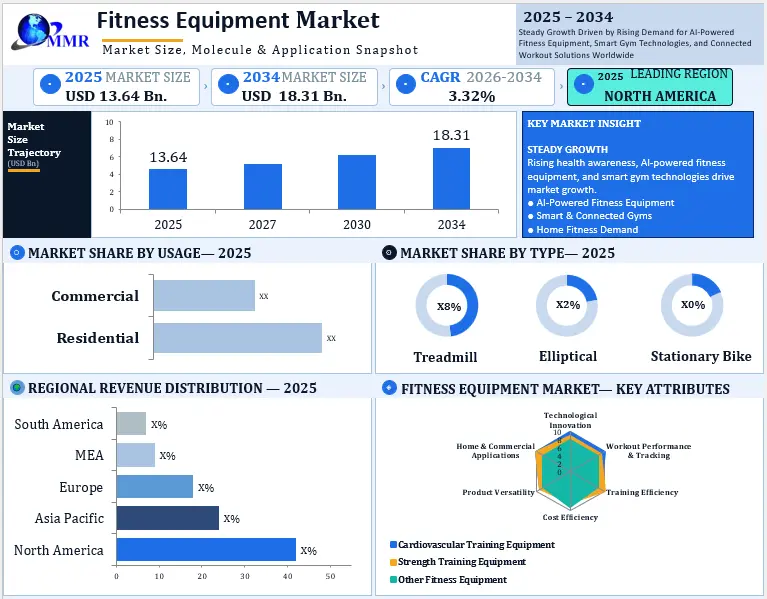
The Global Fitness Equipment Market was valued at USD 13.64 Billion in 2025 and is projected to reach USD 18.31 Billion by 2034, growing at a CAGR of 3.32% during the forecast period 2026–2034.

Parameter Value
Market Size (2025) USD 13.64 Billion
Market Size (2034) USD 18.31 Billion
CAGR 3.32%
Historical Period 2020 to 2025
Forecast Period 2026 to 2034

Fitness Equipment Market Overview:

As the fitness industry continues to grow year after year, with a total profit of $82.7 billion in 2025 alone, as per the IHRSA, the race to find the next improvement in fitness technology has only grown stronger. The dilemma for fitness professionals is to navigate through all of these technological advancements. Fitness equipment leverages cutting-edge technology to deliver informed data to a user's workout while also providing vital insights into the machine's efficiency to club staff. Real-time workout analysis is made possible by sensor technologies.

Machines that grade a user's technique to provide crucial feedback or weight-training equipment that may deliver an automated "spot" when the user fails to finish a rep are two examples of practical implementation. While cloud-connected equipment allows gym personnel to keep up to date on the maintenance requirements of their machines.

As customers seek alternatives to purchase high-quality products at lower prices, manufacturers seek methods to meet those demands, and innovation plays a vital role. E-commerce and developing relationships with retailers are the two most effective ways for fitness equipment manufacturers to cut expenses, boost earnings, and reach a broader target audience.

Innovative ideas assist businesses in differentiating their products to achieve a competitive advantage over other businesses in a market where products tend to be similar. These distinctions are particularly visible in the fitness equipment sector, where modern technologies are leveraged to create cutting-edge solutions.

Secondary research is used to identify the major key players in the Fitness Equipment Market, and primary and secondary research is used to establish their market revenues. Primary research comprised interviews with key public intellectuals and industry specialists such as competent front-line staff, entrepreneurs, and marketing professionals, while secondary research included a review of annual and financial reports from prominent manufacturers.

Brunswick Corporation, Johnson Health Tech Co. Ltd., Technogym, and Amer Sports Corporation are some of the significant competitors in the global Fitness Equipment Market. They are always planning mergers and acquisitions, strategic alliances, joint ventures, and partnerships to increase their market share.

Fitness Equipment Market Analysis from 2025 to 2034
Fitness Equipment Market Growth

To know about the Research Methodology :- Request Free Sample Report

Global Fitness Equipment Market Key Highlights

• Market Growth: The Global Fitness Equipment Market is projected to reach USD 18.31 Billion by 2034, expanding at a CAGR of 3.32% from USD 13.64 Billion in 2025.
• Commercial Gyms Drive Equipment Demand: Expanding health clubs, increasing fitness memberships, and growing investments in cardiovascular and strength training equipment support market growth.
• AI and Smart Fitness Accelerate Innovation: AI-powered exercise machines, IoT-enabled gym equipment, connected fitness platforms, and personalized workout technologies transform the fitness equipment industry.
• North America Leads Global Market: North America maintains market leadership through established fitness infrastructure, while Asia Pacific offers significant growth opportunities driven by urbanization and rising health awareness.
• Home Fitness and Corporate Wellness Create Opportunities: Increasing demand for compact home gyms, workplace fitness centers, rehabilitation equipment, and online fitness equipment sales strengthens market expansion through 2034.

Fitness Equipment Market Dynamics:

Drivers: Rising Health Awareness, Fitness Club Memberships and Home Workout Demand Accelerate Fitness Equipment Market Growth

The Global Fitness Equipment Market is driven by increasing health consciousness, rising obesity concerns, growing gym memberships, and demand for home fitness equipment. Consumers increasingly invest in cardiovascular training equipment, treadmills, exercise bikes, elliptical machines, and strength training equipment to improve physical fitness and muscular endurance. Home treadmills in India commonly range from approximately INR 20,000 to INR 50,000 for mainstream models, supporting different consumer budgets. Expanding fitness centers, health clubs, and personal training facilities further strengthen commercial gym equipment demand, fitness equipment sales, and global fitness equipment industry growth.

Restraints: High Fitness Equipment Costs, Limited Space and Maintenance Expenses Restrict Market Expansion

The Fitness Equipment Market faces restraints from high initial equipment investment, limited residential space, installation expenses, and ongoing maintenance requirements. Commercial treadmills in India typically cost approximately INR 1.5–5.5 lakh, depending on motor capacity, construction quality, and integrated technology. Advanced strength training machines, elliptical trainers, and connected fitness equipment require additional expenditure on servicing, replacement components, and electricity. Space limitations in urban apartments restrict adoption of large exercise machines, while high equipment prices affect purchasing decisions among budget-conscious consumers. These factors constrain residential fitness equipment adoption and commercial fitness equipment market expansion.

Opportunities: Corporate Wellness Programs, Boutique Fitness Studios and Rehabilitation Facilities Create New Growth Potential

The Global Fitness Equipment Market presents opportunities through increasing investment in corporate wellness centers, boutique fitness studios, hotels, residential complexes, and rehabilitation facilities. Businesses and healthcare institutions adopt multifunctional exercise machines, rehabilitation treadmills, resistance training systems, and compact gym equipment to support employee wellness and physical rehabilitation programs. For example, a small commercial gym occupying approximately 1,000–1,500 square feet in India may require an indicative equipment investment of INR 8–12 lakh, depending on the machine configuration. Increasing demand for customized fitness solutions, institutional equipment procurement, and specialized exercise facilities creates new Fitness Equipment Market revenue opportunities.

Challenges: Equipment Durability, Supply Chain Disruptions and After-Sales Service Requirements Increase Operational Complexity

The Fitness Equipment Industry faces challenges involving equipment durability, product safety, component availability, manufacturing costs, and reliable after-sales technical support. Commercial fitness equipment manufacturers must maintain consistent performance under frequent daily use while ensuring motor reliability, accurate resistance mechanisms, and safe operating conditions. Fitness machines with user-weight capacities of approximately 100–150 kg, depending on product specifications, require appropriate structural design and quality testing. Delays in electronic component sourcing, spare-part replacement, and equipment servicing increase operational downtime for fitness centers. Maintaining fitness equipment quality standards, product reliability, and customer satisfaction remains essential for strengthening manufacturer competitiveness.

Global Fitness Equipment Market Trends

AI-Powered Fitness Equipment, Smart Gym Technology and Connected Workout Platforms Transform the Industry

The Global Fitness Equipment Market is witnessing increasing adoption of AI-powered fitness equipment, IoT-enabled exercise machines, connected treadmills, smart exercise bikes, and digital workout platforms. Manufacturers integrate biometric sensors, Bluetooth connectivity, personalized training programs, and real-time workout analytics into residential and commercial fitness equipment. Smart treadmills offer features such as adjustable incline, heart-rate monitoring, and interactive training sessions, while connected strength training systems support personalized resistance settings and workout tracking. Growing interest in compact home gyms, sustainable fitness equipment, virtual coaching, and subscription-based fitness services shapes Fitness Equipment Market technology trends and product innovation through 2034.

Global Fitness Equipment Market – Key Trends (2026–2034)

Key Market Trends Market Impact
AI-Powered Fitness Equipment Enables personalized workouts and smart training.
Connected Fitness Technology Increases demand for IoT-enabled gym equipment.
Compact Home Gym Equipment Drives adoption of space-saving exercise machines.
Sustainable Fitness Equipment Promotes energy-efficient and eco-friendly gym machines.
Smart Strength Training Improves workout tracking and resistance training.
Corporate Wellness Expansion Boosts commercial fitness equipment demand.
Fitness Equipment Subscription Models Creates opportunities for equipment rental and leasing.
Rehabilitation Fitness Equipment Supports senior fitness and physical therapy demand.

Fitness Equipment Market Segment Analysis:

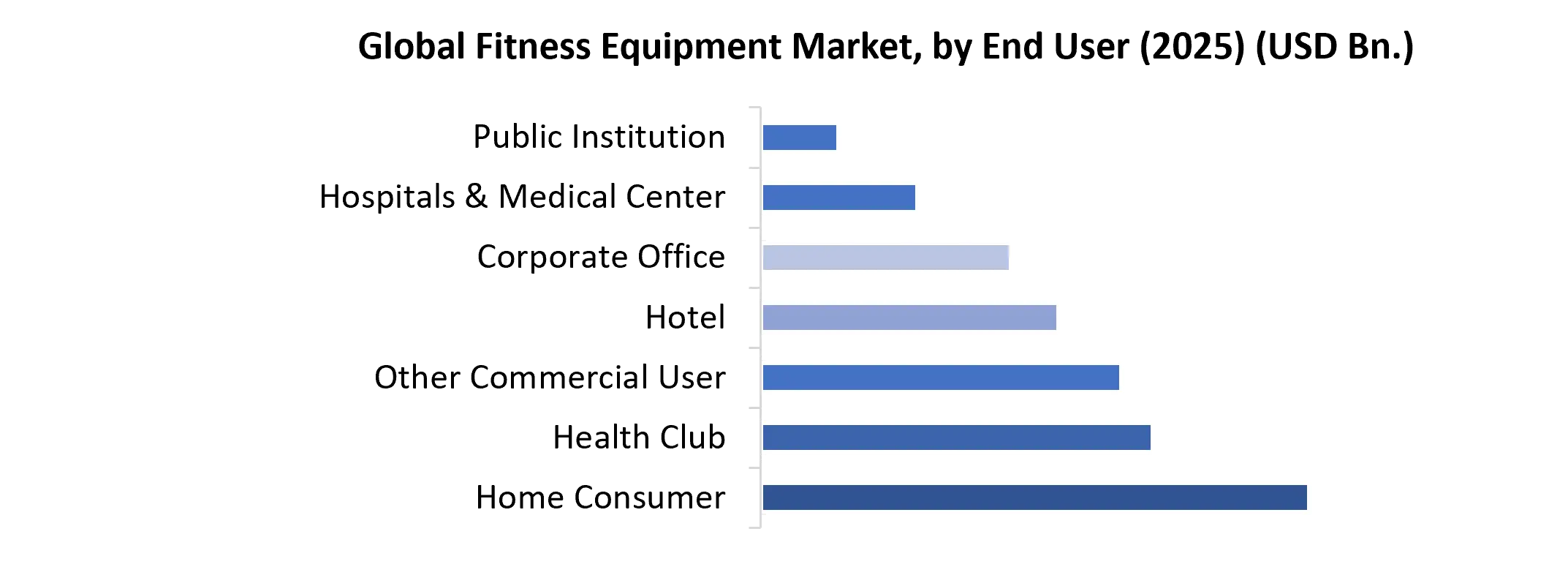
By End-User, The Global Fitness Equipment Market is segmented by end-user into Home Consumer, Health Club/Gym, Other Commercial User, Hotel, Corporate Office, Hospitals & Medical Center, and Public Institution. The Home Consumer segment benefits from rising demand for home fitness equipment, smart treadmills, exercise bikes, and compact workout machines. Health Clubs and Gyms represent a major end-user segment, supported by expanding fitness memberships, commercial gym equipment investments, and demand for cardiovascular and strength training machines. Hotels integrate modern fitness centers to enhance guest wellness experiences, while Corporate Offices adopt workplace fitness equipment to support employee health programs. Hospitals and Medical Centers utilize rehabilitation exercise equipment, therapeutic treadmills, and low-impact training machines for patient recovery. Public Institutions invest in community fitness facilities and recreational exercise equipment. Growing health awareness, connected fitness technology, and institutional wellness investments strengthen Fitness Equipment Market growth, commercial fitness equipment demand, and global industry opportunities through 2034.
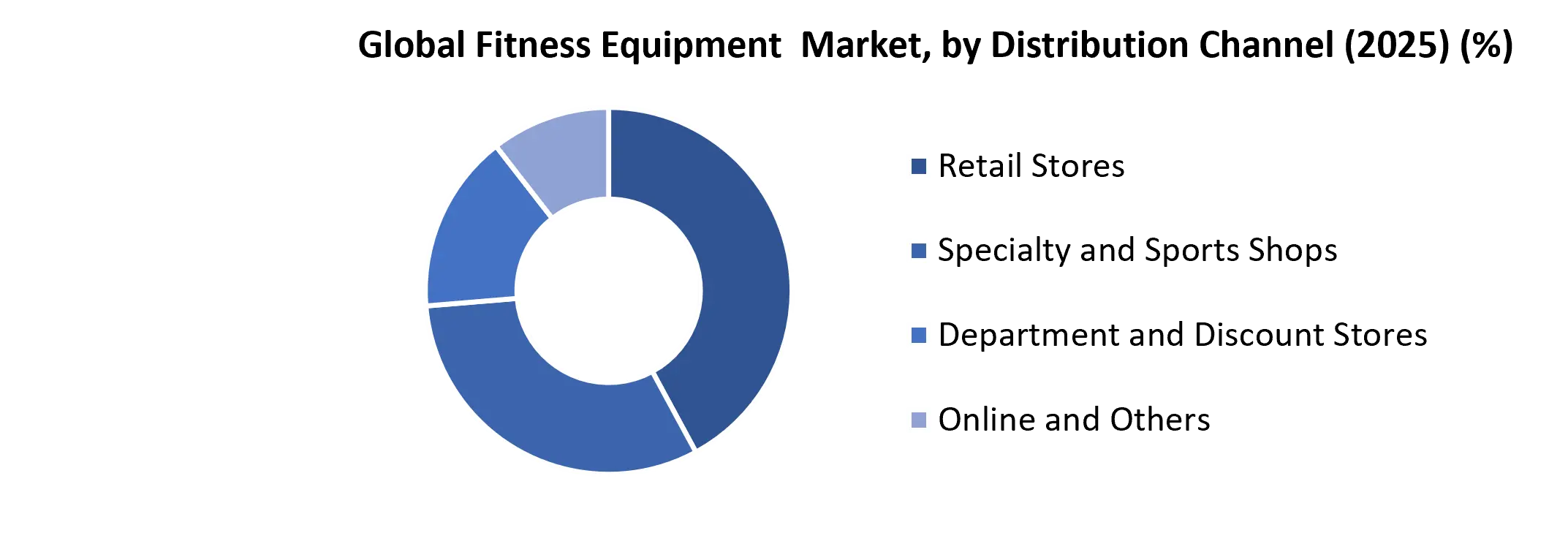
Fitness Equipment Market, by End UserBy Distribution Channel, The Global Fitness Equipment Market is segmented by distribution channel into Retail Stores, Specialty and Sports Shops, Department and Discount Stores, and Online and Others. Retail Stores offer treadmills, exercise bikes, elliptical trainers, and strength training equipment through physical outlets, supporting product demonstrations and customer assistance. Specialty and Sports Shops provide premium gym equipment, professional fitness machines, and customized workout solutions. Department and Discount Stores cater to price-sensitive consumers seeking affordable home fitness equipment and exercise accessories. The Online and Others segment benefits from growing fitness equipment e-commerce sales, digital marketplaces, direct-to-consumer brands, and convenient home delivery services. Increasing demand for smart fitness equipment, connected exercise machines, commercial gym equipment, and home workout products strengthens Fitness Equipment Market distribution channel growth and online retail opportunities through 2034.
Fitness Equipment Market, by Distribution ChannelFitness Equipment Market Regional Insights:

North America leads the Global Fitness Equipment Market, supported by high gym memberships, increasing health awareness, and strong demand for smart fitness equipment. The United States and Canada drive adoption of home fitness equipment, commercial gym machines, and connected workout technologies. Growing investments in premium health clubs, corporate wellness programs, and AI-powered exercise equipment strengthen regional market growth.

The Europe Fitness Equipment Market benefits from expanding fitness centers, rising demand for premium exercise machines, and increasing adoption of connected fitness technology. Germany, the UK, France, and Italy drive demand for cardiovascular training equipment, strength training machines, and home gym products. Growing interest in sustainable fitness equipment, digital workout platforms, and corporate wellness initiatives supports market expansion.

The Asia Pacific Fitness Equipment Market experiences strong growth, driven by rising disposable incomes, urbanization, and increasing awareness of physical fitness. China, India, Japan, and South Korea support demand for smart gym equipment, treadmills, exercise bikes, and strength training machines. Expanding commercial fitness centers, e-commerce platforms, and affordable home workout equipment create significant regional growth opportunities.

The Middle East & Africa Fitness Equipment Market expands through increasing investments in commercial gyms, wellness centers, and modern fitness infrastructure. The UAE, Saudi Arabia, and South Africa support demand for premium gym equipment, cardiovascular exercise machines, and smart fitness solutions. Growing government wellness initiatives, hospitality fitness facilities, and corporate health programs strengthen regional fitness equipment demand.

The South America Fitness Equipment Market benefits from rising health consciousness, expanding gym memberships, and growing demand for affordable exercise equipment. Brazil, Argentina, and Colombia support adoption of home fitness machines, strength training equipment, and commercial gym solutions. Increasing investments in fitness clubs, online fitness equipment sales, and personalized workout technologies create new market growth opportunities.

 Fitness Equipment Market Recent Development

Published Date Recent Developments
7 October 2026 Tonal partners with WeWork to install Tonal 2 smart strength training equipment across nine U.S. coworking locations, expanding connected fitness solutions into corporate wellness.
23 September 2026 Speediance unveils its expanded smart fitness equipment portfolio, including Gym Monster Ultra, Gym Monster 3, Gym Nano, and Speediance Strap, alongside AI-powered workout technologies.
7 July 2026 Interactive Strength Inc. (TRNR) signs a definitive agreement to acquire STEPR, a connected stair-climbing equipment manufacturer, expanding its portfolio of premium home and commercial fitness machines.
23 April 2026 Vision Fitness (Johnson Health Tech) announces a major commercial fitness equipment expansion, with more than 60 product launches planned for 2026 across cardiovascular and strength training equipment.
31 March 2026 EGYM and Playlist complete their merger, combining smart fitness equipment, AI-powered training software, digital fitness platforms, and corporate wellness solutions in a combined enterprise valued at USD 7.5 billion.

Global Fitness Equipment Market Competitive Landscape

The Global Fitness Equipment Market competitive landscape reflects increasing competition among commercial gym equipment manufacturers, home fitness equipment brands, and smart fitness technology providers. Leading Fitness Equipment Market key players, including Technogym, Life Fitness, Johnson Health Tech, Peloton Interactive, Precor, Core Health & Fitness, TRUE Fitness, iFIT, EGYM, and Rogue Fitness, focus on product innovation, technological advancements, strategic partnerships, and global distribution expansion. Technogym offers premium cardiovascular and strength training equipment with connected fitness solutions, while Life Fitness provides commercial treadmills, exercise bikes, and advanced gym machines. Johnson Health Tech strengthens its presence through Matrix Fitness and Horizon Fitness, while Peloton and iFIT focus on interactive workout platforms and connected home fitness equipment. Increasing demand for AI-powered fitness equipment, smart gym machines, IoT-enabled exercise equipment, compact home gyms, and digital fitness subscriptions intensifies market competition. Manufacturers emphasize affordable fitness solutions, sustainable equipment design, direct-to-consumer sales, and after-sales services to strengthen their competitive positioning and capture emerging Fitness Equipment Market growth opportunities through 2034.

Fitness Equipment Market Scope: Inquire before buying

Global Fitness Equipment Market
Report Coverage Details
Base Year: 2025 Forecast Period: 2026-2034
Historical Data: 2020 to 2025 Market Size in 2025: USD 13.64 Bn.
Forecast Period 2026 to 2034 CAGR: 3.32% Market Size in 2034: USD 18.31 Bn.
Segments Covered: by Type Cardiovascular Training Equipment
Treadmill
Elliptical
Stationary Bike
Rowing Machine
Others
Strength Training Equipment
Other Equipment
by End-User Home Consumer
Health Club
Other Commercial User
Hotel
Corporate Office
Hospitals & Medical Center
Public Institution
by Distribution Channel Retail Stores
Specialty and Sports Shops
Department and Discount Stores
Online and Others
by Gender Male
Female
by Usage Residential
Commercial

Fitness Equipment Market, by Region

North America (United States, Canada and Mexico)
Europe (UK, France, Germany, Italy, Spain, Sweden, Austria and Rest of Europe)
Asia Pacific (China, South Korea, Japan, India, Australia, Indonesia, Malaysia, Vietnam, Taiwan, Bangladesh, Pakistan and Rest of APAC)
Middle East and Africa (South Africa, GCC, Egypt, Nigeria and Rest of ME&A)
South America (Brazil, Argentina Rest of South America)

Fitness Equipment Market, Key Players

1. Technogym S.p.A. – Italy
2. Life Fitness, LLC – United States
3. Johnson Health Tech Co., Ltd. – Taiwan
4. Peloton Interactive, Inc. – United States
5. iFIT Health & Fitness Inc. – United States
6. Core Health & Fitness, LLC – United States
7. Precor Incorporated – United States
8. TRUE Fitness Technology, Inc. – United States
9. Dyaco International Inc. – Taiwan
10. Impulse (Qingdao) Health Tech Co., Ltd. – China
11. Shuhua Sports Co., Ltd. – China
12. BH Fitness (Exercycle S.L.) – Spain
13. SportsArt Industrial Co., Ltd. – Taiwan
14. Rogue Fitness (Coulter Ventures, LLC) – United States
15. Concept2, Inc. – United States
16. Torque Fitness, LLC – United States
17. HOIST Fitness Systems, Inc. – United States
18. Panatta S.r.l. – Italy
19. gym80 International GmbH – Germany
20. Eleiko Group AB – Sweden
21. Keiser Corporation – United States
22. Body-Solid, Inc. – United States
23. WaterRower Inc. – United States
24. Woodway USA, Inc. – United States
25. Landice, Inc. – United States
26. Echelon Fitness Multimedia, LLC – United States
27. Tonal Systems, Inc. – United States
28. Hydrow, Inc. – United States
29. Speediance – China
30. Tempo Fitness – United States
31. JERAI Fitness Pvt. Ltd. – India
32. PowerMax Fitness – India
33. VIVA Fitness – India
34. Cosco (India) Limited – India
35. Decathlon S.A. (Domyos) – France
36. Atlantis Strength – Canada
37. Sorinex Exercise Equipment, Inc. – United States
38. Titan Fitness – United States
39. Ab HUR Oy – Finland
40. HAMMER SPORT AG – Germany
41. WNQ Fitness – China
42. Realleader Fitness Co., Ltd. – China
43. Yanre Fitness – China
44. BFT Fitness – China
45. Shandong EM Health Industry Group Co., Ltd. – China
46. Intenza Fitness – Taiwan
47. Merrithew International Inc. – Canada
48. Balanced Body, Inc. – United States
49. Ntaifitness – China
50. Sunny Health & Fitness – United States

Frequently Asked Questions:

1. What is the Global Fitness Equipment Market size in 2025?
The Global Fitness Equipment Market is valued at USD 13.64 Billion in 2025, driven by growing demand for home fitness equipment, commercial gym machines, cardiovascular training equipment, and strength training solutions.

2. What is the Fitness Equipment Market CAGR and forecast for 2034?
The Fitness Equipment Market is projected to reach USD 18.31 Billion by 2034, growing at a CAGR of 3.32% during 2026–2034.

3. What are the major drivers of Fitness Equipment Market growth?
Rising health awareness, increasing gym memberships, home workout adoption, corporate wellness programs, and demand for smart fitness equipment drive Global Fitness Equipment Market growth.

4. Which product types are covered in the Fitness Equipment Market?
Major segments include cardiovascular training equipment, treadmills, elliptical trainers, stationary bikes, rowing machines, strength training equipment, and other exercise equipment.

5. What are the major end-users and distribution channels in the Fitness Equipment Market?
Key end-users include home consumers, health clubs, gyms, hotels, corporate offices, hospitals, and public institutions. Distribution channels include retail stores, specialty sports shops, department stores, and online fitness equipment sales.

6. Which region dominates the Global Fitness Equipment Market?
North America leads the Fitness Equipment Market, supported by commercial gym expansion and connected fitness technology, while Asia Pacific presents growth opportunities across China, India, Japan, and South Korea.

7. Who are the leading Fitness Equipment Market companies, and what are the emerging trends?
Leading companies include Technogym, Life Fitness, Johnson Health Tech, Peloton, Precor, Core Health & Fitness, and iFIT. Key trends include AI-powered fitness equipment, IoT-enabled gym machines, connected fitness platforms, smart strength training, and compact home gyms.

Table of Contents

1. Fitness Equipment Market Introduction 1.1. Study Assumption and Market Definition 1.2. Scope of the Study 1.3. Executive Summary 2. Global Fitness Equipment Market: Competitive Landscape 2.1. MMR Competition Matrix 2.2. Competitive Landscape 2.3. Key Players Benchmarking 2.3.1. Company Name 2.3.2. Business Segment 2.3.3. End-user Segment 2.3.4. Revenue (2025) 2.3.5. Company Locations 2.4. Leading Fitness Equipment Market Companies, by market capitalization 2.5. Market Structure 2.5.1. Market Leaders 2.5.2. Market Followers 2.5.3. Emerging Players 2.6. Mergers and Acquisitions Details 3. Fitness Equipment Market: Dynamics 3.1. Fitness Equipment Market Trends by Region 3.1.1. North America Fitness Equipment Market Trends 3.1.2. Europe Fitness Equipment Market Trends 3.1.3. Asia Pacific Fitness Equipment Market Trends 3.1.4. Middle East and Africa Fitness Equipment Market Trends 3.1.5. South America Fitness Equipment Market Trends 3.2. Fitness Equipment Market Dynamics by Region 3.2.1. North America 3.2.1.1. North America Fitness Equipment Market Drivers 3.2.1.2. North America Fitness Equipment Market Restraints 3.2.1.3. North America Fitness Equipment Market Opportunities 3.2.1.4. North America Fitness Equipment Market Challenges 3.2.2. Europe 3.2.2.1. Europe Fitness Equipment Market Drivers 3.2.2.2. Europe Fitness Equipment Market Restraints 3.2.2.3. Europe Fitness Equipment Market Opportunities 3.2.2.4. Europe Fitness Equipment Market Challenges 3.2.3. Asia Pacific 3.2.3.1. Asia Pacific Fitness Equipment Market Drivers 3.2.3.2. Asia Pacific Fitness Equipment Market Restraints 3.2.3.3. Asia Pacific Fitness Equipment Market Opportunities 3.2.3.4. Asia Pacific Fitness Equipment Market Challenges 3.2.4. Middle East and Africa 3.2.4.1. Middle East and Africa Fitness Equipment Market Drivers 3.2.4.2. Middle East and Africa Fitness Equipment Market Restraints 3.2.4.3. Middle East and Africa Fitness Equipment Market Opportunities 3.2.4.4. Middle East and Africa Fitness Equipment Market Challenges 3.2.5. South America 3.2.5.1. South America Fitness Equipment Market Drivers 3.2.5.2. South America Fitness Equipment Market Restraints 3.2.5.3. South America Fitness Equipment Market Opportunities 3.2.5.4. South America Fitness Equipment Market Challenges 3.3. PORTER's Five Forces Analysis 3.4. PESTLE Analysis 3.5. Technology Roadmap 3.6. Regulatory Landscape by Region 3.6.1. North America 3.6.2. Europe 3.6.3. Asia Pacific 3.6.4. Middle East and Africa 3.6.5. South America 3.7. Key Opinion Leader Analysis For Fitness Equipment Industry 3.8. Analysis of Government Schemes and Initiatives For Fitness Equipment Industry 3.9. Fitness Equipment Market Trade Analysis 3.10. The Global Pandemic Impact on Fitness Equipment Market 4. Fitness Equipment Market: Global Market Size and Forecast by Segmentation (in USD Billion) 2025-2034 4.1. Fitness Equipment Market Size and Forecast, by Type (2025-2034) 4.1.1. Cardiovascular Training Equipment 4.1.2. Treadmill 4.1.3. Elliptical 4.1.4. Stationary Bike 4.1.5. Rowing Machine 4.1.6. Others 4.1.7. Strength Training Equipment 4.1.8. Other Equipment 4.2. Fitness Equipment Market Size and Forecast, by End-User (2025-2034) 4.2.1. Home Consumer 4.2.2. Health Club 4.2.3. Other Commercial User 4.2.4. Hotel 4.2.5. Corporate Office 4.2.6. Hospitals & Medical Center 4.2.7. Public Institution 4.3. Fitness Equipment Market Size and Forecast, by Distribution Channel (2025-2034) 4.3.1. Retail Stores 4.3.2. Specialty and Sports Shops 4.3.3. Department and Discount Stores 4.3.4. Online and Others 4.4. Fitness Equipment Market Size and Forecast, by Gender (2025-2034) 4.4.1. Male 4.4.2. Female 4.5. Fitness Equipment Market Size and Forecast, by Usage (2025-2034) 4.5.1. Residential 4.5.2. Commercial 4.6. Fitness Equipment Market Size and Forecast, by Region (2025-2034) 4.6.1. North America 4.6.2. Europe 4.6.3. Asia Pacific 4.6.4. Middle East and Africa 4.6.5. South America 5. North America Fitness Equipment Market Size and Forecast by Segmentation (in USD Billion) 2025-2034 5.1. North America Fitness Equipment Market Size and Forecast, by Type (2025-2034) 5.1.1. Cardiovascular Training Equipment 5.1.2. Treadmill 5.1.3. Elliptical 5.1.4. Stationary Bike 5.1.5. Rowing Machine 5.1.6. Others 5.1.7. Strength Training Equipment 5.1.8. Other Equipment 5.2. North America Fitness Equipment Market Size and Forecast, by End-User (2025-2034) 5.2.1. Home Consumer 5.2.2. Health Club 5.2.3. Other Commercial User 5.2.4. Hotel 5.2.5. Corporate Office 5.2.6. Hospitals & Medical Center 5.2.7. Public Institution 5.3. North America Fitness Equipment Market Size and Forecast, by Distribution Channel (2025-2034) 5.3.1. Retail Stores 5.3.2. Specialty and Sports Shops 5.3.3. Department and Discount Stores 5.3.4. Online and Others 5.4. North America Fitness Equipment Market Size and Forecast, by Gender (2025-2034) 5.4.1. Male 5.4.2. Female 5.5. North America Fitness Equipment Market Size and Forecast, by Usage (2025-2034) 5.5.1. Residential 5.5.2. Commercial 5.6. North America Fitness Equipment Market Size and Forecast, by Country (2025-2034) 5.6.1. United States 5.6.1.1. United States Fitness Equipment Market Size and Forecast, by Type (2025-2034) 5.6.1.1.1. Cardiovascular Training Equipment 5.6.1.1.2. Treadmill 5.6.1.1.3. Elliptical 5.6.1.1.4. Stationary Bike 5.6.1.1.5. Rowing Machine 5.6.1.1.6. Others 5.6.1.1.7. Strength Training Equipment 5.6.1.1.8. Other Equipment 5.6.1.2. United States Fitness Equipment Market Size and Forecast, by End-User (2025-2034) 5.6.1.2.1. Home Consumer 5.6.1.2.2. Health Club 5.6.1.2.3. Other Commercial User 5.6.1.2.4. Hotel 5.6.1.2.5. Corporate Office 5.6.1.2.6. Hospitals & Medical Center 5.6.1.2.7. Public Institution 5.6.1.3. United States Fitness Equipment Market Size and Forecast, by Distribution Channel (2025-2034) 5.6.1.3.1. Retail Stores 5.6.1.3.2. Specialty and Sports Shops 5.6.1.3.3. Department and Discount Stores 5.6.1.3.4. Online and Others 5.6.1.4. United States Fitness Equipment Market Size and Forecast, by Gender (2025-2034) 5.6.1.4.1. Male 5.6.1.4.2. Female 5.6.1.5. United States Fitness Equipment Market Size and Forecast, by Usage (2025-2034) 5.6.1.5.1. Residential 5.6.1.5.2. Commercial 5.6.2. Canada 5.6.2.1. Canada Fitness Equipment Market Size and Forecast, by Type (2025-2034) 5.6.2.1.1. Cardiovascular Training Equipment 5.6.2.1.2. Treadmill 5.6.2.1.3. Elliptical 5.6.2.1.4. Stationary Bike 5.6.2.1.5. Rowing Machine 5.6.2.1.6. Others 5.6.2.1.7. Strength Training Equipment 5.6.2.1.8. Other Equipment 5.6.2.2. Canada Fitness Equipment Market Size and Forecast, by End-User (2025-2034) 5.6.2.2.1. Home Consumer 5.6.2.2.2. Health Club 5.6.2.2.3. Other Commercial User 5.6.2.2.4. Hotel 5.6.2.2.5. Corporate Office 5.6.2.2.6. Hospitals & Medical Center 5.6.2.2.7. Public Institution 5.6.2.3. Canada Fitness Equipment Market Size and Forecast, by Distribution Channel (2025-2034) 5.6.2.3.1. Retail Stores 5.6.2.3.2. Specialty and Sports Shops 5.6.2.3.3. Department and Discount Stores 5.6.2.3.4. Online and Others 5.6.2.4. Canada Fitness Equipment Market Size and Forecast, by Gender (2025-2034) 5.6.2.4.1. Male 5.6.2.4.2. Female 5.6.2.5. Canada Fitness Equipment Market Size and Forecast, by Usage (2025-2034) 5.6.2.5.1. Residential 5.6.2.5.2. Commercial 5.6.3. Mexico 5.6.3.1. Mexico Fitness Equipment Market Size and Forecast, by Type (2025-2034) 5.6.3.1.1. Cardiovascular Training Equipment 5.6.3.1.2. Treadmill 5.6.3.1.3. Elliptical 5.6.3.1.4. Stationary Bike 5.6.3.1.5. Rowing Machine 5.6.3.1.6. Others 5.6.3.1.7. Strength Training Equipment 5.6.3.1.8. Other Equipment 5.6.3.2. Mexico Fitness Equipment Market Size and Forecast, by End-User (2025-2034) 5.6.3.2.1. Home Consumer 5.6.3.2.2. Health Club 5.6.3.2.3. Other Commercial User 5.6.3.2.4. Hotel 5.6.3.2.5. Corporate Office 5.6.3.2.6. Hospitals & Medical Center 5.6.3.2.7. Public Institution 5.6.3.3. Mexico Fitness Equipment Market Size and Forecast, by Distribution Channel (2025-2034) 5.6.3.3.1. Retail Stores 5.6.3.3.2. Specialty and Sports Shops 5.6.3.3.3. Department and Discount Stores 5.6.3.3.4. Online and Others 5.6.3.4. Mexico Fitness Equipment Market Size and Forecast, by Gender (2025-2034) 5.6.3.4.1. Male 5.6.3.4.2. Female 5.6.3.5. Mexico Fitness Equipment Market Size and Forecast, by Usage (2025-2034) 5.6.3.5.1. Residential 5.6.3.5.2. Commercial 6. Europe Fitness Equipment Market Size and Forecast by Segmentation (in USD Billion) 2025-2034 6.1. Europe Fitness Equipment Market Size and Forecast, by Type (2025-2034) 6.2. Europe Fitness Equipment Market Size and Forecast, by End-User (2025-2034) 6.3. Europe Fitness Equipment Market Size and Forecast, by Distribution Channel (2025-2034) 6.4. Europe Fitness Equipment Market Size and Forecast, by Gender (2025-2034) 6.5. Europe Fitness Equipment Market Size and Forecast, by Usage (2025-2034) 6.6. Europe Fitness Equipment Market Size and Forecast, by Country (2025-2034) 6.6.1. United Kingdom 6.6.1.1. United Kingdom Fitness Equipment Market Size and Forecast, by Type (2025-2034) 6.6.1.2. United Kingdom Fitness Equipment Market Size and Forecast, by End-User (2025-2034) 6.6.1.3. United Kingdom Fitness Equipment Market Size and Forecast, by Distribution Channel (2025-2034) 6.6.1.4. United Kingdom Fitness Equipment Market Size and Forecast, by Gender (2025-2034) 6.6.1.5. United Kingdom Fitness Equipment Market Size and Forecast, by Usage (2025-2034) 6.6.2. France 6.6.2.1. France Fitness Equipment Market Size and Forecast, by Type (2025-2034) 6.6.2.2. France Fitness Equipment Market Size and Forecast, by End-User (2025-2034) 6.6.2.3. France Fitness Equipment Market Size and Forecast, by Distribution Channel (2025-2034) 6.6.2.4. France Fitness Equipment Market Size and Forecast, by Gender (2025-2034) 6.6.2.5. France Fitness Equipment Market Size and Forecast, by Usage (2025-2034) 6.6.3. Germany 6.6.3.1. Germany Fitness Equipment Market Size and Forecast, by Type (2025-2034) 6.6.3.2. Germany Fitness Equipment Market Size and Forecast, by End-User (2025-2034) 6.6.3.3. Germany Fitness Equipment Market Size and Forecast, by Distribution Channel (2025-2034) 6.6.3.4. Germany Fitness Equipment Market Size and Forecast, by Gender (2025-2034) 6.6.3.5. Germany Fitness Equipment Market Size and Forecast, by Usage (2025-2034) 6.6.4. Italy 6.6.4.1. Italy Fitness Equipment Market Size and Forecast, by Type (2025-2034) 6.6.4.2. Italy Fitness Equipment Market Size and Forecast, by End-User (2025-2034) 6.6.4.3. Italy Fitness Equipment Market Size and Forecast, by Distribution Channel (2025-2034) 6.6.4.4. Italy Fitness Equipment Market Size and Forecast, by Gender (2025-2034) 6.6.4.5. Italy Fitness Equipment Market Size and Forecast, by Usage (2025-2034) 6.6.5. Spain 6.6.5.1. Spain Fitness Equipment Market Size and Forecast, by Type (2025-2034) 6.6.5.2. Spain Fitness Equipment Market Size and Forecast, by End-User (2025-2034) 6.6.5.3. Spain Fitness Equipment Market Size and Forecast, by Distribution Channel (2025-2034) 6.6.5.4. Spain Fitness Equipment Market Size and Forecast, by Gender (2025-2034) 6.6.5.5. Spain Fitness Equipment Market Size and Forecast, by Usage (2025-2034) 6.6.6. Sweden 6.6.6.1. Sweden Fitness Equipment Market Size and Forecast, by Type (2025-2034) 6.6.6.2. Sweden Fitness Equipment Market Size and Forecast, by End-User (2025-2034) 6.6.6.3. Sweden Fitness Equipment Market Size and Forecast, by Distribution Channel (2025-2034) 6.6.6.4. Sweden Fitness Equipment Market Size and Forecast, by Gender (2025-2034) 6.6.6.5. Sweden Fitness Equipment Market Size and Forecast, by Usage (2025-2034) 6.6.7. Austria 6.6.7.1. Austria Fitness Equipment Market Size and Forecast, by Type (2025-2034) 6.6.7.2. Austria Fitness Equipment Market Size and Forecast, by End-User (2025-2034) 6.6.7.3. Austria Fitness Equipment Market Size and Forecast, by Distribution Channel (2025-2034) 6.6.7.4. Austria Fitness Equipment Market Size and Forecast, by Gender (2025-2034) 6.6.7.5. Austria Fitness Equipment Market Size and Forecast, by Usage (2025-2034) 6.6.8. Rest of Europe 6.6.8.1. Rest of Europe Fitness Equipment Market Size and Forecast, by Type (2025-2034) 6.6.8.2. Rest of Europe Fitness Equipment Market Size and Forecast, by End-User (2025-2034) 6.6.8.3. Rest of Europe Fitness Equipment Market Size and Forecast, by Distribution Channel (2025-2034) 6.6.8.4. Rest of Europe Fitness Equipment Market Size and Forecast, by Gender (2025-2034) 6.6.8.5. Rest of Europe Fitness Equipment Market Size and Forecast, by Usage (2025-2034) 7. Asia Pacific Fitness Equipment Market Size and Forecast by Segmentation (in USD Billion) 2025-2034 7.1. Asia Pacific Fitness Equipment Market Size and Forecast, by Type (2025-2034) 7.2. Asia Pacific Fitness Equipment Market Size and Forecast, by End-User (2025-2034) 7.3. Asia Pacific Fitness Equipment Market Size and Forecast, by Distribution Channel (2025-2034) 7.4. Asia Pacific Fitness Equipment Market Size and Forecast, by Gender (2025-2034) 7.5. Asia Pacific Fitness Equipment Market Size and Forecast, by Usage (2025-2034) 7.6. Asia Pacific Fitness Equipment Market Size and Forecast, by Country (2025-2034) 7.6.1. China 7.6.1.1. China Fitness Equipment Market Size and Forecast, by Type (2025-2034) 7.6.1.2. China Fitness Equipment Market Size and Forecast, by End-User (2025-2034) 7.6.1.3. China Fitness Equipment Market Size and Forecast, by Distribution Channel (2025-2034) 7.6.1.4. China Fitness Equipment Market Size and Forecast, by Gender (2025-2034) 7.6.1.5. China Fitness Equipment Market Size and Forecast, by Usage (2025-2034) 7.6.2. S Korea 7.6.2.1. S Korea Fitness Equipment Market Size and Forecast, by Type (2025-2034) 7.6.2.2. S Korea Fitness Equipment Market Size and Forecast, by End-User (2025-2034) 7.6.2.3. S Korea Fitness Equipment Market Size and Forecast, by Distribution Channel (2025-2034) 7.6.2.4. S Korea Fitness Equipment Market Size and Forecast, by Gender (2025-2034) 7.6.2.5. S Korea Fitness Equipment Market Size and Forecast, by Usage (2025-2034) 7.6.3. Japan 7.6.3.1. Japan Fitness Equipment Market Size and Forecast, by Type (2025-2034) 7.6.3.2. Japan Fitness Equipment Market Size and Forecast, by End-User (2025-2034) 7.6.3.3. Japan Fitness Equipment Market Size and Forecast, by Distribution Channel (2025-2034) 7.6.3.4. Japan Fitness Equipment Market Size and Forecast, by Gender (2025-2034) 7.6.3.5. Japan Fitness Equipment Market Size and Forecast, by Usage (2025-2034) 7.6.4. India 7.6.4.1. India Fitness Equipment Market Size and Forecast, by Type (2025-2034) 7.6.4.2. India Fitness Equipment Market Size and Forecast, by End-User (2025-2034) 7.6.4.3. India Fitness Equipment Market Size and Forecast, by Distribution Channel (2025-2034) 7.6.4.4. India Fitness Equipment Market Size and Forecast, by Gender (2025-2034) 7.6.4.5. India Fitness Equipment Market Size and Forecast, by Usage (2025-2034) 7.6.5. Australia 7.6.5.1. Australia Fitness Equipment Market Size and Forecast, by Type (2025-2034) 7.6.5.2. Australia Fitness Equipment Market Size and Forecast, by End-User (2025-2034) 7.6.5.3. Australia Fitness Equipment Market Size and Forecast, by Distribution Channel (2025-2034) 7.6.5.4. Australia Fitness Equipment Market Size and Forecast, by Gender (2025-2034) 7.6.5.5. Australia Fitness Equipment Market Size and Forecast, by Usage (2025-2034) 7.6.6. Indonesia 7.6.6.1. Indonesia Fitness Equipment Market Size and Forecast, by Type (2025-2034) 7.6.6.2. Indonesia Fitness Equipment Market Size and Forecast, by End-User (2025-2034) 7.6.6.3. Indonesia Fitness Equipment Market Size and Forecast, by Distribution Channel (2025-2034) 7.6.6.4. Indonesia Fitness Equipment Market Size and Forecast, by Gender (2025-2034) 7.6.6.5. Indonesia Fitness Equipment Market Size and Forecast, by Usage (2025-2034) 7.6.7. Malaysia 7.6.7.1. Malaysia Fitness Equipment Market Size and Forecast, by Type (2025-2034) 7.6.7.2. Malaysia Fitness Equipment Market Size and Forecast, by End-User (2025-2034) 7.6.7.3. Malaysia Fitness Equipment Market Size and Forecast, by Distribution Channel (2025-2034) 7.6.7.4. Malaysia Fitness Equipment Market Size and Forecast, by Gender (2025-2034) 7.6.7.5. Malaysia Fitness Equipment Market Size and Forecast, by Usage (2025-2034) 7.6.8. Vietnam 7.6.8.1. Vietnam Fitness Equipment Market Size and Forecast, by Type (2025-2034) 7.6.8.2. Vietnam Fitness Equipment Market Size and Forecast, by End-User (2025-2034) 7.6.8.3. Vietnam Fitness Equipment Market Size and Forecast, by Distribution Channel (2025-2034) 7.6.8.4. Vietnam Fitness Equipment Market Size and Forecast, by Gender (2025-2034) 7.6.8.5. Vietnam Fitness Equipment Market Size and Forecast, by Usage (2025-2034) 7.6.9. Taiwan 7.6.9.1. Taiwan Fitness Equipment Market Size and Forecast, by Type (2025-2034) 7.6.9.2. Taiwan Fitness Equipment Market Size and Forecast, by End-User (2025-2034) 7.6.9.3. Taiwan Fitness Equipment Market Size and Forecast, by Distribution Channel (2025-2034) 7.6.9.4. Taiwan Fitness Equipment Market Size and Forecast, by Gender (2025-2034) 7.6.9.5. Taiwan Fitness Equipment Market Size and Forecast, by Usage (2025-2034) 7.6.10. Rest of Asia Pacific 7.6.10.1. Rest of Asia Pacific Fitness Equipment Market Size and Forecast, by Type (2025-2034) 7.6.10.2. Rest of Asia Pacific Fitness Equipment Market Size and Forecast, by End-User (2025-2034) 7.6.10.3. Rest of Asia Pacific Fitness Equipment Market Size and Forecast, by Distribution Channel (2025-2034) 7.6.10.4. Rest of Asia Pacific Fitness Equipment Market Size and Forecast, by Gender (2025-2034) 7.6.10.5. Rest of Asia Pacific Fitness Equipment Market Size and Forecast, by Usage (2025-2034) 8. Middle East and Africa Fitness Equipment Market Size and Forecast by Segmentation (in USD Billion) 2025-2034 8.1. Middle East and Africa Fitness Equipment Market Size and Forecast, by Type (2025-2034) 8.2. Middle East and Africa Fitness Equipment Market Size and Forecast, by End-User (2025-2034) 8.3. Middle East and Africa Fitness Equipment Market Size and Forecast, by Distribution Channel (2025-2034) 8.4. Middle East and Africa Fitness Equipment Market Size and Forecast, by Gender (2025-2034) 8.5. Middle East and Africa Fitness Equipment Market Size and Forecast, by Usage (2025-2034) 8.6. Middle East and Africa Fitness Equipment Market Size and Forecast, by Country (2025-2034) 8.6.1. South Africa 8.6.1.1. South Africa Fitness Equipment Market Size and Forecast, by Type (2025-2034) 8.6.1.2. South Africa Fitness Equipment Market Size and Forecast, by End-User (2025-2034) 8.6.1.3. South Africa Fitness Equipment Market Size and Forecast, by Distribution Channel (2025-2034) 8.6.1.4. South Africa Fitness Equipment Market Size and Forecast, by Gender (2025-2034) 8.6.1.5. South Africa Fitness Equipment Market Size and Forecast, by Usage (2025-2034) 8.6.2. GCC 8.6.2.1. GCC Fitness Equipment Market Size and Forecast, by Type (2025-2034) 8.6.2.2. GCC Fitness Equipment Market Size and Forecast, by End-User (2025-2034) 8.6.2.3. GCC Fitness Equipment Market Size and Forecast, by Distribution Channel (2025-2034) 8.6.2.4. GCC Fitness Equipment Market Size and Forecast, by Gender (2025-2034) 8.6.2.5. GCC Fitness Equipment Market Size and Forecast, by Usage (2025-2034) 8.6.3. Nigeria 8.6.3.1. Nigeria Fitness Equipment Market Size and Forecast, by Type (2025-2034) 8.6.3.2. Nigeria Fitness Equipment Market Size and Forecast, by End-User (2025-2034) 8.6.3.3. Nigeria Fitness Equipment Market Size and Forecast, by Distribution Channel (2025-2034) 8.6.3.4. Nigeria Fitness Equipment Market Size and Forecast, by Gender (2025-2034) 8.6.3.5. Nigeria Fitness Equipment Market Size and Forecast, by Usage (2025-2034) 8.6.4. Rest of ME&A 8.6.4.1. Rest of ME&A Fitness Equipment Market Size and Forecast, by Type (2025-2034) 8.6.4.2. Rest of ME&A Fitness Equipment Market Size and Forecast, by End-User (2025-2034) 8.6.4.3. Rest of ME&A Fitness Equipment Market Size and Forecast, by Distribution Channel (2025-2034) 8.6.4.4. Rest of ME&A Fitness Equipment Market Size and Forecast, by Gender (2025-2034) 8.6.4.5. Rest of ME&A Fitness Equipment Market Size and Forecast, by Usage (2025-2034) 9. South America Fitness Equipment Market Size and Forecast by Segmentation (in USD Billion) 2025-2034 9.1. South America Fitness Equipment Market Size and Forecast, by Type (2025-2034) 9.2. South America Fitness Equipment Market Size and Forecast, by End-User (2025-2034) 9.3. South America Fitness Equipment Market Size and Forecast, by Distribution Channel (2025-2034) 9.4. South America Fitness Equipment Market Size and Forecast, by Gender (2025-2034) 9.5. South America Fitness Equipment Market Size and Forecast, by Usage (2025-2034) 9.6. South America Fitness Equipment Market Size and Forecast, by Country (2025-2034) 9.6.1. Brazil 9.6.1.1. Brazil Fitness Equipment Market Size and Forecast, by Type (2025-2034) 9.6.1.2. Brazil Fitness Equipment Market Size and Forecast, by End-User (2025-2034) 9.6.1.3. Brazil Fitness Equipment Market Size and Forecast, by Distribution Channel (2025-2034) 9.6.1.4. Brazil Fitness Equipment Market Size and Forecast, by Gender (2025-2034) 9.6.1.5. Brazil Fitness Equipment Market Size and Forecast, by Usage (2025-2034) 9.6.2. Argentina 9.6.2.1. Argentina Fitness Equipment Market Size and Forecast, by Type (2025-2034) 9.6.2.2. Argentina Fitness Equipment Market Size and Forecast, by End-User (2025-2034) 9.6.2.3. Argentina Fitness Equipment Market Size and Forecast, by Distribution Channel (2025-2034) 9.6.2.4. Argentina Fitness Equipment Market Size and Forecast, by Gender (2025-2034) 9.6.2.5. Argentina Fitness Equipment Market Size and Forecast, by Usage (2025-2034) 9.6.3. Rest Of South America 9.6.3.1. Rest Of South America Fitness Equipment Market Size and Forecast, by Type (2025-2034) 9.6.3.2. Rest Of South America Fitness Equipment Market Size and Forecast, by End-User (2025-2034) 9.6.3.3. Rest Of South America Fitness Equipment Market Size and Forecast, by Distribution Channel (2025-2034) 9.6.3.4. Rest Of South America Fitness Equipment Market Size and Forecast, by Gender (2025-2034) 9.6.3.5. Rest Of South America Fitness Equipment Market Size and Forecast, by Usage (2025-2034) 10. Company Profile: Key Players 10.1. Technogym S.p.A. – Italy 10.1.1. Company Overview 10.1.2. Business Portfolio 10.1.3. Financial Overview 10.1.4. SWOT Analysis 10.1.5. Strategic Analysis 10.1.6. Scale of Operation (small, medium, and large) 10.1.7. Details on Partnership 10.1.8. Regulatory Accreditations and Certifications Received by Them 10.1.9. Awards Received by the Firm 10.1.10. Recent Developments 10.2. Life Fitness, LLC – United States 10.3. Johnson Health Tech Co., Ltd. – Taiwan 10.4. Peloton Interactive, Inc. – United States 10.5. iFIT Health & Fitness Inc. – United States 10.6. Core Health & Fitness, LLC – United States 10.7. Precor Incorporated – United States 10.8. TRUE Fitness Technology, Inc. – United States 10.9. Dyaco International Inc. – Taiwan 10.10. Impulse (Qingdao) Health Tech Co., Ltd. – China 10.11. Shuhua Sports Co., Ltd. – China 10.12. BH Fitness (Exercycle S.L.) – Spain 10.13. SportsArt Industrial Co., Ltd. – Taiwan 10.14. Rogue Fitness (Coulter Ventures, LLC) – United States 10.15. Concept2, Inc. – United States 10.16. Torque Fitness, LLC – United States 10.17. HOIST Fitness Systems, Inc. – United States 10.18. Panatta S.r.l. – Italy 10.19. gym80 International GmbH – Germany 10.20. Eleiko Group AB – Sweden 10.21. Keiser Corporation – United States 10.22. Body-Solid, Inc. – United States 10.23. WaterRower Inc. – United States 10.24. Woodway USA, Inc. – United States 10.25. Landice, Inc. – United States 10.26. Echelon Fitness Multimedia, LLC – United States 10.27. Tonal Systems, Inc. – United States 10.28. Hydrow, Inc. – United States 10.29. Speediance – China 10.30. Tempo Fitness – United States 10.31. JERAI Fitness Pvt. Ltd. – India 10.32. PowerMax Fitness – India 10.33. VIVA Fitness – India 10.34. Cosco (India) Limited – India 10.35. Decathlon S.A. (Domyos) – France 10.36. Atlantis Strength – Canada 10.37. Sorinex Exercise Equipment, Inc. – United States 10.38. Titan Fitness – United States 10.39. Ab HUR Oy – Finland 10.40. HAMMER SPORT AG – Germany 11. Key Findings 12. Industry Recommendations 13. Fitness Equipment Market: Research Methodology 14. Terms and Glossary

Custom Market Research Services

We Will Customise The Research For You, In Case The Report Listed Above Does Not Meet With Your Requirements